This comprehensive analysis evaluates whether Anoma (XAN) represents a sound investment opportunity within the Web3 infrastructure sector. XAN, launched in 2025, has experienced significant volatility—peaking at $0.28948 in September 2025 before declining 90.45% to current levels around $0.0138 as of January 2026. The article examines XAN's intent-centric architecture and cross-chain functionality, which enable developers to deploy applications across multiple blockchains, addressing key infrastructure complexity challenges. Critical investment considerations include the token's $34.5 million market capitalization, only 25% circulating supply (creating substantial dilution potential), and listing on 19 exchanges including Gate. The analysis presents detailed price forecasts through 2031, outlines risk management strategies for different investor profiles, and identifies significant risks including market volatility, regulatory uncertainty, technical execution challenges, and token unlock pressures. The articl
Introduction: Anoma (XAN)'s Investment Position and Market Outlook
Anoma (XAN) represents a significant asset in the cryptocurrency sector, launched in 2025 and positioning itself within the decentralized infrastructure and Web3 application development space. As of January 21, 2026, XAN maintains a market capitalization of approximately $34.5 million with a circulating supply of 2.5 billion tokens, currently trading at around $0.0138. The project describes itself as a decentralized operating system powering a unified app layer for Web3, introducing an intent-centric architecture designed to enable developers to write applications once and deploy them across multiple chains. With this positioning as a cross-chain infrastructure solution, XAN has become a subject of interest among investors exploring "Is Anoma (XAN) a good investment?" This article comprehensively analyzes XAN's investment value, historical price trends, future price predictions, and investment risks to provide reference for investors.
I. Coin (XAN) Price History Review and Current Investment Value Status
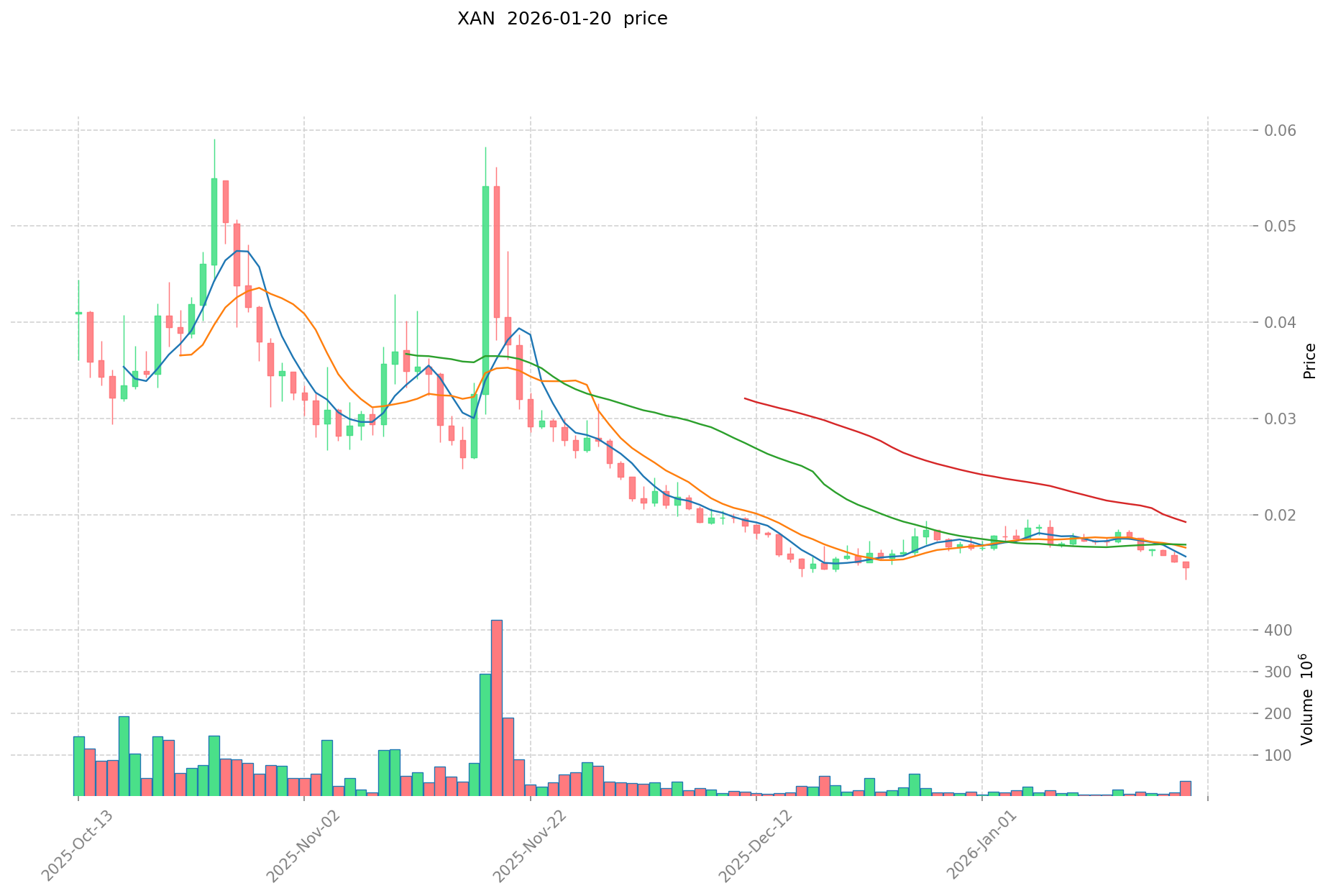
- 2025: XAN reached a notable price level of $0.28948 on September 29, 2025 → Investors experienced significant volatility in subsequent months
- 2026: Market correction phase → Price declined from September 2025 levels to $0.013218 on January 19, 2026
Current XAN Investment Market Status (January 2026)
- XAN current price: $0.013802
- Market sentiment (Fear & Greed Index): Data shows bearish sentiment with recent downward pressure
- 24-hour trading volume: $183,027.09
- Market capitalization: $34,505,000
- Circulating supply: 2,500,000,000 XAN (25% of total supply)
- Token holders: 11,808
- Price changes: -0.91% (1H), -6.06% (24H), -21.64% (7D), -9.22% (30D)
Click to view real-time XAN market price
II. Core Factors Affecting Whether XAN is a Good Investment (Is Anoma(XAN) a Good Investment)
Supply Mechanism and Scarcity (XAN investment scarcity)
- Supply Structure → Impacts price and investment value
- Total Supply: 10,000,000,000 XAN
- Circulating Supply: 2,500,000,000 XAN (25% of total supply)
- Maximum Supply: 10,000,000,000 XAN
- Historical Context: The token experienced significant price fluctuations, with the price reaching $0.28948 on September 29, 2025, and declining to $0.013218 on January 19, 2026
- Investment Significance: With only 25% of tokens currently in circulation, the controlled supply release may influence long-term scarcity dynamics and investment considerations
Institutional Investment and Mainstream Adoption (Institutional investment in XAN)
- Holder Base: As of January 21, 2026, XAN has 11,808 token holders
- Exchange Presence: Listed on 19 exchanges with trading support on Gate.com
- Market Position: Ranked #654 with a market capitalization of $34,505,000 and market dominance of 0.0043%
Macroeconomic Environment's Impact on XAN Investment
- Market Performance: 24-hour trading volume of $183,027.09 indicates active market participation
- Price Volatility: Recent performance shows -0.91% (1H), -6.06% (24H), -21.64% (7D), -9.22% (30D), and -90.45% (1Y) changes
- Market Capitalization to FDV Ratio: 25% suggests significant potential supply expansion that may influence investment dynamics
Technology and Ecosystem Development (Technology & Ecosystem for XAN investment)
- Intent-Centric Architecture: Anoma introduces a next-generation intent-centric architecture optimized for application development and user experience
- Cross-Chain Functionality: The platform enables developers to write applications once that can operate across multiple chains, addressing infrastructure complexity
- Unified Application Layer: Anoma functions as a decentralized operating system powering a unified app layer for Web3, potentially supporting diverse ecosystem applications
- Developer Focus: The platform aims to free developers from infrastructure complexity, allowing them to concentrate on building user-centric applications and experiences
- ERC-20 Standard: XAN operates on the Ethereum network (contract address: 0xcedbea37c8872c4171259cdfd5255cb8923cf8e7), providing compatibility with existing Ethereum infrastructure
III. XAN Future Investment Forecast and Price Outlook (Is Anoma(XAN) worth investing in 2026-2031)
Short-term Investment Forecast (2026, short-term XAN investment outlook)
- Conservative forecast: $0.0103 - $0.0138
- Neutral forecast: $0.0138 - $0.0165
- Optimistic forecast: $0.0165 - $0.0190
Mid-term Investment Outlook (2027-2028, mid-term Anoma(XAN) investment forecast)
-
Market stage expectation: Based on available data, the mid-term outlook suggests a gradual recovery phase following recent price corrections. The project's intent-centric architecture and cross-chain capabilities may continue to attract developer attention as Web3 infrastructure matures.
-
Investment return forecast:
- 2027: $0.0100 - $0.0207
- 2028: $0.0154 - $0.0238
-
Key catalysts: Expansion of the multi-chain application ecosystem, adoption of the intent-centric architecture by developers, and broader Web3 infrastructure development may serve as potential growth drivers.
Long-term Investment Outlook (Is Anoma a good long-term investment?)
- Base scenario: $0.0131 - $0.0262 (assuming steady ecosystem growth and moderate market conditions)
- Optimistic scenario: $0.0233 - $0.0276 (assuming accelerated adoption of cross-chain solutions and favorable market environment)
- Risk scenario: Below $0.0100 (in case of prolonged market downturns or significant technological challenges)
View XAN long-term investment and price forecast: Price Prediction
2026-01-21 - 2031 Long-term Outlook
- Base scenario: $0.0131 - $0.0222 (corresponding to steady progress and gradual mainstream application adoption)
- Optimistic scenario: $0.0233 - $0.0262 (corresponding to large-scale adoption and favorable market conditions)
- Transformative scenario: Above $0.0276 (in case of breakthrough ecosystem developments and mainstream popularization)
- 2031-12-31 forecast high: $0.0276 (based on optimistic development assumptions)
Disclaimer: The above forecasts are based on historical data and current market information analysis and do not constitute investment advice. Cryptocurrency markets are highly volatile and involve significant risks. Investors should conduct independent research and consider their risk tolerance before making investment decisions.
| Year |
Predicted High Price |
Predicted Average Price |
Predicted Low Price |
Price Change |
| 2026 |
0.01904262 |
0.013799 |
0.01034925 |
0 |
| 2027 |
0.0206902206 |
0.01642081 |
0.0100166941 |
18 |
| 2028 |
0.023751059584 |
0.0185555153 |
0.015401077699 |
34 |
| 2029 |
0.0232686161862 |
0.021153287442 |
0.01523036695824 |
53 |
| 2030 |
0.026208923140638 |
0.0222109518141 |
0.013104461570319 |
60 |
| 2031 |
0.0275993287242 |
0.024209937477369 |
0.015978558735063 |
75 |
IV. Anoma Investment Strategy and Risk Management (How to invest in Anoma)
Investment Methodology (Anoma investment strategy)
Investors considering Anoma (XAN) may adopt different approaches based on their risk tolerance and investment objectives:
-
Long-term Holding (HODL Anoma): This strategy suits conservative investors who believe in Anoma's vision of a unified Web3 application layer. Given the project's intent-centric architecture and multi-chain development focus, long-term holders may benefit from potential ecosystem growth as more applications adopt the platform. However, investors should note the current market capitalization of approximately $34.5 million and the 25% circulating supply ratio, which indicates significant token unlock potential that may affect future price dynamics.
-
Active Trading: Traders may utilize technical analysis and momentum strategies, particularly given XAN's price volatility. With 24-hour trading volume around $183,027 and price fluctuations between $0.013639 and $0.014774 in the past day, short-term opportunities may exist. However, the relatively limited exchange availability (19 exchanges) and trading volume suggest lower liquidity compared to major assets, which may result in wider spreads and slippage.
Risk Management (Risk management for Anoma investment)
V. Anoma Investment Risks and Challenges (Risks of investing in Anoma)
-
Market Risk: XAN exhibits significant price volatility, with a 90.45% decline over one year from its peak. The 24-hour price change of -6.06% and 7-day change of -21.64% demonstrate substantial short-term fluctuations. The relatively small market capitalization and holder base of approximately 11,808 addresses may contribute to price sensitivity to large transactions.
-
Regulatory Risk: As a decentralized operating system facilitating cross-chain applications, Anoma operates in an evolving regulatory environment. Different jurisdictions may introduce varying compliance requirements for multi-chain infrastructure projects, potentially affecting adoption and development.
-
Technical Risk: The ambitious goal of creating a unified application layer across multiple blockchains introduces technical complexity. Potential risks include:
- Integration challenges with diverse blockchain architectures
- Smart contract vulnerabilities in the ERC-20 token implementation
- Execution risks related to the intent-centric architecture implementation
- Competition from established cross-chain solutions and other infrastructure projects
-
Token Economics Risk: With only 25% of tokens currently circulating (2.5 billion out of 10 billion maximum supply), significant dilution potential exists as additional tokens enter circulation. The fully diluted market cap of $138 million represents a 4x multiple of current market capitalization, which may create downward price pressure during unlock events.
VI. Conclusion: Is Anoma a Good Investment?
Investment Value Summary: Anoma presents an innovative approach to Web3 infrastructure through its intent-centric, multi-chain architecture. The project addresses genuine developer pain points by enabling single-codebase, cross-chain applications. However, the token has experienced substantial price volatility, with significant declines from its peak, and operates in a competitive landscape of blockchain infrastructure solutions.
Investor Recommendations:
✅ Beginners: Consider small position sizing through dollar-cost averaging. Prioritize secure storage using hardware wallets supporting ERC-20 tokens. Thoroughly research the project's technical documentation and roadmap before investing.
✅ Experienced Investors: May explore tactical trading opportunities while managing position size relative to liquidity constraints. Consider broader portfolio diversification across infrastructure and application-layer projects.
✅ Institutional Investors: Should conduct comprehensive technical and market due diligence. Evaluate token unlock schedules, team background, and competitive positioning before considering strategic allocation.
⚠️ Disclaimer: Cryptocurrency investments carry substantial risk and volatility. This analysis is for informational purposes only and does not constitute investment advice. Investors should conduct independent research and consult financial advisors before making investment decisions. Past performance does not guarantee future results.
VII. FAQ
Q1: What is Anoma (XAN) and what makes it different from other blockchain infrastructure projects?
Anoma is a decentralized operating system designed to power a unified application layer for Web3 through an intent-centric architecture. Unlike traditional blockchain infrastructure, Anoma enables developers to write applications once and deploy them across multiple chains, eliminating the need to rebuild for each specific blockchain. This cross-chain functionality and intent-centric design distinguish it from competitors by focusing on simplifying the developer experience and reducing infrastructure complexity, allowing creators to concentrate on building user-centric applications rather than managing multi-chain integration challenges.
Q2: How has XAN's price performed historically and what is its current market position?
XAN has experienced significant volatility since its 2025 launch. The token reached a peak price of $0.28948 on September 29, 2025, but subsequently declined to approximately $0.0138 as of January 21, 2026—representing a 90.45% decline from its high. Currently, XAN maintains a market capitalization of approximately $34.5 million, ranks #654 among cryptocurrencies, and has 11,808 token holders. The 24-hour trading volume of $183,027 indicates relatively limited liquidity, with the token listed on 19 exchanges including Gate.com.
Q3: What are the key risks associated with investing in Anoma?
Several significant risks exist for XAN investors. Market risk manifests through extreme volatility, with recent losses of 21.64% over seven days and 90.45% over one year. Token economics present dilution concerns, as only 25% of the 10 billion maximum supply currently circulates, meaning unlock events could introduce substantial selling pressure. Technical risks include challenges in executing the ambitious cross-chain architecture, potential smart contract vulnerabilities, and intense competition from established infrastructure projects. Additionally, the evolving regulatory landscape for multi-chain platforms may impact adoption and operational viability.
Q4: What is the investment outlook for XAN in 2026 and beyond?
Short-term forecasts for 2026 range from conservative estimates of $0.0103-$0.0138 to optimistic projections of $0.0165-$0.0190. Mid-term predictions suggest gradual recovery, with 2027 estimates between $0.0100-$0.0207 and 2028 ranging from $0.0154-$0.0238. Long-term projections through 2031 span from a base scenario of $0.0131-$0.0262 to an optimistic scenario reaching $0.0276, contingent upon successful ecosystem adoption and favorable market conditions. However, these forecasts carry substantial uncertainty given the project's early stage, limited trading history, and volatile market environment.
Q5: How should different investor types approach XAN allocation and risk management?
Investment approaches should align with risk tolerance levels. Conservative investors should limit XAN exposure to 1-3% of their cryptocurrency portfolio, utilizing dollar-cost averaging to mitigate volatility. Aggressive investors may allocate 5-10% with active monitoring of market conditions and technical developments. All investors should implement secure storage practices, preferably using hardware wallets supporting ERC-20 tokens for long-term holdings, and verify the contract address (0xcedbea37c8872c4171259cdfd5255cb8923cf8e7) before transactions. Diversification across multiple blockchain infrastructure projects and established assets can help reduce concentration risk.
Q6: What factors could positively influence XAN's future value?
Several catalysts could drive positive price movement. Ecosystem expansion through increased developer adoption of Anoma's intent-centric architecture would validate the platform's value proposition. Successful implementation of the cross-chain application layer and partnerships with major blockchain networks could enhance utility and demand. Growing mainstream recognition of Web3 infrastructure solutions, particularly those addressing developer pain points, may attract institutional interest. Additionally, broader market recovery in the cryptocurrency sector, particularly for infrastructure and middleware projects, could provide tailwind support for XAN's valuation.
Q7: How does XAN's tokenomics structure affect investment considerations?
XAN's tokenomics present both opportunities and concerns for investors. With a total supply of 10 billion tokens and only 2.5 billion currently circulating (25%), the fully diluted valuation of approximately $138 million represents a 4x multiple of current market capitalization. This substantial overhang means future token unlocks could create significant selling pressure, potentially suppressing price appreciation. However, the controlled supply release may also indicate that the project team and early investors have long-term alignment. Investors should carefully monitor unlock schedules and vesting timelines, as these events typically correlate with price volatility and can significantly impact short- to medium-term investment returns.
Q8: Where can investors purchase XAN and what trading considerations should they be aware of?
XAN is currently listed on 19 exchanges, with Gate.com being one of the primary trading venues. The token operates as an ERC-20 token on the Ethereum network, enabling compatibility with standard Ethereum wallets and decentralized exchanges. However, investors should note several trading considerations: relatively low liquidity as evidenced by the $183,027 daily trading volume may result in higher slippage for larger orders; price spreads may be wider compared to major cryptocurrencies; and limited exchange availability could restrict arbitrage opportunities. Traders should use limit orders to control execution prices, verify contract addresses before transactions, and be prepared for potential liquidity challenges during periods of high volatility or market stress.
* The information is not intended to be and does not constitute financial advice or any other recommendation of any sort offered or endorsed by Gate.