This comprehensive guide evaluates whether AO represents a sound investment opportunity by analyzing its market fundamentals, price trajectory, and growth potential. AO is a decentralized compute system with parallel processing capabilities, currently trading at $5.06 with a $29.67 million market cap, having experienced significant volatility since its March 2025 peak of $28.32. The article examines core investment factors including AO's capped supply mechanism (21 million tokens, only 27.94% circulating), institutional adoption across 7 Gate and other exchanges, technological infrastructure based on message-passing architecture, and macroeconomic sensitivity. It presents detailed price forecasts ranging from conservative ($3.95-$5.06) to optimistic ($9.29-$10.84 by 2031) scenarios across multiple timeframes. The analysis addresses critical investment strategies for different investor profiles, risk management protocols emphasizing portfolio allocation of 1-10% depending on risk tolerance, and prominent risks
Introduction: AO's Investment Position and Market Outlook
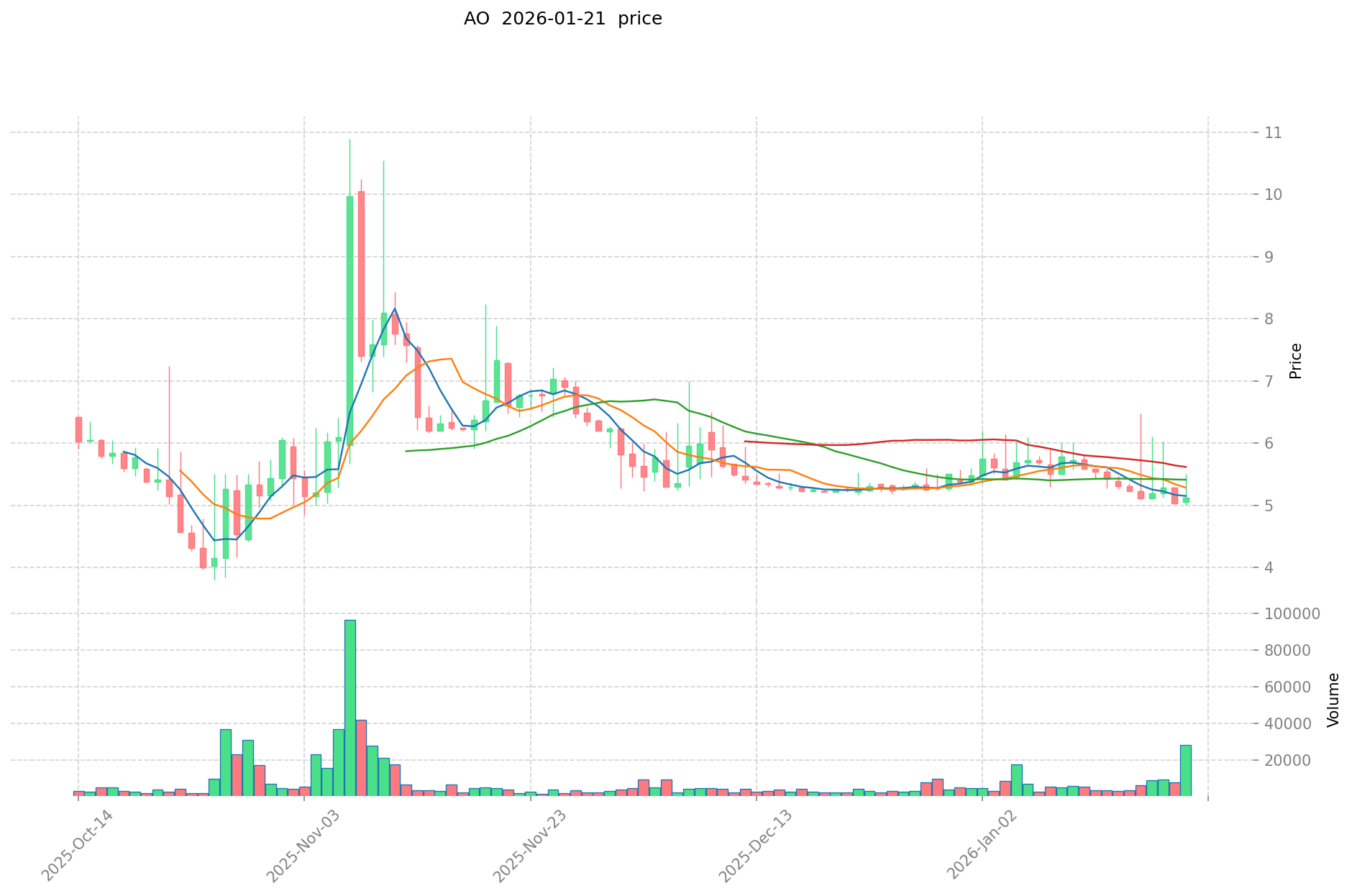
AO is a notable asset in the cryptocurrency space, representing a decentralized compute system where countless parallel processes interact within a single, cohesive environment. As of January 21, 2026, AO holds a market capitalization of approximately $29.67 million, with a circulating supply of around 5.87 million tokens and a current price near $5.06. Positioned as an infrastructure-oriented decentralized computing platform, AO has gradually become a focal point when investors discuss "Is AO a good investment?" With its native message-passing layer connecting independent processes similar to how websites form the World Wide Web, AO presents a technical approach in the broader blockchain ecosystem. This article provides a comprehensive analysis of AO's investment characteristics, historical price movements, future price outlook, and associated risks to serve as a reference for investors.
I. AO Price History Review and Investment Value Status
- 2025: Market Launch and Initial Volatility → AO was introduced with a launch price of $30, experiencing significant price fluctuations in its early trading phase
- March 2025: Peak Price Level → AO reached a notable price point of $28.32, reflecting early market interest and trading activity
- October 2025: Price Adjustment Period → AO experienced a price correction to $3.8, representing a substantial decline from previous levels
Current AO Investment Market Status (January 2026)
- AO Current Price: $5.057
- 24-hour Trading Volume: $115,523.29
- Market Capitalization: $29,668,362.09
- Circulating Supply: 5,866,791 AO
- Total Supply: 3,565,638 AO
- Maximum Supply: 21,000,000 AO
- Market Share: 0.00057%
- Recent Price Performance:
- 1-hour change: +0.02%
- 24-hour change: +0.41%
- 7-day change: -6.23%
- 30-day change: -3.49%
- 24-hour Price Range: $5.013 - $5.216
- Number of Exchanges: 7
Click to view real-time AO market price
II. Core Factors Affecting Whether AO is a Good Investment
Supply Mechanism and Scarcity (AO investment scarcity)
- Supply Mechanism: AO has a maximum supply cap of 21,000,000 tokens, with a current circulating supply of 5,866,791 tokens (approximately 27.94% of the total supply). This capped supply model creates a deflationary characteristic that may influence price dynamics and investment value over time.
- Historical Price Patterns: AO has experienced significant price fluctuations, with a recorded high of $28.32 in March 2025 and a low of $3.80 in October 2025. These variations reflect market volatility and supply-demand dynamics inherent to the asset.
- Investment Implications: The relatively low circulating supply ratio (27.94%) combined with the fixed maximum supply suggests that scarcity could become a more pronounced factor as adoption increases, potentially supporting long-term investment considerations.
Institutional Investment and Mainstream Adoption (Institutional investment in AO)
- Exchange Presence: AO is currently listed on 7 cryptocurrency exchanges, indicating a developing level of market accessibility and institutional interest.
- Market Positioning: With a market capitalization of approximately $29.67 million and a market dominance of 0.00057%, AO remains in an early stage of mainstream adoption. The market cap to fully diluted valuation ratio of 27.94% suggests significant potential supply yet to enter circulation.
- Adoption Trends: As a decentralized compute system with parallel processing capabilities, AO's technological positioning may attract interest from entities seeking decentralized computation solutions, though specific institutional adoption data is not currently available.
Macroeconomic Environment's Impact on AO Investment
- Market Sensitivity: Cryptocurrency assets like AO typically respond to broader macroeconomic factors including monetary policy shifts, interest rate changes, and liquidity conditions in global markets.
- Risk Asset Characteristics: As a relatively smaller market cap digital asset, AO may exhibit heightened sensitivity to macroeconomic uncertainty and capital flow trends compared to more established cryptocurrencies.
- Geopolitical Considerations: Decentralized computation platforms may see varying levels of demand based on regional regulatory approaches and data sovereignty concerns, potentially influencing investment outlook.
Technology and Ecosystem Development (Technology & Ecosystem for AO investment)
- Core Technology: AO operates as a decentralized compute system where numerous parallel processes interact within a unified environment. Each process functions independently while remaining connected through a native message-passing layer, architecturally similar to how websites form the World Wide Web.
- Technical Infrastructure: The project utilizes a mainnet algorithm structure and is associated with the Arweave ecosystem, suggesting integration with permanent data storage solutions.
- Ecosystem Positioning: As a computation-focused platform, AO's investment value depends on the development of applications and use cases that leverage its parallel processing capabilities. The growth of decentralized applications requiring significant computational resources could support long-term value creation.
- Development Activity: The project maintains active community channels including Twitter and provides technical documentation through its whitepaper, indicating ongoing development efforts.
III. AO Future Investment Forecast and Price Outlook (Is AO(AO) worth investing in 2026-2031)
Short-term Investment Forecast (2026, short-term AO investment outlook)
- Conservative forecast: 3.95 - 5.06 USD
- Neutral forecast: 5.06 - 5.76 USD
- Optimistic forecast: 5.76 - 6.43 USD
Mid-term Investment Outlook (2027-2029, mid-term AO(AO) investment forecast)
- Market phase expectation: AO may experience gradual adoption growth as its decentralized compute system attracts developers seeking parallel processing capabilities. The native message-passing layer connecting independent processes could support expanding use cases across the network.
- Investment return forecast:
- 2027: 2.99 - 6.21 USD
- 2028: 3.05 - 6.87 USD
- 2029: 3.53 - 9.06 USD
- Key catalysts: Technology development progress, ecosystem expansion, and broader market sentiment toward decentralized computing solutions may influence price movement during this period.
Long-term Investment Outlook (Is AO a good long-term investment?)
- Base scenario: 6.13 - 10.50 USD (assuming steady ecosystem development and stable market conditions)
- Optimistic scenario: 9.29 - 10.84 USD (assuming enhanced adoption and favorable market environment)
- Risk scenario: 2.99 - 6.58 USD (under challenging market conditions or slower-than-expected adoption)
View AO long-term investment and price forecast: Price Prediction
2026-01-21 - 2031 Long-term Outlook
- Base scenario: 6.13 - 9.29 USD (corresponding to steady progress and gradual mainstream application growth)
- Optimistic scenario: 9.29 - 10.84 USD (corresponding to large-scale adoption and favorable market environment)
- Transformative scenario: Above 10.84 USD (if the ecosystem achieves breakthrough progress and mainstream adoption)
- 2031-12-31 forecast high: 10.84 USD (based on optimistic development assumptions)
Disclaimer: This analysis is for informational purposes only and does not constitute investment advice. Cryptocurrency markets involve significant risks, and past performance does not guarantee future results. Investors should conduct their own research and consult with financial professionals before making investment decisions.
| Year |
Predicted High Price |
Predicted Average Price |
Predicted Low Price |
Price Change |
| 2026 |
6.43001 |
5.063 |
3.94914 |
0 |
| 2027 |
6.2062254 |
5.746505 |
2.9881826 |
13 |
| 2028 |
6.87281998 |
5.9763652 |
3.047946252 |
18 |
| 2029 |
9.0586755519 |
6.42459259 |
3.5335259245 |
27 |
| 2030 |
10.83828769933 |
7.74163407095 |
6.5803889603075 |
53 |
| 2031 |
10.4976558002082 |
9.28996088514 |
6.1313741841924 |
83 |
IV. AO Investment Strategy and Risk Management (How to invest in cryptocurrency)
Investment Methodology (AO investment strategy)
Long-term Holding (HODL AO): This approach suits conservative investors who believe in the project's long-term vision of decentralized computing. Given AO's relatively early stage with a circulating supply of only 5,866,791 tokens (27.94% of max supply), long-term holders may benefit from potential network growth and adoption expansion.
Active Trading: Traders can leverage technical analysis and volatility patterns. With 24-hour price fluctuations showing a 0.41% increase and weekly movements at -6.23%, AO presents opportunities for swing trading strategies. The token's historical range between $3.80 and $28.32 indicates significant price volatility suitable for experienced traders.
Risk Management (Risk management for AO investment)
Asset Allocation Ratios:
- Conservative investors: Allocate no more than 1-3% of total portfolio to AO
- Aggressive investors: May consider 5-10% allocation with active monitoring
- Professional investors: Can adjust based on comprehensive analysis and risk tolerance
Risk Hedging Strategies: Implement diversified portfolio strategies combining AO with established cryptocurrencies and traditional assets. Consider using stop-loss orders and position sizing techniques to manage downside exposure.
Secure Storage:
- Hot wallets: Suitable for active trading amounts only
- Cold wallets: Recommended for long-term holdings
- Hardware wallets: Optimal security solution for significant AO holdings
V. AO Investment Risks and Challenges (Risks of investing in cryptocurrency)
Market Risks: AO exhibits substantial volatility, with historical price movements ranging from $3.80 to $28.32. The relatively low market capitalization of approximately $29.67 million and 24-hour trading volume of $115,523 suggest potential liquidity constraints and susceptibility to price fluctuations.
Regulatory Risks: As a decentralized computing platform, AO may face evolving regulatory frameworks across different jurisdictions. Policy uncertainties regarding decentralized networks and cryptocurrency classifications could impact token utility and market accessibility.
Technical Risks: The project's architecture involving parallel processes and message-passing layers introduces complexity. Potential vulnerabilities in the messaging infrastructure, process coordination mechanisms, or network upgrades could affect system stability and token value.
VI. Conclusion: Is Cryptocurrency a Good Investment?
Investment Value Summary: AO presents an innovative approach to decentralized computing with potential long-term growth opportunities. However, the token demonstrates notable short-term price volatility and operates in a competitive landscape.
Investor Recommendations:
✅ Beginners: Consider dollar-cost averaging (DCA) strategies combined with secure cold wallet storage. Start with minimal allocation to understand market dynamics.
✅ Experienced Investors: Employ swing trading techniques while maintaining core positions. Diversify across multiple cryptocurrency categories and monitor technical indicators.
✅ Institutional Investors: Evaluate AO as a strategic allocation within broader decentralized infrastructure portfolios. Conduct thorough due diligence on technical architecture and competitive positioning.
⚠️ Disclaimer: Cryptocurrency investments carry substantial risks. This content is for informational purposes only and does not constitute investment advice. Conduct independent research and consult financial professionals before making investment decisions.
VII. FAQ
Q1: What makes AO different from other cryptocurrency investments?
AO is a decentralized compute system rather than a traditional blockchain token. Unlike conventional cryptocurrencies that focus primarily on value transfer, AO enables numerous parallel processes to interact within a unified environment through a native message-passing layer, architecturally similar to how websites form the World Wide Web. This positions AO as an infrastructure-oriented investment rather than a pure digital currency, with its value proposition tied to the adoption of decentralized computing applications. The project has a maximum supply cap of 21,000,000 tokens with only 27.94% currently in circulation, creating potential scarcity dynamics as the ecosystem develops.
Q2: Is AO suitable for beginner cryptocurrency investors?
No, AO is generally not recommended as a primary investment for beginners. The token exhibits substantial price volatility, with historical movements ranging from $3.80 to $28.32, and maintains a relatively modest 24-hour trading volume of approximately $115,523. This low liquidity combined with its small market capitalization of around $29.67 million creates heightened risk exposure. Beginners considering AO should start with minimal allocation (1-3% of portfolio), employ dollar-cost averaging strategies, and prioritize secure cold wallet storage. Prior experience with established cryptocurrencies and understanding of decentralized infrastructure is advisable before investing in AO.
Q3: What are the primary risks associated with investing in AO?
AO faces three critical risk categories. Market risks include substantial volatility and liquidity constraints due to its relatively small trading volume and market cap, making it susceptible to significant price fluctuations. Regulatory risks stem from evolving policy frameworks regarding decentralized computing platforms across different jurisdictions, which could impact token utility and accessibility. Technical risks involve the complexity of AO's parallel processing architecture and message-passing infrastructure—potential vulnerabilities in these systems could affect network stability and token value. Additionally, with only 7 exchanges currently listing AO, accessibility and liquidity remain limited compared to more established cryptocurrencies.
Q4: What is AO's long-term investment potential through 2031?
Based on analytical projections, AO's long-term outlook presents varied scenarios. The base scenario forecasts prices ranging from $6.13 to $9.29 USD by 2031, assuming steady ecosystem development and gradual adoption growth. The optimistic scenario projects $9.29 to $10.84 USD, contingent upon enhanced mainstream adoption and favorable market conditions. The transformative scenario suggests potential exceeding $10.84 USD if the ecosystem achieves breakthrough progress. These projections assume continued development of the decentralized computing infrastructure and increasing demand for parallel processing capabilities. However, investors should note that a risk scenario exists where prices could range from $2.99 to $6.58 USD under challenging market conditions or slower-than-expected adoption.
Q5: How should investors allocate AO within their cryptocurrency portfolio?
Portfolio allocation for AO should align with individual risk tolerance and investment objectives. Conservative investors are advised to limit AO allocation to 1-3% of their total portfolio, treating it as a speculative infrastructure play. Aggressive investors comfortable with higher volatility may consider 5-10% allocation while maintaining active monitoring protocols. Professional investors can adjust allocations based on comprehensive technical analysis and competitive landscape assessment. Regardless of allocation strategy, diversification across multiple cryptocurrency categories and traditional assets is essential for risk management. Implement position sizing techniques, stop-loss orders, and maintain the majority of holdings in secure cold storage rather than exchange wallets.
Q6: What factors could drive AO's price appreciation in 2026-2027?
Several catalysts could influence AO's near-to-mid-term price movement. Technology development progress, particularly enhancements to the parallel processing capabilities and message-passing layer, may attract developer interest and ecosystem growth. Increased adoption of decentralized applications requiring significant computational resources could drive demand for AO's infrastructure. Broader market sentiment toward decentralized computing solutions and Web3 infrastructure projects will likely impact AO's valuation. Short-term forecasts for 2026 project an optimistic range of $5.76 to $6.43 USD, while 2027 projections extend to $2.99 - $6.21 USD under various scenarios. The gradual release of remaining token supply (approximately 72% yet to circulate) will also influence price dynamics through supply-side pressure.
Q7: Where can investors trade AO and what security measures should they implement?
AO is currently listed on 7 cryptocurrency exchanges, providing moderate accessibility for investors. When trading AO, implement multi-layered security protocols: utilize hot wallets only for active trading amounts while storing long-term holdings in cold wallets or hardware wallets for optimal security. Enable two-factor authentication on all exchange accounts and regularly monitor for suspicious activity. Given AO's relatively low trading volume of approximately $115,523 per 24 hours, investors should use limit orders rather than market orders to avoid slippage on larger transactions. Maintain awareness of the 24-hour price range (currently $5.013 - $5.216) when executing trades, and consider diversifying exchange usage to mitigate platform-specific risks.
Q8: How does AO's supply mechanism impact its investment value?
AO's supply mechanism creates notable scarcity dynamics that influence investment considerations. With a maximum supply cap of 21,000,000 tokens and only 5,866,791 tokens currently circulating (27.94% of total supply), AO maintains a deflationary characteristic similar to Bitcoin's model. This relatively low circulating ratio means approximately 72% of tokens remain to be released, potentially creating future supply-side pressure. However, the capped maximum supply prevents infinite inflation, which could support long-term value preservation. The market cap to fully diluted valuation ratio of 27.94% suggests significant potential supply yet to enter circulation. Investors should monitor token release schedules and vesting mechanisms to understand future supply dynamics and their potential impact on price movements as adoption increases.
* The information is not intended to be and does not constitute financial advice or any other recommendation of any sort offered or endorsed by Gate.