This comprehensive analysis examines whether ApeCoin (APE) represents a viable investment opportunity in 2026. The article evaluates APE's market position with a current price of $0.2135 and market cap of $193.99 million, reviewing historical performance including an 80.17% year-over-year decline from its 2022 peak. Key sections address supply mechanisms, institutional adoption across 58 exchanges including Gate, and governance structure within the Bored Ape Yacht Club ecosystem. The analysis presents price scenarios through 2031, ranging from $0.206-$0.477 under various market conditions. Investment strategies are tailored for different investor types—conservative, aggressive, and professional—with emphasis on risk management, secure storage via hardware wallets, and portfolio allocation guidelines. Critical risks including market volatility, regulatory uncertainty, and concentrated holder distribution are thoroughly examined. Ultimately, APE presents speculative opportunities for community-focused investors
Introduction: ApeCoin (APE) Investment Position and Market Outlook
ApeCoin (APE) is a significant asset in the cryptocurrency field, having been officially launched in 2022 by Yuga Labs, the parent company of Bored Ape Yacht Club (BAYC). As a native governance token, APE serves as a decentralized protocol layer supporting community-led initiatives within the APE ecosystem, which includes prominent NFT communities such as BAYC and MAYC. As of January 16, 2026, ApeCoin maintains a market capitalization of approximately $193.99 million, with a circulating supply of around 908.66 million tokens out of a maximum supply of 1 billion tokens. The current price stands at approximately $0.2135, reflecting a circulating supply ratio of 90.87%. With its positioning as a community-governed token within the NFT and metaverse space, APE has gradually become a focal point when investors discuss "Is ApeCoin (APE) a good investment?" This article will comprehensively analyze ApeCoin's investment value, historical trends, future price predictions, and investment risks to provide reference for investors.
I. ApeCoin (APE) Price History Review and Current Investment Value
- 2022: APE reached a notable price peak of $26.70 in April 2022 following its launch and initial distribution to BAYC/MAYC community members → Early investors experienced significant returns during the initial distribution phase
- 2025: Market correction phase → APE price declined from higher levels to approximately $0.21, reflecting broader market adjustments and shifts in NFT sector sentiment
- 2025-2026: APE demonstrated price fluctuations between $0.180437 and $0.2266 → The token experienced a decline of approximately 80.17% over the one-year period ending January 2026
Current APE Investment Market Status (January 2026)
- APE current price: $0.2135
- 24-hour trading volume: $358,719.94
- Market capitalization: $193,999,929.04
- Circulating supply: 908,664,773 APE (90.87% of total supply)
- Total token holders: 185,465 addresses
- Major holder concentration: Top holder controls 88,000,000 APE (8.80% of supply), with top 5 holders representing significant portions of circulating tokens
Click to view real-time APE market price
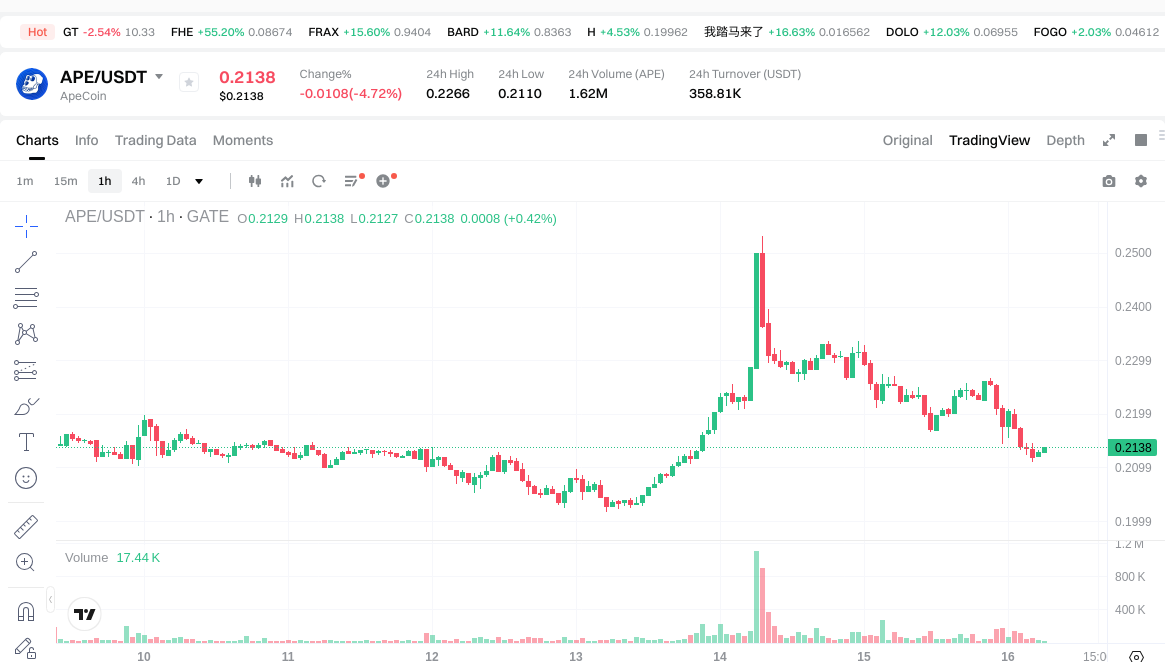
II. Core Factors Influencing Whether APE Is a Good Investment
Supply Mechanism and Scarcity (APE Investment Scarcity)
- Fixed supply model → influences price and investment value
- APE has a maximum supply capped at 1 billion tokens, with approximately 908.66 million tokens (90.87%) currently in circulation as of January 16, 2026
- Historical patterns: Supply dynamics have contributed to APE's price volatility, with the token experiencing significant fluctuations since its launch in March 2022
- Investment significance: The relatively high circulation ratio and fixed maximum supply may limit scarcity-driven price appreciation compared to assets with lower circulation ratios
Institutional Investment and Mainstream Adoption (Institutional Investment in APE)
- Institutional holding trends: As of January 16, 2026, APE is listed on 58 exchanges, indicating broad market access
- Notable ecosystem connections: APE is closely associated with Yuga Labs and prominent NFT collections including Bored Ape Yacht Club (BAYC) and Mutant Ape Yacht Club (MAYC), which have attracted attention from major auction houses such as Christie's
- Governance structure: ApeCoin DAO operates as a decentralized autonomous organization, allowing token holders to participate in ecosystem governance decisions
- The token's integration within the BAYC ecosystem and related NFT projects may influence its adoption trajectory among collectors and digital asset enthusiasts
Macroeconomic Environment's Impact on APE Investment
- Market correlation: As an Ethereum-based ERC-20 token, APE's performance may be influenced by broader cryptocurrency market trends and sentiment
- Digital asset positioning: Unlike traditional inflation hedges, APE functions primarily as a governance and utility token within its specific ecosystem
- Market volatility: Cryptocurrency markets remain highly volatile, making short-term and long-term price predictions challenging for digital assets including APE
- Economic conditions affecting risk appetite may impact investor interest in speculative digital assets such as governance tokens
Technology and Ecosystem Development (Technology & Ecosystem for APE Investment)
- Protocol foundation: APE operates as an ERC-20 token on the Ethereum blockchain, functioning as both a governance and utility token
- Ecosystem structure: The ApeCoin ecosystem encompasses BAYC, MAYC, and Bored Ape Kennel Club communities, with the Ape Foundation serving as the legal steward managing decisions made by ApeCoin DAO
- Governance mechanism: Token holders can participate in voting on ecosystem funds allocation and governance decisions, with holding APE being the only requirement for ApeCoin DAO membership
- Utility applications: The token is designed to support community-led initiatives and serve as a decentralized protocol layer for cultural development within the metaverse context
- Application scope: APE functions as a payment and access token within projects connected to the Bored Ape Yacht Club ecosystem, though specific DeFi or broader payment integrations were not detailed in available materials
III. APE Future Investment Forecast and Price Outlook (Is ApeCoin(APE) worth investing in 2026-2031)
Short-term Investment Forecast (2026, short-term APE investment outlook)
As of January 16, 2026, ApeCoin (APE) is trading at approximately $0.2135. Short-term projections for 2026 present varied scenarios based on market dynamics and technical indicators:
- Conservative forecast: $0.17088 - $0.21360
- Neutral forecast: $0.21360 - $0.23923
- Optimistic forecast: $0.23923 - $0.26000
The token has experienced recent volatility, with a 24-hour decline of 4.89% and a 7-day decrease of 1.34%. The short-term outlook remains sensitive to broader market sentiment, trading volume fluctuations, and developments within the ApeCoin DAO ecosystem.
Mid-term Investment Outlook (2027-2029, mid-term ApeCoin(APE) investment forecast)
The mid-term period reflects potential recovery and stabilization phases for ApeCoin:
-
Market stage expectation: Transitional phase with potential for gradual recovery, contingent upon sustained community engagement and ecosystem development within the APE Foundation and associated NFT communities (BAYC/MAYC).
-
Investment return projections:
- 2027: $0.21736 - $0.29887
- 2028: $0.22325 - $0.37295
- 2029: $0.18114 - $0.37818
-
Key catalysts: Developments in the metaverse and Web3 sectors, enhanced utility of ApeCoin within gaming and digital culture initiatives, governance decisions by ApeCoin DAO members, and broader adoption trends in NFT-related tokens.
Long-term Investment Outlook (Is ApeCoin a good long-term investment?)
Long-term projections for ApeCoin extend through 2031, reflecting diverse scenarios:
- Base scenario: $0.20559 - $0.36713 (assuming steady ecosystem development and maintained community activity)
- Optimistic scenario: $0.34799 - $0.47727 (assuming expanded utility, increased institutional interest, and favorable regulatory environment)
- Risk scenario: $0.17088 - $0.20559 (in cases of prolonged market downturns, reduced NFT market activity, or loss of community momentum)
For detailed APE long-term investment and price predictions: Price Prediction
2026-01-16 to 2031 Long-term Outlook
- Base scenario: $0.206 - $0.367 (corresponding to steady progress and gradual mainstream application growth)
- Optimistic scenario: $0.348 - $0.477 (corresponding to large-scale adoption and favorable market conditions)
- Transformative scenario: Above $0.50 (in cases of breakthrough ecosystem developments and mainstream adoption)
- Projected high by 2031-12-31: $0.477 (based on optimistic development assumptions)
Disclaimer: Price predictions are inherently speculative and subject to significant uncertainty. Multiple factors including market volatility, regulatory changes, technological developments, and macroeconomic conditions can substantially impact actual outcomes. These projections should not be construed as financial advice or guarantees of future performance. Investors should conduct thorough research and consider their risk tolerance before making investment decisions.
| Year |
Predicted High Price |
Predicted Average Price |
Predicted Low Price |
Price Change |
| 2026 |
0.239232 |
0.2136 |
0.17088 |
0 |
| 2027 |
0.29886912 |
0.226416 |
0.21735936 |
6 |
| 2028 |
0.3729524352 |
0.26264256 |
0.223246176 |
23 |
| 2029 |
0.378179022144 |
0.3177974976 |
0.181144573632 |
48 |
| 2030 |
0.38626696845792 |
0.347988259872 |
0.32014919908224 |
62 |
| 2031 |
0.477265898414448 |
0.36712761416496 |
0.205591463932377 |
71 |
IV. APE Investment Strategy and Risk Management (How to invest in ApeCoin)
Investment Methodology (APE investment strategy)
Long-term Holding (HODL APE): Suitable for Conservative Investors
For investors with a long-term perspective on the APE ecosystem and its community-driven governance model, a holding strategy may align with their investment philosophy. This approach focuses on the potential growth of the ApeCoin DAO and its associated NFT communities (BAYC and MAYC). Long-term holders typically view APE as a governance token within a decentralized protocol layer rather than a short-term trading vehicle.
Active Trading: Technical Analysis and Swing Trading
Active traders may leverage APE's price volatility to capture short-term opportunities. With a 24-hour price change of -4.89% and historical fluctuations, technical analysis tools such as support and resistance levels, moving averages, and volume indicators can be employed. Traders should note that APE's 1-hour change of 0.42% and 7-day change of -1.34% reflect its dynamic price movements, which may present both opportunities and risks.
Risk Management (Risk management for APE investment)
Asset Allocation Ratio: Conservative / Aggressive / Professional Investors
- Conservative Investors: Allocate 1-3% of total portfolio to APE, considering its high volatility (1-year change: -80.17%).
- Aggressive Investors: May allocate 5-10% to APE, balancing potential returns with elevated risk exposure.
- Professional Investors: Could incorporate APE as part of a diversified crypto portfolio, with allocation determined by market conditions and risk tolerance.
Investors may consider diversifying across different crypto asset categories and traditional assets to mitigate concentration risk. Hedging strategies such as stop-loss orders and position sizing can help manage downside exposure. APE's market dominance of 0.0063% indicates its relatively smaller market cap compared to major cryptocurrencies, which may affect liquidity during extreme market conditions.
Secure Storage: Hot and Cold Wallets + Hardware Wallet Recommendations
Given that APE is an ERC-20 token on the Ethereum network (contract address: 0x4d224452801ACEd8B2F0aebE155379bb5D594381), investors should prioritize security:
- Hot Wallets: Suitable for active trading with smaller amounts, offering convenient access.
- Cold Wallets: Recommended for long-term storage of larger holdings, minimizing online exposure.
- Hardware Wallets: Devices such as Ledger or Trezor provide enhanced security for storing APE tokens offline.
V. APE Investment Risks and Challenges (Risks of investing in ApeCoin)
Market Risk: High Volatility and Price Dynamics
APE exhibits considerable price volatility, with a current price of $0.2135 representing substantial decline from its all-time high of $26.7 (recorded on April 29, 2022). The all-time low of $0.180437 (October 11, 2025) demonstrates the token's price range. The 24-hour low of $0.211 and high of $0.2266 reflect ongoing price fluctuations. The 30-day change of -0.19% and 1-year change of -80.17% highlight the potential for significant value depreciation.
Regulatory Risk: Policy Uncertainty Across Jurisdictions
As a governance token associated with NFT communities, APE may face regulatory scrutiny in various jurisdictions. Different countries maintain evolving positions on crypto assets, NFTs, and decentralized autonomous organizations (DAOs). The ApeCoin DAO governance structure and its relationship with NFT projects may attract regulatory attention regarding securities classification, consumer protection, and taxation policies. Investors should monitor regulatory developments in their respective jurisdictions.
Technical Risk: Network Security and Upgrade Considerations
As an ERC-20 token, APE's security depends on the Ethereum network's infrastructure. Potential technical risks include:
- Smart Contract Vulnerabilities: The token contract may contain undiscovered vulnerabilities, though audits can mitigate this risk.
- Ethereum Network Congestion: High gas fees during network congestion may affect transaction costs.
- DAO Governance Challenges: Community-driven decision-making through ApeCoin DAO may result in governance disputes or delayed implementation of proposals.
VI. Conclusion: Is ApeCoin a Good Investment?
Investment Value Summary
APE presents a community-driven governance model within the NFT ecosystem, supported by established communities such as BAYC and MAYC. With a circulating supply of 908,664,773 tokens (90.87% of total supply) and a market cap of approximately $194 million, the token's market position reflects moderate liquidity. The market cap to fully diluted valuation ratio of 90.87% indicates limited additional supply pressure. However, the substantial price decline over the past year (-80.17%) and current trading below historical levels warrant careful consideration.
Investor Recommendations
✅ Beginners: Dollar-Cost Averaging + Secure Wallet Storage
New investors may consider gradual accumulation through periodic purchases to average entry prices, while prioritizing secure storage solutions. Understanding the ApeCoin DAO governance mechanism and the underlying NFT ecosystem is recommended before investment.
✅ Experienced Investors: Swing Trading + Portfolio Diversification
Investors with market experience may explore swing trading opportunities based on technical indicators and market sentiment, while maintaining diversified holdings across different crypto sectors to manage risk exposure.
✅ Institutional Investors: Strategic Long-term Allocation
Institutional participants may evaluate APE as part of a broader digital asset strategy, considering its role in the NFT ecosystem and community governance models. Due diligence on governance structure, tokenomics, and ecosystem development roadmap is essential.
⚠️ Disclaimer: Cryptocurrency investment carries substantial risk. This content is for informational purposes only and does not constitute investment advice. Investors should conduct independent research and consider their financial situation and risk tolerance before making investment decisions.
VII. FAQ
Q1: Is ApeCoin (APE) a good investment for beginners in 2026?
APE may be suitable for beginners with high risk tolerance who are willing to learn about NFT ecosystems and DAO governance. For new investors, dollar-cost averaging (DCA) is recommended—investing fixed amounts periodically rather than lump-sum purchases—to mitigate the impact of price volatility. Given APE's significant 80.17% decline over the past year and current price of $0.2135, beginners should allocate only 1-3% of their portfolio to APE, prioritize secure wallet storage (hardware wallets like Ledger or Trezor), and thoroughly understand the token's governance role within the BAYC/MAYC community before investing. The token's high volatility and concentrated holder distribution require careful risk management for newcomers.
Q2: What are the main factors that could drive APE's price up in 2026-2027?
Short to mid-term price catalysts include expansion of ApeCoin DAO governance participation, integration of APE as a utility token in new metaverse or gaming projects, increased NFT market activity (particularly BAYC/MAYC collections), broader cryptocurrency market recovery, and successful implementation of community-voted proposals through the DAO structure. The token's listing on 58 exchanges provides liquidity infrastructure, while connections to established NFT brands offer potential partnership opportunities. However, APE's price appreciation depends heavily on sustained community engagement, practical utility development beyond governance rights, and favorable sentiment in both NFT and broader crypto markets.
Q3: How does APE's supply mechanism affect its investment value?
APE has a fixed maximum supply of 1 billion tokens, with approximately 908.66 million (90.87%) already in circulation as of January 16, 2026. This high circulation ratio means limited additional supply pressure compared to tokens with lower circulation percentages, but also indicates reduced scarcity-driven price potential. The market cap to fully diluted valuation ratio of 90.87% suggests minimal future dilution risk. However, concentration remains a concern—the top holder controls 88 million APE (8.80% of supply), and the top 5 holders represent significant portions. This distribution pattern may impact price stability, as large holders could influence market dynamics through concentrated selling or voting power in DAO governance decisions.
Q4: What are the biggest risks when investing in ApeCoin?
The primary risks include extreme price volatility (APE declined 80.17% year-over-year and dropped from an all-time high of $26.70 to current $0.2135), concentrated holder distribution creating potential market manipulation risk, regulatory uncertainty surrounding NFT-linked governance tokens, dependence on Ethereum network security and gas fee fluctuations, NFT market sentiment correlation (if BAYC/MAYC interest wanes), DAO governance disputes potentially delaying ecosystem development, and limited proven utility beyond governance participation. Additionally, APE's market dominance of only 0.0063% indicates relatively lower liquidity compared to major cryptocurrencies, which may affect exit options during market stress. Investors must accept the possibility of total or near-total capital loss.
Q5: Should I hold APE long-term or trade it actively?
The choice depends on your investment profile and market outlook. Long-term holding suits investors who believe in the APE ecosystem's multi-year development potential, participate in DAO governance, and can tolerate significant volatility—price projections suggest a potential range of $0.206-$0.477 by 2031 under favorable scenarios. Active trading may be appropriate for experienced traders who can analyze technical indicators, manage 24-hour price swings (recent -4.89% change), and set proper stop-losses. Given APE's current depressed price relative to historical levels, some investors adopt a hybrid approach: holding a core position while trading volatility around it. However, the 80% annual decline suggests that neither strategy has been consistently profitable recently—market timing and ecosystem developments remain critical variables.
Q6: How does APE compare to other NFT-related tokens as an investment?
APE's primary differentiation lies in its direct connection to the prestigious BAYC and MAYC communities, which have achieved mainstream recognition through celebrity ownership and major auction house sales (Christie's). Unlike general NFT marketplace tokens, APE functions as a community governance token for specific high-value collections, creating both benefits (strong brand association) and limitations (concentrated ecosystem dependency). The token's DAO structure enables holder participation in fund allocation decisions, distinguishing it from purely transactional NFT tokens. However, APE's 80.17% annual decline and market cap of approximately $194 million position it as a mid-tier NFT asset. Compared to broader metaverse or gaming tokens, APE's utility currently centers on governance rather than in-game functionality, which may limit adoption beyond NFT enthusiasts.
Q7: What wallet and security measures should I use for storing APE?
Since APE is an ERC-20 token (contract address: 0x4d224452801ACEd8B2F0aebE155379bb5D594381), it requires an Ethereum-compatible wallet. For long-term storage of significant holdings, hardware wallets (Ledger Nano S/X, Trezor Model T) provide optimal security by keeping private keys offline and requiring physical confirmation for transactions. Software wallets like MetaMask or Trust Wallet suit active trading with smaller amounts, though they carry higher online exposure risk. Never store large APE holdings on exchanges long-term—only 24-hour trading amounts. Enable two-factor authentication (2FA) on all related accounts, verify the correct contract address before transactions, use separate wallets for different purposes (trading vs. holding), regularly update wallet firmware and software, and maintain secure backups of recovery phrases in physical locations (never digital storage).
Q8: When is the best time to enter an APE investment position in 2026?
Market timing remains inherently uncertain, but several indicators may guide entry decisions. Technical analysis suggests monitoring support levels around $0.17-$0.18 (near the all-time low of $0.180437) as potential accumulation zones, while resistance at $0.23-$0.26 may present profit-taking opportunities. Fundamental catalysts to watch include major ApeCoin DAO governance proposals, new utility implementations within the ecosystem, BAYC/MAYC floor price trends, broader NFT market sentiment indicators, and Bitcoin/Ethereum market cycles (as APE correlates with general crypto trends). Given the current depressed price ($0.2135) relative to historical levels, some analysts suggest gradual accumulation during periods of low volatility rather than attempting to time the absolute bottom. However, with an 80% annual decline, waiting for clear reversal signals (sustained volume increase, positive sentiment shift) may reduce downside risk compared to immediate entry.
* The information is not intended to be and does not constitute financial advice or any other recommendation of any sort offered or endorsed by Gate.