This comprehensive analysis evaluates Apeiron (APRS), a Web3 gaming token launched in April 2024 on the Ronin blockchain, assessing its investment viability through 2031. The article examines APRS's current market position with a $201,273 market capitalization and $0.001018 trading price, analyzes historical price movements showing 97.65% one-year decline, and explores core investment factors including supply mechanics, ecosystem development, and market adoption. Detailed price projections through 2031 range from conservative scenarios ($0.000621-$0.000869) to optimistic outlooks ($0.001479-$0.002097), providing investors with multiple forecast frameworks. The guide addresses critical investment risks including extreme volatility, low liquidity on limited exchange availability, regulatory uncertainties affecting blockchain gaming, and technical vulnerabilities on the Ronin network. Strategic recommendations differentiate approaches for beginners (dollar-cost averaging with hardware wallet storage), experience
Introduction: Apeiron (APRS) Investment Position and Market Prospects
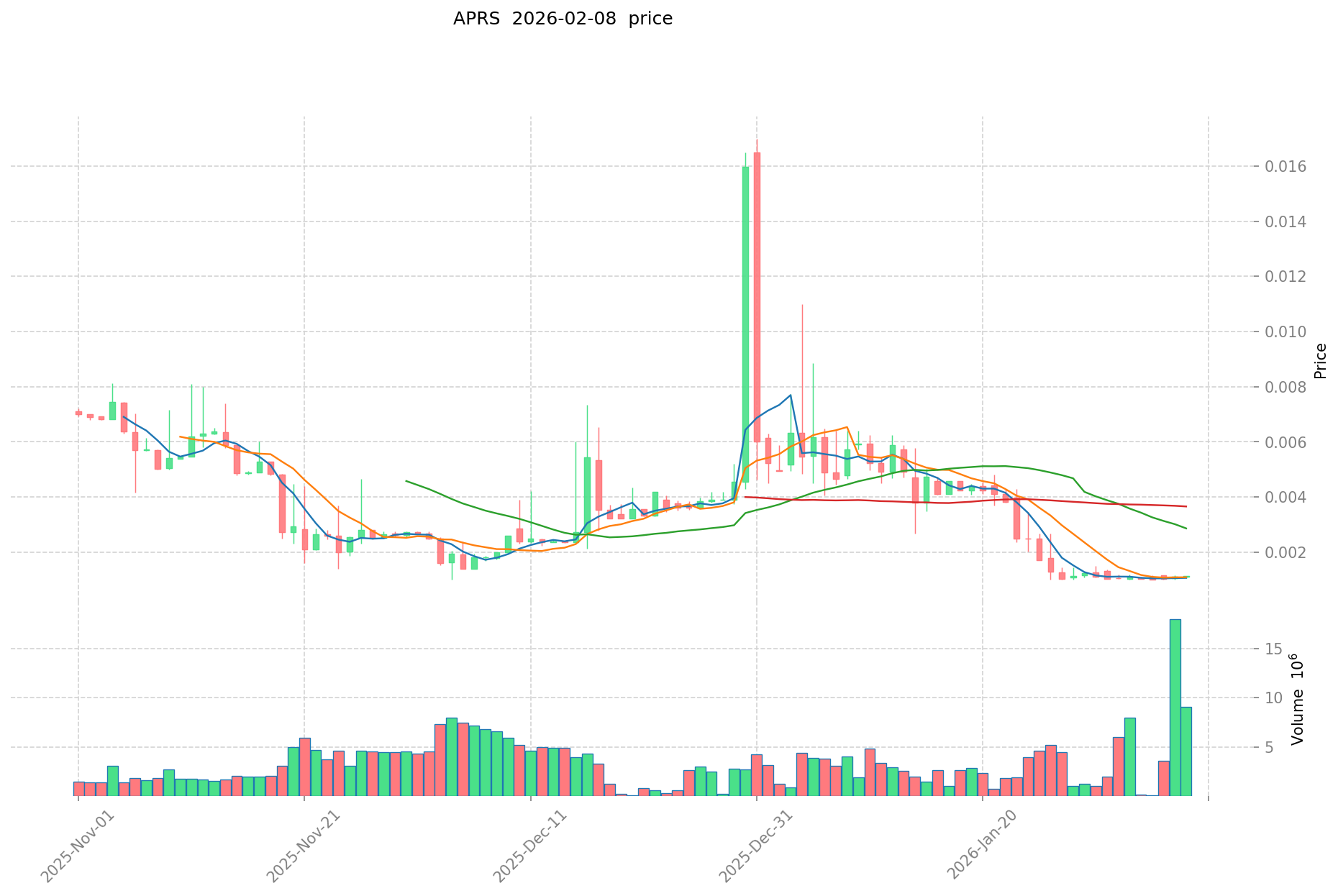
APRS is a digital asset in the cryptocurrency field, launched in April 2024 as part of the Apeiron Web3 gaming ecosystem. Built on the Ronin blockchain, APRS serves as a core component of a strategic card-based gaming platform that combines god simulation mechanics with Roguelike adventure elements. As of February 8, 2026, APRS maintains a market capitalization of approximately $201,273, with a circulating supply of around 197.7 million tokens out of a total supply of 1 billion tokens. The current trading price stands at approximately $0.001018, with 877 token holders recorded. Operating within the play-to-earn gaming sector, APRS has attracted attention in discussions regarding "Is Apeiron (APRS) a good investment?" This analysis examines APRS's investment characteristics, historical price movements, future price projections, and associated investment risks to provide reference information for market participants.
I. Apeiron (APRS) Price History Review and Current Investment Value Status
- 2024: Token listed on exchanges → Price reached $0.7901 on May 24
- 2025: Market adjustment phase → Price declined from earlier levels to $0.0014 on November 24
- Late 2025 to early 2026: Continued price fluctuation → Current trading price approximately $0.001018
Current APRS Investment Market Status (February 2026)
- APRS current price: $0.001018
- Market sentiment (Fear & Greed Index): Data not available in provided materials
- 24-hour trading volume: $8,177.82
- Institutional investor holdings: Data not available in provided materials
Click to view real-time APRS market price
II. Core Factors Affecting Whether APRS is a Good Investment (Is Apeiron(APRS) a Good Investment)
Supply Mechanism and Scarcity (APRS investment scarcity)
- Token supply structure → Impacts price and investment value
- Apeiron has a total supply of 1,000,000,000 APRS tokens with a maximum supply cap of 1,000,000,000 tokens, while the current circulating supply stands at approximately 197,714,888 tokens, representing a circulation ratio of 19.77%
- Investment significance: The controlled supply mechanism and relatively low circulation ratio may contribute to potential scarcity dynamics as adoption increases
Institutional Investment and Mainstream Adoption (Institutional investment in APRS)
- Current holder count: 877 addresses hold APRS tokens
- The project is built on the Ronin blockchain, which provides infrastructure security for the gaming ecosystem
- Exchange availability: APRS is currently listed on 1 exchange platform, which may limit institutional access compared to assets with broader exchange coverage
Macroeconomic Environment's Impact on APRS Investment
- As a gaming-focused token within the Web3 sector, APRS investment appeal may be influenced by broader cryptocurrency market conditions and regulatory frameworks affecting blockchain gaming
- The play-to-earn model's sustainability depends on overall digital asset market sentiment and user adoption patterns in the gaming industry
- Market uncertainty may affect speculative interest in gaming tokens, though blockchain gaming continues to develop as a distinct sector within the digital asset ecosystem
Technology and Ecosystem Development (Technology & Ecosystem for APRS investment)
- Roguelike adventure mechanics: Apeiron combines god simulation gameplay with roguelike elements, featuring strategic card-based combat systems where players craft decks and utilize elemental powers
- Three-token economic system: The project implements a multi-token structure designed to support in-game economy and NFT marketplace functionality
- Gaming ecosystem features: The platform offers diverse gameplay including universe exploration, mythical galaxy conquest, and guild-versus-guild battle systems that aim to provide ongoing engagement opportunities for participants
III. APRS Future Investment Forecast & Price Outlook (Is Apeiron (APRS) worth investing in 2026-2031)
Short-term Investment Outlook (2026, short-term APRS investment outlook)
Based on available projection models, APRS may experience modest fluctuations in the near term:
- Conservative scenario: $0.000621 - $0.000869
- Neutral scenario: $0.001018 - $0.001099
- Optimistic scenario: $0.001181 - $0.001418
The token's short-term trajectory appears influenced by broader market sentiment and platform-specific developments within the Apeiron ecosystem.
Mid-term Investment Outlook (2027-2029, mid-term Apeiron (APRS) investment forecast)
- Market phase expectation: Potential consolidation phase with selective growth opportunities as the gaming ecosystem matures
- Investment return forecast:
- 2027: $0.000869 - $0.001418 (potential 8% year-over-year increase)
- 2028: $0.000692 - $0.001309 (possible 23% cumulative change from 2026)
- 2029: $0.000668 - $0.001823 (potential 26% cumulative adjustment)
- Key catalysts: Platform user engagement metrics, competitive positioning in Web3 gaming sector, and broader blockchain gaming adoption trends
Long-term Investment Outlook (Is APRS a good long-term investment?)
- Base scenario: $0.000932 - $0.001556 (2030, assuming steady ecosystem development)
- Optimistic scenario: $0.001479 - $0.002097 (2030-2031, contingent on favorable market conditions and successful platform expansion)
- Risk scenario: Below $0.000668 (in case of extended market corrections or ecosystem challenges)
For detailed APRS long-term investment analysis and price predictions: Price Forecast
2026-2031 Extended Outlook
- Base scenario: $0.000621 - $0.001826 (reflecting gradual ecosystem maturation and selective adoption)
- Optimistic scenario: $0.001479 - $0.002097 (contingent on expanded user base and favorable Web3 gaming trends)
- Transformative scenario: Above $0.002097 (dependent on breakthrough developments in platform utility or mainstream gaming integration)
- 2031-12-31 projected range: Up to $0.002063 (based on optimistic development assumptions)
Disclaimer: These projections are derived from historical patterns and third-party analytical models. Actual performance may differ materially due to market volatility, regulatory changes, technological developments, and unforeseen circumstances. This information does not constitute investment advice.
| Year |
Predicted High Price |
Predicted Average Price |
Predicted Low Price |
Price Change |
| 2026 |
0.00118088 |
0.001018 |
0.00062098 |
0 |
| 2027 |
0.0014182776 |
0.00109944 |
0.0008685576 |
8 |
| 2028 |
0.001309213152 |
0.0012588588 |
0.00069237234 |
23 |
| 2029 |
0.00182333108592 |
0.001284035976 |
0.00066769870752 |
26 |
| 2030 |
0.002097472766796 |
0.00155368353096 |
0.000932210118576 |
52 |
| 2031 |
0.002062903308232 |
0.001825578148878 |
0.001478718300591 |
79 |
IV. Apeiron (APRS) Investment Strategy and Risk Management (How to invest in Web3 Gaming Tokens)
Investment Methodology (Apeiron investment strategy)
Long-term Holding (HODL Apeiron)
Long-term holding may be suitable for investors who believe in the potential growth of the Web3 gaming sector and Apeiron's ecosystem development. This approach typically involves purchasing APRS tokens and holding them through market fluctuations, focusing on the project's fundamental developments rather than short-term price movements.
Active Trading
Active trading strategies for APRS involve utilizing technical analysis and swing trading approaches. Given the token's price volatility, traders may identify entry and exit points based on technical indicators, chart patterns, and market sentiment. This method requires continuous market monitoring and understanding of cryptocurrency trading dynamics.
Risk Management (Risk management for Apeiron investment)
Asset Allocation Ratios
- Conservative Investors: May consider allocating a minimal percentage (1-3%) of their cryptocurrency portfolio to Web3 gaming tokens like APRS, with the majority held in more established digital assets.
- Aggressive Investors: Could allocate a moderate portion (5-10%) to emerging gaming tokens, balancing potential returns with higher risk exposure.
- Professional Investors: May implement strategic allocations based on comprehensive research and market analysis, potentially incorporating larger positions while maintaining diversified exposure across multiple sectors.
Risk Hedging Solutions
Implementing a multi-asset portfolio approach can help mitigate concentration risk. Investors may consider:
- Diversifying across different cryptocurrency categories (Layer 1, DeFi, Gaming, etc.)
- Maintaining positions in stablecoins for liquidity and risk management
- Utilizing derivative products where available for hedging purposes
Secure Storage
- Cold Wallets: For long-term holdings, hardware wallets or air-gapped storage solutions provide enhanced security against online threats.
- Hot Wallets: For active trading, reputable exchange wallets or software wallets with strong security features may be utilized, though only for amounts needed for trading activities.
- Hardware Wallet Recommendations: Industry-standard hardware wallets that support ERC-20 tokens (as APRS is deployed on Ethereum) can provide secure offline storage options.
V. Apeiron (APRS) Investment Risks and Challenges (Risks of investing in Web3 Gaming Tokens)
Market Risk
- High Volatility: APRS has demonstrated significant price fluctuations, with a 24-hour change of -4.23%, 7-day change of -4.41%, 30-day change of -82.26%, and 1-year change of -97.65% as of February 8, 2026. Such volatility indicates substantial price movement risk.
- Price Manipulation Potential: With a relatively modest 24-hour trading volume of approximately $8,177.82 and market capitalization of around $201,273.76, the token may be susceptible to price manipulation by large holders or coordinated trading activities.
- Liquidity Concerns: The token is listed on a limited number of exchanges (1 exchange), which may impact liquidity and price stability during periods of high market stress.
Regulatory Risk
Different jurisdictions maintain varying regulatory approaches toward cryptocurrency and blockchain gaming:
- Regulatory frameworks for Web3 gaming and play-to-earn models continue evolving across different countries
- Changes in cryptocurrency taxation policies may impact investment returns
- Potential restrictions on blockchain gaming operations in certain regions could affect project accessibility and token utility
Technical Risk
- Network Security Vulnerabilities: As with any blockchain-based project, smart contract vulnerabilities or network attacks could potentially compromise user assets or platform functionality.
- Upgrade Implementation: Technical upgrades or protocol changes may encounter unexpected issues that could temporarily or permanently affect platform operations.
- Dependency on Ronin Blockchain: While the project is described as built on the Ronin blockchain, investors should consider the security and stability of the underlying infrastructure.
VI. Conclusion: Is Web3 Gaming Token a Good Investment?
Investment Value Summary
Apeiron (APRS) represents an emerging Web3 gaming project that combines god simulation with roguelike adventure elements. The token has experienced considerable price volatility, with substantial declines over various timeframes. While the project features a three-token economic system and play-to-earn mechanics, investors should carefully evaluate the token's performance trajectory and market positioning.
Investor Recommendations
✅ Beginners: Consider starting with small allocations through dollar-cost averaging strategies, and prioritize secure storage solutions such as hardware wallets for any cryptocurrency holdings.
✅ Experienced Investors: May explore swing trading opportunities based on technical analysis while maintaining diversified portfolio allocations across different cryptocurrency sectors.
✅ Institutional Investors: Could evaluate strategic positioning based on comprehensive due diligence of the Web3 gaming sector, project fundamentals, and long-term market trends.
⚠️ Disclaimer: Cryptocurrency investments carry substantial risk, including the potential loss of principal. This content is provided for informational purposes only and does not constitute investment advice. Investors should conduct their own research and consult with qualified financial advisors before making investment decisions.
VII. FAQ
Q1: What is Apeiron (APRS) and how does it differ from traditional gaming tokens?
Apeiron (APRS) is a Web3 gaming token launched in April 2024 on the Ronin blockchain, serving as a core component of a god simulation and roguelike adventure gaming platform. Unlike traditional gaming tokens that often focus solely on in-game currency functions, APRS operates within a three-token economic system that supports strategic card-based combat mechanics, NFT marketplace functionality, and play-to-earn gameplay. The platform combines universe exploration, mythical galaxy conquest, and guild-versus-guild battle systems, positioning itself as a comprehensive gaming ecosystem rather than a simple utility token. With a total supply cap of 1 billion tokens and approximately 197.7 million in circulation, APRS represents approximately 19.77% of its maximum supply, which creates a controlled scarcity mechanism distinct from many gaming tokens with higher initial circulation rates.
Q2: What are the primary risks associated with investing in APRS?
APRS carries multiple significant investment risks that potential investors should carefully consider. The most prominent is market volatility, evidenced by a 97.65% decline over a one-year period and an 82.26% drop in the past 30 days as of February 8, 2026. With a modest market capitalization of approximately $201,273 and daily trading volume around $8,177, the token faces substantial liquidity constraints and potential price manipulation risks. Regulatory uncertainty surrounding Web3 gaming and play-to-earn models across different jurisdictions adds another layer of risk, as evolving legal frameworks could impact the project's operations. Technical vulnerabilities in smart contracts, dependency on the Ronin blockchain's security, and the token's limited exchange availability (currently listed on only 1 exchange) further compound the risk profile. Investors should recognize that the combination of these factors creates an exceptionally high-risk investment environment.
Q3: Is APRS suitable for long-term investment or short-term trading?
The investment approach for APRS depends significantly on individual risk tolerance and market expertise. For long-term holding, APRS presents challenges due to its substantial historical decline, modest market capitalization, and uncertain recovery trajectory. Projection models suggest potential price ranges from $0.000621 to $0.002097 through 2031, indicating limited upside potential under base scenarios. Conservative long-term investors might allocate only 1-3% of their cryptocurrency portfolio to such emerging gaming tokens, with the majority held in more established digital assets. For short-term trading, APRS's high volatility creates opportunities for experienced traders who can leverage technical analysis and manage risk effectively. Active traders may identify entry and exit points based on price patterns, though the token's low liquidity requires careful position sizing. Neither approach is inherently superior; the choice depends on whether an investor prioritizes potential ecosystem growth (long-term) or volatility-driven trading opportunities (short-term), while acknowledging the substantial risks in both strategies.
Q4: How does APRS's token supply structure affect its investment potential?
APRS implements a controlled supply mechanism with a maximum cap of 1 billion tokens, of which approximately 197.7 million tokens (19.77%) are currently in circulation as of February 8, 2026. This relatively low circulation ratio creates a theoretical scarcity dynamic that could influence future price movements as adoption increases. However, the investment significance of this supply structure must be evaluated within the broader context of market demand and utility. With only 877 token holders currently, the limited distribution suggests minimal widespread adoption despite the controlled supply. The remaining 80.23% of tokens not yet in circulation represents potential future selling pressure if released without corresponding demand growth. Unlike deflationary tokens with burn mechanisms or those with proven demand drivers, APRS's supply structure alone does not guarantee value appreciation. Investors should recognize that scarcity only contributes to investment potential when combined with genuine utility, active user engagement, and sustainable ecosystem development—factors that require ongoing assessment beyond the token's supply mechanics.
Q5: What factors should investors monitor to assess APRS's future performance?
Several critical indicators should guide ongoing assessment of APRS investment prospects. First, user adoption metrics—particularly growth in the number of token holders beyond the current 877 addresses and active player engagement within the Apeiron gaming platform—serve as fundamental indicators of ecosystem health. Second, exchange listing expansion beyond the current single platform would signal improved liquidity and accessibility to broader investor bases. Third, monitoring competitive positioning within the Web3 gaming sector helps evaluate whether Apeiron maintains relevance against emerging blockchain gaming alternatives. Fourth, observing trading volume trends, as the current $8,177 daily volume suggests limited market interest that needs improvement for sustainable price discovery. Fifth, tracking regulatory developments affecting play-to-earn models and blockchain gaming across major jurisdictions provides early warning of potential operational challenges. Finally, technical developments including platform upgrades, new gameplay features, and security incidents on the underlying Ronin blockchain directly impact investment viability. Investors should establish regular monitoring protocols for these factors rather than relying solely on price movements or speculative projections.
Q6: How does APRS compare to other Web3 gaming tokens in terms of investment risk-reward ratio?
APRS presents a notably high-risk, speculative investment profile even within the already volatile Web3 gaming token sector. Compared to more established gaming tokens with larger market capitalizations, broader exchange listings, and proven user bases, APRS operates at a significantly earlier development stage with correspondingly higher uncertainty. The token's $201,273 market capitalization positions it among micro-cap gaming assets, where volatility and illiquidity risks substantially exceed those of mid-cap or large-cap gaming tokens. While potential percentage gains could theoretically be higher for micro-cap assets during favorable market conditions, the probability of significant losses or total investment loss is proportionally elevated. Unlike gaming tokens associated with operational, revenue-generating platforms, APRS's investment value remains closely tied to speculative expectations of future ecosystem adoption rather than current utility or cash flow generation. The risk-reward ratio suggests this token is more suitable for investors willing to accept potential total loss of invested capital in exchange for exposure to early-stage Web3 gaming developments, rather than those seeking measured risk-adjusted returns common in more mature digital assets.
Q7: What are the recommended storage solutions for APRS tokens?
Secure storage of APRS tokens requires understanding the token's technical infrastructure and implementing appropriate custody solutions based on investment timeframe and holdings size. For long-term investors holding significant amounts, hardware wallets (cold storage) provide the highest security level by keeping private keys offline and protected from online threats. Since APRS operates on the Ronin blockchain (though the reference materials note Ethereum compatibility for ERC-20 tokens), investors should verify wallet compatibility with the specific blockchain implementation before transferring assets. Industry-standard hardware wallets supporting the relevant blockchain network offer secure offline storage options with recovery mechanisms. For active traders maintaining smaller positions for frequent transactions, reputable exchange wallets or software wallets with robust security features (two-factor authentication, withdrawal whitelisting, and biometric verification) may provide adequate protection while maintaining accessibility. However, only amounts needed for immediate trading activities should be kept in hot wallets, as they remain vulnerable to exchange hacks or security breaches. Investors should never store significant long-term holdings on exchanges and should implement backup procedures for wallet recovery phrases stored in secure, offline locations separate from the hardware wallet itself.
Q8: What realistic expectations should investors have regarding APRS price projections through 2031?
Investors should approach APRS price projections with substantial skepticism and understand the limitations of predictive models for highly volatile, micro-cap gaming tokens. The projection models suggest price ranges from $0.000621 (conservative low) to $0.002097 (optimistic high) through 2031, representing potential modest appreciation from the current $0.001018 price under favorable scenarios. However, these projections carry significant uncertainty given APRS's historical performance (97.65% decline over one year) and the unpredictable nature of cryptocurrency markets and gaming sector evolution. Realistic expectations should acknowledge that: (1) the token could experience continued depreciation or stagnation rather than growth; (2) projected "optimistic scenarios" reaching $0.002097 by 2031 represent only approximately 2x returns over five years, modest compared to typical cryptocurrency investment expectations; (3) the token's survival through 2031 itself remains uncertain given high failure rates among Web3 gaming projects; (4) actual performance may deviate materially from models due to regulatory changes, technological disruptions, competitive pressures, or macroeconomic factors. Rather than treating projections as reliable forecasts, investors should view them as speculative scenarios requiring continuous reassessment against actual ecosystem developments, market conditions, and risk tolerance adjustments.
* The information is not intended to be and does not constitute financial advice or any other recommendation of any sort offered or endorsed by Gate.