This comprehensive guide evaluates whether Aptos (APT) represents a sound investment opportunity in 2026. As a high-performance Layer 1 blockchain utilizing the Move programming language, Aptos currently trades at $1.95 with a $1.49 billion market capitalization and ranks 63rd globally. The article examines APT's investment value through multiple dimensions: price history analysis revealing 77.86% year-over-year decline, technology advantages including AptosBFTv4 consensus and parallel transaction processing, and institutional backing from Bitwise Asset Management. Price forecasts range from conservative ($1.76-$1.96) to optimistic ($2.19-$8.07) for 2026, with long-term projections reaching $2.75-$5.15 by 2029-2031. Investment strategies accommodate different risk profiles through dollar-cost averaging, active trading, and secure wallet management, while detailed risk assessment covers market volatility, regulatory uncertainties, and token supply dynamics. Suitable for beginners through institutional investor
Introduction: Aptos (APT) Investment Position and Market Outlook
APT is a significant asset in the cryptocurrency sector. As an independent, high-performance Proof-of-Stake (PoS) Layer 1 project, Aptos focuses on delivering a secure and scalable blockchain infrastructure. The Aptos blockchain utilizes the Move programming language and Move virtual machine for application development, creating and optimizing blockchain use cases. As of January 14, 2026, APT holds a market ranking of 63, with a market capitalization of approximately $1.49 billion and a circulating supply of around 763.36 million tokens. The current price stands at approximately $1.95. With its positioning as a high-performance Layer 1 solution, Aptos has become a focal point for investors discussing "Is Aptos (APT) a good investment?" This article provides a comprehensive analysis of APT's investment value, historical trends, future price predictions, and associated investment risks to serve as a reference for investors.
I. Price History Review and Current Investment Value of APT
- 2023: APT experienced significant price volatility following its launch in October 2022, with early investors witnessing substantial fluctuations in returns as the token navigated initial market discovery.
- 2024: Market conditions led to considerable price adjustments, with APT trading dynamics reflecting broader sector trends and evolving ecosystem development.
- Recent Period: Price movements have shown recovery patterns, with the token demonstrating renewed market interest amid ongoing network expansion activities.
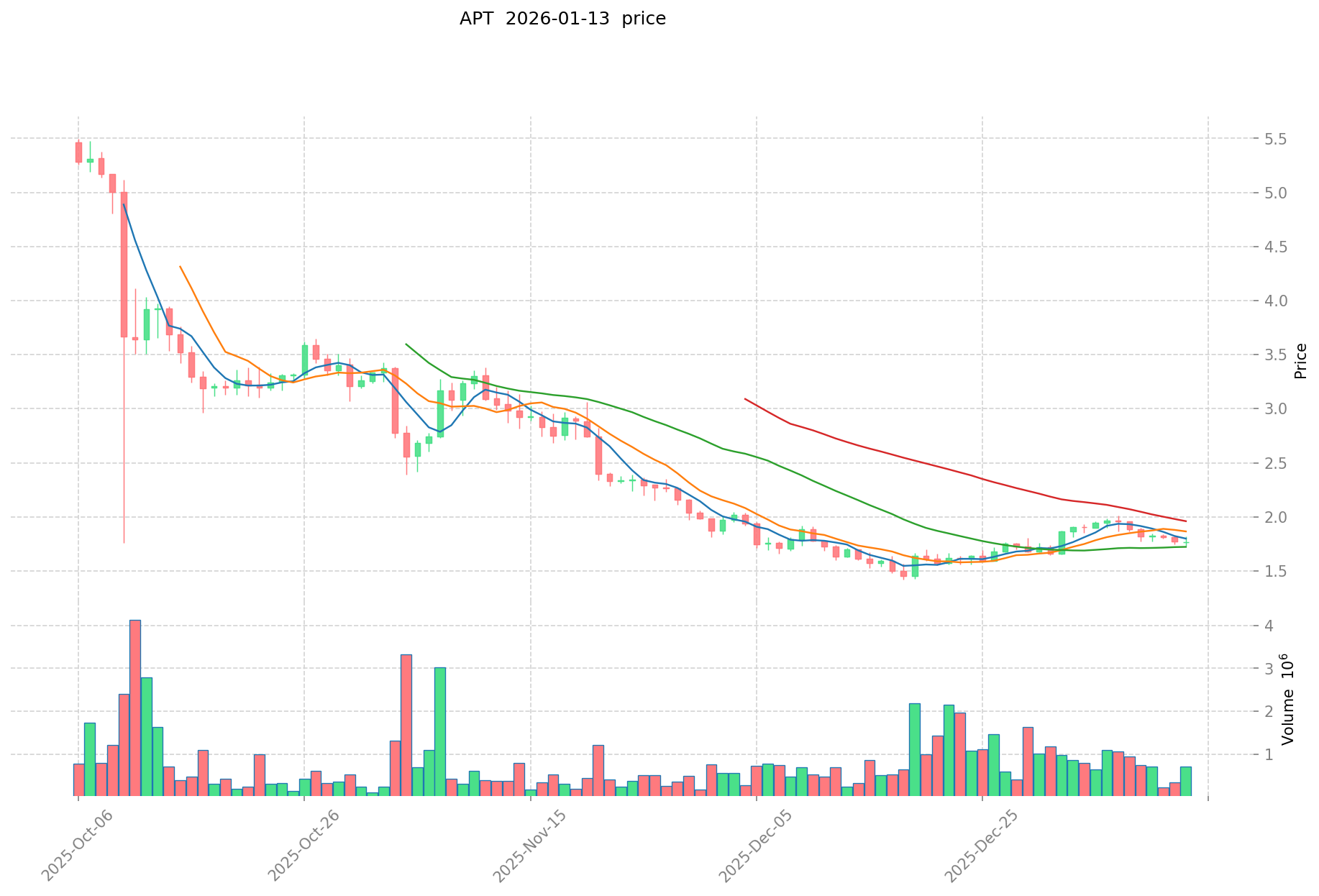
Current APT Investment Market Status (January 2026)
- APT Current Price: $1.9523
- Market Sentiment (Fear & Greed Index): Data indicates positive sentiment with a rating of 1 on the market emotion scale.
- 24-Hour Trading Volume: $2,310,383.61
- Institutional Investor Holdings: The token shows distribution across 127,258,468 holder addresses, reflecting broad market participation.
Click to view real-time APT market price
II. Core Factors Influencing Whether APT is a Good Investment
Supply Mechanism and Scarcity (APT Investment Scarcity)
- APT has a circulating supply of approximately 763.36 million tokens, representing 65.31% of the total supply of 1.19 billion tokens, with an unlimited maximum supply.
- The circulating supply ratio indicates that a significant portion of tokens remains to be released, which may affect future scarcity dynamics and price trends.
- Investment significance: Understanding the token distribution schedule and unlock mechanisms is essential for assessing long-term investment value.
Institutional Investment and Mainstream Adoption (Institutional Investment in APT)
- Bitwise Asset Management has identified Aptos as a strong contender in the Layer-1 blockchain ecosystem, citing its institutional roots in Meta's Diem project and innovative technologies.
- Strategic partnerships with major technology companies have been established, which may enhance the network's credibility and adoption potential.
- The integration of Tether's USDT natively on the Aptos blockchain has positioned the network to capitalize on stablecoin-driven payment and savings applications.
Macroeconomic Environment Impact on APT Investment
- The broader cryptocurrency market sentiment and regulatory environment may influence APT's investment attractiveness.
- Market volatility and shifts in risk appetite among investors could affect APT's price performance and adoption trajectory.
- Developments in blockchain regulation and institutional participation in the crypto sector may create opportunities or challenges for APT investment prospects.
Technology and Ecosystem Development (Technology & Ecosystem for APT Investment)
- AptosBFTv4 consensus mechanism: Enhances network security and transaction finality, potentially improving investor confidence.
- Move programming language and Move virtual machine: Provides developer-friendly capabilities and supports the creation of optimized blockchain applications.
- Block-STM execution engine: Enables parallel transaction processing, which may support high-throughput applications in DeFi, gaming, and NFTs, contributing to ecosystem expansion and long-term value creation.
III. APT Future Investment Forecast and Price Outlook (Is Aptos(APT) worth investing in 2026-2030)
Short-term Investment Forecast (2026, short-term APT investment outlook)
Based on available market data and historical patterns, APT price projections for 2026 show varied scenarios:
- Conservative forecast: $1.76 - $1.96
- Neutral forecast: $1.96 - $2.19
- Optimistic forecast: $2.19 - $8.07
According to statistical models, by the end of 2026, APT may trade within a range of $6.61 to $8.07, with an average predicted value near $7.34. Some predictions suggest the price could reach approximately $1.82 by January 15, 2026. These figures are based on historical patterns and serve as reference points, as future market dynamics may lead to variations.
Mid-term Investment Outlook (2027-2028, mid-term Aptos(APT) investment forecast)
-
Market stage expectation: The mid-term period may witness continued development of the Aptos ecosystem and potential expansion in application scenarios. Price movements are expected to reflect both technological advances and broader market conditions.
-
Investment return forecast:
- 2027: $1.10 - $2.72 (average around $2.08)
- 2028: $2.28 - $3.33 (average around $2.40)
-
Key catalysts: Factors that may influence price development include ecosystem growth, adoption rates of Move-based applications, competitive positioning among Layer 1 blockchains, and overall cryptocurrency market sentiment.
Long-term Investment Outlook (Is Aptos a good long-term investment?)
- Baseline scenario: $2.75 - $3.57 (2029-2030) (assuming steady ecosystem development and moderate market growth)
- Optimistic scenario: $4.27 - $5.15 (2029-2031) (assuming accelerated adoption and favorable market conditions)
- Risk scenario: Below $1.76 (in case of adverse market conditions or significant competitive challenges)
Click to view APT long-term investment and price prediction: Price Prediction
2026-2031 Long-term Outlook
- Base scenario: $2.75 - $4.05 (corresponding to steady progress and gradual mainstream application growth)
- Optimistic scenario: $4.27 - $5.15 (corresponding to large-scale adoption and favorable market environment)
- Transformative scenario: Above $5.15 (in case of breakthrough ecosystem developments and mainstream adoption)
- Predicted high point by December 31, 2031: $5.15 (based on optimistic development assumptions)
Disclaimer: Price predictions are based on historical data and statistical models. Actual market performance may differ significantly due to various factors including market volatility, regulatory changes, technological developments, and macroeconomic conditions. These projections should not be considered as investment advice, and investors should conduct their own research and risk assessment before making any investment decisions.
| Year |
Predicted High Price |
Predicted Average Price |
Predicted Low Price |
Price Change |
| 2026 |
2.194752 |
1.9596 |
1.76364 |
0 |
| 2027 |
2.72110056 |
2.077176 |
1.10090328 |
6 |
| 2028 |
3.3348022092 |
2.39913828 |
2.279181366 |
22 |
| 2029 |
4.271785664454 |
2.8669702446 |
1.691512444314 |
46 |
| 2030 |
4.53311000224929 |
3.569377954527 |
2.81980858407633 |
82 |
| 2031 |
5.145079852552944 |
4.051243978388145 |
2.754845905303938 |
107 |
IV. Aptos Investment Strategy and Risk Management (How to invest in Layer 1 blockchain)
Investment Methodology (Aptos investment strategy)
-
Long-term Holding (HODL Aptos): Suitable for conservative investors who believe in the long-term potential of the Aptos blockchain ecosystem. This approach focuses on holding APT tokens through market cycles, benefiting from potential network growth and adoption of the Move programming language and Move virtual machine.
-
Active Trading: Relies on technical analysis and swing trading strategies. Traders may consider APT's 24-hour volatility of 11.13% and historical price range between $1.42 and $19.92 to identify entry and exit points. The daily trading volume of approximately 2.31 million APT suggests adequate liquidity for active trading.
Risk Management (Risk management for Aptos investment)
V. Aptos Investment Risks and Challenges (Risks of investing in Layer 1 blockchain)
-
Market Risk: APT demonstrates significant price volatility, with a one-year decline of 77.86% from previous levels. The 24-hour price range of $1.755 to $2.0007 indicates substantial intraday fluctuations. Market cap of approximately $1.49 billion and dominance of 0.068% suggest exposure to broader crypto market movements.
-
Regulatory Risk: As a blockchain platform, Aptos faces evolving regulatory frameworks across different jurisdictions. Policy uncertainties in various countries may impact token valuation and project development.
-
Technology Risk: Blockchain projects face potential network security vulnerabilities and technical challenges. Successful implementation and adoption of the Move programming language ecosystem remains critical for long-term viability.
VI. Conclusion: Is Layer 1 blockchain a Good Investment?
-
Investment Value Summary: Aptos represents a high-performance PoS Layer 1 blockchain with distinctive technology features including the Move programming language. With a circulating supply of 763.36 million APT (65.31% of total supply) and current price of $1.95, the project shows potential for long-term growth, though investors should note the significant price volatility evidenced by year-over-year performance.
-
Investor Recommendations:
✅ Beginners: Consider dollar-cost averaging strategy combined with secure wallet storage to mitigate timing risk and ensure asset security.
✅ Experienced Investors: Implement swing trading strategies while maintaining core position allocation. Monitor technical indicators and market sentiment for tactical adjustments.
✅ Institutional Investors: Evaluate strategic long-term allocation within diversified blockchain infrastructure portfolio, considering Aptos's position in the Layer 1 ecosystem.
⚠️ Disclaimer: Cryptocurrency investments carry substantial risk. This content is for informational purposes only and does not constitute investment advice. Investors should conduct independent research and consider their financial situation before making investment decisions.
VII. FAQ
Q1: Is Aptos (APT) a good investment for beginners in 2026?
APT can be a suitable investment for beginners who understand blockchain technology and accept high volatility risks. As a Layer 1 blockchain with distinctive Move programming language technology, Aptos shows long-term potential with its current market cap of $1.49 billion and ranking of 63. However, beginners should note the 77.86% year-over-year decline and implement dollar-cost averaging strategies. Starting with a conservative 5-10% portfolio allocation and using secure cold wallet storage is recommended to mitigate timing risks while building exposure to this emerging ecosystem.
Q2: What is the realistic price prediction for APT by the end of 2026?
Based on statistical models and historical patterns, APT is projected to trade between $6.61 and $8.07 by December 2026, with an average predicted value near $7.34. Conservative estimates suggest a range of $1.76-$1.96, while optimistic scenarios point to $2.19-$8.07. These predictions factor in ecosystem development, adoption rates of Move-based applications, and overall cryptocurrency market conditions. However, actual performance may vary significantly due to market volatility, regulatory changes, and competitive dynamics in the Layer 1 blockchain space.
Q3: How does Aptos compare to other Layer 1 blockchains for investment purposes?
Aptos differentiates itself through its AptosBFTv4 consensus mechanism, Move programming language, and Block-STM execution engine enabling parallel transaction processing. With institutional backing from Bitwise Asset Management and strategic integration of Tether's USDT, Aptos has established credible foundations. However, with only 0.068% market dominance and facing competition from established Layer 1 platforms, investors should evaluate Aptos as part of a diversified blockchain portfolio rather than a standalone investment. The technology shows promise, but market positioning remains developmental compared to dominant Layer 1 competitors.
Q4: What are the main risks of investing in APT tokens?
The primary risks include significant market volatility (11.13% daily fluctuations), regulatory uncertainties across different jurisdictions, and technology implementation challenges. APT's 77.86% year-over-year decline demonstrates substantial downside risk potential. Additionally, with 34.69% of total token supply yet to be released, future unlock schedules may create selling pressure. Competition from established Layer 1 blockchains and the dependency on Move ecosystem adoption present further risks. Investors should limit APT allocation to risk capital they can afford to lose and implement proper risk management through portfolio diversification.
Q5: What investment strategy works best for APT holdings?
The optimal strategy depends on investor profile and risk tolerance. Conservative long-term investors should employ HODL strategy with 5-10% portfolio allocation, focusing on ecosystem development and network growth over multiple market cycles. Active traders can capitalize on APT's 11.13% daily volatility through swing trading, utilizing the $1.42-$19.92 historical range for technical analysis. Both approaches should incorporate secure storage (cold wallets for long-term holdings, limited hot wallet amounts for trading) and maintain position sizing discipline. Dollar-cost averaging helps mitigate timing risk for beginners building initial positions.
Q6: How important is institutional adoption for APT's future value?
Institutional adoption is critically important for APT's long-term investment value. Recognition from Bitwise Asset Management and the project's roots in Meta's Diem initiative provide credibility and potential mainstream pathway. The native integration of Tether's USDT positions Aptos to capture stablecoin-driven payment applications, which could drive significant transaction volume. However, current market dominance of 0.068% indicates institutional adoption remains in early stages. Future partnerships with major technology companies and financial institutions will likely serve as key catalysts for price appreciation and ecosystem expansion.
Q7: Should I invest in APT for short-term gains or long-term holding?
Investment timeframe should align with personal risk tolerance and market outlook. Short-term trading (2026) offers opportunities from volatility but requires active monitoring and technical analysis skills, given projected ranges of $1.76-$8.07. Long-term holding (2026-2031) may better suit those believing in Aptos's technology fundamentals, with predictions suggesting $2.75-$5.15 by 2029-2031 under favorable conditions. Given the 77.86% recent decline and high volatility, long-term strategies with dollar-cost averaging may provide better risk-adjusted returns for most investors while avoiding timing market peaks and troughs.
Q8: What wallet security measures should APT investors implement?
APT investors should prioritize multi-layered security approaches. For long-term holdings, hardware wallets or cold storage solutions provide maximum security against online threats. Active traders should maintain only necessary amounts in hot wallets on exchanges, transferring the majority to cold storage. Implement strong passwords, two-factor authentication, and regular backup of wallet recovery phrases stored in physically secure locations. Given APT's market cap of $1.49 billion and 127 million holder addresses, investors should treat security seriously and never share private keys or recovery phrases with anyone.
* The information is not intended to be and does not constitute financial advice or any other recommendation of any sort offered or endorsed by Gate.