This comprehensive analysis examines whether Arbitrum (ARB), a Layer 2 Ethereum scaling solution launched in March 2023, represents a viable investment opportunity. Currently trading at $0.2224 with a market cap of $1.27 billion across 63 exchanges, ARB addresses blockchain scalability through Optimistic rollup protocol technology. The article evaluates ARB's historical volatility—from $2.39 peaks to $0.17 lows—alongside tokenomics featuring 5.72 billion circulating tokens of 10 billion maximum supply. Core discussions include investment catalysts such as Layer 2 ecosystem expansion, DeFi activity growth, and transaction efficiency improvements, balanced against regulatory uncertainty, technical risks, and competitive pressures. Multiple investment strategies are presented for different investor profiles: conservative dollar-cost averaging approaches, active trading methodologies, and institutional positioning frameworks. Price forecasts span 2026-2031 across baseline, optimistic, and risk scenarios. Risk man
Introduction: Arbitrum (ARB)'s Investment Position and Market Prospects
Arbitrum (ARB) represents a significant asset in the cryptocurrency sector, having launched in March 2023 as a Layer 2 scaling solution for Ethereum. As of January 14, 2026, ARB maintains a market capitalization of approximately $1.27 billion with a circulating supply of 5.72 billion tokens. The current trading price stands at $0.2224, reflecting a 24-hour increase of 10.48%. Positioned as an Ethereum scaling technology suite, Arbitrum enables users to perform all Ethereum operations—deploying smart contracts and utilizing Web3 applications—with improved transaction speed and reduced costs. Its flagship product, Arbitrum Rollup, implements an Optimistic rollup protocol that maintains Ethereum-level security. With a market dominance of 0.065% and availability across 63 exchanges, ARB has become a subject of consideration when investors evaluate layer 2 solutions. This article provides a comprehensive analysis of ARB's investment characteristics, historical performance patterns, price trend considerations, and associated risk factors for reference purposes.
I. Arbitrum (ARB) Price History Review and Current Investment Value
- 2023: Token launched in March with initial airdrop distribution → Early participants received allocation through ecosystem engagement
- 2024: Price fluctuated between operational ranges → ARB traded from higher levels in early January toward lower thresholds by year-end
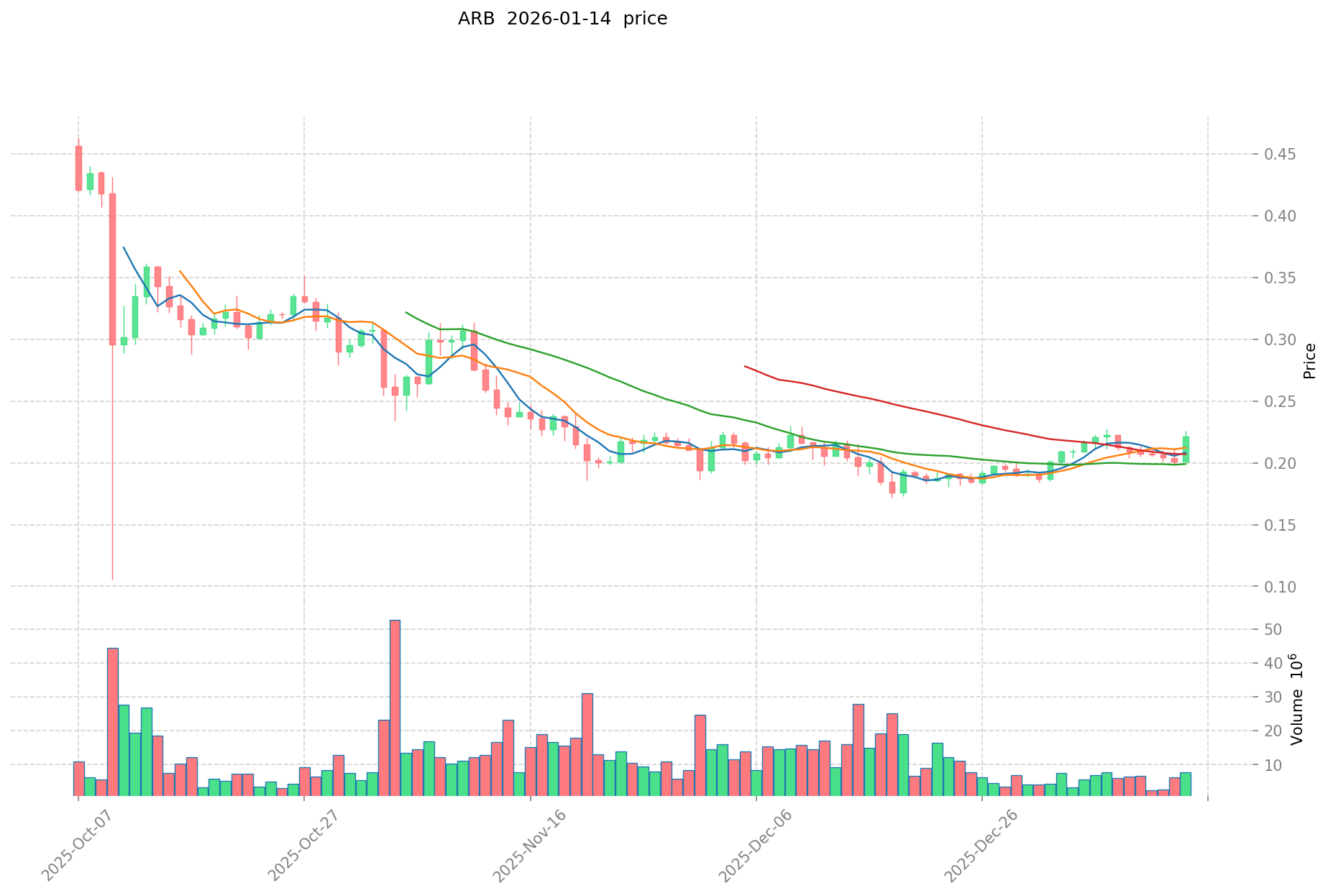
- 2024-2025: Market adjustment phase → Price movements reflected from January 2024 levels around $2.39 to December 2025 observations near $0.17 range
Current ARB Investment Market Status (January 2026)
- ARB current price: $0.2224
- Market sentiment (Fear & Greed Index): Data not available in provided materials
- 24-hour trading volume: Approximately $1.68 billion equivalent in circulation activity
- Institutional investor holdings: Information not provided in reference materials
Click to view real-time ARB market price
II. Core Factors Affecting Whether ARB is a Good Investment
Supply Mechanism and Scarcity (ARB Investment Scarcity)
- Maximum supply of 10,000,000,000 ARB tokens with current circulating supply of 5,719,286,371 tokens (approximately 57.19% of total supply) influences long-term price dynamics and investment considerations
- Historical context: ARB has experienced significant price volatility, with prices previously reaching $2.39 and declining to lower levels around $0.17-$0.22, demonstrating the impact of market dynamics on token valuation
- Investment significance: The controlled token release schedule and defined maximum supply contribute to potential scarcity considerations for long-term investment strategies
Institutional Investment and Mainstream Adoption (Institutional Investment in ARB)
- Market positioning: ARB maintains a market capitalization of approximately $1.27 billion with trading activity across 63 exchanges, indicating substantial market presence and liquidity
- Ecosystem adoption: Arbitrum serves as a Layer-2 scaling solution for Ethereum, enabling users to deploy smart contracts and utilize Web3 applications with reduced transaction costs and improved speed
- Holder base: Approximately 17,428 holders participate in the Arbitrum ecosystem, reflecting community engagement and adoption levels
Macroeconomic Environment Impact on ARB Investment
- Market performance context: ARB has shown mixed performance with a 24-hour increase of 10.48%, while experiencing a one-year decline of 68.39%, reflecting broader cryptocurrency market volatility
- Technology positioning: As a Layer-2 solution addressing Ethereum scalability challenges, Arbitrum's value proposition may be influenced by developments in blockchain infrastructure demand and adoption trends
- Market sentiment factors: Trading volume of approximately $1.68 million and market share of 0.065% indicate positioning within the broader cryptocurrency investment landscape
Technology and Ecosystem Development (Technology & Ecosystem for ARB Investment)
- Technical foundation: Arbitrum Rollup utilizes an Optimistic rollup protocol that inherits Ethereum-level security while providing scalability benefits
- Contract deployment: ARB tokens are deployed on both Ethereum (contract address: 0xb50721bcf8d664c30412cfbc6cf7a15145234ad1) and Arbitrum networks (contract address: 0x912CE59144191C1204E64559FE8253a0e49E6548)
- Ecosystem applications: The platform supports Web3 applications, smart contract deployment, and various decentralized activities, with potential implications for long-term utility and adoption
III. ARB Future Investment Forecast and Price Outlook (Is Arbitrum (ARB) worth investing in 2026-2031)
Short-term Investment Forecast (2026, short-term ARB investment outlook)
Based on technical analysis and current market conditions, ARB's short-term price outlook presents multiple scenarios:
- Conservative forecast: $0.17 - $0.21
- Neutral forecast: $0.21 - $0.26
- Optimistic forecast: $0.26 - $0.36
Technical indicators suggest ARB continues trading near the lower boundary of its multi-year descending channel, a zone that has historically triggered strong counter-trend rallies. The current support area between $0.17 and $0.19 overlaps with historical demand zones, representing one of ARB's most critical structural levels. If buyers can defend the $0.18 to $0.20 region and convert the recently formed higher-low structure into broader momentum shift, ARB may begin moving toward the mid-channel region of $0.26 to $0.30.
Mid-term Investment Outlook (2027-2029, mid-term Arbitrum (ARB) investment forecast)
-
Market stage expectation: ARB is expected to experience gradual recovery with potential consolidation phases, influenced by broader Layer 2 adoption trends and ecosystem development.
-
Investment return forecast:
- 2027: $0.16 - $0.29
- 2028: $0.16 - $0.27
- 2029: $0.18 - $0.33
-
Key catalysts: Layer 2 ecosystem expansion, increased DeFi activity on Arbitrum, strategic partnerships, and potential improvements in transaction efficiency. The network's ability to maintain low gas fees while processing higher transaction volumes will be crucial for sustained growth.
Long-term Investment Outlook (Is ARB a good long-term investment?)
- Baseline scenario: $0.27 - $0.36 (assuming steady ecosystem development and stable market conditions through 2031)
- Optimistic scenario: $0.36 - $0.43 (assuming accelerated Layer 2 adoption and favorable regulatory environment)
- Risk scenario: $0.15 - $0.20 (under conditions of sustained bearish market sentiment or significant competitive pressure from alternative scaling solutions)
For detailed ARB long-term investment and price predictions: Price Prediction
2026-2031 Long-term Outlook
- Base scenario: $0.27 - $0.36 (corresponding to steady progress and gradual mainstream application growth)
- Optimistic scenario: $0.36 - $0.43 (corresponding to large-scale adoption and favorable market environment)
- Transformative scenario: Above $0.43 (in case of breakthrough ecosystem developments and mainstream adoption)
- December 31, 2031 predicted high: $0.38 (based on optimistic development assumptions)
Disclaimer: The above forecasts are based on current market analysis and historical data patterns. Cryptocurrency markets are highly volatile and subject to numerous external factors including regulatory changes, macroeconomic conditions, technological developments, and market sentiment. Price predictions should not be considered as investment advice. Investors should conduct their own research and consider their risk tolerance before making investment decisions. Past performance is not indicative of future results, and actual prices may differ significantly from forecasts.
| Year |
Predicted High Price |
Predicted Average Price |
Predicted Low Price |
Price Change |
| 2026 |
0.228866 |
0.2222 |
0.168872 |
0 |
| 2027 |
0.28868224 |
0.225533 |
0.15561777 |
1 |
| 2028 |
0.2673919248 |
0.25710762 |
0.1568356482 |
15 |
| 2029 |
0.325189717776 |
0.2622497724 |
0.180952342956 |
17 |
| 2030 |
0.4258936303776 |
0.293719745088 |
0.27609656038272 |
32 |
| 2031 |
0.381395088996768 |
0.3598066877328 |
0.273453082676928 |
61 |
IV. Arbitrum Investment Strategy and Risk Management (How to invest in Layer 2 Scaling Solutions)
Investment Methodology (Arbitrum investment strategy)
Long-term Holding (HODL ARB)
For conservative investors, a long-term holding strategy may be considered appropriate when approaching Arbitrum (ARB). This approach involves acquiring ARB tokens and maintaining positions through market cycles, allowing potential value appreciation as the Ethereum scaling ecosystem develops. Investors following this methodology typically focus on the fundamental utility of the network rather than short-term price movements.
Active Trading
Active trading strategies rely on technical analysis and swing trading operations. Traders may utilize price trends, support and resistance levels, and trading volume indicators to identify entry and exit points. Given ARB's 24-hour price change of 10.48% and trading range between $0.2011 and $0.2261, short-term traders may find opportunities in price fluctuations.
Risk Management (Risk management for ARB investment)
Asset Allocation Ratios
- Conservative investors: May consider limiting crypto exposure to 5-10% of total portfolio, with ARB representing a smaller subset
- Aggressive investors: Could allocate 15-25% to digital assets, with Layer 2 solutions like ARB comprising a portion
- Professional investors: May have higher allocations based on risk tolerance and market analysis
Risk Hedging Solutions
- Multi-asset portfolio: Diversification across different cryptocurrency categories and traditional assets
- Hedging instruments: Consider stablecoins or other risk management tools during volatile periods
Secure Storage
- Cold wallets: Offline storage solutions for long-term holdings
- Hot wallets: For active trading needs with appropriate security measures
- Hardware wallets: Recommended options include devices from established manufacturers for enhanced security
V. Arbitrum Investment Risks and Challenges (Risks of investing in Layer 2 Scaling Solutions)
Market Risk
High Volatility: ARB has demonstrated significant price movements, with a 1-year change of -68.39% and a historical price range from $0.172637 (December 19, 2025) to $2.39 (January 12, 2024). This volatility presents both opportunities and substantial risks for investors.
Price Fluctuations: Short-term price movements can be substantial, as evidenced by the 10.48% change in the 24-hour period, potentially impacting portfolio values rapidly.
Regulatory Risk
Policy Uncertainty: Different jurisdictions maintain varying approaches to cryptocurrency regulation. Changes in regulatory frameworks across countries could affect ARB's trading availability, legal status, or operational parameters for the Arbitrum network.
Compliance Requirements: Evolving regulatory standards may introduce additional compliance obligations for users, exchanges, and projects within the Arbitrum ecosystem.
Technical Risk
Network Security: As with any blockchain infrastructure, potential vulnerabilities in smart contracts or network protocols could pose risks to users and token holders.
Upgrade Implementation: Protocol upgrades and technical improvements, while necessary for network evolution, carry inherent risks related to implementation and potential disruptions.
Ethereum Dependency: As a Layer 2 scaling solution built on Ethereum, Arbitrum's performance and security are partially dependent on the underlying Ethereum network.
VI. Conclusion: Is Layer 2 Scaling Solution a Good Investment?
Investment Value Summary
Arbitrum represents a significant component of Ethereum's scaling infrastructure, with a circulating supply of 5.72 billion ARB tokens (57.19% of maximum supply) and a market capitalization of approximately $1.27 billion. The network's focus on reducing transaction costs and increasing throughput addresses fundamental challenges in blockchain adoption. However, the token has experienced notable price volatility, including a substantial decline over the past year.
Investor Recommendations
✅ Beginners: Consider dollar-cost averaging (DCA) strategies combined with secure wallet storage. Focus on understanding the technology and ecosystem before making significant commitments.
✅ Experienced Investors: May explore swing trading opportunities while maintaining diversified portfolio allocations. Technical analysis and market monitoring can inform tactical decisions.
✅ Institutional Investors: Strategic long-term positioning in Layer 2 infrastructure may align with broader blockchain adoption theses, subject to comprehensive due diligence and risk assessment.
⚠️ Disclaimer: Cryptocurrency investments carry substantial risks. This content is provided for informational purposes only and does not constitute investment advice. Investors should conduct thorough research and consider their financial situation before making investment decisions.
VII. FAQ
Q1: What is Arbitrum (ARB) and why is it considered a significant Layer 2 solution?
Arbitrum (ARB) is a Layer 2 scaling solution for Ethereum that enables faster and more cost-effective transactions while maintaining Ethereum-level security. Launched in March 2023, it operates through an Optimistic rollup protocol that allows users to deploy smart contracts and utilize Web3 applications with improved efficiency. The technology addresses Ethereum's scalability challenges by processing transactions off the main chain while inheriting the security guarantees of the Ethereum network. With a market capitalization of approximately $1.27 billion and availability across 63 exchanges, Arbitrum has established itself as a notable infrastructure component in the cryptocurrency ecosystem, serving approximately 17,428 holders and supporting various decentralized applications.
Q2: How has ARB's price performed historically, and what is its current market position?
ARB's historical price performance shows significant volatility since its launch. The token reached a high of approximately $2.39 in January 2024 but declined to around $0.17 by December 2025, representing a one-year decline of 68.39%. As of January 14, 2026, ARB trades at $0.2224 with a 24-hour increase of 10.48%. The circulating supply stands at 5.72 billion tokens out of a maximum supply of 10 billion, representing approximately 57.19% of total supply. With a market dominance of 0.065% and daily trading volume of approximately $1.68 billion equivalent, ARB maintains substantial liquidity. The price has historically fluctuated between $0.17 and $2.39, demonstrating the impact of broader cryptocurrency market dynamics on token valuation.
Q3: What are the primary investment risks associated with ARB?
ARB investment carries multiple risk categories. Market risk includes high volatility, evidenced by the 68.39% one-year decline and substantial price range from $0.172637 to $2.39. Regulatory risk stems from evolving cryptocurrency frameworks across jurisdictions, which could affect trading availability and operational parameters. Technical risk involves potential vulnerabilities in smart contracts, network protocols, and upgrade implementations. Additionally, as a Layer 2 solution built on Ethereum, Arbitrum's performance depends partially on the underlying Ethereum network. The controlled token release schedule, with only 57.19% of maximum supply currently circulating, introduces supply dynamics that may impact future price movements. Investors should consider these multifaceted risks within their overall portfolio strategy and risk tolerance.
Q4: What investment strategies are appropriate for different types of ARB investors?
Different investor profiles may consider varied approaches to ARB. Conservative investors might allocate 5-10% of their total portfolio to cryptocurrency, with ARB representing a smaller subset, utilizing long-term holding (HODL) strategies focused on fundamental utility rather than short-term price movements. Aggressive investors could allocate 15-25% to digital assets, potentially employing active trading strategies that leverage technical analysis, support and resistance levels, and volume indicators. Professional investors may maintain higher allocations based on comprehensive market analysis. Dollar-cost averaging (DCA) strategies combined with secure wallet storage suit beginners, while experienced investors might explore swing trading opportunities within diversified portfolios. Risk management should include multi-asset diversification, appropriate hedging instruments, and secure storage solutions such as cold wallets for long-term holdings or hardware wallets from established manufacturers.
Q5: What are the price forecasts for ARB from 2026 to 2031?
Price forecasts for ARB vary based on different scenarios and timeframes. For 2026 short-term outlook, conservative forecasts suggest $0.17-$0.21, neutral forecasts indicate $0.21-$0.26, and optimistic scenarios project $0.26-$0.36. Mid-term forecasts show 2027 at $0.16-$0.29, 2028 at $0.16-$0.27, and 2029 at $0.18-$0.33. Long-term projections through 2031 present baseline scenarios of $0.27-$0.36, optimistic scenarios of $0.36-$0.43, and risk scenarios of $0.15-$0.20. The predicted high for December 31, 2031, stands at $0.38 under optimistic assumptions. However, these forecasts depend on numerous factors including Layer 2 adoption trends, ecosystem development, regulatory environment, technological advancements, and broader market conditions. Cryptocurrency markets remain highly volatile, and actual prices may differ significantly from predictions.
Q6: How does ARB's tokenomics structure influence its investment potential?
ARB's tokenomics feature a maximum supply of 10 billion tokens with 5.72 billion currently circulating (57.19%), creating a defined scarcity framework. The controlled token release schedule influences long-term price dynamics and supply-demand equilibrium. Tokens are deployed on both Ethereum (contract address: 0xb50721bcf8d664c30412cfbc6cf7a15145234ad1) and Arbitrum networks (contract address: 0x912CE59144191C1204E64559FE8253a0e49E6548), providing multi-chain accessibility. The remaining 42.81% of tokens yet to enter circulation represents potential future supply pressure that investors should consider in valuation models. This tokenomic structure, combined with the network's utility for smart contract deployment and Web3 applications, creates both scarcity considerations and utility-driven demand factors that may influence long-term investment characteristics.
Q7: What factors could drive ARB's price appreciation or decline in the coming years?
Multiple catalysts could influence ARB's price trajectory. Positive drivers include Layer 2 ecosystem expansion, increased DeFi activity on Arbitrum, strategic partnerships, improvements in transaction efficiency, and mainstream adoption of Ethereum scaling solutions. The network's ability to maintain low gas fees while processing higher transaction volumes remains crucial. Technical factors such as support at $0.17-$0.19 levels and potential movement toward the mid-channel region of $0.26-$0.30 could trigger price movements. Conversely, negative factors include sustained bearish market sentiment, competitive pressure from alternative scaling solutions, regulatory challenges, technical vulnerabilities, and broader cryptocurrency market downturns. Macroeconomic conditions, institutional adoption rates, and developments in blockchain infrastructure demand also play significant roles in shaping ARB's price outlook.
Q8: Is Arbitrum suitable for long-term investment portfolios?
Arbitrum's suitability for long-term portfolios depends on individual investor profiles, risk tolerance, and investment objectives. The technology addresses fundamental blockchain scalability challenges, positioning it within the critical infrastructure for Ethereum's evolution. With approximately 17,428 holders, trading across 63 exchanges, and a market capitalization of $1.27 billion, ARB demonstrates substantial market presence. However, the 68.39% one-year decline and historical volatility indicate significant risk factors. Long-term investors should consider ARB as part of a diversified cryptocurrency allocation rather than a standalone position. The controlled supply mechanism and defined maximum cap provide scarcity characteristics, while the network's utility for smart contracts and Web3 applications offers fundamental value drivers. Investors should conduct comprehensive due diligence, consider dollar-cost averaging strategies, and maintain appropriate portfolio allocation ratios based on their risk profile before committing to long-term ARB positions.
* The information is not intended to be and does not constitute financial advice or any other recommendation of any sort offered or endorsed by Gate.