Arowana (ARW) is a real-world asset tokenization protocol launched in 2025, currently trading at $0.25556 with a $127.78 million market capitalization. The token has demonstrated substantial price appreciation from $0.02 in July 2025, reflecting the early-stage development of its blockchain-based gold tokenization (AGT) and planned expansion into real estate, bonds, and commodities. ARW offers both long-term holding and active trading opportunities for cryptocurrency investors, though it carries significant volatility (84.59% 24-hour change) and concentrated exchange liquidity. Investment suitability depends on risk tolerance: conservative investors should allocate 1-3% of crypto portfolios, while aggressive investors may consider up to 15%. Key investment catalysts include protocol expansion, institutional adoption of tokenized assets, and favorable regulatory developments, balanced against market, regulatory, and technical risks. Comprehensive due diligence on smart contract security and market conditions r
Introduction: Arowana (ARW)'s Investment Position and Market Prospects
Arowana (ARW) represents a digital asset in the cryptocurrency sector, launched in 2025, aiming to address liquidity challenges in traditional financial markets through its tokenization protocol. As of January 17, 2026, ARW holds a market capitalization of approximately $127.78 million, with a circulating supply of 500 million tokens and a current trading price around $0.25556. The protocol positions itself as a bridge between traditional assets and blockchain infrastructure, initially focusing on gold tokenization (AGT) before expanding to real estate, bonds, and commodities. ARW ranks 314th by market capitalization, accounting for approximately 0.0038% of the total crypto market dominance. This article examines ARW's investment characteristics, historical price movements, future price analysis, and associated investment risks to provide informational context for market participants considering questions such as "Is Arowana (ARW) a good investment?" The analysis draws on available market data, protocol documentation, and observable trading patterns as of the current date.
I. Arowana (ARW) Price History Review and Current Investment Value
- July 2025: ARW launched at a low point of $0.02, providing early participants with substantial potential for value appreciation
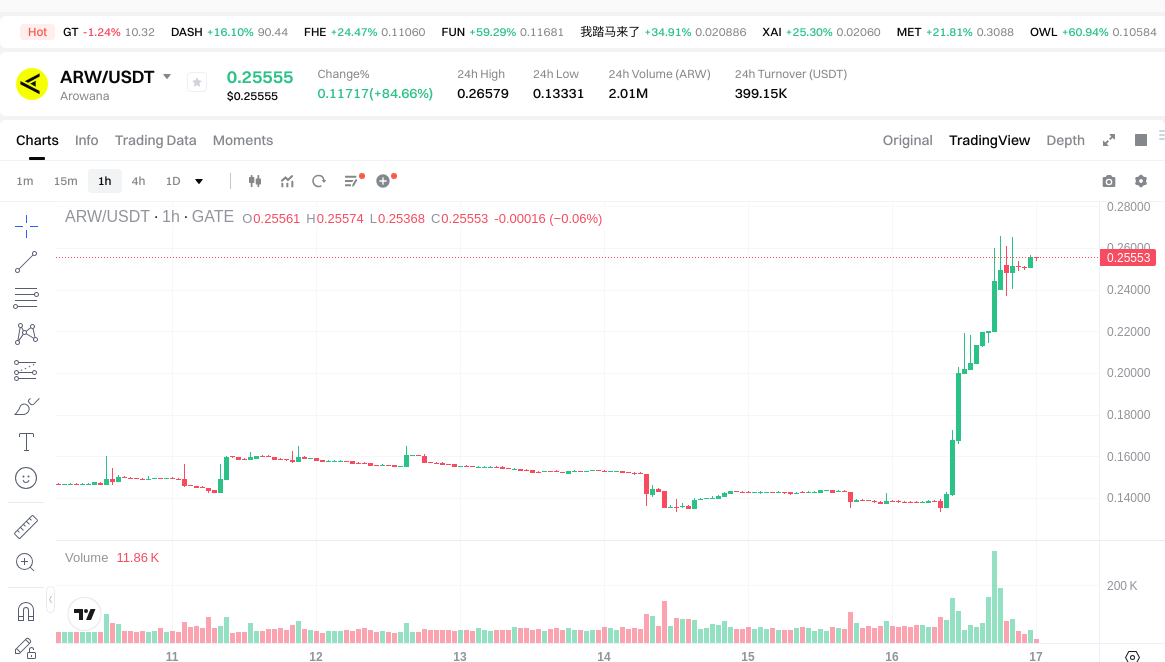
- January 2026: Following months of market development, ARW reached $0.26579 on January 16, 2026, reflecting notable price momentum during its initial trading period
- 2025-2026 Market Cycle: The token experienced significant volatility, with prices ranging from $0.02 to upper levels near $0.26, demonstrating the characteristic price discovery phase of newly launched crypto assets
Current ARW Investment Market Landscape (January 2026)
- ARW Current Price: $0.25556 (as of January 17, 2026)
- Market Sentiment: Data indicates positive sentiment with a 24-hour price change of +84.59%, suggesting increased market interest
- 24-Hour Trading Volume: $399,708.66, reflecting active trading activity for the token
- Market Capitalization: $127.78 million with 500 million tokens in circulation (100% of total supply)
- Holder Distribution: 11,408 holders recorded, indicating a growing user base
Click to view real-time ARW market price
Performance Metrics:
- 1-Hour Change: +2.06%
- 7-Day Change: +74.42%
- 30-Day Change: +126.23%
- 1-Year Change: +856.37%
The token is traded on 1 exchange and has a contract address on the Arbitrum network (0x747952a59292a9b3862f3c59664b95e8b461ef45). Market data shows ARW maintains full circulation with its market cap to fully diluted valuation ratio at 100%, indicating no additional token unlocks are pending.
II. Core Factors Affecting Whether ARW is a Good Investment (Is Arowana(ARW) a Good Investment)
Supply Mechanism and Scarcity (ARW investment scarcity)
- Fixed Supply Structure → Influences Price and Investment Value
- Historical Pattern: Supply characteristics have contributed to ARW price movements, with the token showing notable appreciation from its lower price levels
- Investment Significance: The fixed maximum supply of 500,000,000 tokens, with 100% already in circulation, establishes a clear scarcity framework that may support long-term investment considerations
Institutional Investment and Mainstream Adoption (Institutional investment in ARW)
- Current holder base: 11,408 addresses hold ARW tokens
- The protocol's focus on tokenizing traditional assets (gold, real estate, bonds, and commodities) positions it within the real-world asset (RWA) tokenization sector
- Market presence: ARW is currently available on limited exchanges, which may affect liquidity and institutional accessibility
Macroeconomic Environment's Impact on ARW Investment
- Asset Tokenization Trends → The protocol's foundation in gold tokenization (AGT) aligns with institutional interest in bridging traditional and digital finance
- Real-World Asset Market Dynamics → ARW's expansion into real estate, bonds, and commodities tokenization responds to growing demand for on-chain asset management
- Market Infrastructure Development → The protocol's transparent on-chain infrastructure addresses regulatory and compliance considerations in tokenized asset management
Technology and Ecosystem Development (Technology & Ecosystem for ARW investment)
- On-Chain Infrastructure: The Arowana Protocol implements transparent asset management systems designed to enhance operational efficiency
- Asset Tokenization Framework: Starting with gold (AGT), the protocol extends tokenization capabilities to multiple asset classes including real estate, bonds, and commodities
- Market Application: The protocol aims to unlock liquidity in traditionally illiquid assets, potentially expanding use cases in decentralized finance and institutional asset management
III. ARW Future Investment Forecast and Price Outlook (Is Arowana(ARW) worth investing in 2026-2031)
Short-term Investment Forecast (2026, short-term ARW investment outlook)
- Conservative forecast: $0.1610 - $0.2131
- Neutral forecast: $0.2131 - $0.2555
- Optimistic forecast: $0.2555 - $0.2631
Mid-term Investment Outlook (2027-2029, mid-term Arowana(ARW) investment forecast)
-
Market stage expectation: ARW may experience gradual growth with increased volatility as the protocol expands its tokenization offerings beyond gold to include real estate, bonds, and commodities.
-
Investment return forecast:
- 2027: $0.2126 - $0.3864
- 2028: $0.1872 - $0.4810
- 2029: $0.3617 - $0.4140
-
Key catalysts: Expansion of tokenized asset categories, adoption of on-chain infrastructure for asset management, and broader market acceptance of real-world asset tokenization.
Long-term Investment Outlook (Is Arowana a good long-term investment?)
- Base scenario: $0.3830 - $0.5263 (assuming steady protocol development and moderate market conditions)
- Optimistic scenario: $0.5263 - $0.6540 (assuming accelerated adoption of tokenized assets and favorable regulatory environment)
- Risk scenario: $0.2121 - $0.3830 (under conditions of market downturn or regulatory challenges)
Click to view ARW long-term investment and price prediction: Price Prediction
2026-2031 Long-term Outlook
- Base scenario: $0.3830 - $0.5263 (corresponding to steady progress and gradual increase in mainstream application)
- Optimistic scenario: $0.5263 - $0.6540 (corresponding to large-scale adoption and favorable market environment)
- Transformative scenario: Above $0.6540 (if the ecosystem achieves breakthrough progress and mainstream adoption)
- 2031-12-31 predicted high: $0.6540 (based on optimistic development assumptions)
Disclaimer: The above forecasts are based on available market data and analytical models. Cryptocurrency markets are highly volatile and unpredictable. Past performance does not guarantee future results. These projections should not be considered as investment advice. Investors should conduct their own research and consult with qualified financial advisors before making investment decisions.
| Year |
Predicted High Price |
Predicted Average Price |
Predicted Low Price |
Price Change |
| 2026 |
0.2631444 |
0.25548 |
0.1609524 |
0 |
| 2027 |
0.386375178 |
0.2593122 |
0.212636004 |
1 |
| 2028 |
0.48103709661 |
0.322843689 |
0.18724933962 |
26 |
| 2029 |
0.41399860458915 |
0.401940392805 |
0.3617463535245 |
57 |
| 2030 |
0.526280653319226 |
0.407969498697075 |
0.212144139322479 |
59 |
| 2031 |
0.653975106411411 |
0.46712507600815 |
0.383042562326683 |
82 |
IV. Arowana Investment Strategy and Risk Management (How to invest in Arowana)
Investment Strategy (Arowana investment strategy)
Long-term Holding (HODL Arowana)
For conservative investors seeking stability, a long-term holding strategy may be considered. Arowana Protocol's focus on tokenizing real-world assets such as gold (AGT), real estate, bonds, and commodities through on-chain infrastructure suggests potential fundamental value. The protocol aims to unlock dormant gold liquidity and break down traditional finance barriers. With a fully circulating supply of 500,000,000 ARW tokens and a market cap to fully diluted valuation ratio of 100%, there is no additional token inflation pressure from locked supply releases.
Investors employing this strategy typically focus on the project's long-term development roadmap, ecosystem expansion, and adoption of its asset tokenization infrastructure. The protocol's transparent and efficient asset management approach through blockchain technology represents a growing sector in decentralized finance.
Active Trading
Active traders may leverage technical analysis and swing trading strategies to capitalize on Arowana's price movements. Recent price data shows substantial volatility: the token has experienced an 84.59% increase over 24 hours, 74.42% over 7 days, and 126.23% over 30 days. The 24-hour trading range between $0.13331 (low) and $0.26579 (high) demonstrates significant intraday price swings.
Traders utilizing this approach typically employ technical indicators, chart patterns, and volume analysis. The 24-hour trading volume of approximately $399,708 provides liquidity for entry and exit positions, though traders should assess whether this volume is sufficient for their position sizes.
Risk Management (Risk management for Arowana investment)
Asset Allocation Ratio
- Conservative investors: Consider allocating 1-3% of cryptocurrency portfolio to Arowana, focusing on established assets for the majority of holdings
- Moderate investors: May allocate 3-7% of cryptocurrency portfolio, balancing between established and emerging tokens
- Aggressive investors: Could consider 7-15% allocation, with higher risk tolerance for volatility
Risk Hedging Approach
Diversification across multiple asset classes can help mitigate risk. Investors may consider:
- Multi-asset portfolio: Combining Arowana with established cryptocurrencies, stablecoins, and traditional assets
- Correlation analysis: Evaluating how Arowana's price movements correlate with broader crypto markets and tokenized asset sectors
- Position sizing: Adjusting exposure based on market conditions and personal risk tolerance
Secure Storage
Arowana (ARW) is deployed on the Arbitrum network (contract address: 0x747952a59292a9b3862f3c59664b95e8b461ef45). Secure storage options include:
- Cold wallets: Hardware wallets supporting Arbitrum network tokens provide offline storage with enhanced security
- Hot wallets: Software wallets for active trading, though with higher security risks
- Hardware wallet recommendations: Devices compatible with Ethereum Virtual Machine (EVM) chains, including Arbitrum
V. Arowana Investment Risks and Challenges (Risks of investing in Arowana)
Market Risk
Arowana exhibits substantial price volatility. The token has shown a one-year increase of 856.37%, with recent 24-hour volatility of 84.59%. The price has ranged from a low of $0.02 (recorded on July 2, 2025) to a high of $0.26579 (recorded on January 16, 2026). Such volatility presents opportunities for gains but also significant potential for losses.
The relatively small market capitalization of approximately $127.78 million and 24-hour trading volume of around $399,708 may increase susceptibility to price swings from large transactions. The token is currently listed on one exchange, which may limit liquidity compared to more widely traded assets.
Regulatory Risk
Arowana Protocol operates in the tokenized real-world asset (RWA) sector, which faces evolving regulatory frameworks across jurisdictions. Different countries maintain varying policies toward asset tokenization, cryptocurrency trading, and decentralized finance protocols. Regulatory changes could impact:
- Token classification and compliance requirements
- Cross-border asset tokenization legality
- Exchange listing and trading restrictions
- Tax treatment of tokenized assets
Investors should monitor regulatory developments in their jurisdiction and consider potential impacts on Arowana's operations and token value.
Technical Risk
As a protocol operating on blockchain infrastructure, Arowana faces several technical risks:
- Smart contract vulnerabilities: Potential bugs or exploits in the protocol's smart contracts could lead to loss of funds
- Network security: Dependence on Arbitrum network security and potential network-level attacks
- Protocol upgrades: Implementation of protocol changes or upgrades may encounter technical difficulties
- Oracle dependencies: If the protocol relies on price oracles for real-world asset valuations, oracle failures could impact functionality
The protocol's documentation and security audit status should be reviewed by investors concerned about technical risk exposure.
VI. Conclusion: Is Arowana a Good Investment?
Investment Value Summary
Arowana Protocol presents an investment opportunity in the growing tokenized real-world asset sector. The protocol's focus on unlocking liquidity from traditionally illiquid assets like gold, real estate, and commodities through blockchain infrastructure addresses a recognized market need. The token has demonstrated substantial price appreciation over various timeframes, though such performance has been accompanied by high volatility.
The project's relatively recent launch (January 2025) and single exchange listing indicate early-stage development, which carries both growth potential and elevated risk. The fully circulating supply eliminates concerns about future token unlocks, though the modest trading volume and market capitalization suggest limited market depth.
Investor Recommendations
✅ Novice Investors: Consider dollar-cost averaging (DCA) approach with small, regular purchases to mitigate timing risk. Prioritize secure wallet storage on hardware devices supporting Arbitrum network. Limit allocation to a small percentage of overall portfolio and invest only amounts affordable to lose.
✅ Experienced Investors: May employ swing trading strategies to capitalize on Arowana's volatility, utilizing technical analysis and risk management tools. Consider portfolio allocation that balances Arowana with other tokenized asset protocols and established cryptocurrencies. Monitor protocol development, partnership announcements, and asset tokenization milestones.
✅ Institutional Investors: Could explore strategic long-term positioning if the tokenized RWA sector aligns with investment thesis. Conduct comprehensive due diligence on protocol infrastructure, team credentials, regulatory compliance, and competitive landscape. Assess liquidity constraints and consider over-the-counter (OTC) arrangements for larger positions.
⚠️ Disclaimer: Cryptocurrency investments carry substantial risk, including potential total loss of capital. Price volatility, regulatory uncertainty, and technical risks are inherent to this asset class. This content is provided for informational purposes only and does not constitute investment advice, financial advice, trading advice, or recommendation to buy, sell, or hold any cryptocurrency. Investors should conduct independent research and consult qualified financial advisors before making investment decisions.
VII. FAQ
Q1: What makes Arowana (ARW) different from other cryptocurrency investments?
Arowana distinguishes itself by focusing on real-world asset (RWA) tokenization rather than serving as a purely speculative digital currency. The protocol specializes in converting traditionally illiquid assets—starting with gold (AGT) and expanding to real estate, bonds, and commodities—into blockchain-based tokens. This approach aims to unlock dormant asset liquidity and bridge traditional finance with decentralized infrastructure. With a fully circulating supply of 500 million tokens and deployment on the Arbitrum network, ARW operates in the growing intersection between tangible assets and blockchain technology, addressing institutional and retail demand for on-chain asset management.
Q2: How volatile is Arowana's price compared to established cryptocurrencies?
Arowana exhibits substantially higher volatility than many established cryptocurrencies. Recent market data shows 24-hour price changes of +84.59%, 7-day increases of +74.42%, and one-year appreciation of +856.37%. The token has experienced price swings from a low of $0.02 (July 2025) to a high of $0.26579 (January 2026) within its initial trading period. This volatility stems from its relatively recent launch (January 2025), single exchange listing, modest trading volume of approximately $399,708 per 24 hours, and market capitalization of around $127.78 million. Investors should expect significant price fluctuations that may exceed those of larger-cap cryptocurrencies.
Q3: Is Arowana suitable for long-term holding or short-term trading?
Both strategies may be viable depending on investor objectives and risk tolerance. Long-term holding suits investors who believe in the protocol's fundamental value proposition of asset tokenization and are willing to endure volatility for potential future adoption. The protocol's roadmap includes expanding beyond gold to multiple asset classes, which could drive long-term value. Short-term trading may appeal to those seeking to capitalize on ARW's substantial price swings, as evidenced by intraday ranges exceeding 50%. However, traders should carefully assess whether the current trading volume provides sufficient liquidity for their position sizes and exit strategies.
Q4: What are the primary risks associated with investing in Arowana?
Three major risk categories affect Arowana investments: Market Risk includes extreme price volatility (856% one-year gain accompanied by sharp intraday fluctuations), limited exchange availability, modest trading volume potentially impacting liquidity, and correlation with broader cryptocurrency market downturns. Regulatory Risk encompasses evolving legal frameworks for tokenized assets across jurisdictions, potential restrictions on cross-border asset tokenization, and uncertain tax treatment of RWA tokens. Technical Risk involves smart contract vulnerabilities, dependence on Arbitrum network security, protocol upgrade complications, and potential oracle failures if real-world asset valuations rely on external data feeds.
Q5: How much should I allocate to Arowana in my investment portfolio?
Portfolio allocation depends on your risk tolerance and investment experience. Conservative investors might consider 1-3% of their cryptocurrency holdings allocated to Arowana, maintaining the majority in established assets. Moderate-risk investors may increase this to 3-7%, balancing between emerging and established tokens. Aggressive investors with higher risk tolerance could allocate 7-15%, though this requires careful monitoring and acceptance of potential significant losses. Regardless of allocation percentage, investors should only commit capital they can afford to lose entirely, given the asset's volatility, early development stage, and inherent cryptocurrency market risks.
Q6: Where can I securely store Arowana tokens after purchase?
Arowana (ARW) is deployed on the Arbitrum network (contract address: 0x747952a59292a9b3862f3c59664b95e8b461ef45) and requires Arbitrum-compatible storage solutions. Hardware wallets supporting Ethereum Virtual Machine (EVM) chains, including Arbitrum, provide the most secure cold storage option with offline private key management. Software wallets compatible with Arbitrum offer convenience for active trading but carry higher security risks due to internet connectivity. When selecting storage, verify that your wallet explicitly supports the Arbitrum network, enable all available security features including two-factor authentication, and never share your private keys or seed phrases.
Q7: What factors could drive Arowana's price higher in the future?
Several catalysts could potentially support price appreciation: Protocol expansion beyond gold tokenization to include real estate, bonds, and commodities may increase utility and user adoption. Growing institutional interest in real-world asset tokenization could drive demand for ARW and similar protocols. Additional exchange listings would improve liquidity and accessibility for broader investor bases. Successful implementation of transparent on-chain asset management infrastructure could differentiate Arowana from competitors. Favorable regulatory developments recognizing tokenized asset frameworks may reduce legal uncertainty. However, these factors represent potential scenarios rather than guaranteed outcomes, and market conditions remain unpredictable.
Q8: How does Arowana's fully circulating supply affect investment considerations?
Arowana's 100% circulating supply (500 million tokens with no locked reserves) eliminates inflationary pressure from future token unlocks, a positive characteristic compared to projects with large vesting schedules. This full circulation means no additional supply will enter the market to dilute existing holders' positions through scheduled releases. The market cap to fully diluted valuation ratio of 100% indicates transparent token economics without hidden supply overhangs. However, this also means price appreciation depends entirely on demand growth rather than supply constraints from locked tokens. Investors can evaluate the project without factoring in future unlock events that might suppress price action.
* The information is not intended to be and does not constitute financial advice or any other recommendation of any sort offered or endorsed by Gate.