This comprehensive analysis evaluates Artificial Liquid Intelligence (ALI) as an investment opportunity within the AI-blockchain convergence sector. As of January 2026, ALI trades at $0.002458 with a $22.41 million market capitalization, serving as the native token for the iNFT protocol that powers intelligent, interactive NFTs. The article examines ALI's historical volatility—having declined 82.64% over one year—alongside current market metrics including 16,119 token holders and availability on 8 exchanges including Gate. Key investment considerations encompass supply dynamics, ecosystem development of the Noah's Ark metaverse, technology infrastructure risks, and regulatory uncertainty. Investment strategies range from conservative dollar-cost averaging for beginners to active swing trading for experienced investors, with recommended portfolio allocations of 1-15% depending on risk tolerance. The analysis projects long-term price scenarios through 2031, ranging from $0.00235 to $0.00581 under various market
Introduction: Artificial Liquid Intelligence (ALI) Investment Position and Market Outlook
Artificial Liquid Intelligence (ALI) represents a notable asset in the cryptocurrency sector, focusing on the intersection of generative artificial intelligence and blockchain technology. As of January 22, 2026, ALI maintains a market capitalization of approximately $22.41 million with a circulating supply of around 9.12 billion tokens, while the current price stands at $0.002458. The token operates as the native ERC-20 utility token for the iNFT protocol, which facilitates the creation of interactive and intelligent NFTs. With its positioning at the forefront of integrating AI animation, interaction, and generative capabilities into NFTs, ALI has drawn attention from investors exploring "Is Artificial Liquid Intelligence (ALI) a good investment?" This analysis examines ALI's investment characteristics, historical performance, future price considerations, and associated risks to provide reference for market participants.
The project has demonstrated notable price volatility, with a 24-hour change of 2.46% and a 30-day increase of 18.33%, while experiencing an 18.96% decline over the past week. The token currently ranks 829th by market capitalization, with approximately 92.37% of its maximum supply in circulation. With 16,119 holders and availability on 8 exchanges, ALI maintains a market share of 0.00076%. The fully diluted valuation stands at approximately $24.26 million, reflecting the total supply of 9.87 billion tokens. Understanding these metrics alongside the project's technical foundation in decentralized AI protocols provides context for evaluating ALI's position within the broader cryptocurrency ecosystem.
I. Historical Price Review and Current Investment Value of ALI Token
Based on available data, ALI has experienced notable price fluctuations since its launch:
- April 2022: ALI reached a notable price level of $0.201312 during this period, representing a significant valuation point in the token's trading history.
- December 2025: The token traded at lower price levels around $0.00196181, reflecting market adjustments and broader crypto market conditions.
- January 2026: As of the latest data, ALI is trading at $0.002458, showing a recovery of approximately 25% from the December 2025 levels.
Current ALI Investment Market Status (January 2026)
- Current ALI Price: $0.002458 USD
- 24-Hour Price Change: +2.46%
- 24-Hour Trading Volume: $21,331.32
- 7-Day Price Change: -18.96%
- 30-Day Price Change: +18.33%
- 1-Year Price Change: -82.64%
- Market Capitalization: $22,412,268.13
- Fully Diluted Valuation: $24,262,681.38
- Circulating Supply: 9,118,091,184 ALI (92.37% of total supply)
- Total Supply: 9,870,903,732.81 ALI
- Token Holders: 16,119
- Available on 8 exchanges
Click to view real-time ALI market price
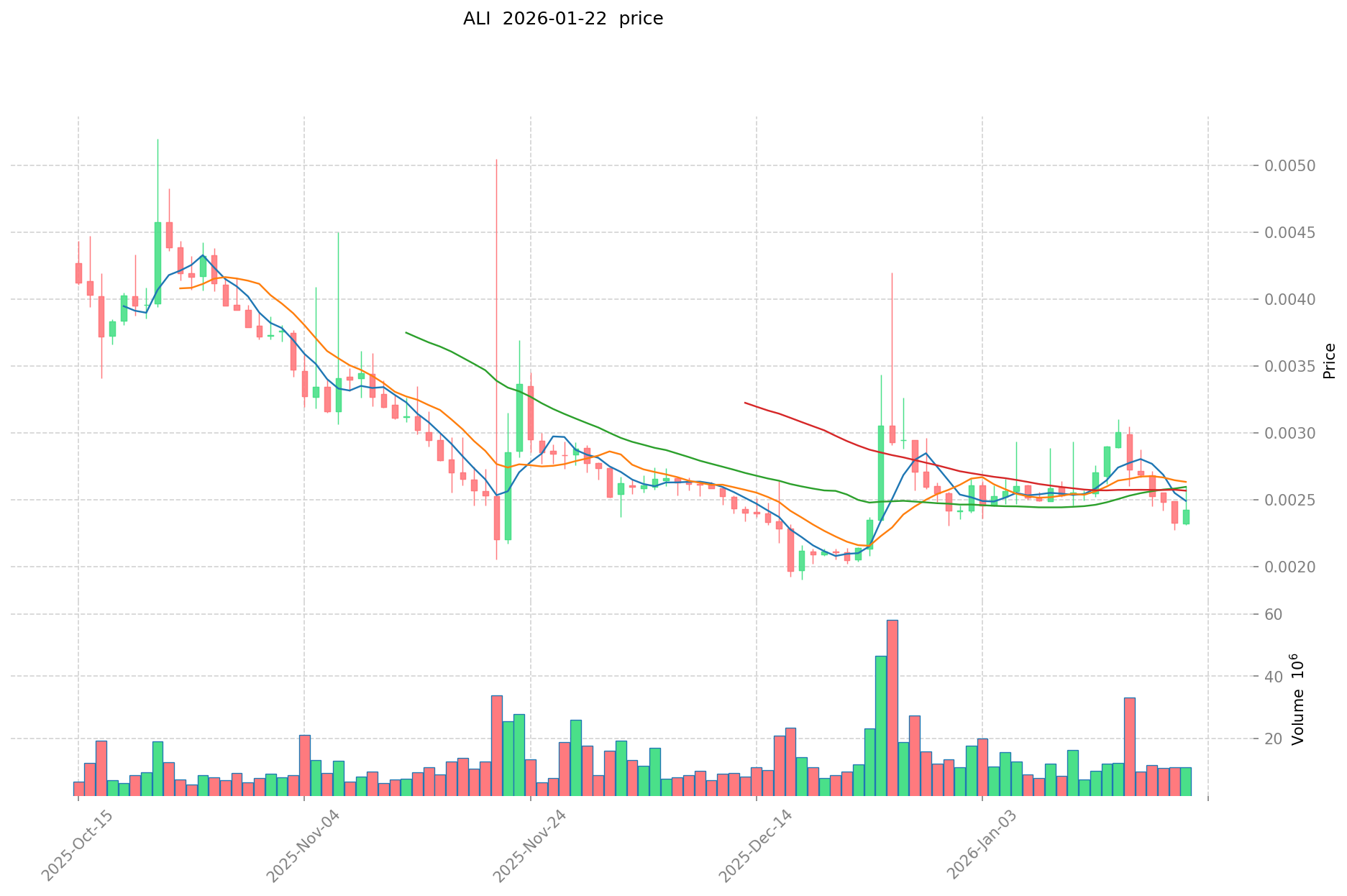
II. Core Factors Affecting Whether ALI is a Good Investment (Is Artificial Liquid Intelligence(ALI) a Good Investment)
Supply Mechanism and Scarcity (ALI investment scarcity)
- Total supply of 9,870,903,732.81 ALI tokens with approximately 92.37% already in circulation → supply dynamics may influence price discovery
- Historical data shows price fluctuations between $0.00196181 and $0.201312 since launch → market volatility has been observed across different supply phases
- Investment significance: the relationship between circulating supply ratio and market valuation represents a consideration for investment analysis
Institutional Investment and Mainstream Adoption (Institutional investment in ALI)
- Token holder base currently stands at 16,119 addresses → indicates distribution among participants
- ALI token serves as the native ERC-20 utility token for the iNFT protocol and applications built upon it → functional utility within the ecosystem
- Trading availability across 8 exchanges → provides accessibility for potential investors
Macroeconomic Environment's Impact on ALI Investment
- Monetary policy and interest rate changes → may alter investment attractiveness across digital asset markets
- Inflation environment's hedging role → digital assets' positioning in portfolio diversification strategies
- Geopolitical uncertainty → may influence demand dynamics for digital assets
Technology and Ecosystem Development (Technology & Ecosystem for ALI investment)
- iNFT protocol development: enables creation of interactive and intelligent NFTs → provides technical foundation for ecosystem applications
- Noah's Ark metaverse platform: described as the world's first intelligent metaverse where users can create, train, and earn through iNFTs → represents ecosystem expansion efforts
- Integration of generative AI capabilities with blockchain technology → positions the project at the intersection of artificial intelligence and decentralized systems
- DeFi, NFT, and application scenarios: the protocol's focus on intelligent NFTs may contribute to use case development within the broader ecosystem
III. ALI Future Investment Forecast and Price Outlook (Is Artificial Liquid Intelligence(ALI) worth investing in 2026-2031)
Short-term Investment Forecast (2026, short-term ALI investment outlook)
- Conservative Forecast: $0.00233 - $0.00245
- Neutral Forecast: $0.00245 - $0.00303
- Optimistic Forecast: $0.00303 - $0.00362
Mid-term Investment Outlook (2027-2028, mid-term Artificial Liquid Intelligence(ALI) investment forecast)
-
Market Stage Expectation: ALI may enter a gradual recovery phase following recent declines, with potential price stabilization as the intelligent NFT protocol and Noah's Ark metaverse ecosystem continue development. Market sentiment could improve if broader AI and NFT sectors gain renewed interest.
-
Investment Return Forecast:
- 2027: $0.00255 - $0.00367
- 2028: $0.00191 - $0.00346
-
Key Catalysts: Expansion of iNFT protocol adoption, development progress in Noah's Ark metaverse platform, partnerships within AI and blockchain sectors, and overall cryptocurrency market conditions.
Long-term Investment Outlook (Is ALI a good long-term investment?)
- Base Scenario: $0.00235 - $0.00494 (Assumes steady development of iNFT protocol and moderate growth in intelligent NFT adoption)
- Optimistic Scenario: $0.00334 - $0.00581 (Assumes accelerated adoption of intelligent NFT technology and favorable market conditions for AI-blockchain convergence)
- Risk Scenario: $0.00191 - $0.00254 (Assumes prolonged market downturn or slower-than-expected protocol adoption)
Check ALI long-term investment and price forecast: Price Prediction
2026-01-22 - 2031 Long-term Outlook
- Base Scenario: $0.00235 - $0.00494 (Corresponding to steady progress and gradual mainstream application improvement)
- Optimistic Scenario: $0.00334 - $0.00581 (Corresponding to large-scale adoption and favorable market environment)
- Transformative Scenario: Above $0.00581 (If ecosystem achieves breakthrough developments and mainstream popularization)
- 2031-12-31 Predicted High: $0.00581 (Based on optimistic development assumptions)
Disclaimer: The above forecasts are based on historical data and market analysis models and do not constitute investment advice. Cryptocurrency investments involve substantial risk, and past performance does not guarantee future results. Investors should conduct independent research and assess their risk tolerance before making investment decisions.
| Year |
Predicted High Price |
Predicted Average Price |
Predicted Low Price |
Price Change |
| 2026 |
0.00362452 |
0.002449 |
0.00232655 |
0 |
| 2027 |
0.0036744796 |
0.00303676 |
0.0025508784 |
23 |
| 2028 |
0.003456288394 |
0.0033556198 |
0.001912703286 |
36 |
| 2029 |
0.00493863344065 |
0.003405954097 |
0.00235010832693 |
38 |
| 2030 |
0.005590873650225 |
0.004172293768825 |
0.00333783501506 |
69 |
| 2031 |
0.005809084614335 |
0.004881583709525 |
0.002538423528953 |
98 |
IV. ALI Investment Strategy and Risk Management (How to invest in ALI)
Investment Methodology (ALI investment strategy)
Long-term Holding (HODL ALI): Suitable for Conservative Investors
For investors seeking stable exposure to the intersection of artificial intelligence and blockchain technology, a long-term holding strategy may be considered. This approach involves acquiring ALI tokens and maintaining positions over extended periods, allowing potential appreciation as the iNFT protocol and Noah's Ark metaverse ecosystem develop. Conservative investors typically allocate a smaller percentage of their portfolio to speculative assets like ALI, focusing on fundamental developments rather than short-term price movements.
Active Trading: Technical Analysis and Swing Operations
Experienced traders may employ active trading strategies for ALI, utilizing technical analysis tools to identify entry and exit points. Given ALI's price fluctuations—with a 24-hour change of 2.46%, 7-day decline of 18.96%, and 30-day increase of 18.33%—swing trading opportunities may emerge. Traders should monitor key support levels around $0.002367 (24-hour low) and resistance near $0.002478 (24-hour high), while considering broader market conditions and volume patterns. The token's trading volume of approximately $21,331 indicates moderate liquidity for execution of trading strategies.
Risk Management (Risk management for ALI investment)
Asset Allocation Ratios: Conservative / Aggressive / Professional Investors
- Conservative Investors: May allocate 1-3% of their cryptocurrency portfolio to ALI, limiting exposure to highly speculative assets while maintaining diversification across established cryptocurrencies and traditional assets.
- Aggressive Investors: Could consider 5-10% allocation to ALI within their crypto holdings, accepting higher volatility in pursuit of potential returns from emerging AI-blockchain projects.
- Professional Investors: May employ dynamic allocation strategies ranging from 3-15% based on market conditions, technical indicators, and fundamental developments within the Alethea AI ecosystem.
Risk Hedging Solutions: Multi-asset Portfolio + Hedging Tools
Investors should implement diversification across multiple asset classes to mitigate ALI-specific risks. A balanced approach might include:
- Combining ALI exposure with established cryptocurrencies to reduce concentration risk
- Maintaining positions in stablecoins for liquidity and capital preservation
- Utilizing portfolio rebalancing strategies to maintain target allocation percentages
- For sophisticated investors, exploring derivatives or correlation-based hedging strategies where available
Secure Storage: Hot and Cold Wallets + Hardware Wallet Recommendations
Given that ALI is an ERC-20 token deployed on the Ethereum network, investors should prioritize secure storage solutions:
- Cold Storage: Hardware wallets such as Ledger or Trezor provide offline security for long-term holdings
- Hot Wallets: For active trading, reputable software wallets with multi-signature support offer convenience while maintaining security
- Security Practices: Implement two-factor authentication, secure backup of recovery phrases, and regular verification of contract addresses (ALI contract: 0x6B0b3a982b4634aC68dD83a4DBF02311cE324181)
- Exchange Storage: Minimize holdings on exchanges, transferring tokens to personal wallets after purchase to maintain custody control
V. ALI Investment Risks and Challenges (Risks of investing in ALI)
Market Risk: High Volatility and Price Manipulation
ALI exhibits significant price volatility characteristic of mid-cap cryptocurrency assets. The token has experienced substantial price swings, with a 1-year decline of 82.64% from previous levels. The current price of $0.002458 represents a considerable distance from its April 2, 2022 peak of $0.201312, demonstrating the potential for dramatic value fluctuations. With a market capitalization of approximately $22.41 million and ranking at position 829, ALI has relatively limited liquidity compared to major cryptocurrencies, potentially increasing susceptibility to price manipulation or large order impacts. The token's 24-hour trading volume and holder count of 16,119 suggest moderate but not extensive market participation, which may contribute to price instability during periods of market stress.
Regulatory Risk: Policy Uncertainty Across Jurisdictions
As a project operating at the intersection of artificial intelligence and blockchain technology, ALI faces evolving regulatory landscapes in multiple jurisdictions. The development of intelligent NFTs and AI-integrated digital assets exists in a regulatory gray area where frameworks are still being established. Different countries maintain varying approaches to cryptocurrency classification, taxation, and permissible use cases. Changes in regulatory stance toward NFTs, AI applications, or cryptocurrency utility tokens could impact ALI's adoption, trading availability, or project operations. Investors should monitor regulatory developments in their jurisdiction and where Alethea AI operates, as policy shifts may affect token accessibility or project viability.
Technical Risk: Network Security Vulnerabilities and Upgrade Failures
Technical risks associated with ALI investment include:
- Smart Contract Vulnerabilities: As an ERC-20 token, ALI relies on smart contract code which may contain undiscovered vulnerabilities despite auditing efforts
- Protocol Development Risk: The iNFT protocol and Noah's Ark metaverse represent complex technical infrastructure where implementation challenges or development delays could impact adoption
- Ethereum Network Dependencies: ALI's performance and usability depend on Ethereum network conditions, including congestion, gas fees, and successful network upgrades
- Integration Complexity: The fusion of generative AI capabilities with blockchain infrastructure presents technical challenges that may affect feature delivery or user experience
- Competition Risk: Rapidly evolving AI and blockchain sectors may produce competing solutions that challenge ALI's market position
VI. Conclusion: Is ALI a Good Investment?
Investment Value Summary: ALI represents exposure to the emerging sector combining artificial intelligence with blockchain technology through the iNFT protocol. The project's focus on creating intelligent, interactive NFTs within the Noah's Ark metaverse addresses a novel use case in the digital asset space. However, the token has experienced significant price volatility, with substantial declines from previous levels and fluctuating shorter-term performance. The relatively modest market capitalization and exchange presence indicate an early-stage project with corresponding risk-reward characteristics.
Investor Recommendations:
✅ Beginners: Consider dollar-cost averaging strategies to mitigate timing risk, allocate only funds that can be held long-term without need for liquidity, and prioritize secure wallet storage using hardware solutions. Research the fundamental technology and use cases before investing, and limit allocation to a small percentage of overall portfolio.
✅ Experienced Investors: May employ swing trading strategies based on technical analysis while maintaining a core long-term position. Implement strict risk management including position sizing, stop-loss disciplines, and portfolio diversification across multiple cryptocurrencies and traditional assets. Monitor project development milestones and ecosystem adoption metrics.
✅ Institutional Investors: Evaluate ALI as a potential strategic allocation within AI-blockchain theme exposure, conducting thorough due diligence on project fundamentals, team background, and competitive positioning. Consider integration into broader thematic portfolios with appropriate risk controls and compliance frameworks.
⚠️ Notice: Cryptocurrency investment carries substantial risk, including potential loss of principal. This article is for informational purposes only and does not constitute investment advice. Conduct independent research and consult qualified financial advisors before making investment decisions. Past performance does not guarantee future results, and the volatile nature of cryptocurrency markets requires careful risk assessment based on individual financial circumstances and risk tolerance.
VII. FAQ
Q1: What is Artificial Liquid Intelligence (ALI) and what makes it unique in the cryptocurrency market?
ALI is the native ERC-20 utility token powering the iNFT protocol, which enables the creation of intelligent and interactive NFTs by integrating generative artificial intelligence with blockchain technology. The project distinguishes itself through its Noah's Ark metaverse platform, described as the world's first intelligent metaverse where users can create, train, and monetize AI-powered NFTs. Unlike traditional static NFTs, iNFTs powered by ALI possess interactive capabilities and AI animation features, positioning the project at the intersection of two emerging technological sectors: artificial intelligence and decentralized blockchain systems.
Q2: How has ALI performed historically and what is its current market position?
ALI has experienced significant volatility since its launch, reaching a notable price of $0.201312 in April 2022 before declining to current levels around $0.002458 as of January 2026—representing an 82.64% decrease over one year. The token currently holds a market capitalization of approximately $22.41 million, ranking 829th among cryptocurrencies. With 16,119 token holders and availability on 8 exchanges, ALI maintains a market share of 0.00076%. Recent performance shows mixed signals: a 30-day increase of 18.33% offset by a 7-day decline of 18.96%, indicating continued price volatility characteristic of mid-cap cryptocurrency assets.
Q3: What factors should investors consider when evaluating ALI's investment potential?
Key consideration factors include: (1) Supply dynamics—with 92.37% of the total 9.87 billion tokens already in circulation, supply-side pressure may be limited; (2) Technological development—progress in the iNFT protocol and Noah's Ark metaverse ecosystem expansion could drive adoption; (3) Market positioning—ALI's focus on AI-blockchain convergence places it in an emerging sector with growth potential but also competitive pressure; (4) Liquidity considerations—modest trading volume of approximately $21,331 daily may impact execution for larger positions; (5) Regulatory environment—evolving frameworks for AI applications and NFTs could affect project operations and token accessibility.
Q4: What are the recommended investment strategies for different types of ALI investors?
Conservative investors may consider allocating 1-3% of their cryptocurrency portfolio to ALI through a long-term holding (HODL) strategy, focusing on fundamental developments rather than short-term price movements. Aggressive investors could allocate 5-10% while potentially employing swing trading strategies based on technical analysis, monitoring support around $0.002367 and resistance near $0.002478. Professional investors might implement dynamic allocation ranging from 3-15% based on market conditions and ecosystem milestones. All investor types should prioritize secure storage using hardware wallets like Ledger or Trezor for long-term holdings, and implement diversification across multiple asset classes to mitigate concentration risk.
Q5: What are the primary risks associated with investing in ALI?
Major risks include: (1) Market volatility—the token has demonstrated substantial price swings with an 82.64% decline over one year and ongoing fluctuations; (2) Liquidity risk—with a market cap of $22.41 million and moderate trading volume, large orders may experience slippage or market impact; (3) Technical risks—dependencies on Ethereum network performance, smart contract vulnerabilities, and complexity of integrating AI with blockchain infrastructure; (4) Regulatory uncertainty—evolving frameworks for AI applications and NFTs across jurisdictions may affect token accessibility or project operations; (5) Competition risk—rapidly developing AI and blockchain sectors may produce alternative solutions challenging ALI's market position.
Q6: What is the long-term price outlook for ALI through 2031?
Based on analytical models, ALI price forecasts present three scenarios: The base scenario projects a range of $0.00235 to $0.00494 through 2031, assuming steady iNFT protocol development and moderate adoption growth. The optimistic scenario forecasts $0.00334 to $0.00581, contingent on accelerated intelligent NFT adoption and favorable market conditions for AI-blockchain convergence. The risk scenario suggests $0.00191 to $0.00254, accounting for potential prolonged market downturns or slower-than-expected protocol adoption. The 2031 predicted high of $0.00581 represents approximately 136% potential appreciation from current levels under optimistic development assumptions. However, these projections carry substantial uncertainty and should not be considered guaranteed outcomes.
Q7: How should investors securely store and manage their ALI tokens?
As an ERC-20 token on the Ethereum network, ALI requires appropriate security measures: For long-term holdings, hardware wallets such as Ledger or Trezor provide cold storage solutions with offline security. Active traders may use reputable hot wallets with multi-signature support for convenience while maintaining security protocols. Essential security practices include implementing two-factor authentication, securely backing up recovery phrases, and verifying the correct contract address (0x6B0b3a982b4634aC68dD83a4DBF02311cE324181) before transactions. Investors should minimize holdings on exchanges, transferring tokens to personal wallets after purchase to maintain custody control and reduce counterparty risk from exchange vulnerabilities or operational issues.
Q8: Is ALI suitable for beginners in cryptocurrency investing?
ALI presents elevated risk characteristics that require careful consideration for novice investors. Beginners should approach ALI investment with caution due to: (1) significant historical volatility and substantial price declines; (2) relatively limited liquidity compared to major cryptocurrencies; (3) technical complexity of the underlying AI-blockchain integration; (4) early-stage project status with associated development uncertainties. If beginners choose to invest, they should allocate only funds they can afford to lose entirely, limit exposure to a small portfolio percentage (1-3%), employ dollar-cost averaging to mitigate timing risk, prioritize learning about secure wallet storage, and conduct thorough research on the project's fundamentals before committing capital. Starting with more established cryptocurrencies may provide a more appropriate entry point for building cryptocurrency market experience.
* The information is not intended to be and does not constitute financial advice or any other recommendation of any sort offered or endorsed by Gate.