This comprehensive guide evaluates Artificial Superintelligence Alliance (FET) as an investment opportunity through 2030. Trading at $0.2935 with a $678.61 million market cap, FET combines machine learning, multi-agent systems, and blockchain technology to build an autonomous economic infrastructure. The article examines FET's historical performance, supply mechanisms, institutional adoption, and macroeconomic factors influencing investment value. It presents realistic price outlooks across conservative, neutral, and optimistic scenarios while detailing investment strategies for beginners, experienced traders, and institutional investors. Key discussion areas include market volatility risks, regulatory uncertainties, technical complexity challenges, and portfolio allocation recommendations. Suitable for investors seeking detailed analysis of AI-blockchain convergence opportunities and risk management frameworks for digital asset positioning on Gate exchange.
Introduction: Artificial Superintelligence Alliance (FET) Investment Position and Market Outlook
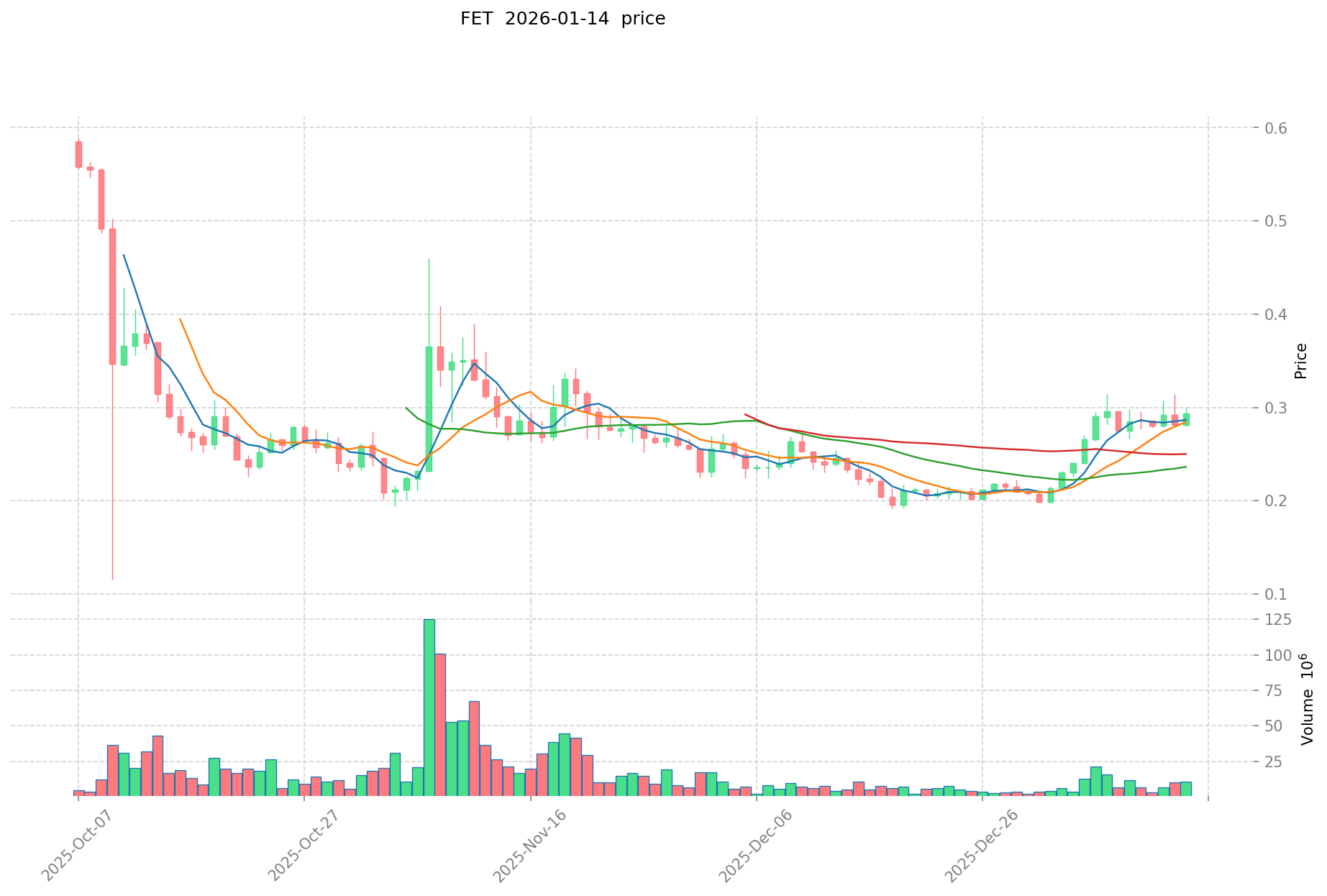
FET is a notable asset in the cryptocurrency sector, launched in 2019, and has demonstrated development in decentralized artificial intelligence and multi-agent systems. As of January 2026, Artificial Superintelligence Alliance holds a market cap of approximately $678.61 million, with a circulating supply of around 2.31 billion tokens, and a current price near $0.2935. With its positioning in combining machine learning, artificial intelligence, and decentralized ledger technology to build an economic internet, FET has become a subject of discussion among investors exploring "Is Artificial Superintelligence Alliance (FET) a good investment?" This article provides a comprehensive analysis of FET's investment characteristics, historical price movements, future price outlook considerations, and investment risks to offer reference for investors.
I. Artificial Superintelligence Alliance (FET) Price History Review and Current Investment Value Status
- 2019: FET launched on Binance Launchpad at $0.236 per token, raising $21 million → Early investors experienced entry at initial offering price
- 2020: Fetch.ai blockchain mainnet went live → FET transitioned from ERC-20 token to native blockchain token
- 2023: AI cryptocurrency sector gained attention following ChatGPT success → FET price showed notable movement with market capitalization surpassing $200 million
- 2024: DWF Labs invested $40 million in Fetch.ai on March 29 → FET demonstrated increased institutional confidence
- Market cycle observations: Price fluctuated between historical levels of $0.00827 and $3.47 during trading history
Current FET Investment Market Status (January 2026)
- FET current price: $0.28 (as of January 14, 2026)
- Market sentiment (Fear & Greed Index): Data not available in provided materials
- 24-hour trading volume: $71.23 million (Kraken platform data)
- Market capitalization: $648.45 million
- Circulating supply: 2,312,273,764 FET tokens
- Total supply: 2,714,384,546.672 FET
- Trading volume: 254,006,230 FET traded on Kraken within 24 hours
- Price changes: -0.37% (24-hour period), +1.03% (1-hour period), +1.31% (7-day period), +22.54% (30-day period), -76.34% (1-year period)
- Token holders: 159,225 addresses
- Exchange listings: 51 platforms
Click to view real-time FET market price
II. Core Factors Influencing Whether FET is a Good Investment
Supply Mechanism and Scarcity (FET Investment Scarcity)
- Supply Structure: FET has a maximum supply of 2,719,493,897 tokens, with a circulating supply of approximately 2,312,127,209 tokens (85.02% of max supply). This relatively high circulation ratio suggests limited immediate scarcity pressure compared to assets with lower circulation rates.
- Supply Dynamics Impact: The token's supply mechanism includes staking requirements for nodes and agents, which can reduce circulating supply and potentially support price stability during network operations.
- Investment Implications: While FET's supply is largely in circulation, the functional utility requiring token staking for network participation creates demand-side dynamics that could influence long-term investment value beyond pure scarcity metrics.
Institutional Investment and Mainstream Adoption (Institutional Investment in FET)
- Holder Distribution: As of January 2026, FET has approximately 159,225 token holders, indicating a moderately distributed ownership structure across retail and institutional participants.
- Exchange Accessibility: The token is listed on 51 exchanges, providing institutional and retail investors with multiple access points and liquidity options for investment allocation.
- Ecosystem Integration: FET's positioning within the AI and multi-agent systems space attracts interest from entities exploring decentralized AI infrastructure, though specific institutional holdings data is not publicly detailed in available materials.
Macroeconomic Environment's Impact on FET Investment
- Market Positioning: FET operates within the intersection of AI technology and blockchain infrastructure, making its investment profile sensitive to both crypto market conditions and broader technology sector trends.
- Volatility Context: The token has experienced significant price fluctuations, with a 76.34% decline over one year (as of January 14, 2026), reflecting exposure to broader crypto market downturns and risk-off sentiment in speculative technology assets.
- Risk Considerations: Current price levels around $0.2935 represent a substantial decrease from previous highs, positioning FET within a higher-risk, potentially higher-reward investment category subject to macroeconomic uncertainty and market sentiment shifts.
Technology and Ecosystem Development (Technology & Ecosystem for FET Investment)
- Core Technology Infrastructure: FET combines machine learning, artificial intelligence, multi-agent systems, and decentralized ledger technology to build an economic internet framework, providing a technical foundation for autonomous digital agents to perform economic activities.
- Network Utility Design: The token serves as the digital currency for network transactions and secure communications, with nodes and agents required to stake tokens for operational qualifications, creating utility-driven demand within the ecosystem.
- Development Activity: The project maintains multiple active GitHub repositories including fetchd, cosmos-sdk, agents-aea, and ledger implementations, demonstrating ongoing technical development and infrastructure building that could support long-term ecosystem value creation.
III. FET Future Investment Forecast and Price Outlook (Is Artificial Superintelligence Alliance (FET) worth investing in 2026-2030)
Short-term Investment Outlook (2026, short-term FET investment outlook)
Based on available market data and technical analysis, FET's short-term trajectory appears cautiously mixed. As of January 14, 2026, the token trades at $0.2935, showing recent volatility with 24-hour fluctuations between $0.2808 and $0.3002.
- Conservative forecast: $0.24 - $0.28 (assuming continued market consolidation and limited catalyst activity)
- Neutral forecast: $0.28 - $0.31 (based on current support levels and moderate trading volume)
- Optimistic forecast: $0.31 - $0.37 (contingent on positive developments in AI integration and partnership announcements)
Analysts suggest that maintaining support above $0.24 remains critical for upward momentum. The token's circulating supply of 2.31 billion FET (85.02% of maximum supply) indicates limited inflationary pressure from token unlocks.
Mid-term Investment Forecast (2027-2028, mid-term Artificial Superintelligence Alliance (FET) investment forecast)
The mid-term outlook reflects divergent expert opinions, highlighting uncertainty in the AI-blockchain sector's evolution.
- Market phase expectation: Consolidation and selective growth phase, with potential volatility driven by broader crypto market sentiment and AI technology adoption rates
- Investment return forecast:
- 2027: $0.20 - $0.47 (wide range reflects analyst disagreement, with some projecting decline to $0.23 while others anticipate growth toward $0.41)
- 2028: $0.21 - $0.39 (most analysts converge on expectations of moderate price adjustment)
- Key catalysts: Integration of payment functionalities scheduled for January 2026, development progress in autonomous AI agents, partnership expansions in logistics and healthcare sectors, and regulatory clarity for AI-blockchain projects
The Artificial Superintelligence Alliance formation, combining Fetch.ai with Ocean Protocol and SingularityNET under a unified token framework, represents a structural factor that may influence mid-term performance. However, ongoing governance disputes within the alliance introduce uncertainty.
Long-term Investment Outlook (Is FET a good long-term investment?)
Long-term projections vary substantially among market analysts, reflecting the nascent nature of AI-blockchain convergence and difficulty in forecasting technological adoption curves.
- Baseline scenario: $0.33 - $0.50 (assuming steady development of decentralized AI infrastructure and gradual mainstream adoption of autonomous economic agents)
- Optimistic scenario: $0.50 - $0.96 (contingent on breakthrough applications in supply chain optimization, energy management, or DeFi integration, coupled with favorable regulatory frameworks)
- Risk scenario: $0.10 - $0.25 (if competitive AI platforms gain market dominance, regulatory headwinds emerge, or fundamental technical limitations constrain network utility)
For detailed FET long-term investment analysis and price predictions: Price Prediction
2026-2030 Long-term Outlook
- Base scenario: $0.28 - $0.42 (corresponding to steady progress in AI agent deployment and incremental mainstream application growth)
- Optimistic scenario: $0.42 - $0.96 (aligned with large-scale adoption scenarios and favorable market conditions)
- Transformational scenario: Above $1.00 (contingent on breakthrough ecosystem developments and mainstream integration across multiple industries)
- December 31, 2030 predicted high: $0.96 (based on optimistic development assumptions and successful execution of the ASI Alliance roadmap)
Disclaimer: These forecasts represent aggregated analyst opinions and historical pattern analysis. Cryptocurrency markets exhibit high volatility and unpredictability. Price predictions should not be construed as investment advice. Multiple factors including technological developments, regulatory changes, competitive dynamics, macroeconomic conditions, and market sentiment may significantly impact actual outcomes. Historical performance does not guarantee future results. Investors should conduct independent research and assess personal risk tolerance before making investment decisions.
| Year |
Predicted High Price |
Predicted Average Price |
Predicted Low Price |
Price Change |
| 2026 |
0.366792 |
0.2958 |
0.28101 |
0 |
| 2027 |
0.3975552 |
0.331296 |
0.1987776 |
12 |
| 2028 |
0.389935392 |
0.3644256 |
0.258742176 |
24 |
| 2029 |
0.4148985456 |
0.377180496 |
0.2263082976 |
28 |
| 2030 |
0.499009796208 |
0.3960395208 |
0.364356359136 |
34 |
| 2031 |
0.46095039825912 |
0.447524658504 |
0.2461385621772 |
52 |
IV. FET Investment Strategy and Risk Management (How to invest in Artificial Superintelligence Alliance)
Investment Methodology (FET investment strategy)
-
Long-term Holding (HODL FET): Suitable for conservative investors
Long-term holding strategies focus on FET's technological fundamentals and ecosystem development potential. Investors may accumulate tokens during market corrections and hold through price fluctuations, anticipating value appreciation as the Fetch.AI network expands its AI and machine learning applications across economic sectors.
-
Active Trading: Relies on technical analysis and swing trading
Active traders may capitalize on FET's price volatility by identifying support levels around $0.2808 and resistance near $0.3002 based on recent 24-hour trading ranges. Technical indicators, volume analysis, and market sentiment tracking can inform entry and exit points for short to medium-term positions.
Risk Management (Risk management for FET investment)
-
Asset Allocation Ratio: Conservative / Aggressive / Professional investors
- Conservative investors: Allocate 2-5% of crypto portfolio to FET
- Aggressive investors: May allocate 10-15% with active monitoring
- Professional investors: Consider 5-20% allocation with hedging strategies
-
Risk Hedging Solutions: Multi-asset portfolio + hedging instruments
Diversification across different crypto categories (Layer 1, DeFi, AI tokens) can mitigate FET-specific risks. Position sizing based on market capitalization rank (#114) and correlation analysis with major cryptocurrencies helps manage systematic risk exposure.
-
Secure Storage: Hot/cold wallets + hardware wallet recommendations
Given FET's multi-chain presence (native Fetch.AI chain and ETH contract at 0xaea46A60368A7bD060eec7DF8CBa43b7EF41Ad85), investors should utilize:
- Hardware wallets (Ledger, Trezor) for long-term holdings
- Cold storage solutions for majority of holdings
- Hot wallets only for active trading amounts
- Multi-signature wallets for institutional holdings
V. FET Investment Risks and Challenges (Risks of investing in Artificial Superintelligence Alliance)
-
Market Risk: High volatility, potential price manipulation
FET has demonstrated significant price volatility, with year-to-date changes showing a -76.34% decline from previous levels and a 30-day increase of 22.54%. The 24-hour trading volume of approximately $4.5 million indicates moderate liquidity, which may contribute to price swings during low-volume periods.
-
Regulatory Risk: Policy uncertainty across jurisdictions
AI and blockchain convergence projects like Fetch.AI operate in evolving regulatory environments. Different jurisdictions may implement varying frameworks for AI-driven autonomous economic agents, potentially impacting network adoption and token utility. Compliance requirements across 51 exchanges where FET is listed may introduce operational complexities.
-
Technical Risk: Network security vulnerabilities, upgrade failures
As a project combining machine learning, multi-agent systems, and decentralized ledger technology, FET faces technical complexity risks. Protocol upgrades, consensus mechanism changes, or smart contract vulnerabilities could affect network stability. The staking mechanism requiring token collateralization introduces additional operational considerations for node operators and agents.
VI. Conclusion: Is Artificial Superintelligence Alliance a Good Investment?
-
Investment Value Summary: FET presents notable long-term investment potential tied to AI and autonomous economy development, though short-term price movements remain volatile.
With a circulating supply of approximately 2.31 billion tokens (85.02% of max supply) and a market capitalization around $678 million, FET maintains established market presence. The project's focus on combining AI with blockchain infrastructure positions it within growing sectors, though realization of value depends on continued technological development and market adoption.
-
Investor Recommendations:
✅ Beginners: Dollar-cost averaging + secure wallet storage
- Implement systematic investment plans to mitigate timing risk
- Prioritize security with hardware wallet solutions
- Start with small allocation percentages (1-3% of crypto portfolio)
✅ Experienced Investors: Swing trading + portfolio diversification
- Monitor technical indicators and volume trends
- Balance FET holdings with other AI/infrastructure tokens
- Set clear risk parameters and stop-loss levels
✅ Institutional Investors: Strategic long-term allocation
- Conduct thorough due diligence on technological roadmap
- Implement professional custody solutions
- Consider broader AI and automation sector exposure
⚠️ Disclaimer: Cryptocurrency investment carries substantial risk. This content is for informational purposes only and does not constitute investment advice. Investors should conduct independent research and consider their financial circumstances before making investment decisions.
VII. FAQ
Q1: Is Artificial Superintelligence Alliance (FET) a good investment for beginners in 2026?
For beginners, FET presents a high-risk, high-volatility investment opportunity that requires careful consideration and risk management. As of January 2026, FET trades at approximately $0.2935 with a market capitalization of $678.61 million, positioning it as an established but speculative asset in the AI-blockchain convergence space. The token has experienced significant price fluctuations, including a 76.34% decline over the past year, reflecting both crypto market volatility and sector-specific challenges. Beginners should consider dollar-cost averaging strategies, allocating only 1-3% of their crypto portfolio to FET, and prioritizing secure storage through hardware wallets. The project's focus on decentralized AI infrastructure and autonomous economic agents offers long-term potential, but requires patience and tolerance for substantial short-term price swings.
Q2: What factors most significantly influence FET's investment value?
FET's investment value is primarily influenced by four critical factors: technological development progress, institutional adoption dynamics, macroeconomic conditions, and ecosystem utility expansion. The token's core technology combines machine learning, multi-agent systems, and decentralized ledger infrastructure to enable autonomous economic agents, making technical execution and partnership developments key value drivers. With 159,225 token holders and listings on 51 exchanges, market accessibility and liquidity conditions affect price discovery. The project's positioning within the AI sector means performance correlates with broader technology adoption trends and regulatory clarity for AI-blockchain applications. Additionally, the staking mechanism requiring nodes and agents to collateralize FET tokens creates demand-side dynamics that support network utility, though this depends on active ecosystem participation and real-world application development.
Q3: How does FET's supply mechanism affect its investment outlook?
FET's supply structure features a maximum supply of 2,719,493,897 tokens with approximately 2,312,273,764 tokens (85.02%) already in circulation as of January 2026, indicating limited immediate inflationary pressure from token unlocks. This high circulation ratio differs from assets with lower circulation rates, suggesting that scarcity-driven price appreciation may be less pronounced. However, the network's operational design requires nodes and agents to stake FET tokens for qualification, which effectively reduces circulating supply during periods of active network usage. This staking requirement creates utility-driven demand that extends beyond pure scarcity metrics, potentially supporting price stability during ecosystem expansion phases. Investors should monitor network activity metrics, staking participation rates, and agent deployment statistics to assess how supply dynamics interact with real-world utility adoption.
Q4: What are the primary risks associated with investing in FET?
Investing in FET involves three principal risk categories requiring active management: market risk, regulatory uncertainty, and technical complexity. Market risk manifests through high price volatility, with recent data showing fluctuations between $0.2808 and $0.3002 within 24-hour periods and a 24-hour trading volume of approximately $71.23 million, which may contribute to price manipulation vulnerability during low-liquidity conditions. Regulatory risk stems from evolving frameworks governing AI-driven autonomous economic agents across multiple jurisdictions, potentially impacting network adoption and token utility across the 51 exchanges where FET is listed. Technical risk arises from the project's complexity in combining machine learning, multi-agent systems, and blockchain infrastructure—protocol upgrades, consensus mechanism modifications, or smart contract vulnerabilities could affect network stability and investor holdings. Risk mitigation strategies should include position sizing appropriate to risk tolerance, diversification across crypto categories, and secure storage practices using hardware wallets for long-term holdings.
Q5: What is FET's realistic price outlook for 2026-2030?
Price forecasts for FET through 2030 reflect substantial analyst divergence due to uncertainty in AI-blockchain sector evolution and mainstream adoption timelines. For 2026, conservative estimates range from $0.24 to $0.28 under continued market consolidation, neutral forecasts suggest $0.28 to $0.31 based on current support levels, while optimistic scenarios project $0.31 to $0.37 contingent on positive AI integration developments. Mid-term forecasts for 2027-2028 span $0.20 to $0.47, with most analysts converging around $0.21 to $0.39 for 2028, reflecting expected consolidation phases. Long-term projections through 2030 present baseline scenarios of $0.33 to $0.50 assuming steady infrastructure development, optimistic scenarios of $0.50 to $0.96 tied to breakthrough applications, and transformational scenarios above $1.00 requiring mainstream integration across multiple industries. Investors should recognize these forecasts as speculative analyses rather than guaranteed outcomes, as actual performance will depend on technological execution, competitive positioning, regulatory developments, and broader market conditions.
Q6: How should different investor types approach FET investment allocation?
Investment allocation strategies for FET should align with individual risk profiles, experience levels, and portfolio objectives. Conservative investors focusing on capital preservation should limit FET exposure to 2-5% of their total crypto portfolio, implementing dollar-cost averaging approaches and prioritizing secure hardware wallet storage to minimize timing risk and custody concerns. Aggressive investors comfortable with higher volatility may allocate 10-15% of crypto holdings to FET, actively monitoring technical indicators, support levels around $0.2808, and resistance near $0.3002 to inform swing trading strategies while maintaining diversification across AI, DeFi, and Layer 1 categories. Professional and institutional investors might consider 5-20% strategic allocations combined with hedging instruments, conducting thorough due diligence on technological roadmaps, implementing multi-signature custody solutions, and analyzing correlation patterns with major cryptocurrencies to manage systematic risk exposure. Regardless of allocation size, investors should establish clear exit criteria, regularly reassess position sizing based on market developments, and maintain emergency liquidity for unforeseen market conditions.
Q7: What distinguishes FET from other AI-focused cryptocurrency projects?
FET differentiates itself through its integration of machine learning, multi-agent systems, and decentralized ledger technology to build an "economic internet" enabling autonomous digital agents to perform economic activities independently. Unlike pure AI tokens or general-purpose blockchains, Fetch.AI's architecture specifically targets autonomous agent deployment across sectors including logistics, healthcare, and energy management through its native blockchain infrastructure launched in 2020. The project's formation of the Artificial Superintelligence Alliance combining Fetch.ai with Ocean Protocol and SingularityNET under a unified token framework represents a collaborative approach to AI-blockchain convergence, though ongoing governance considerations within this alliance require monitoring. FET's staking mechanism requiring nodes and agents to collateralize tokens creates operational utility distinct from purely speculative AI tokens, though the practical success of this model depends on real-world agent deployment and ecosystem adoption rates. Investors evaluating FET against competing AI projects should assess comparative development activity, partnership networks, technical implementation progress, and market positioning within the evolving AI infrastructure landscape.
Q8: What catalysts could drive FET price appreciation in the near term?
Near-term catalysts for FET price movement include several development and market factors that investors should monitor. The scheduled integration of payment functionalities in January 2026 represents a concrete technical milestone that could enhance network utility and attract developer attention. Partnership expansions in target sectors such as logistics, healthcare, and energy management would demonstrate practical application traction beyond theoretical infrastructure building. Broader market catalysts include regulatory clarity for AI-blockchain projects, which would reduce uncertainty premium in token valuations, and positive sentiment shifts in the AI technology sector following breakthrough applications or increased institutional interest. On-chain metrics warrant attention, including staking participation rates, active agent deployments, and network transaction volumes, as these indicate real-world ecosystem utilization. Investors should recognize that catalyst realization remains uncertain, and short-term price movements may not align with development progress due to broader crypto market sentiment, Bitcoin correlation effects, and macroeconomic conditions affecting risk asset appetite.
* The information is not intended to be and does not constitute financial advice or any other recommendation of any sort offered or endorsed by Gate.