This comprehensive guide analyzes whether Arweave (AR) is a good investment in 2026. As of January 2026, AR trades at $4.025 with a $263.45 million market cap, having declined 74.48% over the past year. The article examines AR's tokenomics, including its fixed 66 million token supply and 99.17% circulation rate, providing scarcity fundamentals. It evaluates Arweave's decentralized storage technology, Blockweave architecture, and the February 2025 AO mainnet launch expansion into hyper-parallel computing. Price forecasts range from $3.30-$8.93 through 2031 across conservative, neutral, and optimistic scenarios. Investment strategies include long-term holding for believers in permanent storage adoption and active trading for technical analysis-focused investors. Critical risks encompass market volatility, regulatory uncertainty, and technical vulnerabilities. The guide provides allocation recommendations for beginners (1-3%), aggressive investors (5-10%), and institutional participants, emphasizing portfolio di
Introduction: Arweave (AR) Investment Position and Market Outlook
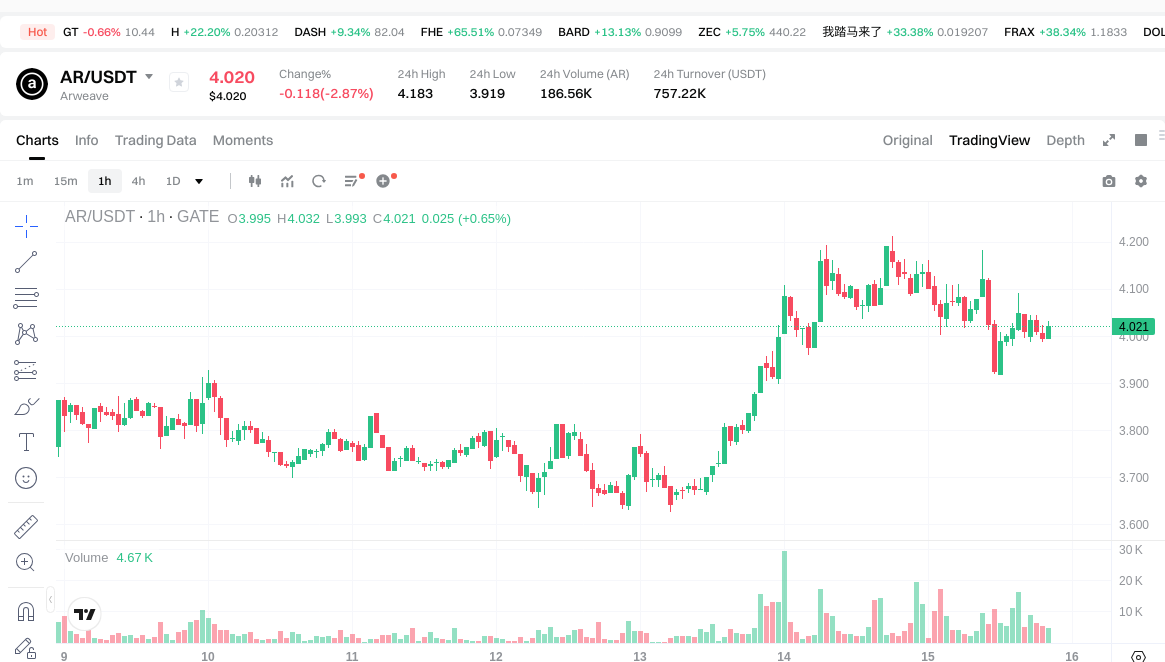
AR is a significant asset in the cryptocurrency sector, serving as the native token of the Arweave blockchain storage platform since its launch in 2018. As of January 2026, AR holds a market capitalization of approximately $263.45 million with a circulating supply of around 65.45 million tokens, maintaining a current price near $4.025. Positioned as a decentralized storage solution built on blockweave technology, AR has gradually become a focal point for investors exploring questions such as "Is Arweave (AR) a good investment?" With its distinctive approach to permanent data storage through the "permaweb" infrastructure and a market share of 0.0076%, the token demonstrates characteristics that warrant examination. This article comprehensively analyzes AR's investment attributes, historical price movements, future price projections, and associated risks to provide reference for market participants.
I. Arweave (AR) Price History and Current Investment Value
- 2018: Arweave launched at $0.73, marking its entry into the decentralized storage market
- 2021: November witnessed significant price appreciation, with AR experiencing substantial upward momentum during the broader crypto market rally
- 2022-2023: Following broader market corrections, AR price declined from elevated levels, reflecting the cyclical nature of crypto assets
- 2024-2025: The token showed recovery tendencies, with price movements influenced by developments in decentralized storage adoption
Current AR Investment Market Status (January 2026)
- AR current price: $4.025
- Market sentiment (Fear & Greed Index): Data not provided in reference materials
- 24-hour trading volume: $757,257.34
- Institutional investor holdings: Specific institutional holdings data not disclosed in available materials
- Market capitalization: $263,453,096.79
- Circulating supply: 65,454,185.54 AR (99.17% of total supply)
- Market cap to fully diluted valuation ratio: 99.17%
Click to view real-time AR market price
- 1-hour change: +0.3%
- 24-hour change: -2.91%
- 7-day change: +6.61%
- 30-day change: +10.83%
- 1-year change: -74.48%
The token currently ranks #202 among cryptocurrencies by market capitalization, with a market dominance of 0.0076%. The 24-hour price range shows fluctuation between $3.919 and $4.183, indicating moderate volatility within the daily trading session.
II. Core Factors Influencing Whether AR is a Good Investment (Is Arweave(AR) a Good Investment)
Supply Mechanism and Scarcity (AR investment scarcity)
- Fixed supply cap and circulation rate → Influence on price and investment value
- Supply dynamics: AR has a maximum supply of 66,000,000 tokens, with a current circulation of approximately 65,454,185 tokens (99.17% circulating supply)
- Investment significance: Limited supply provides fundamental support for long-term scarcity value, though market dynamics remain subject to demand fluctuations
Institutional Investment and Mainstream Adoption (Institutional investment in AR)
- Ecosystem partnerships: Arweave has established connections with major blockchain networks, contributing to its position within the Web3 infrastructure landscape
- Use case expansion: The permanent storage model attracts projects seeking censorship-resistant, long-term data preservation solutions
- Adoption trends: Growing interest from developers and decentralized applications requiring permanent data layers may influence institutional consideration
Macroeconomic Environment's Impact on AR Investment
- Market volatility: Cryptocurrency assets including AR remain sensitive to broader monetary policy shifts and interest rate changes
- Technological positioning: As a decentralized storage solution, AR's value proposition differs from traditional inflation hedges, focusing instead on Web3 infrastructure needs
- Regulatory landscape: Evolving global cryptocurrency regulations and data storage policies could impact adoption rates and investment appeal
Technology and Ecosystem Development (Technology & Ecosystem for AR investment)
- AO mainnet launch (February 2025): Introduction of hyper-parallel computing capabilities alongside permanent storage, expanding platform functionality beyond data preservation
- Blockweave architecture: Unique "pay once, store forever" economic model differentiates AR from subscription-based storage providers
- Permaweb ecosystem: Development of permanent, distributed network infrastructure supporting community-driven applications may strengthen long-term utility value
- DeFi and dApp integration: Permanent storage integration with decentralized applications creates potential use cases across Web3 sectors
III. AR Future Investment Forecast and Price Outlook (Is Arweave(AR) worth investing in 2026-2031)
Short-term AR Investment Outlook (2026)
- Conservative forecast: $3.30 - $3.83
- Neutral forecast: $4.03 - $4.31
- Optimistic forecast: $4.58 - $4.82
Mid-term Arweave(AR) Investment Forecast (2027-2029)
-
Market stage expectation: AR may enter a phase of gradual price appreciation as the decentralized storage sector matures and network adoption potentially expands. The period may witness evolving demand for permanent data storage solutions.
-
Investment return forecast:
- 2027: $3.83 - $4.82
- 2028: $3.20 - $4.84
- 2029: $3.72 - $6.44
-
Key catalysts: Network growth in terms of data stored, ecosystem development on the Permaweb, potential partnerships with content creators and institutions, and broader adoption of decentralized storage technologies.
Long-term Investment Outlook (Is AR a good long-term investment?)
- Baseline scenario: $3.96 - $5.99 (assuming steady network expansion and moderate adoption of permanent storage solutions)
- Optimistic scenario: $6.41 - $8.93 (assuming significant ecosystem growth, mainstream recognition of decentralized storage, and favorable market conditions)
- Risk scenario: $3.20 - $3.65 (under conditions of limited adoption, competitive pressure from alternative storage solutions, or adverse market environment)
For detailed AR long-term investment and price predictions, visit: Price Prediction
2026-2031 Long-term Outlook
- Baseline scenario: $4.03 - $5.99 (corresponding to steady progress and gradual mainstream application enhancement)
- Optimistic scenario: $6.41 - $8.93 (corresponding to large-scale adoption and favorable market environment)
- Transformative scenario: Above $8.93 (in case of breakthrough progress in the ecosystem and mainstream popularization)
- Predicted high point on 2031-12-31: $8.93 (based on optimistic development assumptions)
Disclaimer: The forecasts provided are based on available market data and historical trends. Cryptocurrency markets are highly volatile and unpredictable. These projections should not be considered as investment advice. Investors should conduct their own research and consult with financial professionals before making investment decisions.
| Year |
Predicted High Price |
Predicted Average Price |
Predicted Low Price |
Price Change |
| 2026 |
4.58964 |
4.026 |
3.30132 |
0 |
| 2027 |
4.8247584 |
4.30782 |
3.8339598 |
7 |
| 2028 |
4.840266552 |
4.5662892 |
3.19640244 |
13 |
| 2029 |
6.44349069012 |
4.703277876 |
3.71558952204 |
16 |
| 2030 |
6.409391925519 |
5.57338428306 |
3.9571028409726 |
38 |
| 2031 |
8.927168275391355 |
5.9913881042895 |
3.654746743616595 |
48 |
IV. AR Investment Strategy and Risk Management (How to invest in Arweave)
Investment Methodology (AR investment strategy)
Long-term Holding (HODL AR): Suitable for Conservative Investors
For investors who believe in Arweave's vision of permanent data storage and the Permaweb ecosystem, a long-term holding strategy may be appropriate. This approach involves acquiring AR tokens and maintaining positions over extended periods, regardless of short-term price fluctuations. Given Arweave's utility as both a miner reward mechanism and transaction fee currency within its network, long-term holders may benefit from the platform's adoption growth. However, investors should note that AR has experienced significant price volatility, with historical data showing a decline of approximately 74.48% over a one-year period as of January 15, 2026.
Active Trading: Relying on Technical Analysis and Swing Operations
For more experienced investors, active trading strategies leveraging technical analysis may be considered. AR's price movements show varied patterns across different timeframes - a 0.3% increase over 1 hour, a decrease of 2.91% over 24 hours, but gains of 6.61% over 7 days and 10.83% over 30 days. These fluctuations may present opportunities for swing trading. Traders utilizing this approach should monitor support and resistance levels, with recent 24-hour ranges between $3.919 and $4.183 providing reference points for entry and exit strategies.
Risk Management (Risk management for AR investment)
Asset Allocation Ratios: Conservative / Aggressive / Professional Investors
- Conservative Investors: May consider allocating 1-3% of their crypto portfolio to AR, given its established position as a decentralized storage solution but considering its price volatility.
- Aggressive Investors: Could allocate 5-10% of their portfolio, balancing AR's technological innovation potential against market risks.
- Professional Investors: May employ dynamic allocation strategies based on market conditions, technical indicators, and ecosystem development milestones.
Risk Hedging Solutions: Multi-asset Portfolio + Risk Management Tools
Investors should consider diversification across multiple blockchain sectors rather than concentrating solely in decentralized storage tokens. Combining AR holdings with assets from different categories (such as layer-1 protocols, DeFi tokens, or stablecoins) can help mitigate sector-specific risks. Additionally, investors might employ stop-loss orders to limit potential downside, particularly given AR's historical price range from an all-time high of $89.24 to an all-time low of $0.298788.
Secure Storage: Hot and Cold Wallets + Hardware Wallet Recommendations
Proper storage of AR tokens is essential for investment security. For active traders requiring frequent access, reputable hot wallets with strong security features may be suitable. However, for long-term holdings, cold storage solutions provide enhanced security. Hardware wallets from established manufacturers offer robust protection against online threats. Investors should also implement best practices such as backing up recovery phrases, using multi-signature options where available, and never sharing private keys.
V. AR Investment Risks and Challenges (Risks of investing in Arweave)
Market Risk: High Volatility and Price Manipulation
AR exhibits significant price volatility, as evidenced by its historical price movements and 74.48% decline over the past year. The token's 24-hour trading volume of approximately $757,257 suggests moderate liquidity, which may contribute to price swings. With a relatively small market capitalization of approximately $263.45 million and market dominance of only 0.0076%, AR may be more susceptible to price movements influenced by large transactions or trading activities. Investors should be prepared for substantial short-term price fluctuations.
Regulatory Risk: Policy Uncertainty Across Different Countries
Decentralized storage platforms and cryptocurrency projects face evolving regulatory landscapes globally. Different jurisdictions maintain varying approaches to blockchain technology, data storage regulations, and cryptocurrency classification. Changes in regulatory frameworks could impact Arweave's operations, token utility, or market accessibility. Investors should monitor regulatory developments in their respective countries and key markets where Arweave operates.
Technical Risk: Network Security Vulnerabilities and Upgrade Failures
As a blockchain-based storage platform utilizing Blockweave technology, Arweave faces technical risks inherent to all distributed systems. Potential network security vulnerabilities, smart contract bugs, or challenges in protocol upgrades could affect platform functionality and token value. Additionally, the platform's reliance on miner participation for data storage means that insufficient network participation could impact service reliability. The content moderation approach, which allows individual miners to choose which blocks and transactions to store, introduces probabilistic rather than absolute storage guarantees.
VI. Conclusion: Is Arweave a Good Investment?
Investment Value Summary
AR presents a distinctive value proposition within the blockchain storage sector, addressing scalability, data availability, and cost challenges through its Blockweave technology and Permaweb vision. The token serves functional purposes within the ecosystem as both miner rewards and transaction fees. However, the investment faces considerable short-term price volatility, as demonstrated by significant historical price fluctuations and a substantial decline over the past year.
Investor Recommendations
✅ Beginners: Consider a dollar-cost averaging approach combined with secure wallet storage. Focus on understanding the platform's technology and use cases before investing. Start with small allocations and prioritize learning about proper security practices.
✅ Experienced Investors: May explore swing trading opportunities based on technical analysis while maintaining a core position. Consider combining AR with diversified holdings across different blockchain sectors to balance portfolio risk.
✅ Institutional Investors: Could evaluate strategic long-term positions based on Arweave's technological differentiation and ecosystem development. Conduct thorough due diligence on network metrics, adoption trends, and competitive positioning within the decentralized storage sector.
⚠️ Notice: Cryptocurrency investments involve substantial risk. This content is for informational purposes only and does not constitute investment advice. Investors should conduct independent research and consider their financial situation and risk tolerance before making investment decisions.
VII. FAQ
Q1: Is Arweave (AR) a good investment for beginners in 2026?
AR may be suitable for beginners willing to accept high volatility and seeking exposure to the decentralized storage sector. As of January 2026, AR trades at approximately $4.025 with a market cap of $263.45 million, having declined 74.48% over the past year. Beginners should consider starting with small allocations (1-3% of crypto portfolio) and employ dollar-cost averaging to mitigate timing risks. The platform's unique permanent storage model and Blockweave technology provide a clear use case, but investors must understand that AR experiences significant price fluctuations. Proper security measures, including hardware wallet storage for long-term holdings, are essential. New investors should prioritize education about Arweave's technology and the broader decentralized storage market before committing capital.
Q2: What is the price prediction for Arweave (AR) by 2031?
Based on available market analysis, AR's predicted price for 2031 ranges from $3.65 to $8.93, with an average forecast of approximately $5.99. The optimistic scenario projects a high of $8.93, assuming significant ecosystem growth, mainstream adoption of permanent storage solutions, and favorable market conditions. The baseline scenario estimates $3.96 to $5.99, reflecting steady network expansion and moderate adoption. The risk scenario suggests $3.20 to $3.65 under conditions of limited adoption or adverse market environment. These projections incorporate factors such as the AO mainnet integration, Permaweb ecosystem development, and increasing demand for decentralized data storage. However, cryptocurrency markets remain highly unpredictable, and these forecasts should not be considered guaranteed outcomes or investment advice.
Q3: How does Arweave's permanent storage model affect AR's investment value?
The permanent storage model significantly influences AR's value proposition by creating ongoing utility demand. Arweave's "pay once, store forever" approach differentiates it from subscription-based storage competitors, with users paying a one-time fee in AR tokens to store data permanently. This model generates continuous demand for AR tokens as network usage increases, while the fixed supply cap of 66 million tokens (99.17% already circulating) provides scarcity characteristics. The Blockweave technology enables this model by incentivizing miners to maintain historical data through storage proofs. However, the investment value depends on adoption rates of permanent storage solutions, competition from alternative platforms, and the ecosystem's ability to attract developers and content creators. The recent AO mainnet launch in February 2025 expands utility beyond storage to include hyper-parallel computing, potentially enhancing long-term value.
Q4: What are the primary risks when investing in Arweave (AR)?
AR investment carries three principal risk categories. First, market risk stems from high volatility, evidenced by a 74.48% decline over the past year and significant price swings across different timeframes. The relatively small market cap of $263.45 million and 0.0076% market dominance make AR susceptible to price manipulation and liquidity constraints. Second, regulatory risk arises from evolving global policies toward cryptocurrency and data storage platforms, with different jurisdictions maintaining varied approaches to blockchain technology. Changes in regulatory frameworks could impact token utility and market accessibility. Third, technical risk includes potential network security vulnerabilities, smart contract bugs, and protocol upgrade challenges. The platform's reliance on miner participation means insufficient network engagement could affect service reliability. Additionally, the probabilistic nature of storage guarantees introduces technical uncertainty not present in centralized systems.
Q5: Should I choose long-term holding or active trading for AR?
The choice between strategies depends on investment objectives, risk tolerance, and market expertise. Long-term holding (HODL) suits investors who believe in Arweave's vision of permanent data storage and are willing to weather significant volatility. This approach benefits from potential ecosystem growth, Permaweb adoption, and the platform's expanding utility through the AO mainnet. Historical data shows AR declined 74.48% over one year but gained 10.83% over 30 days, suggesting recovery potential for patient investors. Active trading may suit experienced investors who can leverage technical analysis to capitalize on AR's price fluctuations - such as the 0.3% hourly gain, 2.91% daily decline, and 6.61% weekly increase. Traders should monitor support/resistance levels within the $3.919-$4.183 range observed in 24-hour trading. Conservative investors might combine both approaches, maintaining a core long-term position while trading a smaller allocation based on market conditions.
Q6: How does Arweave compare to traditional cloud storage as an investment?
Arweave represents a fundamentally different investment proposition than traditional cloud storage providers. Traditional cloud companies (AWS, Google Cloud, Azure) operate on recurring subscription models generating predictable revenue streams, while Arweave employs a one-time payment model for permanent storage. This creates distinct economic dynamics - AR token value depends on adoption of decentralized permanent storage rather than recurring enterprise contracts. Traditional cloud storage investments offer stability and established market positions but limited exposure to blockchain technology innovation. AR provides exposure to Web3 infrastructure and censorship-resistant data preservation but carries significantly higher volatility and adoption uncertainty. The Permaweb ecosystem and AO mainnet integration position AR within the broader decentralized technology landscape, while traditional cloud providers serve primarily centralized enterprise needs. Investors seeking stable returns may prefer established cloud companies, while those pursuing exposure to decentralized storage innovation might consider AR despite higher risk profiles.
Q7: What role does institutional adoption play in AR's investment potential?
Institutional adoption significantly influences AR's long-term investment potential, though current institutional holdings data remains limited in public disclosures. The platform's partnerships with major blockchain networks and growing ecosystem connections indicate early-stage institutional interest in decentralized storage infrastructure. Institutional involvement could provide several benefits: increased liquidity, price stability, and validation of Arweave's technology. The permanent storage model appeals to institutions requiring censorship-resistant, long-term data preservation - including academic archives, media organizations, and regulatory compliance applications. However, AR's relatively small market cap ($263.45 million) and 0.0076% market dominance suggest limited institutional exposure compared to major cryptocurrencies. The February 2025 AO mainnet launch expanding platform capabilities beyond storage may attract greater institutional attention. Investors should monitor metrics such as data stored on the network, enterprise partnerships, and integration with institutional-grade applications as indicators of growing adoption. Institutional involvement typically correlates with reduced volatility and enhanced long-term value stability.
Q8: What allocation strategy should different investor types consider for AR?
Allocation strategies should reflect individual risk profiles and investment objectives across three investor categories. Conservative investors may allocate 1-3% of their cryptocurrency portfolio to AR, prioritizing capital preservation while gaining exposure to decentralized storage innovation. This allocation acknowledges AR's technological differentiation but accounts for historical volatility and the 74.48% decline over the past year. Aggressive investors could allocate 5-10% of their portfolio, accepting higher risk in exchange for potentially greater returns from ecosystem growth and mainstream adoption. This approach suits investors with longer time horizons who can withstand significant price fluctuations. Professional investors might employ dynamic allocation strategies ranging from 3-15% based on market conditions, technical indicators, and ecosystem development milestones such as network growth metrics and Permaweb application adoption. All investor types should combine AR holdings with diversified positions across different blockchain sectors (layer-1 protocols, DeFi, stablecoins) to mitigate sector-specific risks. Regular portfolio rebalancing ensures allocations remain aligned with risk tolerance as market conditions evolve.
* The information is not intended to be and does not constitute financial advice or any other recommendation of any sort offered or endorsed by Gate.