This comprehensive analysis evaluates whether Astar Token (ASTR) represents a sound investment opportunity in 2026 and beyond. ASTR, the governance and staking token for Astar Network and Soneium Layer 2 ecosystem, currently trades at $0.011208 with a market cap of $92.77 million across 26 exchanges including Gate. The article examines ASTR's price history showing 81.67% year-over-year decline, market position ranked 373rd, and mid-term forecasts ranging from $0.0079 to $0.0151 by 2028. Core investment factors include Sony partnership integration, multi-VM infrastructure, unlimited token supply dynamics, and ecosystem interoperability features. The analysis provides diversified investment strategies for conservative, aggressive, and professional investors while detailing critical risks including volatility, regulatory uncertainty, and technical vulnerabilities. Investors should implement disciplined risk management through proper asset allocation, secure storage solutions, and continuous ecosystem monitoring
Introduction: Astar Token (ASTR)'s Investment Position and Market Outlook
ASTR is a significant asset in the cryptocurrency sector, launched in January 2022, and has demonstrated notable development within web3 infrastructure and multi-chain interoperability domains. As of January 17, 2026, Astar Token holds a market capitalization of approximately $92.77 million with a circulating supply of around 8.28 billion tokens, while the current price stands at approximately $0.011208. With its positioning as a bridge connecting Astar Network and Soneium ecosystems, ASTR has gradually become a focal point for investors discussing "Is Astar Token (ASTR) a good investment?" This article comprehensively analyzes ASTR's investment characteristics, historical trends, future price projections, and associated risks to provide reference for investors.
Astar Token serves as the unifying asset across the Astar collective, which originated from Japan and focuses on driving web3 adoption. The project integrates governance and staking functionalities through Astar Network while leveraging Soneium, a Layer 2 solution developed by Sony Block Solutions Labs, to facilitate mainstream adoption through consumer-friendly applications and decentralized finance solutions. The token currently ranks 373rd by market capitalization and maintains a market share of 0.0028%. With 848,881 holders and availability on 26 exchanges, ASTR demonstrates a degree of market presence within the blockchain infrastructure segment.
The token's price performance shows variation across different timeframes. Over the past 30 days, ASTR recorded an increase of 11.34%, while the 24-hour and 7-day periods showed gains of 1.33% and 1.52% respectively. However, the yearly performance indicates a decline of 81.67% from previous levels. The historical price range extends from an all-time low of $0.00948783 recorded on January 1, 2026, to an all-time high of $0.421574 observed on January 17, 2022. This article examines the factors influencing these price movements, evaluates the project's technical infrastructure and ecosystem development, and discusses considerations relevant to assessing ASTR's position within the digital asset landscape.
I. Astar Token (ASTR) Price History Review and Current Investment Status
- 2022: ASTR launched on January 17, 2022 → The token entered the market during a period of significant volatility in the broader crypto ecosystem
- 2022-2026: Market cycle evolution → ASTR price fluctuated from higher valuations to current levels, reflecting broader market dynamics and ecosystem development
- 2026: Current market positioning → As of early 2026, ASTR continues trading as part of the evolving Web3 infrastructure landscape
Current ASTR Investment Market Status (January 2026)
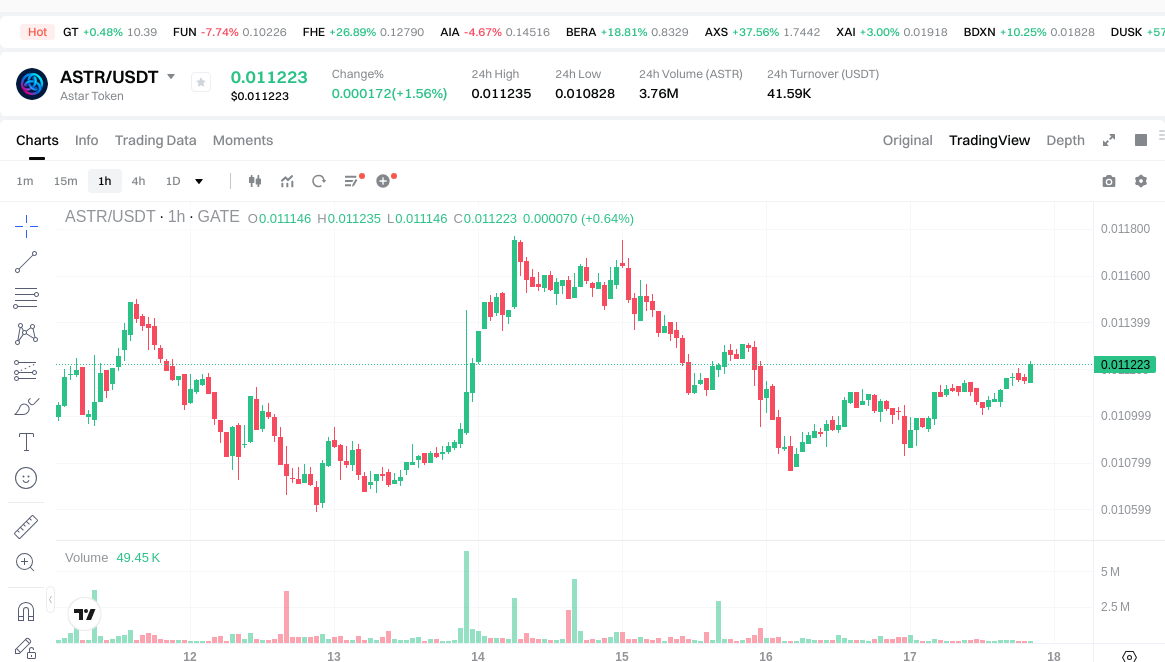
- ASTR current price: $0.011208
- Market sentiment (Fear & Greed Index): Not available in provided materials
- 24-hour trading volume: $41,253.78
- Circulating supply: 8,277,428,483 ASTR
- Market capitalization: $92,773,418.44
- Total supply: 8,617,570,155 ASTR
- Market cap rank: 373
- Market dominance: 0.0028%
Click to view real-time ASTR market price
Price Performance:
- 1-hour change: +0.36%
- 24-hour change: +1.33%
- 7-day change: +1.52%
- 30-day change: +11.34%
- 1-year change: -81.67%
Trading Range (24h):
- High: $0.011203
- Low: $0.010828
Supply Metrics:
- Circulating/Total ratio: 96.05%
- Market cap to FDV ratio: 100%
- Token holders: 848,881
- Listed on exchanges: 26 platforms
II. Core Factors Influencing Whether ASTR is a Good Investment (Is Astar Token(ASTR) a Good Investment)
Supply Mechanism and Scarcity (ASTR investment scarcity)
- Total Supply: 8,617,570,155 ASTR with unlimited maximum supply → Ongoing token generation may impact long-term scarcity dynamics
- Circulating Supply: 8,277,428,483 ASTR (approximately 96% of total supply) → High circulation ratio suggests limited near-term supply pressure from token unlocks
- Market Cap to FDV Ratio: 100% → Indicates full valuation alignment between circulating and total supply, reducing dilution concerns for current holders
- Investment Significance: The unlimited maximum supply structure may present challenges for scarcity-driven valuation, contrasting with fixed-supply models that typically support deflationary narratives in crypto assets
Institutional Investment and Mainstream Adoption (Institutional investment in ASTR)
- Sony Partnership: Astar collective integrates with Soneium, a Layer 2 solution developed by Sony Block Solutions Labs → Establishes connection with major entertainment conglomerate infrastructure
- Ecosystem Positioning: ASTR serves as unified asset across Astar Network and Soneium ecosystems → Dual-layer architecture targets both developer infrastructure and consumer adoption
- Exchange Presence: Listed on 26 exchanges including mainstream platforms → Provides accessibility for institutional and retail participants
- Holder Distribution: 848,881 total holders → Indicates established community participation across the network
Macroeconomic Environment Impact on ASTR Investment
- Market Position: Ranked #373 with market dominance of 0.0028% → Positions ASTR as mid-tier asset subject to broader crypto market volatility
- 24-Hour Trading Volume: $41,253.78 → Moderate liquidity levels may amplify price sensitivity to macroeconomic shifts
- Year-over-Year Performance: -81.67% decline from prior year → Reflects exposure to market cycles and risk-off sentiment in uncertain economic conditions
- Correlation Dynamics: As a lower-cap asset, ASTR may exhibit heightened sensitivity to changes in risk appetite, monetary policy adjustments, and overall crypto market sentiment
Technology and Ecosystem Development (Technology & Ecosystem for ASTR investment)
- Multi-VM Environment: Astar Network operates as governance and staking layer with secure, scalable multi-virtual machine architecture → Supports diverse developer tooling and application deployment
- Layer 2 Integration: Soneium leverages Ethereum's OP Stack for high-speed, low-cost transactions tailored to entertainment and consumer applications → Positions ecosystem for scalability in mass-market use cases
- Cross-Ecosystem Interoperability: ASTR token facilitates seamless interconnection between Astar Network and Soneium through multiple interoperable solutions → Enhances utility across governance, staking, and adoption layers
- DeFi and Payment Applications: Ecosystem focuses on consumer-friendly applications, payment solutions, and decentralized finance → Targets mainstream web3 adoption and real-world transaction use cases
- Geographic Origin: Originating from Japan with backing from Sony infrastructure → Benefits from established regional presence and alignment with Japan's blockchain development initiatives
III. ASTR Future Investment Forecast and Price Outlook (Is Astar Token(ASTR) worth investing in 2026-2031)
Short-term Investment Forecast (2026, short-term ASTR investment outlook)
- Conservative Forecast: $0.0071 - $0.0113
- Neutral Forecast: $0.0112 - $0.0130
- Optimistic Forecast: $0.0130 - $0.0135
Mid-term Investment Outlook (2027-2028, mid-term Astar Token(ASTR) investment forecast)
- Market Stage Expectation: Expected gradual growth driven by ecosystem expansion and potential interoperability developments between Astar Network and Soneium
- Investment Return Forecast:
- 2027: $0.0072 - $0.0131 (approximately 8% increase)
- 2028: $0.0079 - $0.0151 (approximately 12% increase)
- Key Catalysts: Cross-chain interoperability enhancements, developer incentive programs, strategic partnerships, and potential adoption growth within the Soneium ecosystem
Long-term Investment Outlook (Is ASTR a good long-term investment?)
- Baseline Scenario: $0.0128 - $0.0194 (assuming steady ecosystem development and maintained market position)
- Optimistic Scenario: $0.0166 - $0.0240 (assuming accelerated adoption and favorable market conditions)
- Risk Scenario: $0.0071 - $0.0113 (under adverse market conditions or delayed ecosystem growth)
Click to view ASTR long-term investment and price forecast: Price Prediction
2026-01-17 - 2031 Long-term Outlook
- Baseline Scenario: $0.0128 - $0.0194 (corresponding to steady progress and gradual mainstream application adoption)
- Optimistic Scenario: $0.0166 - $0.0240 (corresponding to large-scale adoption and favorable market environment)
- Transformative Scenario: Above $0.0240 (if ecosystem achieves breakthrough developments and mainstream adoption)
- 2031-12-31 Forecast High: $0.0217 (based on optimistic development assumptions)
Disclaimer: These forecasts are based on current market data and ecosystem developments. Cryptocurrency markets are highly volatile and subject to numerous unpredictable factors. Past performance does not guarantee future results. This analysis does not constitute investment advice, and investors should conduct their own research and consider their risk tolerance before making investment decisions.
| Year |
Predicted High Price |
Predicted Average Price |
Predicted Low Price |
Price Change |
| 2026 |
0.01301868 |
0.011223 |
0.00707049 |
0 |
| 2027 |
0.0130905072 |
0.01212084 |
0.0071512956 |
8 |
| 2028 |
0.01512680832 |
0.0126056736 |
0.007941574368 |
12 |
| 2029 |
0.019412737344 |
0.01386624096 |
0.013172928912 |
23 |
| 2030 |
0.02396086437888 |
0.016639489152 |
0.01297880153856 |
48 |
| 2031 |
0.02172118913902 |
0.02030017676544 |
0.012789111362227 |
81 |
IV. ASTR Investment Strategy and Risk Management (How to invest in ASTR)
Investment Methodology (ASTR investment strategy)
Long-term Holding (HODL ASTR): Suitable for Conservative Investors
Long-term holding represents a strategic approach for investors who believe in the fundamental value proposition of Astar's collective ecosystem. This strategy involves accumulating ASTR tokens during market corrections and maintaining positions through various market cycles. Given Astar Network's role as a governance and staking layer, combined with its integration with Soneium's Layer 2 solution, long-term holders may benefit from potential ecosystem growth as web3 adoption expands. The token's utility across both Astar Network and Soneium ecosystems provides multiple value accrual mechanisms for patient investors.
Active Trading: Relying on Technical Analysis and Swing Operations
Active traders may capitalize on ASTR's price movements by employing technical analysis tools and swing trading strategies. With 24-hour trading volume reaching approximately $41,253, the token demonstrates sufficient liquidity for tactical operations. Traders can utilize support and resistance levels, with recent 24-hour price ranging between $0.010828 and $0.011203, to identify entry and exit points. Moving averages, volume indicators, and momentum oscillators can assist in timing short to medium-term positions. However, this approach requires continuous market monitoring and disciplined execution.
Risk Management (Risk management for ASTR investment)
Asset Allocation Ratio: Conservative / Aggressive / Professional Investors
- Conservative Investors: May consider allocating 2-5% of their crypto portfolio to ASTR, balancing exposure with established digital assets
- Aggressive Investors: Could allocate 10-15% of their crypto holdings to ASTR, accepting higher volatility for potential growth opportunities
- Professional Investors: Might implement dynamic allocation strategies ranging from 5-20%, adjusting positions based on technical indicators and ecosystem developments
Risk Hedging Solutions: Multi-asset Portfolio + Hedging Tools
Diversification remains essential for managing ASTR investment risks. Investors can construct portfolios combining ASTR with other blockchain infrastructure tokens, stablecoins, and traditional crypto assets. Position sizing should account for correlation factors with broader market movements. For sophisticated investors, options strategies or stablecoin conversion during high volatility periods may provide downside protection. Regular portfolio rebalancing helps maintain target allocation percentages and capture gains during favorable market conditions.
Secure Storage: Hot and Cold Wallets + Hardware Wallet Recommendations
Secure storage infrastructure is fundamental for ASTR holdings. For active traders, reputable exchange wallets with two-factor authentication provide convenient access while maintaining reasonable security. For long-term holders, transferring ASTR to non-custodial wallets offers enhanced security. Hardware wallets compatible with Astar Network provide robust protection against online threats. Investors should implement multi-signature solutions for substantial holdings and maintain secure backup procedures for recovery phrases. Regular security audits of storage solutions help identify potential vulnerabilities.
V. ASTR Investment Risks and Challenges (Risks of investing in ASTR)
Market Risks: High Volatility and Price Manipulation
ASTR exhibits significant price volatility characteristic of blockchain infrastructure tokens. The token has experienced substantial price fluctuations, with historical data showing considerable variation from its previous levels. Market depth and liquidity conditions can amplify price movements during periods of elevated trading activity. Investors should recognize that sudden market shifts may result in rapid value changes. The relatively concentrated holder distribution, with approximately 848,881 holders, may contribute to price sensitivity during large-scale transactions.
Regulatory Risks: Policy Uncertainty Across Different Countries
Regulatory frameworks for blockchain infrastructure and Layer 2 solutions continue evolving across jurisdictions. Changes in regulatory approaches toward decentralized networks, staking mechanisms, or cross-chain operations could impact ASTR's operational environment. Different countries maintain varying stances on cryptocurrency taxation, trading restrictions, and compliance requirements. Investors should monitor regulatory developments in key markets, particularly those affecting Japanese blockchain projects and Ethereum Layer 2 solutions. Compliance requirements may evolve, potentially affecting token utility or accessibility in certain regions.
Technical Risks: Network Security Vulnerabilities and Upgrade Failures
As a multi-virtual machine environment integrated with Ethereum's OP Stack through Soneium, Astar's infrastructure faces inherent technical complexities. Smart contract vulnerabilities, consensus mechanism issues, or interoperability challenges could affect network stability. Protocol upgrades, while necessary for ecosystem development, introduce implementation risks. The interconnection between Astar Network and Soneium ecosystems creates additional technical dependencies. Security audits and continuous monitoring help mitigate these risks, but investors should recognize that blockchain technology inherently involves technical uncertainties.
VI. Conclusion: Is ASTR a Good Investment?
Investment Value Summary
ASTR represents an infrastructure token within an ecosystem bridging Astar Network and Soneium's Layer 2 solution, targeting web3 adoption through consumer applications and decentralized finance. The token's dual ecosystem utility and integration with Sony Block Solutions Labs' development efforts provide potential growth pathways. However, market performance reflects substantial volatility, with price movements influenced by broader cryptocurrency market trends, ecosystem development progress, and adoption metrics.
Investor Recommendations
✅ Beginners: Consider implementing dollar-cost averaging strategies combined with secure wallet storage. Start with modest allocations to understand market dynamics and ecosystem developments. Prioritize learning about Astar's governance mechanisms and Soneium's adoption initiatives.
✅ Experienced Investors: May employ swing trading strategies combined with portfolio diversification approaches. Monitor technical indicators, ecosystem milestones, and market sentiment shifts. Consider staking opportunities within Astar Network while maintaining appropriate risk management protocols.
✅ Institutional Investors: Could evaluate strategic long-term allocation within blockchain infrastructure portfolios. Conduct thorough due diligence on ecosystem partnerships, technology roadmaps, and competitive positioning. Implement comprehensive risk management frameworks incorporating regulatory considerations and technical assessments.
⚠️ Disclaimer: Cryptocurrency investments involve substantial risks and high volatility. This content serves informational purposes only and does not constitute investment advice. Conduct independent research and consider personal financial circumstances before making investment decisions.
VII. FAQ
Q1: Is Astar Token (ASTR) a good investment for beginners in 2026?
ASTR may be suitable for beginners who are willing to accept high volatility and have a long-term investment horizon, but it requires careful risk management and should represent only a small portion of a diversified portfolio. As a mid-tier blockchain infrastructure token with a market cap ranking of 373, ASTR carries significant volatility risks. The token's 81.67% year-over-year decline demonstrates the substantial price fluctuations that characterize this asset class. Beginners should start with modest allocations (2-5% of crypto portfolio), implement dollar-cost averaging strategies to reduce timing risk, and prioritize secure storage solutions using hardware wallets. Understanding Astar Network's governance mechanisms and Soneium's Layer 2 integration is essential before committing capital. The token's utility across dual ecosystems provides potential growth pathways, but newcomers must recognize that blockchain infrastructure investments require patience and tolerance for market cycles.
Q2: What are the main factors that could drive ASTR price growth in the future?
The primary growth drivers for ASTR include ecosystem expansion through Astar Network and Soneium adoption, cross-chain interoperability enhancements, strategic partnerships (particularly with Sony Block Solutions Labs), and broader web3 mainstream acceptance. Successful deployment of consumer-friendly applications on Soneium's Layer 2 infrastructure could significantly increase token utility and demand. Developer incentive programs that attract quality projects to build on the multi-VM environment may expand network effects. Additionally, increased participation in governance and staking mechanisms could reduce circulating supply while enhancing holder engagement. The token's integration with entertainment and payment solutions through Sony's ecosystem presents unique adoption opportunities. However, these catalysts depend on execution quality, competitive positioning against other Layer 2 solutions, and favorable overall cryptocurrency market conditions.
Q3: What are the biggest risks associated with investing in ASTR?
The primary risks include extreme price volatility, regulatory uncertainty, technical vulnerabilities, unlimited token supply, and market liquidity constraints. ASTR's price has demonstrated substantial fluctuations, with the potential for rapid value changes during market stress periods. The unlimited maximum supply structure may create long-term inflationary pressure that undermines scarcity-driven valuation. Regulatory frameworks for blockchain infrastructure and Layer 2 solutions continue evolving globally, potentially affecting operational capabilities or accessibility. Technical risks emerge from the complexity of maintaining a multi-VM environment integrated with Ethereum's OP Stack, including smart contract vulnerabilities and protocol upgrade failures. The relatively modest 24-hour trading volume of $41,253 indicates limited liquidity that could amplify price movements during large transactions. Investors must also consider competition from other blockchain infrastructure projects and the execution risks associated with achieving mainstream web3 adoption.
Q4: How does ASTR's price prediction look for 2026-2031?
Based on current analysis, ASTR's forecasted price trajectory spans from conservative to optimistic scenarios across the 2026-2031 timeframe. For 2026, predictions range from $0.0071 (low) to $0.0130 (high) with an average around $0.0112. Mid-term forecasts for 2027-2028 suggest gradual appreciation, with 2028 projections reaching $0.0079-$0.0151 (approximately 12% increase from 2026). Long-term 2031 estimates extend from $0.0128 (baseline) to $0.0240 (optimistic scenario), with a forecasted high of $0.0217 under favorable development assumptions. These projections assume steady ecosystem growth, successful Soneium adoption, enhanced interoperability features, and supportive market conditions. However, cryptocurrency markets remain highly unpredictable, and actual outcomes may diverge significantly based on execution quality, competitive dynamics, regulatory developments, and macroeconomic factors. Investors should treat these forecasts as theoretical frameworks rather than guaranteed outcomes.
Q5: What investment strategy works best for ASTR holdings?
The optimal ASTR investment strategy depends on individual risk tolerance, investment horizon, and market expertise. Long-term holding (HODL) suits conservative investors who believe in the fundamental value proposition of Astar's dual-ecosystem architecture and are prepared to weather market cycles while participating in governance and staking. This approach benefits from potential ecosystem growth as web3 adoption expands and requires less active management. Active trading strategies utilizing technical analysis and swing operations appeal to experienced investors who can dedicate time to monitoring price movements, support/resistance levels, and momentum indicators. This approach capitalizes on ASTR's volatility but demands disciplined execution and risk management. Regardless of strategy, proper asset allocation is critical: conservative investors should limit exposure to 2-5% of crypto portfolios, while aggressive investors might allocate 10-15%. Professional investors may implement dynamic allocation (5-20%) adjusted based on technical signals and ecosystem milestones. All strategies must incorporate secure storage solutions, portfolio diversification, and regular rebalancing to manage downside risks effectively.
Q6: How does ASTR compare to other Layer 2 blockchain infrastructure tokens?
ASTR differentiates itself through its dual-ecosystem approach combining Astar Network's governance layer with Soneium's consumer-focused Layer 2 solution backed by Sony Block Solutions Labs. This unique positioning bridges developer infrastructure with mainstream entertainment and payment applications, contrasting with purely technical infrastructure tokens. The multi-VM environment supports diverse developer tooling, while Soneium's Ethereum OP Stack integration targets high-speed, low-cost transactions for mass-market use cases. However, ASTR's market capitalization of $92.77 million and ranking of 373 positions it as a mid-tier asset compared to leading Layer 2 solutions with substantially larger market presence. The token's unlimited supply structure differs from fixed-supply models that emphasize scarcity. With 848,881 holders and listing on 26 exchanges, ASTR demonstrates established community participation but faces liquidity constraints relative to dominant infrastructure tokens. Competitive advantages stem from Sony partnership alignment and Japanese market presence, though execution risks remain regarding achieving mainstream web3 adoption against well-established competitors.
Q7: Should investors stake ASTR tokens, and what are the benefits?
Staking ASTR within Astar Network presents potential benefits for long-term holders, including earning yield on holdings while contributing to network security and governance participation. Staking mechanisms reduce circulating supply, potentially creating upward price pressure while generating passive income streams. Participants gain voting rights on protocol governance decisions, enabling influence over ecosystem development direction. However, investors must consider several factors before staking: lock-up periods may restrict liquidity during market volatility, smart contract risks introduce technical vulnerabilities, and staking rewards fluctuate based on network participation rates. The opportunity cost of staking versus active trading should be evaluated based on individual strategies and market conditions. Additionally, tax implications of staking rewards vary by jurisdiction and require proper accounting. Investors should research specific staking requirements, validator performance metrics, and unstaking procedures before committing tokens. For those aligned with Astar's long-term vision and comfortable with reduced liquidity, staking can complement a HODL strategy while enhancing engagement with ecosystem governance.
Q8: What are the key ecosystem developments to monitor for ASTR investment decisions?
Critical indicators for ASTR investment assessment include Soneium adoption metrics, developer activity on Astar Network, strategic partnership announcements, governance participation rates, and cross-chain interoperability enhancements. Monitoring the number and quality of applications deployed on Soneium's Layer 2 infrastructure provides insight into mainstream adoption progress, particularly consumer-facing entertainment and payment solutions leveraging Sony's ecosystem connections. Developer engagement metrics—including active projects, GitHub activity, and hackathon participation—signal ecosystem vitality and innovation potential. Announcements regarding new exchange listings, institutional partnerships, or integration with major protocols may catalyze price movements. Staking participation rates and governance proposal activity reflect community health and token holder engagement. Technical milestones such as protocol upgrades, security audits, and interoperability solutions between Astar Network and Soneium layers indicate execution capability. Regulatory developments affecting blockchain infrastructure in key markets, particularly Japan and regions where Sony operates, require continuous monitoring. Investors should also track competitive positioning relative to other Layer 2 solutions and overall blockchain infrastructure market trends to contextualize ASTR's performance.
* The information is not intended to be and does not constitute financial advice or any other recommendation of any sort offered or endorsed by Gate.