This comprehensive analysis examines Audius (AUDIO), a decentralized music streaming protocol launched in October 2020, currently trading at $0.02991 with a market cap of $41.56 million. The article evaluates AUDIO's investment potential by analyzing its price history, which peaked at $4.95 in 2021 before declining significantly, and current market position ranking #588 in cryptocurrency rankings. Key factors influencing investment decisions include unlimited token supply, institutional adoption across 33 exchanges, and protocol utility for staking and governance. The guide presents price forecasts through 2031 ranging from conservative to transformative scenarios, outlines investment strategies for different investor types from beginners implementing dollar-cost averaging to institutional participants engaging governance mechanisms, and identifies critical risks including high volatility, regulatory uncertainty, and technical vulnerabilities. Comprehensive risk management approaches and secure storage recomm
Introduction: Audius (AUDIO) Investment Position and Market Outlook
Audius (AUDIO) represents a notable asset within the cryptocurrency sector, having launched in October 2020 as a decentralized music sharing and streaming protocol. The protocol facilitates direct transactions between listeners and creators, enabling free distribution, commercialization, and streaming of audio content. As of January 20, 2026, AUDIO maintains a market capitalization of approximately $41.56 million, with a circulating supply of around 1.39 billion tokens and a current price hovering near $0.02991. The token serves multiple functions within the network, including staking for node operation, unlocking exclusive features, and participating in protocol governance. With its position ranked at #588 in the cryptocurrency market and a market dominance of 0.0012%, AUDIO has established itself as a specialized asset within the decentralized media sector. The protocol's infrastructure comprises content nodes operated by users to host content and manage access permissions, a content ledger serving as the authoritative data source, and discovery nodes that index metadata for easy retrieval. This article provides a comprehensive analysis of AUDIO's investment characteristics, historical performance trends, future price considerations, and associated risk factors for market participants seeking to evaluate the token's position in their portfolio strategy.
I. Audius (AUDIO) Price History Review and Current Investment Landscape
- 2021: On March 27, AUDIO reached a notable peak of $4.95 → Early-stage investors experienced substantial gains during this period
- 2022-2023: Crypto market transitioned into bearish territory → AUDIO price declined significantly from previous levels
- 2025: As of January 20, 2026, AUDIO trades at $0.02991 → The token has experienced considerable volatility, with recorded low of $0.02719366 in December 2025
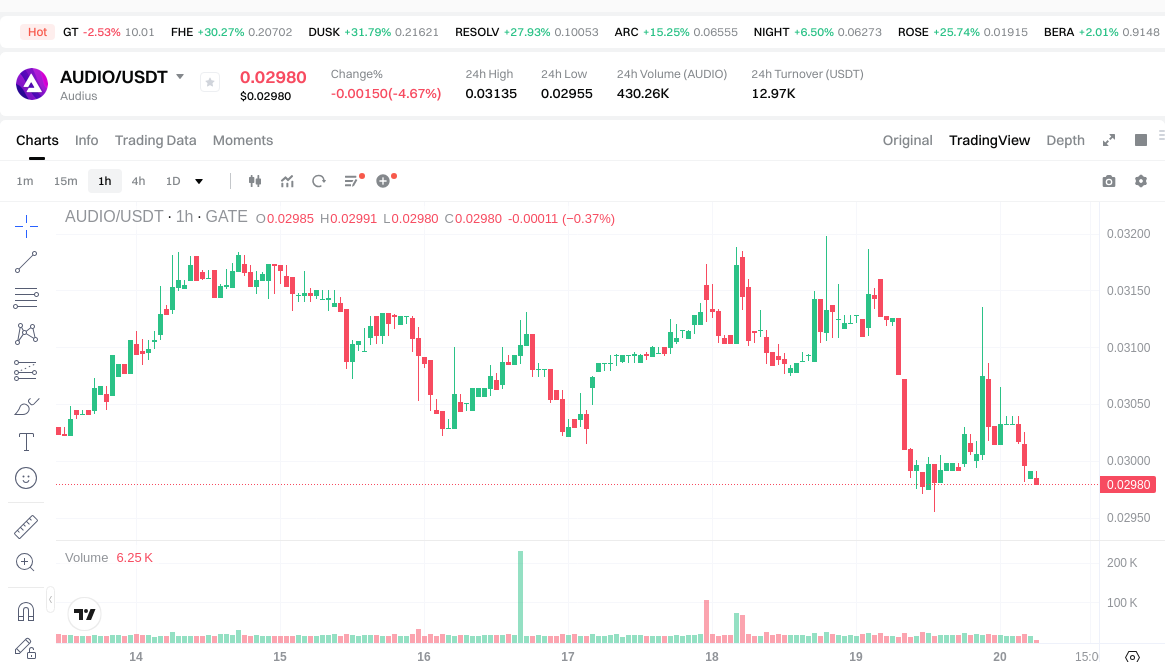
Current AUDIO Investment Market Overview (January 2026)
- Current AUDIO Price: $0.02991
- Market Sentiment: Data indicates a 24-hour price change of -4.22%, suggesting cautious market conditions
- 24-Hour Trading Volume: Approximately $12,962.73
- Market Capitalization: Around $41.56 million with circulating supply of 1.389 billion tokens
Click to view real-time AUDIO market price
II. Core Factors Influencing Whether AUDIO Is a Good Investment
Supply Mechanism and Scarcity (AUDIO Investment Scarcity)
- Total supply stands at 1,389,386,283 AUDIO tokens with no maximum supply cap (∞), indicating an unlimited supply mechanism that may affect long-term scarcity considerations.
- Current circulating supply represents approximately 100% of the total supply, suggesting full token circulation in the market.
- The unlimited supply model differs from deflationary assets, which may influence price dynamics and investment value assessment over extended periods.
- Investment significance: The absence of a hard cap requires investors to evaluate scarcity through alternative factors such as token utility, staking mechanisms, and network adoption rather than supply limitation alone.
Institutional Investment and Mainstream Adoption (Institutional Investment in AUDIO)
- The token holder count currently stands at 37,655, reflecting a moderate level of community participation and ownership distribution.
- AUDIO is listed on 33 exchanges, providing reasonable liquidity access for institutional and retail participants.
- The protocol's integration with content distribution and music streaming applications positions it within the growing creator economy sector.
- Adoption dynamics: The platform's ability to facilitate direct transactions between listeners and creators represents a use case that may attract interest from participants in the digital content and entertainment sectors.
Macroeconomic Environment Impact on AUDIO Investment
- As a digital asset operating within the broader cryptocurrency market, AUDIO's investment appeal may be influenced by changes in monetary policy and interest rate environments.
- Market capitalization of approximately $41.56 million positions AUDIO as a mid-tier asset, which may respond differently to macroeconomic conditions compared to larger-cap cryptocurrencies.
- The token's performance over the past year, with a decline of 80.07%, reflects sensitivity to broader market cycles and risk appetite changes in the digital asset space.
- Trading volume of approximately $12.96 thousand indicates moderate liquidity conditions that could be affected by shifts in overall market sentiment.
Technology and Ecosystem Development (Technology & Ecosystem for AUDIO Investment)
- The protocol architecture comprises three main components: Content Nodes for hosting and access control, Content Ledger as the trusted data source, and Discovery Nodes for metadata indexing and retrieval.
- Token utility includes staking mechanisms that enable users to operate nodes and receive network fee participation, unlocking exclusive features such as artist tokens and badges, and participating in protocol governance decisions.
- The decentralized infrastructure aims to support content distribution, commercialization, and streaming capabilities for audio content creators.
- Ecosystem positioning: The platform operates within the intersection of blockchain technology and digital content distribution, with potential value supported by ongoing protocol development and user adoption in the music streaming sector.
III. AUDIO Future Investment Forecast and Price Outlook (Is Audius (AUDIO) worth investing in 2026-2031)
Short-term Investment Outlook (2026, short-term AUDIO investment outlook)
- Conservative Estimate: $0.0218 - $0.0298
- Neutral Estimate: $0.0255 - $0.0320
- Optimistic Estimate: $0.0298 - $0.0349
Mid-term Investment Forecast (2027-2029, mid-term Audius (AUDIO) investment forecast)
- Market Phase Expectation: Potential growth phase with increased volatility as the platform ecosystem continues to develop and user base expands.
- Investment Return Forecast:
- 2027: $0.0290 - $0.0449
- 2028: $0.0255 - $0.0491
- 2029: $0.0355 - $0.0614
- Key Catalysts: Platform iteration and enhancement, expansion of NFT-related applications within the AUDIO ecosystem, and broader adoption of decentralized music streaming protocols.
Long-term Investment Outlook (Is AUDIO a good long-term investment?)
- Base Scenario: $0.0295 - $0.0778 (assuming steady progress in mainstream application adoption and stable market conditions)
- Optimistic Scenario: $0.0526 - $0.0855 (assuming large-scale adoption, favorable market environment, and significant ecosystem developments)
- Transformative Scenario: Above $0.0855 (contingent upon breakthrough progress in ecosystem development and mainstream popularization)
Check AUDIO long-term investment and price prediction: Price Prediction
2026-01-20 - 2031 Long-term Outlook
- Base Scenario: $0.0295 - $0.0778 (corresponding to steady progress and gradual mainstream application enhancement)
- Optimistic Scenario: $0.0526 - $0.0855 (corresponding to large-scale adoption and favorable market conditions)
- Transformative Scenario: Above $0.0855 (if the ecosystem achieves breakthrough developments and mainstream penetration)
- 2031-12-31 Predicted High: $0.0855 (based on optimistic development assumptions)
Disclaimer: The above forecasts are derived from available market data and analytical models. Cryptocurrency markets are highly volatile and subject to various risks. These projections do not constitute investment advice, and investors should conduct their own research and risk assessment before making any investment decisions.
| Year |
Predicted High Price |
Predicted Average Price |
Predicted Low Price |
Price Change |
| 2026 |
0.034866 |
0.0298 |
0.021754 |
0 |
| 2027 |
0.04494287 |
0.032333 |
0.0290997 |
8 |
| 2028 |
0.04907017745 |
0.038637935 |
0.0255010371 |
29 |
| 2029 |
0.061395678715 |
0.043854056225 |
0.03552178554225 |
46 |
| 2030 |
0.0778848038556 |
0.05262486747 |
0.0294699257832 |
75 |
| 2031 |
0.085483834718268 |
0.0652548356628 |
0.037195256327796 |
118 |
IV. AUDIO Investment Strategy and Risk Management (How to invest in Audius)
Investment Methodology (AUDIO investment strategy)
Long-term Holding (HODL AUDIO): Suitable for Conservative Investors
Long-term holding represents a strategy where investors acquire AUDIO tokens and maintain positions over extended periods, focusing on the protocol's fundamental development rather than short-term price fluctuations. This approach may be appropriate for investors who believe in Audius's vision of decentralized music streaming and are willing to tolerate interim volatility. Given AUDIO's use cases in network governance, staking for discovery and content nodes, and unlocking exclusive features, long-term holders may benefit from protocol growth and increased adoption within the decentralized music ecosystem.
Active Trading: Relying on Technical Analysis and Swing Operations
Active trading involves utilizing technical indicators, chart patterns, and market sentiment analysis to capitalize on AUDIO's price movements. Traders may employ strategies such as swing trading to exploit short-term volatility, particularly given the token's recent 24-hour price change of -4.22% and observable trading range between $0.02955 and $0.03135. This methodology requires continuous market monitoring, understanding of trading volume patterns (current 24-hour volume: $12,962.73), and implementation of appropriate entry and exit strategies based on technical signals.
Risk Management (Risk management for AUDIO investment)
Asset Allocation Ratio: Conservative / Aggressive / Professional Investors
Conservative Investors: May consider allocating 1-3% of their crypto portfolio to AUDIO, maintaining a diversified approach with established digital assets forming the portfolio core. This allocation acknowledges the higher risk profile associated with mid-cap tokens while limiting potential downside exposure.
Aggressive Investors: Could allocate 5-10% to AUDIO, accepting higher volatility in pursuit of potentially greater returns tied to the protocol's growth and the decentralized music streaming sector's expansion.
Professional Investors: May implement more sophisticated allocation strategies, potentially ranging from 3-15% depending on comprehensive fundamental analysis, market conditions assessment, and portfolio construction objectives. Professional participants might also engage with staking mechanisms and governance participation as part of their investment thesis.
Diversification remains essential when investing in AUDIO tokens. Investors may consider:
- Portfolio Diversification: Combining AUDIO with assets across different crypto categories, including established cryptocurrencies, stablecoins, and other sector-specific tokens to reduce concentration risk.
- Correlation Analysis: Understanding AUDIO's price correlation with broader market movements and sector-specific trends within decentralized applications and entertainment-focused protocols.
- Position Sizing: Implementing dynamic position sizing based on volatility metrics and market conditions to maintain appropriate risk exposure levels.
Secure Storage: Hot and Cold Wallets + Hardware Wallet Recommendations
Secure storage of AUDIO tokens is critical for asset protection:
Cold Wallet Storage: For long-term holdings, hardware wallets provide offline security by keeping private keys isolated from internet-connected devices. This approach significantly reduces exposure to online threats and unauthorized access attempts.
Hot Wallet Usage: For active trading or regular protocol interaction (such as staking or governance participation), hot wallets connected to exchanges or decentralized applications offer convenience while requiring robust security practices including two-factor authentication and regular security audits.
Multi-signature Solutions: Advanced users and institutional investors may implement multi-signature wallet configurations, requiring multiple approvals for transaction execution, thereby adding an additional security layer.
V. AUDIO Investment Risks and Challenges (Risks of investing in Audius)
Market Risk: High Volatility and Price Manipulation
AUDIO exhibits considerable price volatility, characteristic of mid-cap crypto assets. The token has experienced significant price fluctuations, with historical data showing a price range from $0.02719366 to $4.95. Recent performance indicates negative returns across multiple timeframes: -0.16% (1H), -4.22% (24H), -1.73% (7D), and -80.07% (1Y), demonstrating substantial volatility that investors must acknowledge.
The relatively modest market capitalization of approximately $41.56 million and 24-hour trading volume of $12,962.73 may result in lower liquidity compared to larger-cap assets, potentially increasing susceptibility to price swings driven by concentrated trading activity or large order executions.
Regulatory Risk: Policy Uncertainty in Different Countries
Crypto assets face evolving regulatory frameworks across jurisdictions, creating uncertainty for AUDIO token holders. Key regulatory considerations include:
- Securities Classification: Regulatory authorities in various jurisdictions continue evaluating whether certain crypto tokens constitute securities, which could impact trading, distribution, and usage of AUDIO.
- Platform Regulation: As a decentralized music streaming protocol, Audius may encounter regulatory scrutiny related to content distribution, intellectual property rights, and platform governance mechanisms.
- Tax Treatment: Tax obligations for AUDIO holders vary significantly across jurisdictions, with potential implications for staking rewards, governance participation, and trading activities.
- Cross-border Compliance: International regulatory divergence may affect AUDIO's accessibility, exchange listings, and protocol operations in different markets.
Technical Risk: Network Security Vulnerabilities and Upgrade Failures
Technical risks associated with AUDIO investment include:
Smart Contract Vulnerabilities: AUDIO operates through smart contracts, which, despite auditing processes, may contain undiscovered vulnerabilities that could be exploited, potentially affecting token functionality or user funds.
Protocol Upgrade Risks: Future protocol developments, improvements, or modifications carry implementation risks. Upgrade failures, bugs introduced during updates, or governance disputes regarding protocol changes could negatively impact network functionality and token value.
Network Infrastructure Dependencies: The Audius protocol relies on user-operated content nodes and discovery nodes. Insufficient node participation, technical failures, or coordination challenges within this infrastructure could affect service quality and protocol utility.
Blockchain Infrastructure Risks: Given AUDIO's deployment on Ethereum (contract address: 0x18aaa7115705e8be94bffebde57af9bfc265b998), the token inherits risks associated with the underlying blockchain, including network congestion, transaction costs, and potential technical issues affecting the base layer.
VI. Conclusion: Is Audius a Good Investment?
Investment Value Summary
AUDIO presents an investment opportunity within the decentralized music streaming sector, offering utility through network governance, staking mechanisms, and access to exclusive protocol features. The token's fundamental value proposition connects to the broader vision of enabling direct transactions between content creators and listeners while removing traditional intermediaries from music distribution.
However, investors should recognize that AUDIO has experienced significant price volatility, with negative performance across recent timeframes and current trading substantially below historical peaks. The token's market position, with a market cap of approximately $41.56 million and ranking around position 588, indicates a mid-cap asset profile with corresponding risk characteristics.
Investor Recommendations
✅ Beginners: Dollar-Cost Averaging + Secure Wallet Storage
New investors exploring AUDIO should consider:
- Implementing systematic investment approaches to mitigate timing risk
- Allocating only funds appropriate for higher-risk investments
- Prioritizing secure storage solutions and understanding wallet security fundamentals
- Educating themselves on Audius protocol mechanics, tokenomics, and governance processes
- Starting with conservative position sizes within diversified portfolios
✅ Experienced Investors: Swing Trading + Portfolio Configuration
Investors with trading experience may:
- Leverage technical analysis tools to identify potential entry and exit points
- Monitor AUDIO's trading patterns, volume trends, and correlation with broader market movements
- Implement risk management protocols including stop-loss orders and position sizing discipline
- Consider protocol developments, partnership announcements, and sector trends in trading decisions
- Maintain diversified exposure across multiple crypto sectors and asset classes
✅ Institutional Investors: Strategic Long-term Allocation
Institutional participants might:
- Conduct comprehensive due diligence on protocol fundamentals, team, technology, and competitive positioning
- Evaluate AUDIO within broader thematic allocations to decentralized applications and content distribution sectors
- Engage with protocol governance mechanisms as active stakeholders
- Implement institutional-grade custody solutions and risk management frameworks
- Monitor regulatory developments affecting decentralized protocols and entertainment-sector crypto assets
⚠️ Notice
Cryptocurrency investment carries substantial risk. AUDIO tokens exhibit high volatility and are subject to market, regulatory, and technical uncertainties. This content is provided for informational purposes only and does not constitute investment advice. Investors should conduct independent research, assess their risk tolerance, and consult with financial advisors before making investment decisions. Past performance does not indicate future results, and investors should be prepared for the possibility of partial or total loss of invested capital.
VII. FAQ
Q1: What is AUDIO token and what makes it different from traditional music streaming platforms?
AUDIO is the native cryptocurrency of Audius, a decentralized music sharing and streaming protocol launched in October 2020. Unlike traditional streaming platforms (such as Spotify or Apple Music), AUDIO enables direct transactions between listeners and creators without intermediaries, allowing artists to maintain greater control over their content and revenue. The token serves multiple functions including staking for node operation, unlocking exclusive features like artist tokens and badges, and participating in protocol governance decisions. The protocol's decentralized architecture comprises Content Nodes (for hosting and access control), a Content Ledger (as the authoritative data source), and Discovery Nodes (for metadata indexing), fundamentally differentiating it from centralized music platforms.
Q2: How has AUDIO performed historically, and what is its current market position?
AUDIO experienced significant volatility since its launch, reaching a peak price of $4.95 on March 27, 2021, during the bull market. However, as of January 20, 2026, the token trades at approximately $0.02991, representing a substantial decline from historical highs. Recent performance shows negative returns across multiple timeframes: -4.22% (24H), -1.73% (7D), and -80.07% (1Y). With a market capitalization of approximately $41.56 million and ranking around position #588 in the cryptocurrency market, AUDIO occupies a mid-cap position with a market dominance of 0.0012%. The token has a circulating supply of approximately 1.39 billion tokens with an unlimited maximum supply.
Q3: What are the main use cases for AUDIO tokens within the ecosystem?
AUDIO tokens provide three primary utility functions within the Audius ecosystem. First, they enable staking mechanisms where users can operate content nodes and discovery nodes, receiving network fee participation in return for maintaining protocol infrastructure. Second, token holders can unlock exclusive features including access to artist tokens, special badges, and premium platform functionalities. Third, AUDIO serves as a governance token, allowing holders to participate in protocol decision-making processes regarding network upgrades, parameter changes, and ecosystem development. These utilities create demand for the token beyond speculative trading, connecting its value to actual protocol usage and network participation.
Q4: What investment risks should be considered when evaluating AUDIO?
AUDIO presents several significant investment risks that potential investors must evaluate. Market risk is substantial, evidenced by high volatility and the token's decline of over 80% in the past year, with relatively low trading volume ($12,962.73 in 24 hours) potentially amplifying price swings. Regulatory risk exists as authorities continue evaluating crypto asset classifications, particularly for tokens associated with content distribution platforms. Technical risks include smart contract vulnerabilities, protocol upgrade failures, and dependencies on user-operated node infrastructure. Additionally, the unlimited token supply mechanism differs from deflationary assets, which may affect long-term scarcity considerations. The modest market capitalization also suggests higher volatility compared to established cryptocurrencies.
Q5: What is the investment outlook for AUDIO through 2031?
Price forecasts for AUDIO show graduated growth expectations across different timeframes. Short-term (2026) predictions range from $0.0218 to $0.0349 depending on market conditions. Mid-term forecasts (2027-2029) suggest potential ranges of $0.0290-$0.0449 (2027), $0.0255-$0.0491 (2028), and $0.0355-$0.0614 (2029), assuming continued ecosystem development and user adoption. Long-term outlook through 2031 presents multiple scenarios: base case ($0.0295-$0.0778), optimistic case ($0.0526-$0.0855), and transformative case (above $0.0855), with the predicted 2031 high reaching $0.0855. However, these projections carry significant uncertainty and depend on factors including mainstream adoption, ecosystem developments, favorable market conditions, and successful protocol iterations. Cryptocurrency markets remain highly volatile, and these forecasts should not be considered investment advice.
Q6: What investment strategies are appropriate for different types of AUDIO investors?
Investment strategies should align with investor experience and risk tolerance. Beginners are advised to implement dollar-cost averaging to mitigate timing risk, allocate only 1-3% of their crypto portfolio to AUDIO, prioritize secure wallet storage, and focus on education regarding protocol mechanics before investing. Experienced investors may consider active trading strategies using technical analysis, with allocation ranges of 5-10%, implementing swing trading to capitalize on volatility, and maintaining disciplined risk management including stop-loss orders. Institutional investors might adopt strategic long-term allocations of 3-15%, engage with protocol governance as active stakeholders, conduct comprehensive due diligence on fundamentals, and implement institutional-grade custody solutions. All investor categories should maintain diversified portfolios and prepare for potential partial or total loss of invested capital.
Q7: How does AUDIO's tokenomics structure impact its long-term investment value?
AUDIO's tokenomics present both opportunities and challenges for long-term value assessment. The current supply structure shows 1.39 billion tokens in circulation with no maximum supply cap (∞), indicating an unlimited supply mechanism that contrasts with deflationary crypto assets. This unlimited supply model means scarcity must be evaluated through alternative factors such as token utility, staking mechanisms, and network adoption rather than supply limitation alone. The token holder count of 37,655 reflects moderate community participation, while listing on 33 exchanges provides reasonable liquidity access. Investment value ultimately depends on whether demand growth from protocol adoption, staking participation, and governance activity outpaces any potential supply expansion, requiring investors to closely monitor network usage metrics and ecosystem development progress.
Q8: What security measures should AUDIO investors implement to protect their holdings?
Security implementation requires a multi-layered approach appropriate to investment strategy. For long-term holdings, cold wallet storage using hardware wallets provides optimal security by keeping private keys offline and isolated from internet-connected devices, significantly reducing exposure to online threats. Active traders requiring regular protocol interaction may use hot wallets connected to exchanges or decentralized applications, but must implement robust security practices including two-factor authentication, strong passwords, and regular security audits. Advanced users and institutional investors should consider multi-signature wallet configurations requiring multiple approvals for transactions, adding an additional security layer. Regardless of storage method, investors must verify wallet addresses carefully, avoid phishing attempts, maintain backup recovery phrases in secure locations, and never share private keys or seed phrases with anyone.
* The information is not intended to be and does not constitute financial advice or any other recommendation of any sort offered or endorsed by Gate.