This comprehensive analysis examines whether Aurora (AURORA), an Ethereum Virtual Machine built on NEAR Protocol, represents a viable investment opportunity in 2026 and beyond. The article evaluates AURORA's current market position (trading at $0.046 with $31M market cap), historical performance (down 74.86% from January 2022 peak), and tokenomics (673.2M of 1B max supply circulating). Core sections assess supply mechanisms, institutional adoption, macroeconomic influences, and technological infrastructure supporting long-term value creation. The guide projects price ranges through 2031, with base scenarios of $0.0650-$0.0729 and optimistic scenarios reaching $0.1029. Investment strategies accommodate beginner to institutional investors with specific allocation recommendations (1-3% for conservative, 5-10% for moderate, 15-20% for experienced investors). Detailed risk analysis addresses market volatility, regulatory uncertainty, bridge vulnerabilities, and competitive pressures from alternative Layer 2 soluti
Introduction: Aurora (AURORA) Investment Status and Market Outlook
Aurora (AURORA) represents a noteworthy asset in the cryptocurrency ecosystem, functioning as an Ethereum Virtual Machine (EVM) built on the NEAR Protocol. As of January 21, 2026, AURORA holds a market capitalization of approximately $30.99 million with a circulating supply of 673.20 million tokens, trading at around $0.046. The token is distributed across 9 exchanges and maintains 7,435 holders, reflecting its presence in the blockchain infrastructure sector. With its positioning as a bridge solution facilitating Ethereum-to-NEAR migration for developers and decentralized applications, Aurora has attracted attention from observers examining questions such as "Is Aurora (AURORA) a good investment?" This article provides an analysis of AURORA's investment characteristics, historical price movements, future price considerations, and associated risks to offer reference points for market participants.
I. AURORA Price History Review and Current Investment Value
- 2022: Token reached a significant price level of $35.4 in January → Marked a notable peak period for early participants
- 2022-2025: Extended market adjustment phase → AURORA price experienced considerable downward movement over multiple years
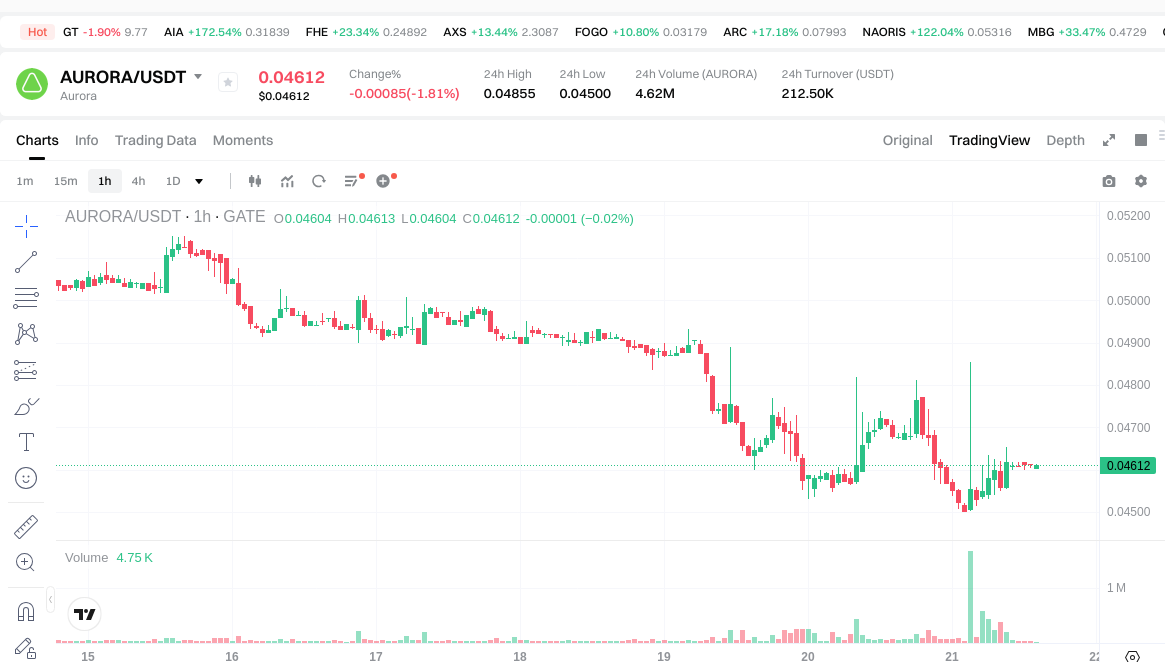
- 2026: Price fluctuation observed in January → Trading within a range near $0.045-$0.049
Current AURORA Investment Market Status (January 2026)
- AURORA current price: $0.04604
- 24-hour trading volume: $213,827.80
- Circulating supply: 673,203,215 AURORA (67.32% of total supply)
- Market capitalization: $30,994,276
- Fully diluted valuation: $46,032,581
- Market dominance: 0.0014%
- Price changes: -0.02% (1H), -2.18% (24H), -8.6% (7D), -4.51% (30D), -74.86% (1Y)
Click to view real-time AURORA market price
II. Core Factors Affecting Whether AURORA is a Good Investment
Supply Mechanism and Scarcity (AURORA Investment Scarcity)
- Supply Structure: AURORA has a maximum supply of 1,000,000,000 tokens, with a current circulating supply of 673,203,215 tokens (approximately 67.32% of the total supply). This defined supply cap may contribute to long-term scarcity dynamics.
- Market Cap to Fully Diluted Valuation Ratio: With a market cap to FDV ratio of 67.32%, a significant portion of the total supply is already in circulation, potentially reducing future dilution concerns.
- Investment Implication: The limited maximum supply and relatively high circulation ratio may support scarcity-based valuation over time, though market conditions and adoption remain key variables.
Institutional Investment and Mainstream Adoption (Institutional Investment in AURORA)
- Holder Distribution: AURORA currently has 7,435 token holders, indicating a developing user base.
- Exchange Availability: The token is listed on 9 exchanges, providing accessibility for investors.
- Adoption Context: As an EVM built on the NEAR Protocol, AURORA facilitates Ethereum-to-NEAR migration for dApps and users, potentially attracting developers seeking scalable infrastructure.
Macroeconomic Environment Impact on AURORA Investment
- Market Sensitivity: AURORA's price has shown significant volatility, with a 1-year decline of approximately 74.86%, reflecting broader market conditions and risk sentiment.
- Low Transaction Costs: The platform's design emphasizes low transaction fees, which may enhance appeal during periods when users seek cost-efficient blockchain solutions.
- Geopolitical and Economic Uncertainty: As with other digital assets, AURORA may experience demand fluctuations tied to macroeconomic factors, though its specific correlation to inflation or interest rate changes has not been documented in available materials.
Technology and Ecosystem Development (Technology & Ecosystem for AURORA Investment)
- Technical Infrastructure: AURORA provides an Ethereum-compatible environment on NEAR Protocol, enabling developers to deploy Solidity smart contracts with enhanced throughput and scalability.
- Cross-Chain Functionality: The platform supports asset transfers between Ethereum and NEAR, including ERC-20 tokens, potentially expanding its utility within decentralized finance applications.
- Ecosystem Expansion: The development of DeFi, NFT, and payment applications on Aurora could contribute to long-term value creation, though the pace and scale of such growth remain dependent on developer adoption and market conditions.
III. Aurora (AURORA) Future Investment Forecast and Price Outlook (Is Aurora (AURORA) Worth Investing in 2026-2031)
Short-term Investment Forecast (2026, Short-term AURORA Investment Outlook)
- Conservative forecast: $0.0397 - $0.0461
- Neutral forecast: $0.0461 - $0.0470
- Optimistic forecast: $0.0470 - $0.0480
Mid-term Investment Outlook (2027-2029, Mid-term Aurora (AURORA) Investment Forecast)
- Market stage expectation: During the mid-term period, Aurora may experience gradual recovery and growth phases as the broader crypto market stabilizes and the NEAR ecosystem continues to develop.
- Investment return forecast:
- 2027: $0.0348 - $0.0565
- 2028: $0.0378 - $0.0745
- 2029: $0.0335 - $0.0751
- Key catalysts: Expansion of the NEAR Protocol ecosystem, increased adoption of Aurora's EVM solution by Ethereum developers, and improvements in cross-chain interoperability between Ethereum and NEAR.
Long-term Investment Outlook (Is Aurora a Good Long-term Investment?)
- Base scenario: $0.0650 - $0.0729 (assuming steady ecosystem development and moderate market conditions)
- Optimistic scenario: $0.0693 - $0.1029 (assuming accelerated adoption of NEAR-based solutions and favorable market environment)
- Risk scenario: $0.0335 - $0.0650 (under adverse market conditions or slower-than-expected ecosystem growth)
For more details on Aurora's long-term investment and price forecasts: Price Prediction
2026-01-21 to 2031 Long-term Outlook
- Base scenario: $0.0650 - $0.0729 (corresponding to steady progress and gradual mainstream application growth)
- Optimistic scenario: $0.0693 - $0.1029 (corresponding to large-scale adoption and favorable market environment)
- Transformative scenario: Above $0.1029 (if the ecosystem achieves breakthrough developments and mainstream adoption)
- 2031-12-31 predicted high: $0.1029 (based on optimistic development assumptions)
Disclaimer: These forecasts are for informational purposes only and should not be considered as investment advice. Cryptocurrency markets are highly volatile and subject to numerous unpredictable factors.
| Year |
Predicted High Price |
Predicted Average Price |
Predicted Low Price |
Price Change |
| 2026 |
0.0479752 |
0.04613 |
0.0396718 |
0 |
| 2027 |
0.05646312 |
0.0470526 |
0.034818924 |
2 |
| 2028 |
0.0745313184 |
0.05175786 |
0.0377832378 |
12 |
| 2029 |
0.075142061148 |
0.0631445892 |
0.033466632276 |
37 |
| 2030 |
0.07674909094314 |
0.069143325174 |
0.06499472566356 |
50 |
| 2031 |
0.102854153362583 |
0.07294620805857 |
0.069298897655641 |
58 |
IV. Aurora Investment Strategy and Risk Management (How to invest in EVM-compatible blockchain tokens)
Investment Methodology (Aurora investment strategy)
-
Long-term holding (HODL Aurora): This approach may be suitable for conservative investors who believe in the long-term development potential of NEAR Protocol's ecosystem and Ethereum compatibility solutions. Given Aurora's role as an EVM built on NEAR Protocol, long-term holders would be betting on increased adoption of cross-chain solutions and migration of Ethereum dApps to more scalable platforms.
-
Active trading: This strategy relies on technical analysis and swing trading opportunities. With Aurora showing a 24-hour price volatility of -2.18% and a 7-day change of -8.6%, traders may identify short to medium-term opportunities. However, this approach requires continuous market monitoring and understanding of both technical indicators and broader market sentiment affecting Layer 2 and scaling solutions.
Risk Management (Risk management for Aurora investment)
-
Asset allocation ratio:
- Conservative investors: Consider limiting exposure to 1-3% of total portfolio
- Moderate investors: May allocate 5-10% depending on risk tolerance
- Experienced investors: Could consider up to 15-20% with active management
Given Aurora's current market cap ranking at 705 and market dominance of 0.0014%, position sizing should reflect its mid-cap status and associated volatility.
-
Risk hedging approach: Diversification across multiple blockchain ecosystems and asset classes may help mitigate concentration risk. Investors might consider balancing Aurora holdings with established Layer 1 tokens, stablecoins, and other EVM-compatible solutions to reduce single-project exposure.
-
Secure storage:
- Hot wallets: Suitable for active trading amounts only
- Cold wallets: Recommended for long-term holdings
- Hardware wallets: Provide enhanced security for substantial allocations
Aurora tokens are available on both Ethereum (contract: 0xAaAAAA20D9E0e2461697782ef11675f668207961) and Aurora EVM networks, requiring appropriate wallet solutions for each chain.
V. Aurora Investment Risks and Challenges (Risks of investing in EVM-compatible blockchain tokens)
-
Market risks: Aurora has experienced significant volatility, with a 1-year decline of -74.86% from its all-time high of $35.4 in January 2022 to current levels around $0.046. The 24-hour trading volume of approximately $213,828 indicates relatively limited liquidity compared to major assets, which may amplify price movements and increase slippage risk during large transactions.
-
Regulatory risks: As a token facilitating cross-chain operations between Ethereum and NEAR Protocol, Aurora may face evolving regulatory scrutiny regarding bridge security, cross-border asset transfers, and classification as a utility or security token. Different jurisdictions maintain varying approaches to cross-chain solutions, creating ongoing regulatory uncertainty.
-
Technical risks:
- Bridge vulnerabilities: Cross-chain asset transfers introduce additional security considerations
- Network security: While built on NEAR Protocol, Aurora's EVM compatibility layer requires continuous security auditing
- Integration challenges: Maintaining compatibility with Ethereum upgrades while operating on NEAR infrastructure presents ongoing technical complexity
- Smart contract risks: Users deploying Solidity contracts on Aurora face potential bugs or exploits
VI. Conclusion: Is EVM-compatible blockchain token a Good Investment?
-
Investment value summary: Aurora represents a specialized solution addressing Ethereum scalability challenges through NEAR Protocol integration. The token has experienced substantial volatility, declining significantly from its all-time high. With a circulating supply of 673.2 million tokens (67.32% of max supply) and a fully diluted market cap of approximately $46 million, Aurora remains a mid-cap asset with corresponding risk-reward characteristics. The project's focus on providing Ethereum developers with a scalable, low-cost alternative presents potential long-term value, though adoption rates and competitive pressures from other Layer 2 solutions will significantly influence outcomes.
-
Investor recommendations:
✅ Newcomers: Consider dollar-cost averaging with small allocations, utilizing secure wallet storage (hardware wallet recommended). Begin with thorough research on cross-chain technology and NEAR Protocol ecosystem before investing.
✅ Experienced investors: May explore swing trading opportunities while maintaining a diversified portfolio across multiple blockchain ecosystems. Monitor technical indicators, trading volume trends, and ecosystem development announcements for timing decisions.
✅ Institutional investors: Could evaluate Aurora as part of a strategic allocation to Ethereum scaling solutions and cross-chain infrastructure, with appropriate due diligence on technical architecture, team credentials, and competitive positioning.
⚠️ Disclaimer: Cryptocurrency investments carry substantial risk of loss. This content is provided for informational purposes only and does not constitute investment advice, financial guidance, or trading recommendations. Conduct independent research and consult qualified financial professionals before making investment decisions.
VII. FAQ
Q1: Is Aurora (AURORA) a good investment for beginners in 2026?
Aurora presents moderate-to-high risk characteristics for beginners. As a mid-cap token with significant historical volatility (down 74.86% year-over-year) and relatively low liquidity ($213,828 24-hour volume), newcomers should approach with caution. The token's role as an EVM solution on NEAR Protocol offers long-term potential tied to ecosystem growth, but its current market position (ranked 705 with 0.0014% market dominance) suggests substantial uncertainty. Beginners considering Aurora should limit exposure to 1-3% of their portfolio, utilize dollar-cost averaging to manage timing risk, and prioritize secure storage through hardware wallets. Understanding cross-chain technology fundamentals and NEAR Protocol's competitive landscape is essential before investing.
Q2: What are the main factors that could drive AURORA's price recovery?
Several catalysts could support Aurora's price appreciation: (1) Increased migration of Ethereum developers and dApps seeking lower transaction costs and improved scalability; (2) Expansion of the NEAR Protocol ecosystem, particularly in DeFi and NFT sectors; (3) Enhanced cross-chain interoperability features between Ethereum and NEAR networks; (4) Broader cryptocurrency market recovery improving sentiment toward infrastructure tokens; (5) Strategic partnerships or integrations that expand Aurora's user base beyond its current 7,435 holders. However, price recovery remains contingent on execution of technical roadmaps, successful competition against alternative Layer 2 solutions, and sustained developer adoption rates.
Q3: How does Aurora's supply structure affect its investment outlook?
Aurora's tokenomics feature a maximum supply of 1 billion tokens with 673.2 million currently circulating (67.32% of total supply), resulting in a market cap to fully diluted valuation ratio of 67.32%. This relatively high circulation percentage reduces concerns about significant future dilution, as approximately two-thirds of tokens are already in the market. The defined supply cap may support scarcity-based valuation dynamics over time, though this effect depends heavily on demand-side factors including adoption rates and ecosystem development. The remaining 32.68% of tokens (326.8 million) represents potential future supply that could create selling pressure if released without corresponding demand growth.
Q4: What are the primary risks associated with investing in Aurora?
Aurora investors face multiple risk categories: (1) Market risk: Extreme volatility demonstrated by the 74.86% annual decline and low liquidity increasing slippage potential; (2) Technical risk: Bridge vulnerabilities inherent to cross-chain operations, smart contract exploits, and challenges maintaining Ethereum compatibility while operating on NEAR infrastructure; (3) Regulatory risk: Evolving regulatory frameworks for cross-chain solutions and potential classification uncertainties across jurisdictions; (4) Competition risk: Intense competition from established Layer 2 solutions (Arbitrum, Optimism, Polygon) and other Ethereum scaling alternatives; (5) Ecosystem risk: Aurora's success depends heavily on NEAR Protocol's continued development and adoption, creating concentration risk.
Q5: What is Aurora's realistic price forecast for 2026-2031?
Based on current market conditions and ecosystem development trajectories, Aurora price forecasts show: 2026: $0.0397-$0.0480 range reflecting near-term consolidation; 2027-2029: Mid-term recovery potential with estimates ranging from $0.0348 to $0.0751 depending on adoption rates; 2031: Base scenario of $0.0650-$0.0729, optimistic scenario of $0.0693-$0.1029, with transformative outcomes potentially exceeding $0.1029. These forecasts assume continued NEAR ecosystem development, successful developer migration, and favorable market conditions. However, cryptocurrency markets remain highly unpredictable, and actual outcomes may differ substantially from these projections. Conservative investors should reference base-case scenarios while acknowledging downside risks could push prices toward $0.0335 or lower under adverse conditions.
Q6: Should investors choose long-term holding or active trading for Aurora?
The optimal strategy depends on investor profile and market conditions: Long-term holding (HODL) suits conservative investors believing in NEAR Protocol's ecosystem growth and Ethereum compatibility solutions' future adoption, accepting current volatility for potential multi-year appreciation. This approach requires 3-5 year timeframes and tolerance for drawdowns. Active trading may capitalize on Aurora's volatility (7-day change: -8.6%, 24-hour: -2.18%) but demands continuous market monitoring, technical analysis proficiency, and understanding of both Layer 2 trends and cross-chain dynamics. Given Aurora's mid-cap status and limited liquidity, active traders face higher slippage risks. Many experienced investors employ hybrid strategies: maintaining core long-term positions (60-70%) while allocating smaller percentages (30-40%) to tactical trading opportunities.
Q7: How does Aurora compare to other Ethereum scaling solutions as an investment?
Aurora differentiates through its NEAR Protocol foundation, offering unique cross-chain functionality rather than traditional Layer 2 rollup architectures. Compared to established solutions like Arbitrum or Optimism (which maintain larger market caps and deeper liquidity), Aurora trades at significantly lower valuations with correspondingly higher risk-reward ratios. Its $31 million market cap positions it as a speculative bet on NEAR ecosystem growth rather than a proven scaling solution. Aurora's advantages include low transaction costs, fast finality, and Ethereum compatibility, while disadvantages include limited adoption (7,435 holders vs. hundreds of thousands for major Layer 2s), lower liquidity, and dependence on NEAR's competitive success. Investors seeking established scaling solutions might prefer larger Layer 2 tokens, while those accepting higher risk for asymmetric returns may consider Aurora as a portfolio satellite position.
Q8: What allocation percentage is appropriate for Aurora in a diversified crypto portfolio?
Recommended allocation varies by investor sophistication and risk tolerance: Conservative investors (limited crypto experience, low risk tolerance) should limit Aurora exposure to 1-3% of total portfolio, treating it as a speculative position within a broader allocation to established cryptocurrencies; Moderate investors (intermediate experience, balanced risk approach) might allocate 5-10% depending on conviction in NEAR ecosystem and cross-chain solutions, balanced with major Layer 1 tokens and stablecoins; Experienced investors (advanced understanding, higher risk tolerance) could consider 15-20% with active management and hedging strategies. These allocations reflect Aurora's mid-cap volatility, development-stage ecosystem, and concentration risk. Position sizing should account for Aurora's correlation with broader crypto markets while maintaining sufficient diversification across blockchain platforms, use cases, and market capitalizations.
* The information is not intended to be and does not constitute financial advice or any other recommendation of any sort offered or endorsed by Gate.