Aventus (AVT) is a blockchain-based event ticketing solution launched in September 2017, currently trading at $0.8138 with a market capitalization of $8.05 million as of January 2026. This comprehensive analysis evaluates whether AVT represents a viable investment opportunity by examining its market position, price history, future growth prospects, and associated risks. The article covers AVT's price trajectory from its $3.37 launch price to historical highs of $10.25, current trading on Gate exchange with limited liquidity ($12,430.50 daily volume), and projected scenarios through 2031 ranging from $0.538 to $2.102. Key investment considerations include the token's fixed supply scarcity, constrained exchange availability (2 exchanges), thin liquidity conditions, significant 67.62% decline over the past year, and regulatory uncertainties in the ticketing industry. The analysis provides tailored investment strategies for conservative, moderate, and experienced investors, emphasizing risk management through por
Introduction: Aventus (AVT) Investment Status and Market Outlook
Aventus (AVT) is a notable digital asset in the cryptocurrency sector, launched in September 2017 as a blockchain-based event ticketing solution. As of January 27, 2026, AVT maintains a market capitalization of approximately $8.05 million, with a circulating supply of around 9.89 million tokens and a current trading price near $0.8138. Positioned as a protocol addressing fraud and transparency challenges in the ticketing industry, AVT has gradually attracted attention among investors exploring whether Aventus (AVT) represents a viable investment opportunity. This article provides a comprehensive analysis of AVT's investment characteristics, historical price movements, future price projections, and associated investment risks to serve as a reference for market participants.
With a total supply capped at 10.6 million tokens and approximately 93.27% already in circulation, AVT demonstrates a relatively mature token distribution structure. The token serves as the economic foundation of the Aventus protocol, designed to incentivize participants who contribute value judgments such as validating event legitimacy, purchasing tickets, promoting activities, and facilitating connections between buyers and ticket distributors. As the digital asset landscape continues to evolve, understanding AVT's market position, technical fundamentals, and risk factors becomes increasingly relevant for those considering exposure to blockchain-based event management solutions.
I. Aventus (AVT) Price History Review and Current Investment Value
- September 2017: AVT launched at an initial offering price of $3.37, representing the project's entry into the blockchain-based event ticketing sector.
- March 2024: AVT experienced notable price movement, reaching $10.25 during a period of market activity.
- August 2021: The token traded at lower price levels around $0.029, reflecting broader market correction phases.
- Recent Period (2025-2026): AVT has undergone significant price adjustments, with valuations declining from previous peaks to current trading ranges around $0.81.
Current AVT Investment Market Status (January 2026)
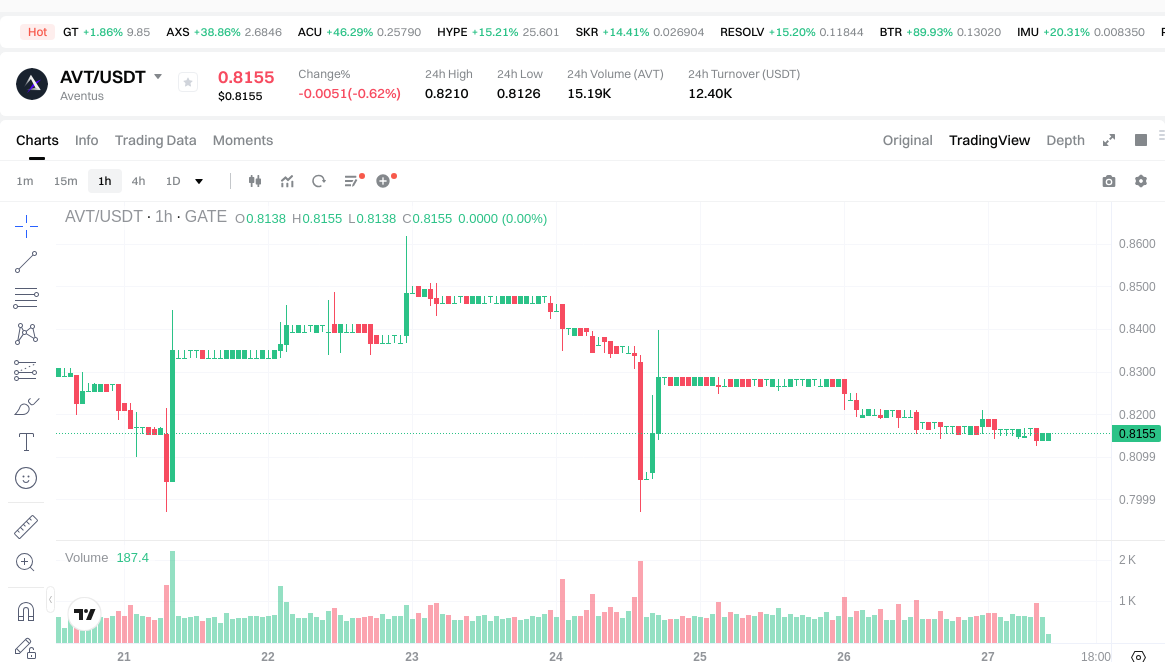
- AVT Current Price: $0.8138 (as of January 27, 2026)
- 24-Hour Price Change: -0.82% (decrease of $0.0067)
- Trading Volume (24H): $12,430.50
- Market Capitalization: Approximately $8.05 million
- Circulating Supply: 9.89 million AVT (93.27% of maximum supply)
- Total Supply: 10.6 million AVT
- Exchange Availability: Listed on 2 exchanges
- Token Holder Count: 4,689 addresses
Click to view real-time AVT market price
Recent Price Performance:
- 1-Hour Change: +0.26%
- 7-Day Change: -2.05%
- 30-Day Change: -6.00%
- 1-Year Change: -67.62%
The token currently represents 0.00027% of the total cryptocurrency market capitalization, with a market cap to fully diluted valuation ratio of 93.27%, indicating that most tokens are already in circulation.
II. Core Factors Influencing Whether AVT is a Good Investment
Supply Mechanism and Scarcity (AVT investment scarcity)
- Fixed maximum supply of 10,600,000 AVT tokens → creates inherent scarcity that may influence long-term value proposition
- Current circulating supply stands at approximately 9,886,781 tokens (93.27% of maximum supply) → limited additional supply expansion potential
- Historical patterns: The token experienced significant price movements, with notable volatility between historical price levels
- Investment significance: The constrained supply structure represents a foundational element for evaluating long-term investment characteristics
Institutional Investment and Mainstream Adoption (Institutional investment in AVT)
- Current holder distribution: Approximately 4,689 addresses hold AVT tokens
- Enterprise-focused use cases: The project positions itself around blockchain scalability and enterprise applications, which may attract institutional interest in enterprise blockchain solutions
- Exchange availability: Trading accessibility is currently limited to 2 exchanges, which may impact liquidity and institutional participation
Macroeconomic Environment Impact on AVT Investment
- Market positioning: AVT represents approximately 0.00027% of total cryptocurrency market dominance, indicating exposure to broader market dynamics
- Trading volume: 24-hour trading volume of $12,430.50 reflects current market liquidity conditions
- Economic context: As with other digital assets, AVT's investment profile may be influenced by monetary policy shifts, interest rate environments, and macroeconomic uncertainty factors
Technology and Ecosystem Development (Technology & Ecosystem for AVT investment)
- Core technology focus: Aventus operates as a blockchain-based event ticketing solution, emphasizing transparency and fraud prevention mechanisms
- Token utility: AVT serves within the protocol's economic model, including functions related to event legitimacy verification, ticket purchasing, and ecosystem participation incentives
- Contract infrastructure: Deployed on Ethereum network (contract address: 0x0d88eD6E74bbFD96B831231638b66C05571e824F), leveraging established blockchain infrastructure
- Development activity: Technical development is tracked through multiple GitHub repositories, including AventusProtocolFoundation and aventus-dapp-proposals
III. AVT Future Investment Forecast and Price Outlook (Is Aventus(AVT) worth investing in 2026-2031)
Short-term Investment Forecast (2026, short-term AVT investment outlook)
- Conservative forecast: $0.538 - $0.816
- Neutral forecast: $0.816 - $0.986
- Optimistic forecast: $0.986 - $1.158
Mid-term Investment Outlook (2027-2029, mid-term Aventus(AVT) investment forecast)
- Market stage expectation: The mid-term phase may witness gradual ecosystem development and market expansion, with price movements influenced by adoption rates and broader market conditions.
- Investment return forecast:
- 2027: $0.553 - $1.204
- 2028: $0.931 - $1.281
- 2029: $0.642 - $1.581
- Key catalysts: Ecosystem expansion, technological developments, market adoption rates, and macroeconomic conditions may serve as potential catalysts.
Long-term Investment Outlook (Is Aventus a good long-term investment?)
- Base scenario: $1.163 - $1.952 (assuming steady progress in adoption and ecosystem development through 2030)
- Optimistic scenario: $1.668 - $2.102 (assuming favorable market conditions and accelerated adoption by 2031)
- Risk scenario: $0.538 - $0.642 (under adverse market conditions or significant ecosystem challenges)
Click to view AVT long-term investment and price forecast: Price Prediction
2026-01-27 to 2031 Long-term Outlook
- Base scenario: $0.816 - $1.384 USD (corresponding to steady progress and gradual mainstream application growth)
- Optimistic scenario: $1.668 - $2.102 USD (corresponding to large-scale adoption and favorable market environment)
- Transformative scenario: Above $2.102 USD (if ecosystem achieves breakthrough progress and mainstream penetration)
- 2031-12-31 forecast high: $2.102 USD (based on optimistic development assumptions)
Disclaimer: The forecast data presented is derived from analytical models and historical trends. Cryptocurrency markets are highly volatile and subject to numerous unpredictable factors. These projections should not be construed as financial advice, and investors should conduct thorough due diligence before making any investment decisions.
| Year |
Predicted High Price |
Predicted Average Price |
Predicted Low Price |
Price Change |
| 2026 |
1.15801 |
0.8155 |
0.53823 |
0 |
| 2027 |
1.2038411 |
0.986755 |
0.5525828 |
21 |
| 2028 |
1.2814987185 |
1.09529805 |
0.9310033425 |
34 |
| 2029 |
1.5805698510525 |
1.18839838425 |
0.641735127495 |
46 |
| 2030 |
1.952122605888262 |
1.38448411765125 |
1.16296665882705 |
70 |
| 2031 |
2.102062235829892 |
1.668303361769756 |
1.267910554945014 |
105 |
IV. Aventus (AVT) Investment Strategy and Risk Management (How to invest in Aventus)
Investment Strategy (Aventus investment strategy)
Long-term Holding (HODL AVT)
For conservative investors seeking stable exposure to blockchain-based ticketing solutions, a long-term holding strategy may be considered. This approach involves acquiring AVT tokens and holding them through market cycles, based on the fundamental value proposition of the Aventus protocol in addressing fraud and transparency issues in the event ticketing industry. Investors should carefully evaluate the project's adoption rate, ecosystem development, and competitive positioning before committing capital.
Active Trading
Active traders may utilize technical analysis and swing trading strategies to capitalize on AVT's price movements. Given the token's observed volatility patterns, including recent performance changes of 0.26% (1H), -0.82% (24H), and -2.050% (7D), traders can identify potential entry and exit points through chart patterns, volume analysis, and momentum indicators. This approach requires continuous market monitoring and disciplined execution.
Risk Management (Risk management for Aventus investment)
Asset Allocation Guidelines
- Conservative Investors: Consider allocating no more than 1-3% of cryptocurrency portfolio to AVT, given its mid-tier market capitalization ranking (1306) and relatively limited exchange availability (2 exchanges).
- Moderate Investors: May allocate 3-5% of their crypto holdings to AVT as part of a diversified blockchain infrastructure portfolio.
- Experienced Investors: Could consider up to 5-10% allocation for those with higher risk tolerance and deeper understanding of the ticketing and blockchain sectors.
Risk Hedging Solutions
Implement a multi-asset portfolio approach by combining AVT with established cryptocurrencies and stablecoins. Consider position sizing based on correlation analysis with broader crypto markets. Dollar-cost averaging (DCA) can help mitigate timing risk, particularly given AVT's historical price range from $0.0292 to $10.25.
Secure Storage
- Cold Wallet Solutions: For long-term holders, hardware wallets such as Ledger or Trezor provide secure offline storage for AVT tokens (ERC-20 on Ethereum).
- Hot Wallet Usage: For active traders, reputable exchanges or software wallets may be used, but only for amounts needed for immediate trading.
- Multi-Signature Options: Consider multi-sig wallets for larger holdings to add an additional security layer.
V. Aventus (AVT) Investment Risks and Challenges (Risks of investing in Aventus)
Market Risks
High Volatility: AVT has demonstrated significant price volatility, with a 67.62% decline over the past year. The 24-hour trading volume of $12,430.49 relative to its market cap of approximately $8.05 million indicates relatively thin liquidity, which can amplify price swings during periods of buying or selling pressure.
Price Fluctuation Risk: The token's current price of $0.8138 represents a substantial decrease from its all-time high of $10.25 (March 2024), indicating potential for sharp directional moves in either direction.
Regulatory Risks
As a blockchain-based ticketing solution, Aventus may face regulatory challenges across different jurisdictions. Event ticketing is subject to various consumer protection laws and regulations that vary by country. Changes in blockchain regulation, securities classification, or ticketing industry regulations could impact the protocol's operations and AVT's utility value.
Technical Risks
Network Security: As an Ethereum-based token (contract address: 0x0d88eD6E74bbFD96B831231638b66C05571e824F), AVT is exposed to both Ethereum network risks and smart contract vulnerabilities. Any security incidents affecting the protocol or underlying blockchain could negatively impact token value.
Technology Adoption Risk: The success of Aventus depends on widespread adoption by event organizers, venues, and ticket purchasers. Limited adoption could restrict the utility and demand for AVT tokens.
Limited Liquidity: With availability on only 2 exchanges and a circulating supply of approximately 9.89 million tokens (93.27% of max supply), AVT may face liquidity constraints that could make large transactions difficult to execute without significant price impact.
VI. Conclusion: Is Aventus (AVT) a Good Investment?
Investment Value Summary
Aventus (AVT) presents a niche value proposition in the blockchain-based event ticketing sector, addressing real industry challenges related to fraud and transparency. However, the investment case faces notable challenges, including limited exchange availability, relatively low trading volume, and significant price decline over the past year. The token's market position (ranked 1306) and market dominance of 0.00027% indicate it remains a smaller-cap project with associated risks.
Investor Recommendations
✅ Beginners: Consider starting with small allocations through dollar-cost averaging (DCA) and ensure secure storage using hardware wallets. Given AVT's limited liquidity and higher volatility, new investors should prioritize education about the project fundamentals before investing.
✅ Experienced Investors: May explore swing trading opportunities based on technical analysis, given the token's volatility patterns. Maintain strict position sizing within a diversified portfolio and set clear risk parameters for both upside targets and downside stops.
✅ Institutional Investors: Could evaluate AVT as part of a thematic allocation to blockchain infrastructure solutions for specific industries. Due diligence should include assessment of protocol adoption metrics, partnership developments, and competitive positioning within the ticketing industry.
⚠️ Disclaimer: Cryptocurrency investments carry substantial risks, including the potential for complete loss of capital. This analysis is provided for informational purposes only and does not constitute financial, investment, or trading advice. Investors should conduct their own research and consult with qualified financial advisors before making investment decisions.
VII. FAQ
Q1: What is the current market status of Aventus (AVT) and is it actively traded?
Aventus (AVT) is actively traded but with limited liquidity. As of January 27, 2026, AVT has a market capitalization of approximately $8.05 million, trading at $0.8138 with a 24-hour trading volume of $12,430.50. The token is available on only 2 exchanges, which constrains trading accessibility. With approximately 4,689 token holders and 9.89 million tokens in circulation (93.27% of maximum supply), AVT represents a smaller-cap cryptocurrency ranked #1306 by market capitalization, indicating relatively modest market presence compared to major cryptocurrencies.
Q2: How has AVT's price performed historically and what are the key price milestones?
AVT has experienced significant price volatility since its launch. The token launched at $3.37 in September 2017, reached an all-time high of $10.25 in March 2024, but also dropped to lows around $0.029 in August 2021. Currently trading at $0.8138, AVT has declined by 67.62% over the past year. Recent performance shows -0.82% over 24 hours, -2.05% over 7 days, and -6.00% over 30 days, reflecting ongoing price pressure and market uncertainty around the token's value proposition.
Q3: What is the utility and economic function of the AVT token?
The AVT token serves as the economic foundation of the Aventus protocol, a blockchain-based event ticketing solution. Token holders can use AVT to participate in various protocol functions including validating event legitimacy, purchasing tickets, promoting activities, and facilitating connections between buyers and ticket distributors. The token incentivizes participants who contribute value judgments and helps address fraud and transparency challenges in the traditional ticketing industry. As an ERC-20 token deployed on Ethereum (contract address: 0x0d88eD6E74bbFD96B831231638b66C05571e824F), AVT benefits from established blockchain infrastructure.
Q4: What are the primary risks associated with investing in AVT?
Investing in AVT carries several significant risks. Market risks include high volatility demonstrated by a 67.62% decline over the past year and thin liquidity with only $12,430.49 in 24-hour trading volume. Regulatory risks stem from potential changes in blockchain regulation and event ticketing industry laws across different jurisdictions. Technical risks include smart contract vulnerabilities, Ethereum network dependencies, and technology adoption challenges, as the protocol's success depends on widespread acceptance by event organizers, venues, and ticket purchasers. Additionally, limited exchange availability on only 2 platforms restricts trading flexibility and may amplify price volatility.
Q5: What are the price forecasts for AVT in the short and long term?
Short-term forecasts for 2026 suggest AVT could trade between $0.538-$1.158, with a neutral scenario around $0.816-$0.986. Mid-term projections for 2027-2029 range from $0.553-$1.581 depending on ecosystem development and adoption rates. Long-term forecasts through 2031 present varied scenarios: a base case of $1.163-$1.952, an optimistic scenario of $1.668-$2.102, and a risk scenario of $0.538-$0.642. The 2031 forecasted high reaches $2.102 under optimistic assumptions, though these projections are subject to significant uncertainty given cryptocurrency market volatility and dependency on protocol adoption success.
Q6: How should different types of investors approach AVT as an investment?
Beginners should consider small allocations (1-3% of crypto portfolio) using dollar-cost averaging and prioritize secure storage through hardware wallets, given AVT's limited liquidity and higher volatility. Experienced investors may explore swing trading opportunities based on technical analysis while maintaining strict position sizing (3-5% allocation) within diversified portfolios and setting clear risk parameters. Institutional investors could evaluate AVT as part of thematic allocations to blockchain infrastructure solutions (up to 10% for risk-tolerant investors), conducting thorough due diligence on protocol adoption metrics, partnership developments, and competitive positioning within the ticketing industry before making investment decisions.
Q7: What factors should investors monitor to evaluate AVT's investment potential?
Investors should monitor several critical factors: protocol adoption rates among event organizers, venues, and ticket purchasers; technological development tracked through GitHub repositories including AventusProtocolFoundation and aventus-dapp-proposals; exchange listing expansions beyond the current 2 platforms; trading volume trends and liquidity improvements; regulatory developments affecting blockchain ticketing solutions; token holder growth beyond the current 4,689 addresses; macroeconomic conditions impacting cryptocurrency markets; and competitive developments in blockchain-based ticketing solutions. These metrics collectively inform the assessment of whether AVT can achieve meaningful market penetration and sustainable value appreciation.
Q8: What allocation strategies are recommended for different risk profiles when investing in AVT?
Conservative investors should limit AVT exposure to 1-3% of their cryptocurrency portfolio, given its mid-tier market capitalization ranking and limited liquidity. Moderate investors with balanced risk tolerance may allocate 3-5% as part of a diversified blockchain infrastructure portfolio. Experienced investors with higher risk tolerance and deeper understanding of the ticketing and blockchain sectors could consider allocations up to 5-10%. All investors should implement risk hedging through multi-asset portfolio approaches, combining AVT with established cryptocurrencies and stablecoins, and consider dollar-cost averaging to mitigate timing risk, particularly given AVT's historical price range from $0.029 to $10.25.
* The information is not intended to be and does not constitute financial advice or any other recommendation of any sort offered or endorsed by Gate.