AWE Network (AWE) represents an emerging opportunity in autonomous AI agent infrastructure, with a market capitalization of $108.48 million and current price of $0.05585 as of January 2026. The project deploys a modular framework on the BASE network enabling scalable agent-to-agent collaboration within self-sustaining digital environments, positioning itself within high-growth AI blockchain sectors. AWE demonstrates mixed performance characteristics: recent gains of 1.9% over 24 hours offset by 24.15% annual decline, with daily trading volume of approximately $32,416.88 across 19 exchanges serving 10,323 holders. Long-term price projections through 2031 range from baseline scenarios of $0.0691-$0.1110 to optimistic forecasts exceeding $0.1363, contingent on successful ecosystem adoption and technological execution. However, investors must carefully evaluate substantial risks including market volatility, regulatory uncertainty for AI-infrastructure tokens, smart contract vulnerabilities, and execution challeng
Introduction: AWE Network (AWE) Investment Position and Market Outlook
AWE Network (AWE) represents a notable digital asset in the cryptocurrency sector, focusing on autonomous worlds where AI agents collaborate and evolve. As of January 17, 2026, AWE holds a market ranking of #344 with a market capitalization of approximately $108.48 million and a circulating supply of 1.94 billion tokens. The current trading price stands at $0.05585, with a 24-hour trading volume of $32,416.88. The Autonomous Worlds Engine (AWE) serves as a modular framework designed to enable self-sustaining environments for scalable agent-to-agent and human-to-agent collaboration. With 97.12% of its maximum supply of 2 billion tokens already in circulation and deployment on the BASE network, AWE has attracted attention from 10,323 holders across 19 exchanges. Recent price movements show a 1.9% increase over 24 hours and a 5.39% gain over the past 30 days, though the asset has experienced a decline of 24.15% over the past year. The project's focus on AI agent collaboration and autonomous world creation positions it within emerging sectors of blockchain technology. This analysis examines AWE's investment characteristics, historical price trends, future outlook considerations, and associated risk factors to provide reference information for market participants.
I. AWE Price History Review and Current Investment Value Status
- 2025: Token launched on January 21, 2025, followed by market participation across 19 exchanges → Early investors experienced initial price discovery phase
- 2025: Price reached $0.12949 on September 25, 2025 → AWE demonstrated upward momentum during market expansion period
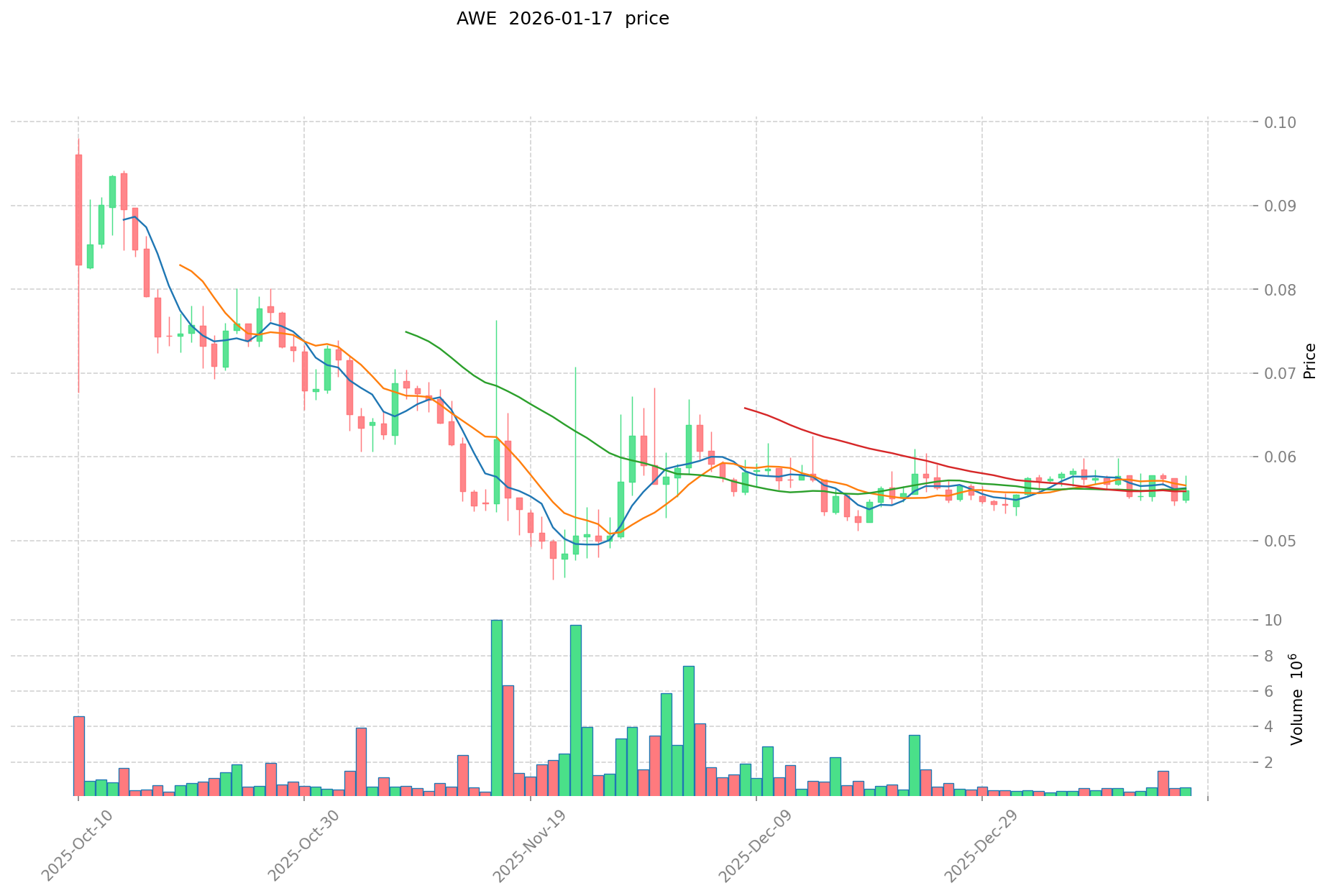
- 2025: Market correction phase → Price adjusted from elevated levels to $0.04533 on November 21, 2025
Current AWE Investment Market Status (January 2026)
- AWE current price: $0.05585
- Market sentiment (Fear & Greed Index): Data not available in provided materials
- 24-hour trading volume: $32,416.88
- Institutional investor holdings: 10,323 holders recorded
Click to view real-time AWE market price
II. Core Factors Influencing Whether AWE is a Good Investment (Is AWE Network(AWE) a Good Investment)
Supply Mechanism and Scarcity (AWE investment scarcity)
- Supply structure → influences price and investment value
- AWE Network has a maximum supply of 2,000,000,000 tokens with a current circulating supply of 1,942,419,283 tokens (97.12% circulation ratio)
- The high circulation ratio suggests limited token release pressure, which may support price stability
- Investment significance: the near-complete circulation reduces uncertainty around future supply dilution
Institutional Investment and Mainstream Adoption (Institutional investment in AWE)
- Current holder base: 10,323 holders as of the latest data
- The project focuses on AI agent collaboration and autonomous world framework development, positioning itself within emerging technology sectors
- Exchange listings: AWE is available on 19 exchanges, indicating growing platform support
Macroeconomic Environment's Impact on AWE Investment
- Market performance context: AWE showed mixed performance with 1.9% gain over 24 hours but -2.13% decline over 7 days
- Broader market conditions and risk sentiment influence investor appetite for emerging AI-focused blockchain projects
- Economic uncertainty may affect speculative interest in mid-cap tokens like AWE
Technology and Ecosystem Development (Technology & Ecosystem for AWE investment)
- Core technology: Autonomous Worlds Engine (AWE) is a modular framework enabling creation of self-sustaining worlds for scalable agent-agent and human-agent collaboration
- Ecosystem focus: the project aims to facilitate AI agent collaboration, adaptation, and evolution within autonomous environments
- Network activity: user engagement and locked AWE tokens in in-world activities may indicate ecosystem utilization and long-term value potential
- Application scope: the framework supports building self-maintaining worlds, which could expand use cases across AI-driven decentralized applications
III. AWE Future Investment Prediction and Price Outlook (Is AWE Network (AWE) worth investing in 2026-2031)
Short-term Investment Prediction (2026, short-term AWE investment outlook)
- Conservative Prediction: $0.0463 - $0.0500
- Neutral Prediction: $0.0520 - $0.0557
- Optimistic Prediction: $0.0600 - $0.0630
Mid-term Investment Outlook (2027-2029, mid-term AWE Network (AWE) investment forecast)
- Market Stage Expectation: The AWE Network token is anticipated to enter a phase of gradual expansion, with potential growth driven by increased adoption of AI agent collaboration frameworks and autonomous world infrastructure development.
- Investment Return Prediction:
- 2027: $0.0487 - $0.0748 (projected change of approximately 6% from 2026 baseline)
- 2028: $0.0537 - $0.0805 (projected change of approximately 20% from 2026 baseline)
- 2029: $0.0612 - $0.0907 (projected change of approximately 32% from 2026 baseline)
- Key Catalysts: Expansion of autonomous world ecosystems, enhanced agent-to-agent collaboration protocols, strategic partnerships within the AI and blockchain sectors, and broader integration of modular frameworks for self-sustaining digital environments.
Long-term Investment Outlook (Is AWE a good long-term investment?)
- Baseline Scenario: $0.0691 - $0.1110 (assuming steady ecosystem development and moderate market acceptance through 2030)
- Optimistic Scenario: $0.0860 - $0.1363 (assuming accelerated adoption, favorable market conditions, and significant technological advancements by 2031)
- Risk Scenario: Below $0.0463 (in cases of adverse market conditions, regulatory challenges, or failure to achieve key development milestones)
For detailed long-term investment analysis and price predictions for AWE, visit: Price Prediction
2026-2031 Long-term Outlook
- Base Scenario: $0.0463 - $0.0805 (corresponding to steady progress and gradual mainstream application growth)
- Optimistic Scenario: $0.0860 - $0.1110 (corresponding to large-scale adoption and favorable market environment)
- Transformative Scenario: Above $0.1363 (in the event of breakthrough ecosystem developments and mainstream widespread adoption)
- Predicted High by December 31, 2031: $0.1363 (based on optimistic development assumptions)
Disclaimer: The above predictions are based on available market data and analytical models. Cryptocurrency markets are highly volatile and subject to significant risks. This information does not constitute investment advice, and investors should conduct their own research and consult financial professionals before making investment decisions.
| Year |
Predicted High Price |
Predicted Average Price |
Predicted Low Price |
Price Change |
| 2026 |
0.0629749 |
0.05573 |
0.0462559 |
0 |
| 2027 |
0.074784087 |
0.05935245 |
0.048669009 |
6 |
| 2028 |
0.0804819222 |
0.0670682685 |
0.0536546148 |
20 |
| 2029 |
0.0907433672805 |
0.07377509535 |
0.0612333291405 |
32 |
| 2030 |
0.111049962275587 |
0.08225923131525 |
0.06909775430481 |
47 |
| 2031 |
0.13628298148154 |
0.096654596795418 |
0.086022591147922 |
73 |
IV. AWE Investment Strategy and Risk Management (How to invest in AI Agent Infrastructure)
Investment Methodology (AWE investment strategy)
Long-term Holding (HODL AWE)
For conservative investors seeking exposure to the autonomous AI agent ecosystem, a long-term holding strategy may be considered. AWE Network's modular framework for building self-sustaining worlds positions it within the emerging AI agent infrastructure sector. Given the project's focus on enabling scalable agent-agent and human-agent collaboration, investors with a multi-year horizon might evaluate AWE as part of a diversified AI-focused portfolio.
Key considerations for long-term holders include monitoring the project's development milestones, adoption metrics, and the broader evolution of autonomous world technologies. The circulating supply represents approximately 97.12% of the maximum supply, which suggests limited additional token inflation risk from supply expansion.
Active Trading
Active traders may approach AWE through technical analysis and momentum-based strategies. Historical price data shows the token has experienced significant volatility, with prices ranging between $0.04533 (recorded on November 21, 2025) and $0.12949 (recorded on September 25, 2025). Recent performance indicates a 1.9% increase over 24 hours and 5.39% over 30 days, while showing a decline of 2.13% over 7 days and 24.15% over one year.
Traders should consider:
- Daily trading volume patterns (current 24h volume: $32,416.88)
- Support and resistance levels within the established price range
- Market correlation with broader AI agent tokens and sentiment indicators
- Liquidity conditions across the 19 exchanges where AWE is listed
Risk Management (Risk management for AWE investment)
Asset Allocation Ratios
- Conservative investors: May limit AWE exposure to 1-3% of total crypto portfolio, focusing primarily on established assets
- Aggressive investors: Could allocate 5-10% to AWE as part of a thematic AI agent infrastructure position
- Professional investors: May incorporate AWE within specialized AI/infrastructure portfolios with appropriate hedging strategies and deeper due diligence
Given AWE's market capitalization of approximately $108.48 million and ranking at #344, position sizing should account for liquidity constraints and price impact potential.
Risk Hedging Approaches
- Multi-asset portfolio construction: Combine AWE with uncorrelated or negatively correlated assets across different blockchain sectors
- Diversification across AI agent projects: Spread exposure across multiple autonomous agent infrastructure platforms to mitigate single-project risk
- Stablecoin reserves: Maintain liquidity buffers for opportunistic rebalancing during market volatility
- Stop-loss mechanisms: Implement predetermined exit levels for active positions
Secure Storage Solutions
AWE tokens are deployed on the BASE network. Recommended storage practices include:
- Cold wallet storage: For long-term holdings, use hardware wallets compatible with BASE network (such as Ledger or Trezor with appropriate software integration)
- Hot wallet management: For active trading, use reputable wallets with BASE support while maintaining only necessary trading amounts
- Multi-signature solutions: Institutional holders should consider multi-sig wallet configurations
- Security protocols: Verify contract address (0x1b4617734c43f6159f3a70b7e06d883647512778 on BASE) through official sources before any transactions
V. AWE Investment Risks and Challenges (Risks of investing in AI Agent Infrastructure)
Market Risk
High Volatility: AWE has demonstrated substantial price fluctuations, with historical data showing movements between $0.04533 and $0.12949. Current 24-hour price range of $0.05456 to $0.05783 reflects ongoing volatility patterns. The relatively small market capitalization of $108.48 million can amplify price movements in response to trading activity.
Liquidity Considerations: With daily trading volume of approximately $32,416.88, larger position entries or exits may experience slippage. The token's availability across 19 exchanges provides some liquidity distribution, but concentration risk on specific platforms should be evaluated.
Market Manipulation Susceptibility: Lower market cap assets can be more vulnerable to coordinated trading activities. Investors should monitor unusual volume spikes and price movements.
Regulatory Risk
Jurisdictional Uncertainty: AI-related blockchain projects face evolving regulatory frameworks across different jurisdictions. As AWE Network operates in the autonomous AI agent space, future regulations concerning AI systems, data governance, and decentralized computing could impact project operations.
Classification Ambiguity: The regulatory treatment of tokens associated with AI infrastructure platforms remains undefined in many regions, creating uncertainty regarding securities laws, taxation, and reporting requirements.
Compliance Evolution: Investors should stay informed about regulatory developments in their jurisdiction and be prepared for potential changes in token accessibility or trading restrictions.
Technical Risk
Smart Contract Vulnerabilities: As with any blockchain-based project, smart contract exploits or undiscovered vulnerabilities in the AWE Network protocol could result in loss of funds or functionality disruptions.
Network Dependencies: AWE's deployment on the BASE network means the project inherits underlying infrastructure risks, including potential network congestion, security incidents, or protocol changes on the base layer.
Development Execution: The project's roadmap for building modular frameworks for autonomous worlds requires successful technical execution. Delays, architectural challenges, or inability to achieve stated technical objectives could impact token value.
Integration Complexity: The vision of enabling scalable agent-agent and human-agent collaboration involves complex technical challenges. Implementation difficulties or competitive solutions emerging in the market present execution risks.
VI. Conclusion: Is AI Agent Infrastructure a Good Investment?
Investment Value Summary
AWE Network represents an emerging opportunity within the autonomous AI agent infrastructure sector. The project's focus on building modular frameworks for self-sustaining worlds aligns with growing interest in AI agent ecosystems. However, investors should recognize that AWE exhibits characteristics typical of emerging blockchain projects: significant price volatility, evolving technology, and regulatory uncertainty.
The token's recent performance shows mixed signals, with short-term gains offset by longer-term declines from historical peaks. The market capitalization of approximately $108.48 million and position outside the top 300 cryptocurrencies indicates early-stage project status with corresponding risk-reward characteristics.
Investor Recommendations
✅ Beginners: Consider starting with dollar-cost averaging small amounts while learning about AI agent technologies. Prioritize secure wallet storage and avoid overexposure. Focus on educational resources about the autonomous worlds concept before committing significant capital.
✅ Experienced investors: May explore tactical allocation within a diversified AI infrastructure portfolio. Consider wave trading strategies based on technical indicators while maintaining core positions in established assets. Monitor project development milestones and community growth metrics.
✅ Institutional investors: Could evaluate AWE as part of thematic exposure to AI agent infrastructure, with appropriate position sizing relative to liquidity constraints. Conduct comprehensive due diligence on team credentials, technical architecture, and competitive positioning within the autonomous agent landscape.
⚠️ Disclaimer: Cryptocurrency investments carry substantial risk, including potential total loss of capital. AWE Network, as an emerging project in a nascent sector, involves elevated volatility and uncertainty. This analysis is provided for informational purposes only and does not constitute financial, investment, or legal advice. Investors should conduct independent research, assess their risk tolerance, and consult qualified financial advisors before making investment decisions.
VII. FAQ
Q1: What is AWE Network and what makes it unique in the cryptocurrency space?
AWE Network (AWE) is a blockchain project that provides a modular framework for building autonomous worlds where AI agents can collaborate, adapt, and evolve. Unlike traditional blockchain platforms, AWE focuses specifically on enabling scalable agent-to-agent and human-to-agent collaboration within self-sustaining digital environments. Deployed on the BASE network with approximately 1.94 billion tokens in circulation (97.12% of maximum supply), the project positions itself at the intersection of artificial intelligence and blockchain technology. As of January 17, 2026, AWE holds a market capitalization of $108.48 million and ranks #344 among cryptocurrencies, with availability across 19 exchanges and a holder base of 10,323 participants.
Q2: Is AWE Network a good short-term investment in 2026?
Short-term investment in AWE carries substantial volatility risk, with recent data showing mixed performance signals. While the token demonstrated a 1.9% gain over 24 hours and 5.39% increase over 30 days, it experienced a 2.13% decline over 7 days and a significant 24.15% drop over the past year. Conservative short-term predictions for 2026 range from $0.0463 to $0.0500, neutral predictions span $0.0520 to $0.0557, and optimistic scenarios suggest $0.0600 to $0.0630. The daily trading volume of approximately $32,416.88 indicates limited liquidity, which may amplify price movements. Active traders should implement technical analysis, monitor support and resistance levels, and maintain strict risk management protocols including stop-loss mechanisms.
Q3: What is the long-term investment outlook for AWE Network through 2031?
Long-term projections for AWE suggest gradual growth potential through 2031, contingent on successful ecosystem development and broader adoption of AI agent infrastructure. Under a baseline scenario, prices are expected to reach $0.0691 to $0.1110 by 2030, with optimistic forecasts predicting $0.0860 to $0.1363 by 2031—representing approximately 73% growth from the 2026 baseline. Key growth catalysts include expansion of autonomous world ecosystems, enhanced collaboration protocols, strategic partnerships within AI and blockchain sectors, and integration of modular frameworks for digital environments. However, investors should recognize the transformative nature of this technology remains unproven at scale, and risk scenarios exist where prices could fall below $0.0463 due to adverse market conditions, regulatory challenges, or developmental setbacks.
Q4: What are the primary risks of investing in AWE Network?
AWE Network presents multiple risk categories that investors must carefully evaluate. Market risks include high volatility with historical price swings between $0.04533 and $0.12949, limited liquidity based on daily trading volume, and potential manipulation vulnerability given its mid-cap status. Regulatory risks encompass evolving frameworks for AI-related blockchain projects, classification ambiguity regarding token treatment, and jurisdictional uncertainty affecting operations. Technical risks involve smart contract vulnerabilities, dependencies on BASE network infrastructure, complex development execution requirements for autonomous world frameworks, and competitive threats from emerging solutions in the AI agent space. Additionally, as an early-stage project outside the top 300 cryptocurrencies, AWE carries heightened uncertainty compared to established digital assets.
Q5: How should investors approach position sizing and risk management for AWE?
Position sizing for AWE should align with investor risk profiles and portfolio diversification principles. Conservative investors may limit AWE exposure to 1-3% of their total cryptocurrency portfolio, focusing primarily on established assets while treating AWE as exploratory exposure to AI agent infrastructure. Aggressive investors could allocate 5-10% within a thematic AI/infrastructure position, while professional investors might incorporate AWE into specialized portfolios with appropriate hedging strategies. Risk management approaches should include multi-asset portfolio construction combining AWE with uncorrelated assets, diversification across multiple AI agent projects to mitigate single-project risk, maintaining stablecoin reserves for opportunistic rebalancing, and implementing stop-loss mechanisms for active positions. Secure storage using cold wallets compatible with BASE network (such as hardware wallets) is essential for long-term holdings.
Q6: What technological factors influence AWE's investment value?
AWE's investment value is fundamentally tied to its technological capabilities and ecosystem development. The Autonomous Worlds Engine provides a modular framework enabling creation of self-sustaining environments for scalable collaboration, which positions the project within emerging AI-driven decentralized applications. Network activity metrics, including user engagement and locked AWE tokens in in-world activities, serve as indicators of ecosystem utilization and long-term value potential. The project's ability to facilitate AI agent adaptation and evolution within autonomous environments represents its core value proposition. However, the execution complexity of building these frameworks presents both opportunity and risk—successful implementation could drive adoption and token demand, while technical challenges or competitive solutions could undermine value. The high circulation ratio of 97.12% reduces uncertainty around future supply dilution, potentially supporting price stability as ecosystem development progresses.
Q7: How does AWE compare to other investment opportunities in the AI agent infrastructure sector?
AWE Network occupies a niche position within the broader AI agent infrastructure landscape, focusing specifically on autonomous worlds and agent collaboration frameworks. With a market capitalization of approximately $108.48 million and ranking at #344, AWE represents a smaller-scale project compared to established blockchain platforms, carrying both higher growth potential and elevated risk. The token's availability across 19 exchanges provides reasonable accessibility, while the holder base of 10,323 participants suggests growing but still developing community engagement. Investors evaluating AWE relative to other AI infrastructure projects should consider factors including technical differentiation (modular framework approach), market traction (holder growth and exchange listings), development progress toward stated objectives, and competitive positioning within the autonomous agent ecosystem. A diversified approach allocating across multiple AI agent infrastructure projects may offer superior risk-adjusted returns compared to concentrated exposure to any single platform in this emerging sector.
Q8: What investment strategy is most appropriate for AWE Network?
The optimal AWE investment strategy depends on investor objectives, risk tolerance, and market outlook. Long-term holding (HODL) strategies may suit conservative investors seeking diversified exposure to the autonomous AI agent ecosystem, with a multi-year horizon allowing time for technology maturation and potential adoption. This approach requires monitoring development milestones, adoption metrics, and the broader evolution of autonomous world technologies. Active trading strategies may be more appropriate for experienced participants comfortable with volatility, utilizing technical analysis and momentum-based approaches within the established price range of $0.04533 to $0.12949. Dollar-cost averaging represents a middle-ground approach suitable for beginners, accumulating positions gradually while learning about the technology and market dynamics. Regardless of strategy selection, all investors should prioritize secure token storage using appropriate BASE network-compatible wallets, implement predetermined risk management protocols, and maintain position sizes consistent with their broader portfolio diversification objectives and capacity for potential loss.
* The information is not intended to be and does not constitute financial advice or any other recommendation of any sort offered or endorsed by Gate.