Babylon (BABY) is a Bitcoin staking infrastructure token currently trading at $0.01762 with a market cap of $40.42 million. This comprehensive analysis examines whether BABY represents a sound investment across multiple dimensions: price history reveals an 82.66% annual decline from peak performance, while technical fundamentals highlight native Bitcoin staking capabilities and shared-security architecture. The article evaluates investment characteristics through supply mechanisms, institutional adoption on 31 exchanges including Gate, and macroeconomic factors affecting Bitcoin ecosystem assets. Short-to-long-term price projections range from $0.0155-$0.0181 (2026) to $0.0179-$0.0364 (2031), contingent upon ecosystem adoption and regulatory environment. Investment strategies span conservative long-term holding to active trading approaches, with recommended portfolio allocations of 1-10% depending on risk tolerance. Critical considerations include market volatility, unlimited supply dynamics, regulatory uncer
Introduction: Babylon (BABY)'s Investment Position and Market Prospects
Babylon (BABY) represents a notable asset in the cryptocurrency space, designed to enable native Bitcoin staking directly on the Bitcoin blockchain without intermediaries. As of January 20, 2026, BABY maintains a market capitalization of approximately $40.42 million, with a circulating supply of about 2.29 billion tokens and a current price around $0.01762. The token holds a market ranking of 604 and accounts for 0.0053% of the total cryptocurrency market. With its positioning in Bitcoin staking infrastructure and shared-security architecture, Babylon has garnered attention among investors exploring "Is Babylon (BABY) a good investment?" This article provides a comprehensive analysis of BABY's investment characteristics, historical performance, future price projections, and associated risks to serve as a reference for investors.
I. Price History Review and Investment Value Status of BABY Token
Babylon (BABY) demonstrated significant price volatility since its launch in April 2025. The token reached a peak of $0.17201 on April 10, 2025, but subsequently experienced substantial downward pressure, declining to $0.00935 by October 10, 2025. Over the past year, BABY has recorded a decline of 82.66%, reflecting broader market adjustments and evolving investor sentiment within the cryptocurrency sector.
Current BABY Investment Market Status (January 2026)
- Current BABY Price: $0.01762
- 24-hour Trading Volume: $147,094.51
- Market Capitalization: $40,420,922.97
- Circulating Supply: 2,294,036,491 BABY (22.94% of total supply)
- 24-hour Price Change: +1.32%
- 7-day Price Change: -0.73%
- 30-day Price Change: +1.79%
- Market Dominance: 0.0053%
- Listed on 31 Exchanges
Click to view real-time BABY market price
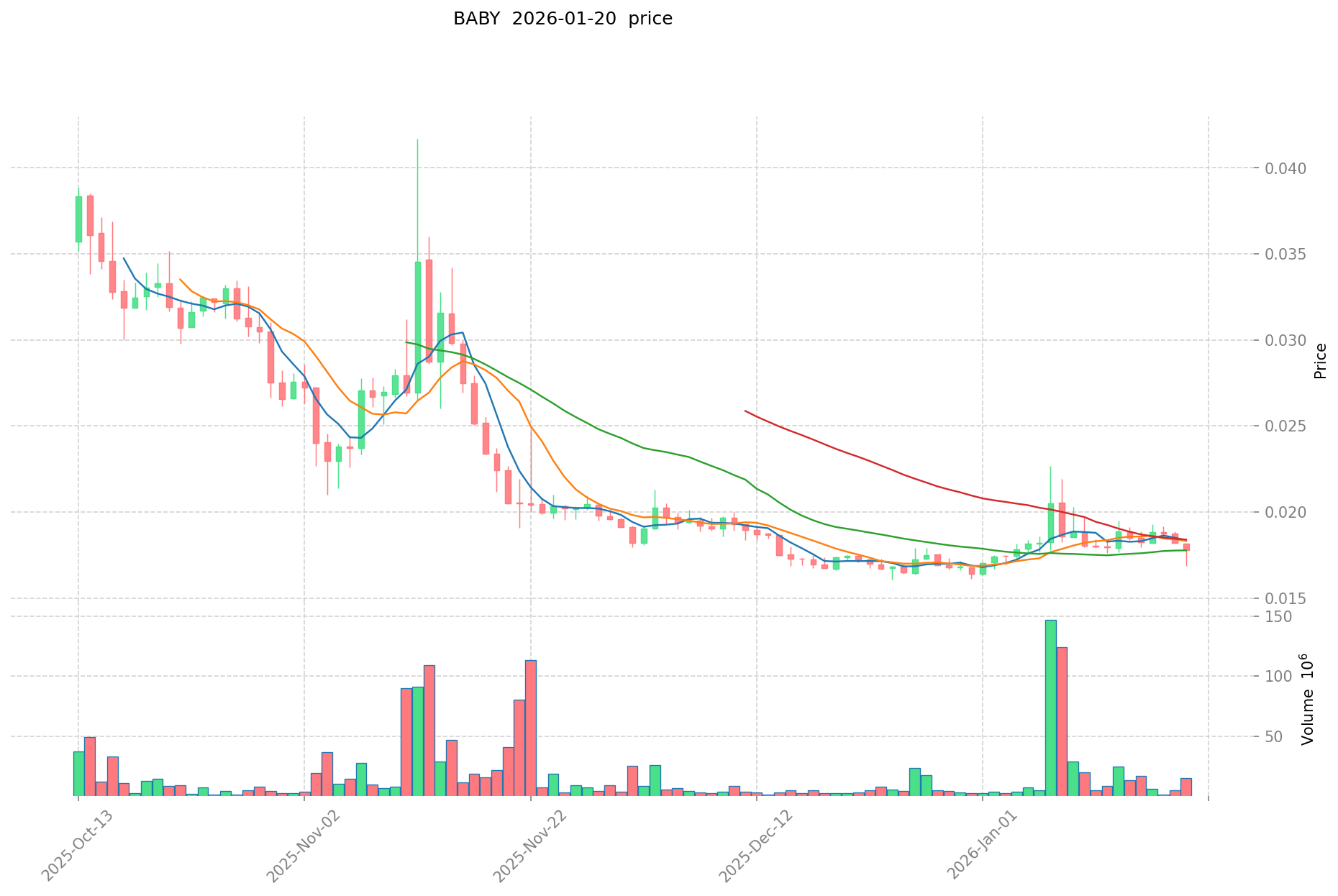
II. Core Factors Affecting Whether BABY is a Good Investment (Is Babylon(BABY) a Good Investment)
Supply Mechanism and Scarcity (BABY investment scarcity)
- Unlimited maximum supply mechanism → potentially affects long-term price dynamics and investment value assessment
- Current circulating supply represents 22.94% of total supply, with 2.29 billion BABY tokens in circulation
- Investment consideration: The infinite supply model requires investors to evaluate scarcity factors differently compared to fixed-supply assets
Institutional Investment and Mainstream Adoption (Institutional investment in BABY)
- Exchange adoption: BABY is listed on 31 cryptocurrency exchanges, indicating a certain level of market recognition
- Market capitalization to fully diluted valuation ratio stands at 22.94%, reflecting current circulation relative to potential total supply
Macroeconomic Environment's Impact on BABY Investment
- Monetary policy and interest rate changes → may alter investment attractiveness across digital asset markets
- Market positioning: As part of the Bitcoin ecosystem expansion, BABY's investment appeal may correlate with broader Bitcoin market sentiment
- Geopolitical uncertainty → could influence demand for decentralized finance solutions and Bitcoin-related assets
Technology and Ecosystem Development (Technology & Ecosystem for BABY investment)
- Native Bitcoin staking protocol: Enables direct staking on Bitcoin blockchain without intermediaries → enhances utility value proposition
- Shared-security architecture: Extends Bitcoin's security model to broader decentralized ecosystem → supports long-term ecosystem development
- Bitcoin Secured Networks (BSNs) infrastructure: Provides verifiable security guarantees while maintaining assets on Bitcoin network → strengthens investment fundamentals through technical innovation
III. BABY Future Investment Predictions and Price Outlook (Is Babylon(BABY) worth investing in 2026-2031)
Short-term Investment Prediction (2026, short-term BABY investment outlook)
- Conservative Forecast: $0.0155 - $0.0165
- Neutral Forecast: $0.0165 - $0.0176
- Optimistic Forecast: $0.0176 - $0.0181
Mid-term Investment Outlook (2027-2028, mid-term Babylon(BABY) investment forecast)
- Market Phase Expectation: The token may experience gradual growth as the native Bitcoin staking infrastructure matures and attracts more participants seeking to leverage Bitcoin's security model for decentralized applications.
- Investment Return Prediction:
- 2027: $0.0118 - $0.0202
- 2028: $0.0122 - $0.0236
- Key Catalysts: Expansion of Bitcoin Secured Networks (BSNs), increased adoption of shared-security architecture, protocol upgrades enhancing multi-staking operations, and broader market acceptance of native Bitcoin staking mechanisms.
Long-term Investment Outlook (Is Babylon a good long-term investment?)
- Base Scenario: $0.0179 - $0.0259 (assuming steady ecosystem development and moderate expansion of Bitcoin staking adoption)
- Optimistic Scenario: $0.0259 - $0.0364 (assuming accelerated BSN integration, significant protocol enhancements, and favorable regulatory environment for Bitcoin-based DeFi solutions)
- Risk Scenario: $0.0115 - $0.0155 (considering potential technical challenges, limited market adoption, or adverse macroeconomic conditions affecting the broader cryptocurrency market)
Click to view BABY long-term investment and price prediction: Price Prediction
2026-01-20 - 2031 Long-term Outlook
- Base Scenario: $0.0179 - $0.0280 USD (corresponding to steady progress and gradual mainstream application enhancement)
- Optimistic Scenario: $0.0259 - $0.0364 USD (corresponding to large-scale adoption and favorable market environment)
- Transformative Scenario: Above $0.0364 USD (if the ecosystem achieves breakthrough developments and mainstream popularization)
- 2031-12-31 Predicted High: $0.0364 USD (based on optimistic development assumptions)
Disclaimer: Price predictions are speculative and subject to market volatility. Cryptocurrency investments carry inherent risks, and past performance does not guarantee future results. Investors should conduct thorough research and consider their risk tolerance before making investment decisions.
| Year |
Predicted High Price |
Predicted Average Price |
Predicted Low Price |
Price Change |
| 2026 |
0.0181486 |
0.01762 |
0.0155056 |
0 |
| 2027 |
0.020209259 |
0.0178843 |
0.011803638 |
1 |
| 2028 |
0.02361800658 |
0.0190467795 |
0.01218993888 |
8 |
| 2029 |
0.0305053220472 |
0.02133239304 |
0.0115194922416 |
21 |
| 2030 |
0.030065874750576 |
0.0259188575436 |
0.023586160364676 |
47 |
| 2031 |
0.036390075991214 |
0.027992366147088 |
0.017915114334136 |
58 |
IV. Babylon Investment Strategy and Risk Management (How to invest in Babylon)
Investment Methodology (Babylon investment strategy)
Long-term Holding (HODL Babylon)
Long-term holding represents a suitable approach for conservative investors in the Babylon ecosystem. This strategy involves acquiring BABY tokens and maintaining positions through market cycles, focusing on the protocol's fundamental value proposition in Bitcoin staking infrastructure. Investors adopting this methodology typically prioritize the project's technological development and ecosystem expansion over short-term price movements.
Active Trading
Active trading strategies for Babylon rely on technical analysis and swing trading techniques. Given the token's 24-hour volatility of 1.32% and trading range between $0.01724 and $0.018, traders may identify opportunities through price action patterns and volume analysis. The asset's circulation ratio of 22.94% and total supply structure should be considered when evaluating liquidity conditions for entry and exit positions.
Risk Management (Risk management for Babylon investment)
Asset Allocation Ratios
- Conservative investors: May consider allocating 1-3% of their crypto portfolio to Babylon, given its relatively early stage and market position at rank 604
- Aggressive investors: Could allocate 5-10% depending on risk tolerance and conviction in Bitcoin staking infrastructure
- Professional investors: May employ dynamic allocation strategies based on market conditions and protocol developments
Risk Hedging Solutions
Multi-asset portfolio construction combined with hedging instruments can mitigate Babylon-specific risks. Investors might consider diversifying across different Bitcoin ecosystem projects, maintaining positions in established cryptocurrencies, and utilizing stablecoin reserves for opportunistic rebalancing.
Secure Storage
Cold and hot wallet solutions present different security profiles for BABY token storage. Hardware wallets provide enhanced security for long-term holdings, while hot wallets may facilitate active trading strategies. Investors should evaluate custody solutions based on their investment timeframe and trading frequency.
V. Babylon Investment Risks and Challenges (Risks of investing in Babylon)
Market Risks
Babylon exhibits notable price volatility characteristics. The token has experienced a 1-year decline of 82.66%, with its current price at $0.01762 representing significant deviation from its all-time high of $0.17201 recorded on April 10, 2025. The 24-hour trading volume of $147,094.51 and market capitalization of approximately $40.42 million suggest relatively limited liquidity compared to established cryptocurrencies. Price dynamics may be influenced by broader market sentiment and Bitcoin ecosystem developments.
Regulatory Risks
Regulatory frameworks for cryptocurrency staking mechanisms vary across jurisdictions. The protocol's native Bitcoin staking functionality may face evolving compliance requirements as regulators develop guidelines for decentralized finance activities. Different national approaches to cryptocurrency regulation introduce uncertainty regarding the protocol's operational environment and potential market access restrictions.
Technical Risks
As a decentralized system implementing shared-security architecture on the Bitcoin blockchain, Babylon faces technical considerations including network security vulnerabilities and protocol upgrade execution. The innovation of enabling native Bitcoin staking without intermediaries introduces novel technical complexities that require ongoing development and security auditing. Potential smart contract vulnerabilities or consensus mechanism challenges could impact the protocol's functionality and user funds.
VI. Conclusion: Is Babylon a Good Investment?
Investment Value Summary
Babylon presents a distinctive value proposition within the Bitcoin ecosystem through its native staking functionality and shared-security architecture. The protocol addresses a specific infrastructure need for Bitcoin holders seeking staking opportunities while maintaining assets on the Bitcoin network. However, the token's performance metrics indicate substantial price volatility, with the current valuation significantly below historical peaks. The market capitalization to fully diluted valuation ratio of 22.94% suggests considerable potential token supply expansion that investors should consider.
Investor Recommendations
✅ Beginners: Consider dollar-cost averaging strategies combined with secure wallet storage solutions. Focus on understanding the protocol's fundamental mechanisms before establishing positions.
✅ Experienced Investors: May explore swing trading opportunities while maintaining core portfolio allocations. Consider the token's volatility profile and liquidity conditions when determining position sizing.
✅ Institutional Investors: Could evaluate strategic long-term allocation within broader Bitcoin infrastructure thesis, conducting thorough due diligence on protocol development and ecosystem adoption metrics.
⚠️ Disclaimer: Cryptocurrency investments involve substantial risk. This content is provided for informational purposes only and does not constitute investment advice. Investors should conduct independent research and consider their financial circumstances before making investment decisions.
VII. FAQ
Q1: What is the current market position of Babylon (BABY) and is it suitable for new investors?
Babylon (BABY) currently holds a market ranking of 604 with a market capitalization of approximately $40.42 million and trades at $0.01762 as of January 20, 2026. For new investors, BABY represents a speculative early-stage investment in Bitcoin staking infrastructure. The token has experienced significant volatility, declining 82.66% over the past year from its all-time high of $0.17201. New investors should approach cautiously, considering only conservative portfolio allocations (1-3%) and employing dollar-cost averaging strategies to mitigate volatility risks. The protocol's technological innovation in native Bitcoin staking provides long-term potential, but investors must acknowledge the substantial risk profile associated with early-stage cryptocurrency projects.
Q2: How does Babylon's unlimited supply mechanism affect its investment value?
Babylon operates with an unlimited maximum supply model, which fundamentally differs from fixed-supply cryptocurrencies like Bitcoin. Currently, only 22.94% of the total supply (2.29 billion BABY tokens) is in circulation, indicating substantial potential for future token releases. This unlimited supply mechanism may create downward price pressure as additional tokens enter circulation, affecting long-term scarcity dynamics. Investors should evaluate this characteristic within their investment thesis, understanding that traditional scarcity-driven value appreciation may not apply. The supply model requires continuous assessment of the protocol's ability to generate demand through utility and adoption that exceeds the pace of supply expansion, making fundamental analysis of ecosystem development critical for investment decisions.
Q3: What are the primary catalysts that could drive BABY's price appreciation through 2031?
Several key catalysts could support BABY's price trajectory through 2031. First, the expansion of Bitcoin Secured Networks (BSNs) and increased adoption of the shared-security architecture may drive fundamental demand for the token. Second, protocol upgrades enhancing multi-staking operations and native Bitcoin staking functionality could attract more participants seeking to leverage Bitcoin's security model. Third, broader market acceptance of Bitcoin-based DeFi solutions and favorable regulatory developments for cryptocurrency staking mechanisms would create positive conditions. Fourth, successful integration with additional decentralized applications requiring Bitcoin-level security could expand the protocol's utility. Price predictions range from $0.0179-$0.0280 in base scenarios to $0.0259-$0.0364 in optimistic scenarios by 2031, dependent on these catalysts materializing effectively.
Q4: What trading strategies are most effective for investing in Babylon (BABY)?
Two primary strategies suit different investor profiles for BABY investment. Long-term holding (HODL) appeals to conservative investors focused on the protocol's fundamental development in Bitcoin staking infrastructure, prioritizing technological progress over short-term price movements. This approach suits those with conviction in the project's long-term value proposition and tolerance for extended holding periods through market cycles. Active trading strategies leverage the token's volatility (24-hour range of $0.01724-$0.018) through technical analysis and swing trading, suitable for experienced traders comfortable with risk management and technical chart patterns. Given the token's 24-hour volatility of 1.32% and relatively limited liquidity (trading volume of $147,094.51), active traders should implement strict position sizing and stop-loss disciplines. Hybrid approaches combining core long-term holdings with tactical trading allocations may balance exposure optimization with risk management.
Q5: What are the main technical risks associated with investing in Babylon?
Babylon faces several technical risks inherent to its innovative architecture. As a protocol enabling native Bitcoin staking without intermediaries, it introduces novel technical complexities requiring ongoing development and security auditing. Smart contract vulnerabilities could potentially compromise user funds or protocol functionality, particularly given the early-stage nature of the implementation. The shared-security architecture extending Bitcoin's security model to broader decentralized ecosystems presents coordination challenges and potential consensus mechanism risks. Network security vulnerabilities may emerge as the protocol scales and attracts more participants. Protocol upgrade execution risks include potential bugs, migration challenges, or coordination failures during critical updates. Investors should monitor the project's security audit reports, development activity, and community response to technical issues as ongoing indicators of technical risk management effectiveness.
Q6: How does Babylon compare to traditional Bitcoin investment opportunities?
Babylon represents a distinct investment category within the Bitcoin ecosystem rather than a direct alternative to Bitcoin holdings. Unlike holding Bitcoin directly, BABY investment focuses on infrastructure enabling Bitcoin staking functionality, creating exposure to protocol adoption rather than Bitcoin's price appreciation alone. The unlimited supply model contrasts sharply with Bitcoin's fixed 21 million supply cap, fundamentally altering scarcity dynamics. BABY's volatility (82.66% annual decline) significantly exceeds typical Bitcoin volatility, indicating higher risk-reward profiles. The protocol's value depends on successful ecosystem development and adoption of Bitcoin staking mechanisms, whereas Bitcoin's value derives from network effect, scarcity, and store-of-value characteristics. Investors viewing Babylon as complementary to Bitcoin holdings rather than substitutes may benefit from portfolio diversification across different Bitcoin ecosystem exposure types, though BABY carries substantially higher risk than established Bitcoin positions.
Q7: What regulatory considerations should investors evaluate before investing in BABY?
Regulatory frameworks for cryptocurrency staking mechanisms vary significantly across jurisdictions, creating uncertainty for Babylon investors. The protocol's native Bitcoin staking functionality may face evolving compliance requirements as regulators develop guidelines for decentralized finance activities and staking-as-a-service operations. Different national approaches to cryptocurrency regulation introduce uncertainty regarding operational environments and potential market access restrictions in specific regions. Securities classification considerations may affect how BABY tokens are treated in various jurisdictions, potentially impacting exchange listings, institutional participation, and retail access. Tax implications for staking rewards and token appreciation differ across countries, requiring investor awareness of local reporting requirements. Investors should monitor regulatory developments in their jurisdictions, assess the protocol's compliance framework, and consider geographic diversification of custody solutions to mitigate jurisdiction-specific regulatory risks.
Q8: What portfolio allocation is appropriate for Babylon (BABY) investment?
Appropriate portfolio allocation for BABY depends on investor risk tolerance, experience level, and overall investment objectives. Conservative investors should consider limiting BABY exposure to 1-3% of their cryptocurrency portfolio, given its relatively early-stage development, market ranking of 604, and significant price volatility. Aggressive investors comfortable with higher risk profiles might allocate 5-10% depending on conviction in Bitcoin staking infrastructure and tolerance for substantial drawdowns. Professional investors may employ dynamic allocation strategies, adjusting positions based on market conditions, protocol development milestones, and risk-adjusted return metrics. The token's market capitalization to fully diluted valuation ratio of 22.94% suggests potential future dilution that should inform sizing decisions. Investors should avoid concentration risk by maintaining diversification across established cryptocurrencies, different blockchain ecosystems, and stablecoin reserves for opportunistic rebalancing during market dislocations.
* The information is not intended to be and does not constitute financial advice or any other recommendation of any sort offered or endorsed by Gate.