This comprehensive analysis evaluates whether Badger DAO (BADGER) represents a sound investment opportunity within the DeFi ecosystem. Trading at $0.5171 with a market capitalization of $10.31 million, BADGER functions as a governance token for Bitcoin-focused DeFi yield strategies through its Sett vault aggregator and DIGG elastic supply token. The article examines BADGER's historical performance from its $89.08 peak in February 2021 to current levels, analyzing key investment factors including fixed maximum supply of 21 million tokens at 94.91% circulation, institutional adoption across 9 exchanges with 31,241 holders, and governance utility mechanisms. Price forecasts range from conservative ($0.34-$0.52 by 2026) to optimistic ($1.18-$1.60 by 2031) scenarios, though investors must consider substantial market volatility, regulatory uncertainties, and technical risks associated with DeFi protocols. The analysis provides investment strategies for different risk profiles and emphasizes the importance of thorou
Introduction: Badger DAO (BADGER) Investment Position and Market Outlook
BADGER is a notable asset in the cryptocurrency sector, launched in December 2020 as a decentralized autonomous organization (DAO) focused on integrating Bitcoin into decentralized finance (DeFi). As of January 26, 2026, BADGER holds a market capitalization of approximately $10.31 million, with a circulating supply of around 19.93 million tokens and a current trading price near $0.5171. With its positioning as a governance token for Bitcoin-focused DeFi yield strategies, BADGER has attracted attention in discussions around "Is Badger DAO (BADGER) a good investment?" This article provides a comprehensive analysis of BADGER's investment characteristics, historical performance trends, future price perspectives, and associated risks to serve as reference material for market participants.
I. Historical Price Review and Current Investment Value of BADGER
- February 2021: BADGER reached a significant price level of $89.08 during the early DeFi expansion period → Early investors experienced substantial gains during this phase
- 2021-2025: The token underwent multiple market cycles → Price declined from peak levels to lower ranges as market conditions evolved
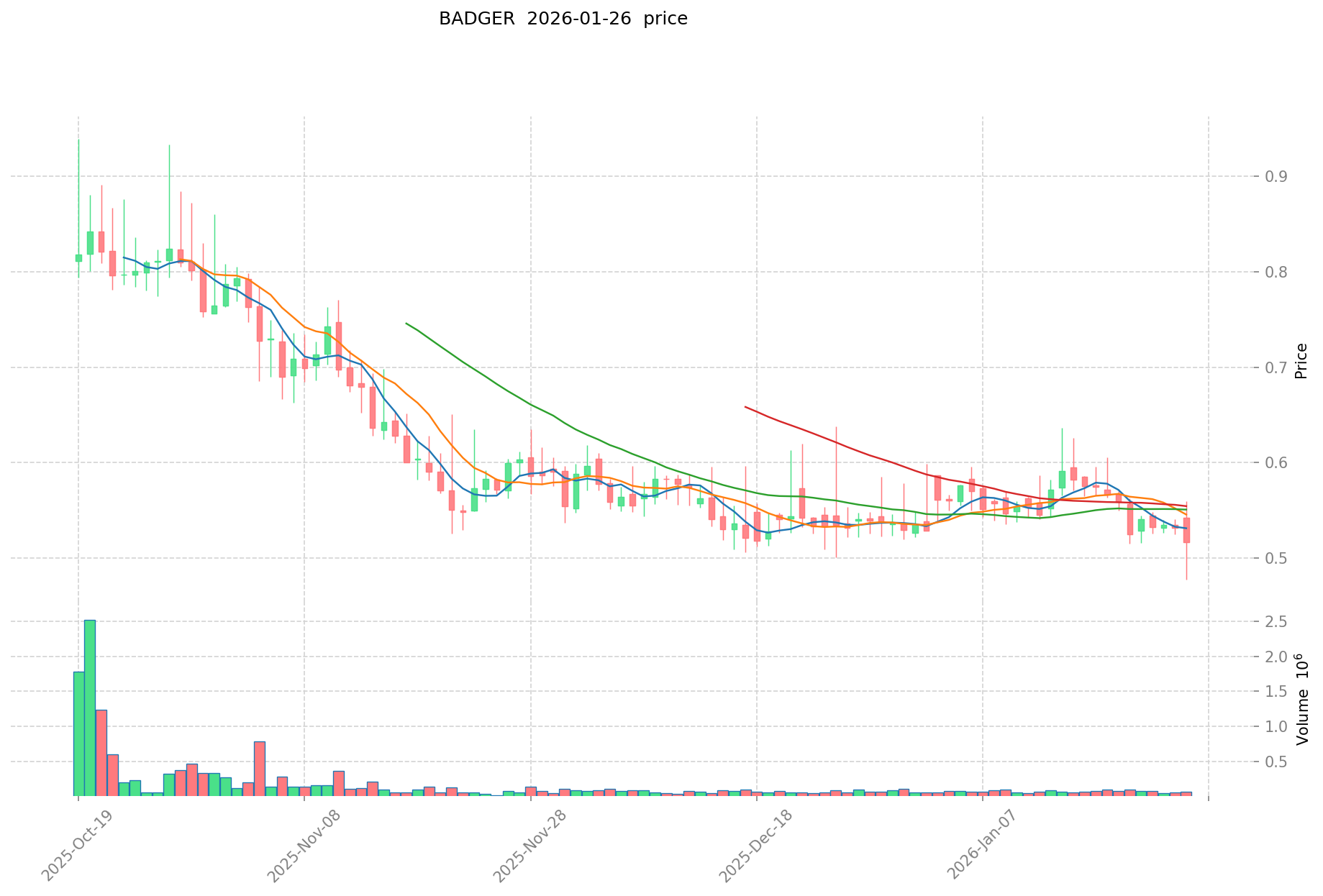
- January 2026: Current market phase → Trading at $0.5171, representing a considerable adjustment from previous price levels
Current BADGER Investment Market Status (January 2026)
- Current BADGER Price: $0.5171
- 24-hour Trading Volume: $37,603.06
- Market Capitalization: $10.31 million
- Circulating Supply: 19.93 million BADGER (94.91% of max supply)
- Token Holder Count: 31,241 addresses
Click to view real-time BADGER market price
II. Core Factors Affecting Whether BADGER is a Good Investment
Supply Mechanism and Scarcity (BADGER Investment Scarcity)
- Fixed Maximum Supply: BADGER has a maximum supply of 21,000,000 tokens, with approximately 19,930,669.91 tokens currently in circulation, representing a circulation ratio of 94.91%. This fixed supply cap creates inherent scarcity similar to Bitcoin's model.
- Supply Impact on Value: The token's supply mechanism directly influences its investment characteristics. As circulation approaches the maximum supply, the limited availability may affect price dynamics in relation to demand fluctuations.
- Investment Significance: The predetermined supply ceiling establishes a transparent scarcity framework that investors can factor into long-term value assessments.
Institutional Investment and Mainstream Adoption (Institutional Investment in BADGER)
- Holder Distribution: The token currently has 31,241 holders across various platforms, indicating a distributed ownership structure within the cryptocurrency ecosystem.
- Exchange Accessibility: BADGER is listed on 9 exchanges, providing liquidity channels for institutional and retail participants to access the asset.
- Adoption Considerations: The token's integration within the DeFi ecosystem, particularly its focus on bringing Bitcoin-related assets into decentralized finance, positions it within a specific market segment that may attract institutions interested in Bitcoin-DeFi bridging solutions.
Macroeconomic Environment's Impact on BADGER Investment
- Market Conditions: Cryptocurrency assets, including BADGER, can be influenced by broader macroeconomic factors such as monetary policy adjustments and interest rate changes, which may affect risk appetite in digital asset markets.
- Inflation Dynamics: During periods of currency devaluation concerns, some investors explore cryptocurrency allocations as part of portfolio diversification strategies, though BADGER's specific role differs from larger-cap assets.
- Regulatory Environment: Evolving policies regarding decentralized finance and governance tokens may impact the operational framework and investment considerations for DAO-structured projects like Badger DAO.
Technology and Ecosystem Development (Technology & Ecosystem for BADGER Investment)
- Core Product Suite: Badger DAO's ecosystem includes Sett (a yield aggregator focused on Bitcoin-related yield strategies) and DIGG (an elastic supply token pegged to Bitcoin's price), which form the foundation of its value proposition.
- Governance Functionality: BADGER token holders can participate in governance decisions covering marketing strategies, protocol parameters, token supply management, and smart contract modifications, providing utility beyond price speculation.
- Incentive Mechanisms: The platform implements multiple reward systems including staking rewards for deposited assets, liquidity mining rewards for Sett product participants, and developer mining rewards for ecosystem contributors.
- DeFi Integration: As an ERC-20 token on Ethereum, BADGER operates within the broader DeFi infrastructure, with potential interactions across various protocols and applications focused on Bitcoin-backed assets in decentralized finance.
III. BADGER Future Investment Forecast and Price Outlook (Is Badger DAO(BADGER) worth investing in 2026-2031)
Short-term Investment Forecast (2026, short-term BADGER investment outlook)
- Conservative forecast: $0.34 - $0.52
- Neutral forecast: $0.52 - $0.72
- Optimistic forecast: $0.72 and above
Mid-term Investment Outlook (2027-2029, mid-term Badger DAO(BADGER) investment forecast)
-
Market stage expectation: During 2027-2029, BADGER may experience moderate growth cycles influenced by DeFi sector development and Bitcoin-related yield strategies. The token's performance could correlate with broader adoption of decentralized governance mechanisms and Bitcoin DeFi integration initiatives.
-
Investment return forecast:
- 2027: $0.39 - $0.83
- 2028: $0.44 - $0.96
- 2029: $0.67 - $1.17
-
Key catalysts: Evolution of Badger DAO's governance structure, development of Sett yield aggregator products, potential enhancements to the DIGG elastic supply token mechanism, and overall growth trajectory of Bitcoin-related DeFi protocols.
Long-term Investment Outlook (Is BADGER a good long-term investment?)
- Baseline scenario: $0.76 - $1.47 (assuming steady development of DAO governance and moderate expansion of Bitcoin DeFi ecosystem)
- Optimistic scenario: $1.18 - $1.60 (assuming enhanced adoption of Badger products and favorable regulatory environment for DeFi)
- Risk scenario: Below $0.34 (in case of severe market downturns or significant protocol challenges)
View BADGER long-term investment and price forecast: Price Prediction
2026-01-26 - 2031 Long-term Outlook
- Baseline scenario: $0.76 - $1.47 USD (corresponding to steady progress and gradual mainstream application enhancement)
- Optimistic scenario: $1.18 - $1.60 USD (corresponding to large-scale adoption and favorable market environment)
- Transformative scenario: Above $1.60 USD (if ecosystem achieves breakthrough progress and mainstream popularization)
- 2031-12-31 predicted high: $1.60 USD (based on optimistic development assumptions)
Disclaimer: Cryptocurrency investments carry substantial risk. Price predictions are speculative estimates based on historical data and market analysis models, and should not be considered as investment advice. Past performance does not guarantee future results. Investors should conduct independent research and assess their risk tolerance before making investment decisions.
| Year |
Predicted High Price |
Predicted Average Price |
Predicted Low Price |
Price Change |
| 2026 |
0.721271 |
0.5189 |
0.342474 |
0 |
| 2027 |
0.83091457 |
0.6200855 |
0.390653865 |
19 |
| 2028 |
0.9576600462 |
0.725500035 |
0.44255502135 |
39 |
| 2029 |
1.169796256434 |
0.8415800406 |
0.67326403248 |
62 |
| 2030 |
1.46830469683482 |
1.005688148517 |
0.76432299287292 |
93 |
| 2031 |
1.595725385251923 |
1.23699642267591 |
1.175146601542114 |
138 |
IV. BADGER Investment Strategy and Risk Management (How to invest in Badger DAO)
Investment Strategy (BADGER investment strategy)
Long-term Holding (HODL BADGER): Suitable for Conservative Investors
Long-term holding represents a fundamental approach for investors seeking exposure to Badger DAO's governance and DeFi ecosystem. This strategy involves acquiring BADGER tokens and maintaining positions through market cycles, potentially benefiting from the platform's governance utility and DeFi Bitcoin integration initiatives.
Active Trading: Technical Analysis and Swing Trading
Active traders may utilize technical analysis to identify entry and exit points based on BADGER's price movements. The token has demonstrated notable volatility, with 24-hour fluctuations ranging between $0.4774 and $0.5376 as of January 26, 2026. Traders employing this approach should monitor volume patterns, with recent 24-hour trading volume at approximately $37,603.
Risk Management (Risk management for BADGER investment)
Asset Allocation Ratios: Conservative / Aggressive / Professional Investors
Conservative Portfolio: 1-3% allocation to BADGER within a diversified crypto portfolio, combined with traditional assets and stablecoins.
Moderate Portfolio: 5-10% allocation for investors comfortable with higher volatility, balanced with established cryptocurrencies and DeFi tokens.
Aggressive Portfolio: 15-25% allocation for experienced investors specifically targeting DeFi governance opportunities and Bitcoin-related protocols.
Investors can implement diversification strategies by combining BADGER with other DeFi governance tokens, Bitcoin-wrapped assets, and major cryptocurrencies. Position sizing should account for BADGER's circulating supply of approximately 19.93 million tokens out of a maximum supply of 21 million, representing approximately 94.91% circulation.
Secure Storage: Hot/Cold Wallets + Hardware Wallet Recommendations
Cold Storage Solutions: Hardware wallets provide optimal security for long-term BADGER holdings. Given that BADGER operates as an ERC-20 token on Ethereum (contract address: 0x3472a5a71965499acd81997a54bba8d852c6e53d), compatible hardware wallets supporting Ethereum standards are recommended.
Hot Wallet Considerations: For active traders and governance participants, secure software wallets with multi-signature capabilities offer convenience while maintaining reasonable security standards.
Multi-signature Setups: Institutional investors and high-net-worth individuals should consider multi-signature wallet configurations to enhance security protocols.
V. BADGER Investment Risks and Challenges (Risks of investing in Badger DAO)
Market Risks: High Volatility and Price Fluctuations
BADGER exhibits considerable price volatility characteristic of smaller-cap DeFi governance tokens. Recent performance indicators show:
- 1-hour change: +1.31%
- 24-hour change: -3.43%
- 7-day change: -8.67%
- 30-day change: -4.12%
- 1-year change: -86.82%
The token's current price of $0.5171 reflects substantial distance from previous price levels, with the current market capitalization at approximately $10.31 million and fully diluted valuation at $10.86 million. The relatively modest trading volume of $37,603 over 24 hours may indicate limited liquidity conditions.
Regulatory Risks: Policy Uncertainty Across Jurisdictions
As a DeFi governance token facilitating Bitcoin integration into decentralized finance, BADGER faces evolving regulatory landscapes across multiple jurisdictions. Governance token classifications, DeFi protocol regulations, and cross-border digital asset policies remain subject to ongoing developments that could impact token utility and market accessibility.
Technical Risks: Network Security Vulnerabilities and Upgrade Challenges
Smart Contract Dependencies: As an ERC-20 token operating on Ethereum, BADGER inherits the security assumptions and potential vulnerabilities of both the Ethereum network and its own protocol smart contracts.
Protocol Evolution Risks: The Badger DAO ecosystem includes complex DeFi products such as Sett (yield aggregator) and DIGG (elastic supply token pegged to Bitcoin price), which introduce technical complexity and potential integration challenges.
Governance Implementation: Decentralized governance mechanisms, while promoting community participation, may face coordination challenges or potential governance attacks affecting protocol decisions.
VI. Conclusion: Is Badger DAO a Good Investment?
Investment Value Summary
BADGER represents a specialized DeFi governance token targeting Bitcoin integration into decentralized finance. The project's focus on yield optimization through Sett vaults and Bitcoin-pegged mechanisms offers specific utility within the DeFi ecosystem. However, investors should note that BADGER faces considerable volatility and significant price adjustments from previous levels, with market performance showing negative trends across multiple timeframes.
The token maintains a relatively high circulation rate of approximately 94.91%, with 19.93 million tokens circulating out of a 21 million maximum supply. The project is listed on 9 exchanges and has approximately 31,241 holders, indicating a moderate but established community presence.
Investor Recommendations
✅ Beginners: Consider small position sizing through dollar-cost averaging strategies, combined with secure hardware wallet storage. Focus on understanding DeFi governance mechanisms and platform utility before significant capital allocation.
✅ Experienced Investors: May explore tactical allocation strategies incorporating technical analysis for entry and exit timing. Portfolio diversification across multiple DeFi protocols and governance tokens can help manage concentrated risk exposure.
✅ Institutional Investors: Should conduct comprehensive due diligence on protocol security, governance structures, and technical roadmap execution before considering strategic positions. Multi-signature custody solutions and risk management frameworks are recommended.
⚠️ Disclaimer: Cryptocurrency investments carry substantial risk, including potential complete loss of capital. This content is provided for informational purposes only and does not constitute financial advice, investment recommendations, or solicitation to buy or sell any digital assets. Market conditions, regulatory environments, and project developments can change rapidly. Investors should conduct independent research and consult with qualified financial advisors before making investment decisions.
VII. FAQ
Q1: What is the maximum supply of BADGER tokens and how does it affect investment value?
BADGER has a fixed maximum supply of 21,000,000 tokens, with approximately 19,930,669.91 tokens currently in circulation (94.91% circulation ratio). This predetermined supply cap creates inherent scarcity similar to Bitcoin's model, establishing a transparent framework that investors can factor into long-term value assessments. The limited supply mechanism means that as circulation approaches the maximum cap, token availability becomes increasingly constrained, potentially influencing price dynamics in relation to demand fluctuations within the DeFi ecosystem.
Q2: How does BADGER's governance functionality provide utility beyond price speculation?
BADGER token holders can participate in decentralized governance decisions covering critical protocol aspects including marketing strategies, protocol parameters, token supply management, and smart contract modifications. This governance utility extends beyond simple price speculation by granting holders direct influence over the platform's development trajectory, product evolution, and strategic direction. The governance mechanism transforms BADGER from purely a tradable asset into a functional tool for shaping the Badger DAO ecosystem's future.
Q3: What are the primary technical risks associated with investing in BADGER?
BADGER faces several technical risk categories: (1) Smart contract dependencies—as an ERC-20 token on Ethereum, it inherits security assumptions and potential vulnerabilities of both the Ethereum network and protocol-specific contracts; (2) Protocol complexity—the ecosystem includes sophisticated DeFi products like Sett yield aggregator and DIGG elastic supply token, introducing integration challenges; (3) Governance implementation risks—decentralized governance mechanisms may encounter coordination difficulties or potential governance attacks affecting protocol decisions. Investors should evaluate these technical considerations alongside market factors.
Q4: How does BADGER's recent price performance indicate investment risk levels?
BADGER exhibits considerable volatility with significant negative performance across multiple timeframes: 24-hour change of -3.43%, 7-day change of -8.67%, 30-day change of -4.12%, and notably a 1-year change of -86.82%. The current price of $0.5171 represents substantial distance from historical highs, with relatively modest 24-hour trading volume of $37,603 potentially indicating limited liquidity conditions. This performance profile suggests high-risk characteristics requiring careful position sizing and risk management strategies for potential investors.
Q5: What portfolio allocation percentages are recommended for different investor types?
Conservative investors should consider 1-3% BADGER allocation within a diversified crypto portfolio combined with traditional assets and stablecoins. Moderate investors comfortable with higher volatility may allocate 5-10%, balanced with established cryptocurrencies and DeFi tokens. Aggressive investors specifically targeting DeFi governance opportunities might consider 15-25% allocation, though this requires experience with protocol-specific risks and market dynamics. All allocation strategies should account for BADGER's high volatility profile and implement appropriate risk management frameworks.
Q6: What security measures are recommended for storing BADGER tokens?
For long-term holdings, hardware wallets provide optimal security since BADGER operates as an ERC-20 token on Ethereum (contract address: 0x3472a5a71965499acd81997a54bba8d852c6e53d), making it compatible with Ethereum-standard hardware wallets. Active traders and governance participants may utilize secure software wallets with multi-signature capabilities for convenience while maintaining reasonable security standards. Institutional investors and high-net-worth individuals should implement multi-signature wallet configurations to enhance security protocols and protect against unauthorized access.
Q7: How does the macroeconomic environment impact BADGER investment potential?
BADGER's investment characteristics can be influenced by broader macroeconomic factors including monetary policy adjustments and interest rate changes, which affect risk appetite in digital asset markets. During periods of currency devaluation concerns, some investors explore cryptocurrency allocations as portfolio diversification strategies, though BADGER's role differs from larger-cap assets due to its specialized DeFi focus. Additionally, evolving regulatory policies regarding decentralized finance and governance tokens may impact the operational framework and investment considerations for DAO-structured projects like Badger DAO.
Q8: What are the key catalysts that could drive BADGER's mid-term price performance (2027-2029)?
Mid-term BADGER price performance may be influenced by several catalysts: (1) Evolution of Badger DAO's governance structure and community participation levels; (2) Development and adoption of Sett yield aggregator products attracting Bitcoin holders seeking DeFi yield opportunities; (3) Potential enhancements to the DIGG elastic supply token mechanism and its peg stability to Bitcoin price; (4) Overall growth trajectory of Bitcoin-related DeFi protocols and cross-chain integration initiatives. The forecasted price range of $0.39-$1.17 across 2027-2029 reflects varying scenarios of these catalyst developments and market conditions.
* The information is not intended to be and does not constitute financial advice or any other recommendation of any sort offered or endorsed by Gate.