This comprehensive analysis evaluates Balance (EPT), an AI-focused Web3 infrastructure token launched in 2025, to determine its investment viability. The article examines EPT's current market status (February 2026: $0.000922 price, $2.25M market cap), historical price performance from April 2025 launch ($0.03) to recent declines (-52.68% in 7 days), and supply dynamics with only 24.42% circulating supply. Core investment considerations include limited institutional adoption (148 holders), early-stage ecosystem development, and significant tokenomics dilution risks. The analysis projects 2026-2031 price scenarios ranging from conservative ($0.00052584) to optimistic ($0.01913+) forecasts based on AI-Web3 adoption growth. Key risks encompass extreme volatility, regulatory uncertainty for AI-blockchain integration, technical vulnerabilities, and micro-cap liquidity constraints. Investment recommendations span newcomers (dollar-cost averaging), experienced traders (swing trading strategies), and institutional inv
Introduction: Balance (EPT) Investment Status and Market Outlook
Balance (EPT) represents an emerging asset in the cryptocurrency sector, launched in 2025 as an AI-focused Web3 user experience infrastructure. The project integrates AI technology with Web3 frameworks, enabling users to create personalized AI agents for gaming and entertainment applications. As of February 2026, Balance maintains a market capitalization of approximately 2.25 million USD, with a circulating supply of around 2.44 billion tokens and a current price near 0.000922 USD. Positioned as a next-generation AI+Web3 protocol combining intelligent digital companions with decentralized network governance, Balance has drawn attention in discussions about whether EPT presents a viable investment opportunity. This analysis examines Balance's investment characteristics, historical price movements, future price considerations, and associated risks to provide reference information for market participants.
I. Balance (EPT) Price History Review and Current Investment Value
- April 2025: Token launch → EPT reached $0.03 during initial trading period
- Late April 2025: Post-launch adjustment → Price corrected from early levels as market found equilibrium
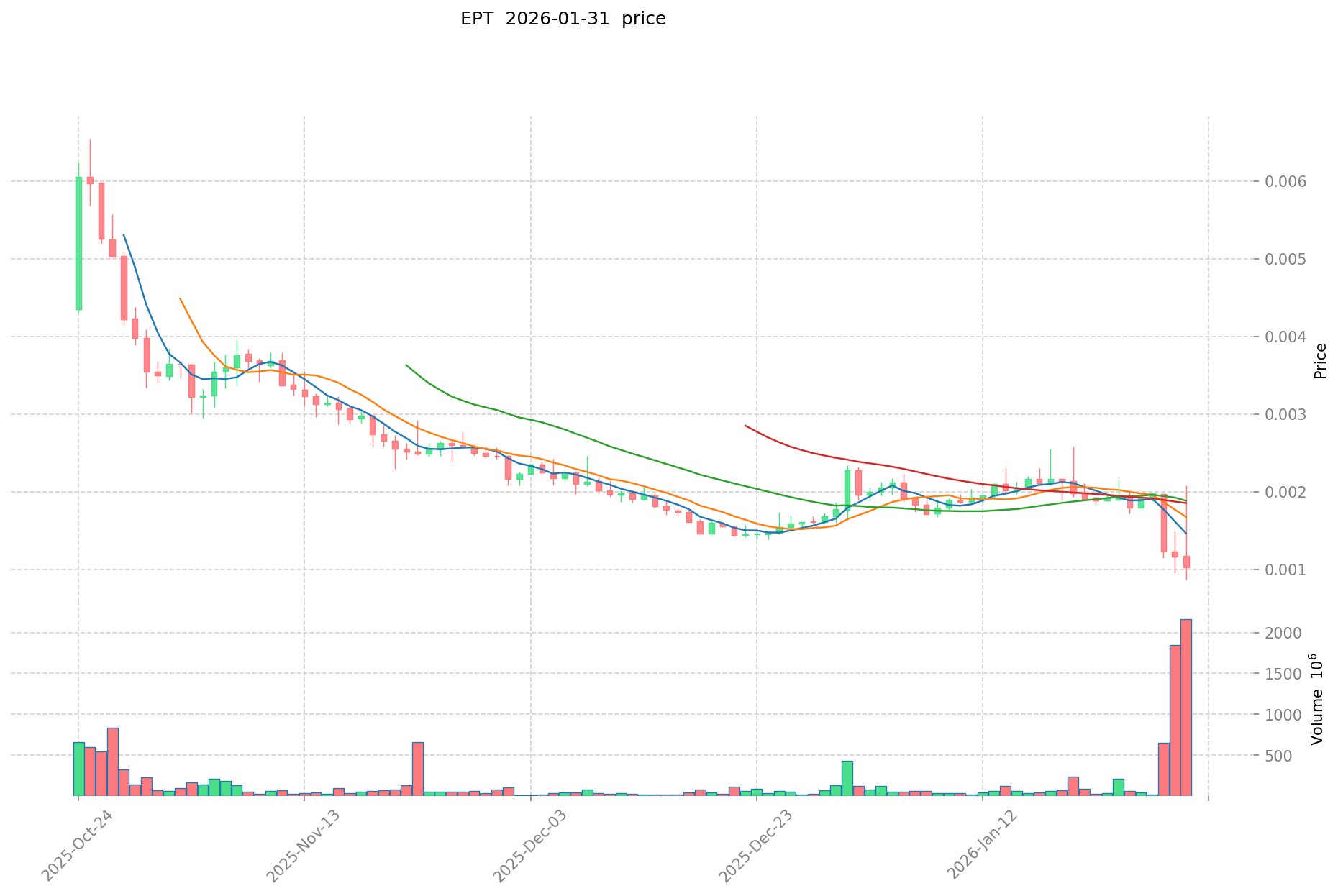
- January 2026: Market consolidation → Price traded within range around $0.000869 to $0.00105
- February 2026: Recent volatility → EPT experienced -52.68% decline over 7-day period, with current price at $0.000922
Current EPT Investment Market Status (February 2026)
- EPT current price: $0.000922
- 24-hour trading volume: $401,456.06
- Market capitalization: $2,251,139.83
- Circulating supply: 2,441,583,333 EPT (24.42% of total supply)
- Recent price performance: -2.69% (1H), -9.02% (24H), -52.68% (7D), -52.41% (30D)
- Trading activity: Listed on 27 exchanges with 148 token holders
Click to view real-time EPT market price
II. Core Factors Influencing Whether EPT is a Good Investment
Supply Mechanism and Scarcity (EPT Investment Scarcity)
- Balance (EPT) operates with a total supply of 10,000,000,000 tokens and a maximum supply also capped at 10,000,000,000 tokens. The current circulating supply is 2,441,583,333 tokens, representing approximately 24.42% of the total supply. This indicates that a significant portion of tokens remains unlocked or reserved, which could influence future market dynamics.
- The relatively low circulating supply ratio suggests that the potential release of additional tokens into the market may affect price movements. Historical data shows that EPT experienced price volatility, with a recorded price point near $0.03 in April 2025, followed by a decline to approximately $0.000869 in January 2026. Such fluctuations reflect the impact of supply changes and market sentiment on token valuation.
- Scarcity remains a consideration for long-term investment evaluation. However, with the majority of tokens yet to enter circulation, the scarcity factor may be moderated by future unlocking schedules. Investors should monitor token release timelines and their potential impact on market supply and demand balance.
Institutional Investment and Mainstream Adoption (Institutional Investment in EPT)
- Available reference materials do not provide specific data on institutional holdings or mainstream adoption trends for Balance (EPT). The current holder count is reported at 148, which represents a relatively small user base compared to more established digital assets.
- The project's integration of AI technology with Web3 infrastructure aims to create personalized AI agents for gaming and entertainment sectors. While this positions EPT within emerging technological trends, the extent of institutional participation or enterprise-level adoption remains unclear from the provided data.
Macroeconomic Environment's Impact on EPT Investment
- Broader macroeconomic conditions, including monetary policy shifts, interest rate adjustments, and inflation trends, can influence investor sentiment toward digital assets. In environments characterized by currency devaluation concerns or heightened inflation expectations, some investors may seek alternative stores of value. However, EPT's current market capitalization of approximately $2,251,139 and relatively low trading volume of $401,456 over 24 hours suggest limited liquidity and market depth.
- Geopolitical uncertainties and regulatory developments in the cryptocurrency sector may also affect investment demand. As of early 2026, the regulatory landscape for AI-integrated Web3 projects continues to evolve, potentially impacting investor confidence and market participation in projects like Balance.
Technology and Ecosystem Development (Technology & Ecosystem for EPT Investment)
- Balance employs a multi-layered architecture comprising application, platform, protocol, token, and infrastructure layers. This design aims to facilitate the integration of AI agents with decentralized applications across gaming and entertainment domains. The project's focus on AI-driven user experiences represents an attempt to differentiate itself within the Web3 ecosystem.
- EPT operates using ERC-20 and BEP-20 standards, with contract addresses deployed on Ethereum and Binance Smart Chain networks. This multi-chain presence may enhance accessibility and interoperability. However, the reference materials do not detail specific technical upgrades, DeFi integrations, or NFT applications that could serve as long-term value drivers.
- The project's ecosystem development remains in early stages, with a whitepaper available through GitBook and active social media presence on platforms such as Twitter. The extent to which Balance can expand its application scenarios and attract developer participation will be relevant factors for assessing its long-term investment potential.
III. EPT Future Investment Forecast and Price Outlook (Is Balance(EPT) worth investing in 2026-2031)
Short-term Investment Outlook (2026, short-term EPT investment outlook)
- Conservative Forecast: $0.00052584 - $0.000939
- Neutral Forecast: $0.000939 - $0.00106107
- Optimistic Forecast: $0.00106107 and above
Mid-term Investment Outlook (2027-2029, mid-term Balance(EPT) investment forecast)
- Market Stage Expectation: The token is projected to experience gradual growth as the AI-Web3 infrastructure matures and user adoption expands across gaming and entertainment applications.
- Investment Return Forecast:
- 2027: $0.0005800203 - $0.00127004445
- 2028: $0.000817228602 - $0.001634457204
- 2029: $0.001121646256245 - $0.001814020488495
- Key Catalysts: Development of personalized AI agent features, expansion of multi-layer architecture integration, and increased platform adoption within decentralized gaming ecosystems.
Long-term Investment Outlook (Is Balance a good long-term investment?)
- Base Scenario: $0.001377070034264 - $0.002262329342005 (assuming steady ecosystem development and moderate market conditions through 2031)
- Optimistic Scenario: $0.002262329342005 - $0.01913 (assuming accelerated adoption of AI-Web3 solutions and favorable regulatory environment)
- Risk Scenario: Below $0.000921 (under prolonged market downturns or significant competitive pressure)
Check EPT long-term investment and price forecast: Price Prediction
2026-02-01 - 2031 Long-term Outlook
- Base Scenario: $0.001377070034264 - $0.002262329342005 (corresponding to steady progress and gradual mainstream application growth)
- Optimistic Scenario: $0.01913 and above (corresponding to large-scale adoption and favorable market conditions)
- Transformative Scenario: Above $0.01913 (in case of breakthrough ecosystem developments and mainstream popularization)
- 2031-12-31 Projected High: $0.01913 (based on optimistic development assumptions)
Disclaimer: Price predictions are based on historical data analysis and market trend assessments. Cryptocurrency markets involve substantial risk, and actual performance may differ significantly from forecasts. This content does not constitute investment advice.
| Year |
Predicted High Price |
Predicted Average Price |
Predicted Low Price |
Price Change |
| 2026 |
0.00106107 |
0.000939 |
0.00052584 |
1 |
| 2027 |
0.00127004445 |
0.001000035 |
0.0005800203 |
8 |
| 2028 |
0.001634457204 |
0.001135039725 |
0.000817228602 |
23 |
| 2029 |
0.001814020488495 |
0.0013847484645 |
0.001121646256245 |
50 |
| 2030 |
0.001679353700322 |
0.001599384476497 |
0.000927642996368 |
73 |
| 2031 |
0.002262329342005 |
0.001639369088409 |
0.001377070034264 |
77 |
IV. Balance Investment Strategy and Risk Management (How to invest in AI+Web3 tokens)
Investment Methodology (Balance investment strategy)
-
Long-term Holding (HODL Balance): Suitable for conservative investors
Balance (EPT) operates as an AI-focused Web3 infrastructure protocol, integrating AI technology with Web3 frameworks to enable personalized AI agents for gaming and entertainment applications. The project's multi-layered architecture includes application, platform, protocol, token, and infrastructure layers, designed to redefine user-AI agent interactions.
For investors seeking long-term exposure to the AI+Web3 narrative, a buy-and-hold approach may align with the project's developmental trajectory. However, given Balance's early-stage status with a circulating supply of approximately 2.44 billion tokens (24.42% of the 10 billion total supply), investors should monitor token unlock schedules and ecosystem development milestones.
-
Active Trading: Relies on technical analysis and swing operations
Balance exhibits substantial price volatility, with 7-day and 30-day declines of approximately 52.68% and 52.41% respectively as of February 1, 2026. The 24-hour trading volume stands at approximately $401,456, with price fluctuations ranging from $0.000921 to $0.00105 within the same period.
Active traders may identify opportunities through technical indicators and market sentiment analysis. The token is available on 27 exchanges and operates on both Ethereum (ERC-20) and BNB Smart Chain (BEP-20) standards, providing liquidity across multiple platforms. Traders should establish clear entry and exit points, considering the token's recent downward momentum.
Risk Management (Risk management for Balance investment)
-
Asset Allocation Ratio: Conservative / Aggressive / Professional investors
Given Balance's market capitalization of approximately $2.25 million and ranking of 1967, position sizing becomes critical:
- Conservative investors: Allocate no more than 1-2% of crypto portfolio to speculative AI+Web3 tokens
- Aggressive investors: May allocate 3-5% while maintaining diversification across established assets
- Professional investors: Could consider strategic positions up to 5-10% with active management protocols
Balance currently holds approximately 0.00033% market dominance, indicating its micro-cap status and associated volatility risks.
-
Risk Hedging Solutions: Multi-asset portfolio + hedging tools
Investors may consider:
- Diversification across established cryptocurrencies (BTC, ETH) to balance exposure
- Allocation to stablecoins for maintaining liquidity and rebalancing opportunities
- Position sizing adjusted according to market conditions and personal risk tolerance
Given the token's fully diluted valuation of approximately $9.22 million against its current market cap, potential dilution from future token unlocks should factor into hedging strategies.
-
Secure Storage: Hot/cold wallets + hardware wallet recommendations
Balance tokens can be stored using:
- Hardware wallets: Ledger or Trezor devices supporting ERC-20 and BEP-20 tokens
- Software wallets: MetaMask, Trust Wallet, or other multi-chain compatible wallets
- Exchange wallets: Only for active trading purposes, not recommended for long-term storage
Security best practices include:
- Never sharing private keys or seed phrases
- Verifying contract addresses (Ethereum: 0x3dc8e2d80b6215a1bccae4d38715c3520581e77c; BSC: 0x3dc8e2d80b6215a1bccae4d38715c3520581e77c)
- Using multi-signature wallets for larger holdings
- Regular security audits of storage solutions
V. Balance Investment Risks and Challenges (Risks of investing in AI+Web3 tokens)
-
Market Risk: High volatility, price manipulation
Balance demonstrates significant price volatility, with recent data showing:
- 1-hour price change: -2.69%
- 24-hour price change: -9.02%
- 7-day price change: -52.68%
The token's relatively low trading volume of approximately $401,456 in 24 hours may expose investors to liquidity risks and potential price manipulation. The holder count of approximately 148 addresses indicates limited distribution, which could amplify volatility during market stress.
The token's price range shows substantial variation, having reached approximately $0.03 in April 2025 and declining to approximately $0.000869 in January 2026, representing significant downside movement.
-
Regulatory Risk: Policy uncertainty across different jurisdictions
AI+Web3 projects face evolving regulatory frameworks globally:
- Classification uncertainty regarding AI-generated content and blockchain integration
- Potential securities law implications depending on token utility and distribution
- Gaming and entertainment applications may face jurisdiction-specific regulations
- Cross-border compliance challenges given the project's multi-chain deployment
Investors should monitor regulatory developments in their respective jurisdictions and the project's compliance disclosures.
-
Technical Risk: Network security vulnerabilities, upgrade failures
Balance's multi-layered architecture introduces several technical considerations:
- Smart contract security risks on both Ethereum and BNB Smart Chain deployments
- AI agent integration complexity may introduce unforeseen technical challenges
- Dependence on underlying blockchain infrastructure (Ethereum, BSC) for security and performance
- Potential vulnerabilities in cross-chain operations
The project's early stage of development (with only 24.42% of tokens circulating) suggests ongoing technical implementations that carry execution risks. The holder count of approximately 148 addresses may indicate limited community testing and feedback.
VI. Conclusion: Is AI+Web3 Infrastructure a Good Investment?
-
Investment Value Summary: Balance presents exposure to the convergence of AI and Web3 technologies, with a focus on gaming and entertainment applications. The project's multi-layered architecture and integration of AI agents with decentralized networks addresses emerging use cases in the crypto ecosystem. However, the token faces substantial short-term volatility, as evidenced by significant price declines across multiple timeframes.
-
Investor Recommendations:
✅ Newcomers: Dollar-cost averaging + secure wallet storage
- Allocate only capital designated for speculative investments
- Utilize hardware wallets for security (Ledger, Trezor)
- Research the project's development roadmap and team credentials
- Start with minimal positions to understand market dynamics
✅ Experienced Investors: Swing trading + portfolio allocation
- Monitor technical indicators given recent price trends
- Consider position sizing relative to market cap and liquidity
- Track token unlock schedules and ecosystem milestones
- Implement stop-loss mechanisms to manage downside risk
✅ Institutional Investors: Strategic long-term allocation
- Conduct thorough due diligence on project fundamentals
- Assess team expertise in both AI and blockchain technologies
- Evaluate competitive positioning within the AI+Web3 sector
- Consider allocation as part of diversified venture exposure
⚠️ Disclaimer: Cryptocurrency investments carry substantial risk. Balance's micro-cap status, limited liquidity, and early-stage development introduce elevated volatility and potential loss of capital. This analysis is for informational purposes only and does not constitute financial, investment, or legal advice. Investors should conduct independent research and consult qualified professionals before making investment decisions.
VII. FAQ
Q1: What is Balance (EPT) and what makes it different from other AI+Web3 projects?
Balance (EPT) is an AI-focused Web3 user experience infrastructure launched in 2025 that enables users to create personalized AI agents for gaming and entertainment applications. The project distinguishes itself through a multi-layered architecture comprising application, platform, protocol, token, and infrastructure layers, designed to facilitate seamless integration of AI agents with decentralized applications. Unlike many blockchain projects that add AI as a secondary feature, Balance positions AI agents as the core interaction mechanism. The token operates on both Ethereum (ERC-20) and BNB Smart Chain (BEP-20) standards, providing multi-chain accessibility. As of February 2026, the project maintains a market capitalization of approximately $2.25 million with 2.44 billion tokens in circulation (24.42% of total supply).
Q2: Is Balance (EPT) a good short-term investment given its recent price performance?
Balance presents significant short-term challenges for investment consideration. Recent market data shows substantial downward momentum: -2.69% (1-hour), -9.02% (24-hour), -52.68% (7-day), and -52.41% (30-day) as of February 1, 2026. The current price stands at approximately $0.000922, representing a significant decline from the April 2025 launch price near $0.03. Short-term forecasts project a range between $0.00052584 (conservative) and $0.00106107 (optimistic) for 2026. The 24-hour trading volume of approximately $401,456 indicates limited liquidity, which may amplify volatility. Active traders should employ strict risk management, including stop-loss mechanisms and position sizing appropriate to the token's micro-cap status. Conservative investors may consider waiting for price stabilization before establishing positions.
Q3: What are the main risks associated with investing in Balance (EPT)?
Balance carries multiple investment risks typical of early-stage AI+Web3 projects. Market risk remains elevated due to high volatility, with recent 7-day declines exceeding 50%, and a small holder base of approximately 148 addresses that could amplify price swings. Regulatory risk stems from evolving frameworks governing AI-blockchain integration, gaming applications, and cross-border compliance challenges. Technical risks include smart contract vulnerabilities across both Ethereum and BSC deployments, AI agent integration complexity, and dependence on underlying blockchain infrastructure. Additionally, the token's current circulating supply represents only 24.42% of total supply, meaning future token unlocks could introduce dilution pressure. The project's micro-cap status ($2.25 million market cap) and limited liquidity increase susceptibility to market manipulation and sudden price movements.
Q4: How should different investor types approach Balance (EPT) investment?
Investment approaches vary by investor profile and risk tolerance. Newcomers should consider dollar-cost averaging with minimal capital allocated for speculative purposes (1-2% of crypto portfolio), utilizing hardware wallets like Ledger or Trezor for secure storage, and conducting thorough research on the project's development roadmap before entry. Experienced investors may employ swing trading strategies based on technical analysis, given the token's volatility patterns, while maintaining strict position sizing (3-5% of portfolio) and implementing stop-loss mechanisms. Institutional investors considering strategic exposure should conduct comprehensive due diligence on team credentials, competitive positioning within the AI+Web3 sector, and token unlock schedules, potentially allocating 5-10% as part of diversified venture exposure with active management protocols. All investor types should verify contract addresses and monitor ecosystem development milestones.
Q5: What factors could drive Balance (EPT) price growth in the medium to long term?
Several factors may influence Balance's potential appreciation through 2031. Technology development remains primary, including the maturation of personalized AI agent features, successful integration across gaming and entertainment applications, and expansion of the multi-layered architecture. Ecosystem growth drivers include increasing developer participation, user adoption within decentralized gaming platforms, and formation of strategic partnerships with established Web3 projects. Market structure improvements such as listing on additional exchanges, increased liquidity, and broader token distribution beyond the current 148 holders could reduce volatility. Mid-term forecasts project prices ranging from $0.0005800203 to $0.00127004445 by 2027, potentially reaching $0.001814020488495 by 2029. Long-term optimistic scenarios suggest prices above $0.01913 by 2031, contingent upon large-scale adoption, favorable regulatory environment, and breakthrough ecosystem developments. However, these projections carry substantial uncertainty and should not be interpreted as guaranteed outcomes.
Q6: How does Balance's tokenomics affect its investment potential?
Balance's tokenomics structure significantly impacts investment considerations. The project maintains a total and maximum supply of 10 billion tokens, with only 2.44 billion (24.42%) currently in circulation as of February 2026. This low circulation ratio indicates that approximately 75.58% of tokens remain unlocked or reserved, representing potential future supply pressure that could affect price dynamics. The fully diluted valuation stands at approximately $9.22 million versus the current market cap of $2.25 million, suggesting a 4x dilution factor if all tokens enter circulation at current prices. Investors should monitor token release schedules, vesting timelines, and distribution mechanisms to assess potential dilution impacts. Historical price action from $0.03 in April 2025 to $0.000922 in February 2026 demonstrates the market's sensitivity to supply changes. The scarcity narrative remains moderated by future unlock schedules, making tokenomics transparency a critical factor for long-term investment evaluation.
Q7: What security measures should investors implement when holding Balance (EPT)?
Security protocols for Balance tokens should follow cryptocurrency best practices. Hardware wallets (Ledger, Trezor) supporting both ERC-20 and BEP-20 standards provide the most secure storage option for long-term holdings. Software wallets like MetaMask and Trust Wallet offer multi-chain compatibility for active management, though they carry higher risk than cold storage solutions. Investors must verify contract addresses before transactions: Ethereum (0x3dc8e2d80b6215a1bccae4d38715c3520581e77c) and BSC (0x3dc8e2d80b6215a1bccae4d38715c3520581e77c). Critical security measures include never sharing private keys or seed phrases, enabling two-factor authentication on exchange accounts, using dedicated devices for crypto transactions, and conducting regular security audits. Exchange wallets should only be used for active trading purposes, not long-term storage. For larger holdings, multi-signature wallet solutions provide additional security layers. Given the token's presence on 27 exchanges, investors should research platform security track records before selecting trading venues.
Q8: How does Balance compare to other AI+Web3 infrastructure projects in terms of investment opportunity?
Balance occupies an early-stage position within the emerging AI+Web3 infrastructure sector, with several distinguishing characteristics for investment comparison. The project's market capitalization of approximately $2.25 million and ranking of 1967 indicates micro-cap status, contrasting with more established AI-blockchain projects that may have higher valuations and liquidity. The focus on personalized AI agents for gaming and entertainment represents a specific niche application compared to broader AI infrastructure plays. The multi-chain deployment (Ethereum and BSC) provides technical flexibility, though adoption metrics remain limited with approximately 148 token holders. Unlike projects with institutional backing or venture capital disclosure, Balance's funding structure and major investor presence remain unclear from available data. The project's whitepaper availability and social media presence demonstrate community engagement efforts, though the extent of developer participation and application deployment lags behind more mature competitors. Investment comparison should consider Balance's early-stage risk-reward profile, requiring higher risk tolerance than established alternatives while potentially offering asymmetric upside if the AI agent paradigm gains mainstream adoption within Web3 gaming ecosystems.
* The information is not intended to be and does not constitute financial advice or any other recommendation of any sort offered or endorsed by Gate.