This comprehensive analysis evaluates Balance (EPT) as an AI-Web3 gaming infrastructure investment with a current market cap of $2.47 million and price of $0.00101. The article examines Balance's tokenomics (10 billion max supply, 24.42% circulating), historical performance from $0.03 launch to current levels, and multi-chain deployment on Ethereum and BNB Chain via Gate exchange. Key investment factors include AI agent technology integration, limited 148-holder base suggesting early-stage adoption, and projected price ranges from $0.001-$0.00226 through 2031 under various scenarios. The analysis provides investment strategies for conservative to professional investors, risk management through portfolio diversification and hardware wallet storage, and details critical risks including extreme volatility (-50.52% weekly), regulatory uncertainty, and token dilution. Suitable primarily for experienced investors with high risk tolerance seeking AI-Web3 sector exposure.
Introduction: Balance (EPT) Investment Position and Market Outlook
Balance (EPT) represents a specialized position within the cryptocurrency sector as an AI-focused Web3 user experience infrastructure. As of February 1, 2026, Balance maintains a market capitalization of approximately $2.47 million, with a circulating supply of 2.44 billion tokens and a current trading price around $0.00101. The token operates on both Ethereum and BSC networks using ERC-20 and BEP-20 standards, respectively. With its positioning as a next-generation AI+Web3 protocol integrating artificial intelligence technology with blockchain frameworks for social and gaming applications, Balance has attracted attention among investors exploring opportunities in the convergence of AI and decentralized technologies. This article provides a comprehensive analysis of Balance's investment characteristics, historical price movements, future price considerations, and associated investment risks to offer reference information for market participants.
I. Balance (EPT) Historical Price Review and Current Investment Value
- 2025: Balance (EPT) launched on April 21, 2025 → Token reached a price level of $0.03 during its early trading phase
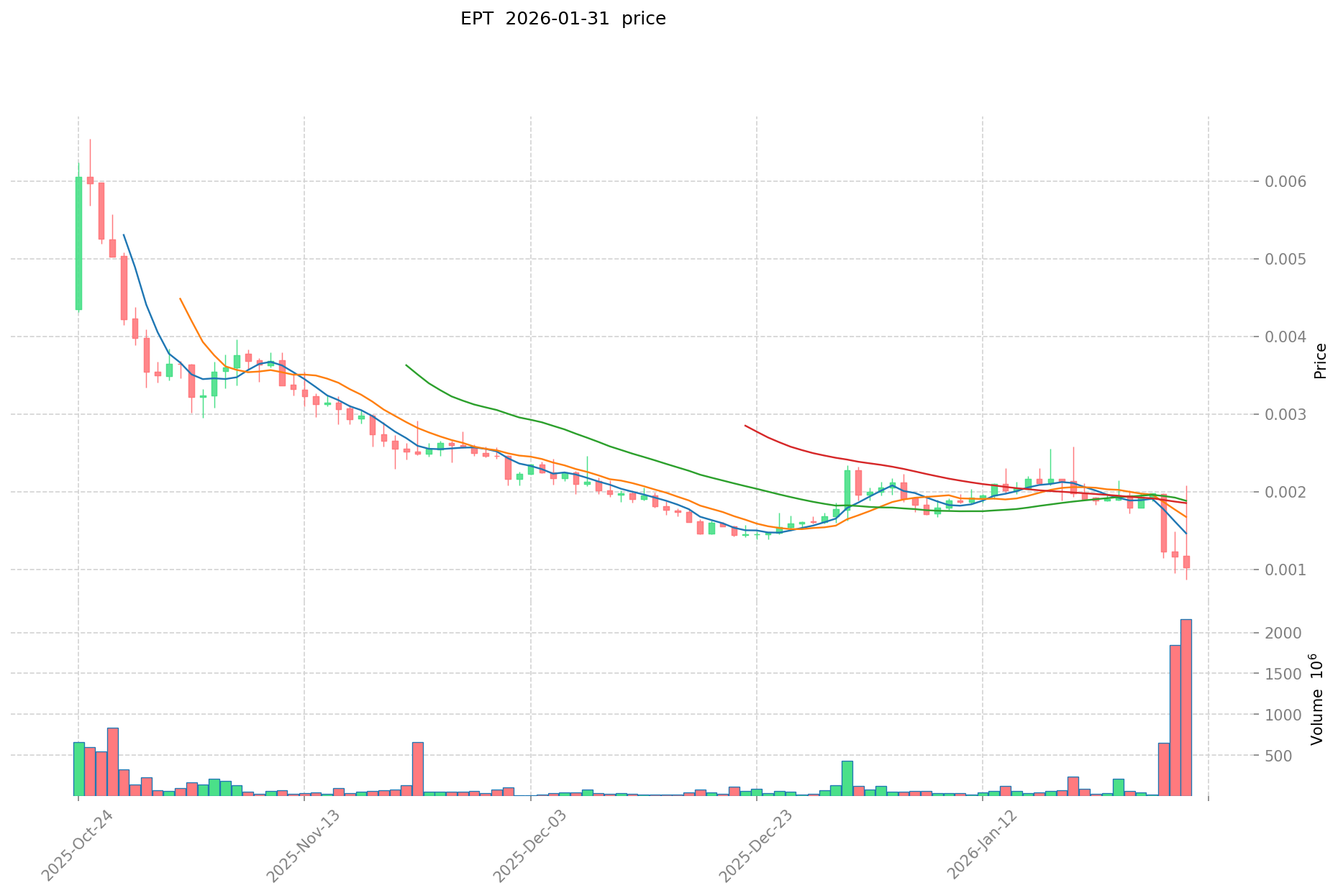
- 2025-2026: Market volatility period → Price experienced significant fluctuations from higher levels to $0.000869
- Recent period: Trading pattern shows recovery attempts → Price stabilized around $0.00101 with notable short-term movements
Current EPT Investment Market Status (February 2026)
- EPT current price: $0.00101
- 24-hour trading volume: $408,059.56
- 24-hour price range: High $0.00105, Low $0.000931
- Price changes: 1-hour +7.02%, 24-hour +1.85%, 7-day -50.52%, 30-day -47.75%
- Market capitalization: $2,465,999.17
- Circulating supply: 2,441,583,333 EPT (24.42% of total supply)
- Fully diluted valuation: $10,100,000
- Market dominance: 0.00035%
- Trading across: 27 exchanges
- Token holder count: 148 addresses
Visit real-time EPT market price
II. Core Factors Influencing Whether EPT is a Good Investment
Supply Mechanism and Scarcity (EPT investment scarcity)
- Total and Circulating Supply: Balance (EPT) has a maximum supply of 10,000,000,000 tokens, with a current circulating supply of approximately 2,441,583,333 tokens (24.42% of total supply). The limited circulating supply relative to the total supply suggests controlled token release, which may influence price dynamics over time.
- Market Capitalization Structure: As of February 1, 2026, EPT's market capitalization stands at approximately $2.47 million, with a fully diluted market cap of $10.1 million. The significant gap between current market cap and fully diluted valuation indicates potential dilution as more tokens enter circulation.
- Investment Consideration: The token's scarcity profile is shaped by its circulation ratio. While the controlled release may limit immediate selling pressure, future token unlocks could impact long-term value retention. Investors should monitor unlock schedules and vesting periods when evaluating scarcity as an investment factor.
Institutional Investment and Mainstream Adoption (Institutional investment in EPT)
- Current Holder Base: EPT currently has 148 token holders, reflecting a relatively small and developing community. This limited holder base suggests early-stage adoption with potential for expansion.
- Exchange Availability: The token is listed on 27 exchanges, providing accessibility to a broad range of investors. This multi-exchange presence may facilitate liquidity and price discovery.
- Adoption Trajectory: As an AI-focused Web3 infrastructure project, Balance targets gaming and entertainment sectors. The project's multi-layer architecture (application layer, platform layer, protocol layer, token layer, and infrastructure layer) positions it within emerging AI-agent frameworks, though mainstream institutional adoption remains uncertain at this stage.
Macroeconomic Environment's Impact on EPT Investment
- Market Volatility: EPT has experienced notable price fluctuations, with a 24-hour change of +1.85%, 7-day decline of -50.52%, and 30-day drop of -47.75%. Such volatility reflects sensitivity to broader cryptocurrency market conditions and risk sentiment.
- Correlation with Crypto Market Trends: As a smaller-cap token with 0.00035% market dominance, EPT's price movements may be influenced by Bitcoin and broader crypto market trends, as well as investor appetite for AI-related blockchain projects.
- Risk-On/Risk-Off Dynamics: The token's price trajectory suggests it functions as a higher-risk asset within the crypto ecosystem. Economic uncertainty or shifts in monetary policy affecting risk assets could amplify EPT's price volatility.
Technology and Ecosystem Development (Technology & Ecosystem for EPT investment)
- AI-Web3 Integration: Balance integrates AI technology with Web3 frameworks, enabling users to create personalized AI agents for gaming and entertainment applications. This technological positioning aligns with growing interest in AI-driven decentralized applications.
- Multi-Chain Deployment: EPT operates on both Ethereum (ERC-20) and BNB Smart Chain (BEP-20), with contract address 0x3dc8e2d80b6215a1bccae4d38715c3520581e77c on both networks. Multi-chain support may enhance accessibility and interoperability within the broader DeFi and Web3 ecosystems.
- Protocol Architecture: The project's layered design aims to redefine AI agent-user interactions, though the practical implementation and adoption of these use cases remain critical to long-term investment value. Development progress, community engagement, and real-world application deployment will be key factors in assessing technological viability and ecosystem growth potential.
III. EPT Future Investment Prediction and Price Outlook (Is Balance(EPT) worth investing in 2026-2031)
Short-term Investment Prediction (2026, short-term EPT investment outlook)
- Conservative forecast: $0.00084296 - $0.001028
- Neutral forecast: $0.001028 - $0.00126444
- Optimistic forecast: $0.00126444 and above
Mid-term Investment Outlook (2027-2029, mid-term Balance(EPT) investment forecast)
- Market stage expectation: EPT may experience gradual growth as the AI-Web3 integration ecosystem continues to develop, with potential price appreciation driven by platform adoption and ecosystem expansion.
- Investment return prediction:
- 2027: $0.001031598 - $0.0015588592
- 2028: $0.00081152376 - $0.001934131628
- 2029: $0.0010681681491 - $0.00177480246312
- Key catalysts: Expansion of AI Agent applications, increased user adoption in gaming and entertainment sectors, development of multi-layer architecture infrastructure, and growth in platform ecosystem partnerships.
Long-term Investment Outlook (Is Balance a good long-term investment?)
- Base scenario: $0.001196348326992 - $0.001914157323187 (assuming steady ecosystem development and moderate market conditions through 2030)
- Optimistic scenario: $0.001811613180873 - $0.002264516476092 (assuming accelerated adoption, favorable market environment, and successful implementation of AI-Web3 integration features by 2031)
- Risk scenario: Below $0.000923922722245 (under adverse market conditions or significant technological challenges)
For detailed EPT long-term investment and price predictions: Price Prediction
2026-2031 Long-term Outlook
- Base scenario: $0.00084296 - $0.001914157323187 (corresponding to steady progress and gradual mainstream application growth)
- Optimistic scenario: $0.001811613180873 - $0.002264516476092 (corresponding to large-scale adoption and favorable market environment)
- Transformative scenario: Above $0.002264516476092 (in case of breakthrough ecosystem developments and mainstream popularization)
- Projected high point by December 31, 2031: $0.002264516476092 (based on optimistic development assumptions)
Disclaimer: The above predictions are based on historical data analysis and market trend projections. Cryptocurrency investments carry substantial risks, and actual prices may deviate significantly from predictions due to market volatility, regulatory changes, technological developments, and other unforeseen factors. This content does not constitute investment advice, and investors should conduct their own research and risk assessment before making any investment decisions.
| Year |
Predicted High Price |
Predicted Average Price |
Predicted Low Price |
Price Change |
| 2026 |
0.00126444 |
0.001028 |
0.00084296 |
1 |
| 2027 |
0.0015588592 |
0.00114622 |
0.001031598 |
13 |
| 2028 |
0.001934131628 |
0.0013525396 |
0.00081152376 |
33 |
| 2029 |
0.00177480246312 |
0.001643335614 |
0.0010681681491 |
62 |
| 2030 |
0.001914157323187 |
0.00170906903856 |
0.001196348326992 |
69 |
| 2031 |
0.002264516476092 |
0.001811613180873 |
0.000923922722245 |
79 |
IV. Balance Investment Strategy and Risk Management (How to invest in AI+Web3 tokens)
Investment Methodology (Balance investment strategy)
Long-term Holding (HODL Balance): Suitable for conservative investors
For investors seeking to participate in the emerging AI and Web3 integration space, a long-term holding approach may be considered for Balance tokens. This strategy involves acquiring EPT tokens and maintaining positions over extended periods, allowing exposure to potential developments in AI agent technology and decentralized gaming ecosystems. Given Balance's multi-layered architecture encompassing application, platform, protocol, token, and infrastructure layers, long-term holders may benefit from the project's ecosystem expansion. However, investors should note the token's significant price volatility, with historical data showing fluctuations between $0.000869 and $0.03.
Active Trading: Relying on technical analysis and swing operations
Active traders may approach Balance through technical analysis and short-term trading strategies. With 24-hour trading volume reaching $408,059.56 and price movements showing +7.02% (1H), +1.85% (24H), and -50.52% (7D) as of February 1, 2026, the token demonstrates considerable intraday volatility that may present trading opportunities. Traders should monitor key support and resistance levels, with recent 24-hour range between $0.000931 and $0.00105. The token is available across 27 exchanges, providing adequate liquidity for position entry and exit.
Risk Management (Risk management for Balance investment)
Asset Allocation Ratio: Conservative / Aggressive / Professional investors
- Conservative investors: May consider allocating 1-3% of cryptocurrency portfolio to Balance, treating it as a speculative position within a diversified digital asset portfolio
- Aggressive investors: Could allocate 5-10% to AI and Web3-focused tokens including Balance, while maintaining broader exposure to established cryptocurrencies
- Professional investors: May incorporate Balance as part of a thematic allocation to AI agent protocols and gaming infrastructure, with position sizing based on risk-adjusted return expectations and correlation analysis
Risk Hedging Solutions: Multi-asset portfolio + hedging tools
Investors can implement risk management through diversification across different blockchain ecosystems, as Balance operates on both Ethereum (ERC-20) and BNB Chain (BEP-20). Portfolio construction may include combining Balance exposure with established Layer-1 protocols, stablecoins, and traditional assets. For more sophisticated investors, hedging strategies could involve setting stop-loss orders at technical support levels or using portfolio rebalancing mechanisms to maintain target allocation percentages.
Secure Storage: Hot and cold wallets + hardware wallet recommendations
Given Balance's token standards (ERC-20 and BEP-20), investors should prioritize secure storage solutions:
- Cold storage: Hardware wallets compatible with Ethereum and BNB Chain networks (such as Ledger or Trezor devices) provide optimal security for long-term holdings
- Hot wallets: For active traders, reputable software wallets with multi-signature support and two-factor authentication may be used for operational amounts
- Exchange custody: While convenient for trading, storing significant amounts on exchanges exposes investors to platform risks; only trading amounts should remain on exchange platforms
V. Balance Investment Risks and Challenges (Risks of investing in AI+Web3 tokens)
Market Risks: High volatility and price manipulation concerns
Balance demonstrates substantial price volatility, with a 7-day decline of -50.52% and 30-day decline of -47.75% as of February 1, 2026. The token's price has ranged from $0.000869 to $0.03 since launch. With a relatively modest market capitalization of $2.47 million and circulating supply of 2.44 billion tokens (24.42% of maximum supply), the token may be susceptible to significant price swings from large transactions. The holder count of 148 addresses suggests concentrated ownership, which could amplify volatility. Investors should be prepared for potential price fluctuations exceeding 20-30% within short timeframes.
Regulatory Risks: Policy uncertainty across jurisdictions
As an AI-integrated Web3 protocol, Balance operates in a rapidly evolving regulatory landscape. Different jurisdictions maintain varying approaches to cryptocurrency regulation, AI governance, and decentralized gaming platforms. Potential regulatory developments could impact token utility, exchange listings, or project operations. Investors should monitor regulatory announcements in their respective jurisdictions and major cryptocurrency markets that may affect AI agent protocols and gaming-focused digital assets.
Technical Risks: Network security vulnerabilities and upgrade failures
Balance's multi-layered architecture, while designed to integrate AI agents with blockchain infrastructure, introduces technical complexity. Potential risks include:
- Smart contract vulnerabilities in token contracts deployed on Ethereum and BNB Chain
- Integration challenges between AI agent functionality and blockchain protocols
- Dependency on underlying blockchain networks (Ethereum and BNB Chain) for security and performance
- Potential technical issues during protocol upgrades or feature implementations
With the project operating across multiple blockchain networks and incorporating AI technology, investors should consider the technical execution risks inherent in innovative, early-stage protocols.
VI. Conclusion: Is AI+Web3 Gaming Infrastructure a Good Investment?
Investment Value Summary: Balance presents exposure to the emerging intersection of AI agents and Web3 gaming infrastructure, though with significant short-term price volatility.
Balance operates within the developing AI and Web3 integration sector, offering a protocol framework for AI agents in gaming and social applications. The project's multi-layered architecture and dual-chain deployment (Ethereum and BNB Chain) demonstrate technical ambition. However, investors should consider the token's early stage, with only 24.42% of maximum supply circulating, modest market capitalization of $2.47 million, and substantial recent price declines (-50.52% over 7 days). The project's long-term potential depends on successful execution of its AI agent integration vision and user adoption in gaming and entertainment applications.
Investor Recommendations:
✅ Beginners: Consider dollar-cost averaging with small allocation percentages + secure wallet storage using hardware wallets compatible with ERC-20 and BEP-20 tokens
✅ Experienced Investors: May explore swing trading opportunities based on technical analysis + portfolio diversification across AI and gaming protocols
✅ Institutional Investors: Could evaluate strategic positioning within thematic AI+Web3 allocations, with appropriate due diligence on project fundamentals and technical roadmap
⚠️ Notice: Cryptocurrency investments carry high risk. This content is for informational purposes only and does not constitute investment advice. Investors should conduct independent research and consult financial advisors before making investment decisions.
VII. FAQ
Q1: What is Balance (EPT) and why is it categorized as an AI+Web3 investment?
Balance (EPT) is an AI-focused Web3 user experience infrastructure protocol that integrates artificial intelligence technology with blockchain frameworks for social and gaming applications. It is categorized as an AI+Web3 investment because it operates through a multi-layered architecture (application layer, platform layer, protocol layer, token layer, and infrastructure layer) designed to enable users to create personalized AI agents for decentralized gaming and entertainment purposes. The protocol operates on both Ethereum (ERC-20) and BNB Chain (BEP-20) networks, combining blockchain's decentralized infrastructure with AI agent functionality, positioning it at the convergence of two emerging technology sectors within the cryptocurrency ecosystem.
Q2: What are the primary risks associated with investing in Balance (EPT)?
The primary risks include extreme price volatility (with 7-day decline of -50.52% and 30-day decline of -47.75% as of February 2026), limited liquidity with a market capitalization of only $2.47 million, concentrated ownership among 148 holders that could amplify price swings, regulatory uncertainty surrounding AI governance and decentralized gaming platforms, technical execution risks in integrating complex AI agent functionality with blockchain protocols, and token dilution concerns as only 24.42% of maximum supply currently circulates. Additionally, the project operates in early-stage development with unproven mainstream adoption, making it a high-risk speculative investment suitable only for investors who can afford potential total loss of invested capital.
Q3: How does Balance's token supply mechanism affect its investment potential?
Balance has a maximum supply of 10 billion tokens with only 2.44 billion (24.42%) currently circulating, creating a significant gap between the current market cap ($2.47 million) and fully diluted valuation ($10.1 million). This supply mechanism presents both opportunities and risks: the controlled token release may limit immediate selling pressure and support short-term price stability, but future token unlocks could introduce substantial dilution that negatively impacts price appreciation. Investors should monitor vesting schedules and unlock timelines, as the remaining 75.58% of tokens entering circulation over time could exert downward pressure on price unless offset by proportional demand growth from ecosystem adoption and user engagement.
Q4: What is a realistic price expectation for Balance (EPT) by 2030-2031?
Based on historical data analysis and market trend projections, Balance's long-term price outlook varies significantly by scenario. Under a base scenario assuming steady ecosystem development and moderate market conditions, prices could range from $0.001196 to $0.001914 by 2030. An optimistic scenario factoring in accelerated AI-Web3 adoption and successful protocol implementation suggests potential prices between $0.001812 and $0.002265 by 2031. However, a risk scenario under adverse market conditions or technological challenges could see prices fall below $0.000924. These projections represent 79-124% potential upside from current levels ($0.00101) over five years under favorable conditions, though investors should note that cryptocurrency markets remain highly unpredictable and actual outcomes may deviate substantially from these estimates.
Q5: Which investor profile is best suited for Balance (EPT) investment?
Balance is most suitable for experienced cryptocurrency investors with high risk tolerance and portfolio diversification strategies. Conservative investors might consider only 1-3% portfolio allocation as a speculative position within a broader digital asset portfolio. Aggressive investors could allocate 5-10% to AI and Web3-focused tokens including Balance while maintaining exposure to established cryptocurrencies. Professional investors may incorporate Balance as part of thematic allocations to AI agent protocols and gaming infrastructure, using risk-adjusted position sizing. The token is generally not recommended as a core holding for beginners or risk-averse investors due to its extreme volatility, limited liquidity, early-stage development status, and concentrated holder base—characteristics that make it appropriate only for those who understand cryptocurrency market dynamics and can afford complete capital loss.
Q6: How can investors implement effective risk management when holding Balance (EPT)?
Investors can implement risk management through several strategies: First, maintain strict position sizing with Balance representing no more than 1-10% of total cryptocurrency portfolio depending on risk tolerance. Second, use secure storage solutions including hardware wallets compatible with ERC-20 and BEP-20 standards (such as Ledger or Trezor) for long-term holdings, keeping only trading amounts on exchange platforms. Third, employ portfolio diversification by combining Balance exposure with established Layer-1 protocols, stablecoins, and traditional assets to reduce concentration risk. Fourth, set predetermined stop-loss levels at technical support zones to limit downside exposure during price declines. Fifth, consider dollar-cost averaging to mitigate timing risk rather than making lump-sum investments. Finally, continuously monitor project developments, holder distribution changes, and unlock schedules that could impact token supply dynamics and price action.
Q7: What factors could drive Balance's price appreciation in the medium to long term?
Several factors could potentially drive Balance's price appreciation through 2029-2031: expansion of AI agent applications in gaming and entertainment sectors increasing platform utility and token demand; growth in user adoption as the multi-layer architecture demonstrates practical functionality; successful development of protocol infrastructure enabling seamless AI-Web3 integration; strategic ecosystem partnerships with gaming platforms and entertainment providers; broader cryptocurrency market bull cycles that increase risk appetite for innovative AI and Web3 projects; technological breakthroughs in AI agent personalization and blockchain scalability; increased exchange listings improving liquidity and accessibility; and favorable regulatory clarity around AI governance and decentralized gaming platforms. However, these positive catalysts must materialize alongside consistent project execution, community growth, and sustained market interest for meaningful price appreciation to occur.
Q8: What are the key differences between short-term trading and long-term holding strategies for Balance (EPT)?
Short-term trading strategies focus on capitalizing on Balance's significant intraday volatility (with 24-hour movements averaging ±7% and weekly swings exceeding 50%) through technical analysis, support/resistance levels, and momentum indicators across its 27 exchange listings. Traders can exploit price inefficiencies and rapid movements but face execution risks, transaction costs, and the psychological challenges of volatile markets. Long-term holding strategies involve acquiring EPT tokens with a multi-year investment horizon, allowing exposure to potential ecosystem development as the AI-Web3 gaming infrastructure matures. Long-term holders benefit from avoiding frequent trading costs and timing risks while accepting extended price drawdowns and uncertainty about project execution. Given Balance's early-stage status, modest holder base (148 addresses), and ongoing protocol development, long-term holding may suit investors with conviction in the AI+Web3 thesis, while short-term trading appeals to those with technical analysis expertise and active portfolio management capabilities.
* The information is not intended to be and does not constitute financial advice or any other recommendation of any sort offered or endorsed by Gate.