This comprehensive analysis evaluates Balancer (BAL) as a cryptocurrency investment opportunity in 2024-2026. The article examines BAL's market position with current pricing at $0.4997 and market capitalization of $32.27 million across 16 exchanges including Gate. It reviews historical price trends from its 2021 peak of $74.45 to current levels, analyzing core investment factors including supply mechanisms (64.58 million circulating supply representing 67.17% of max supply), institutional adoption patterns, and DeFi ecosystem dynamics. The analysis provides detailed price forecasts ranging from conservative estimates of $0.45-$0.83 to optimistic scenarios reaching $1.17 by 2031. Investment strategy recommendations address both conservative and aggressive approaches, while comprehensive risk management frameworks cover market volatility, regulatory uncertainty, and technical vulnerabilities. Risk considerations highlight the token's 81.54% annual decline and ongoing DeFi protocol competition, providing investo
Introduction: Balancer (BAL) Investment Position and Market Prospects
BAL is a significant asset in the cryptocurrency field. As an automated market-making trading protocol with self-balancing attributes, Balancer generates weighted portfolios and price sensors. As of January 21, 2026, BAL has a market capitalization of approximately $32.27 million, with a circulating supply of about 64.58 million tokens, and the current price is maintained around $0.4997. The protocol subverts the traditional index fund concept by allowing traders to rebalance portfolios through arbitrage opportunities while collecting fees, rather than paying portfolio managers for rebalancing services. With approximately 48,525 holders and availability on 16 exchanges, BAL has gradually become a focal point for investors discussing "Is Balancer (BAL) a good investment?" The token currently holds a market share of 0.0011%, with a circulating supply representing 67.17% of its total supply. This article will comprehensively analyze BAL's investment value, historical trends, future price forecasts, and investment risks to provide reference for investors.
I. BAL Price History Review and Investment Value Status
- 2021: BAL experienced significant price appreciation following its launch period → Early investors saw substantial gains during the DeFi summer momentum
- May 2021: Token reached a notable price level of $74.45 during the peak of market activity → BAL price reflected strong market demand for decentralized exchange protocols
- 2022-2025: Market correction phase → Price declined from previous highs as the broader cryptocurrency market experienced cooling trends
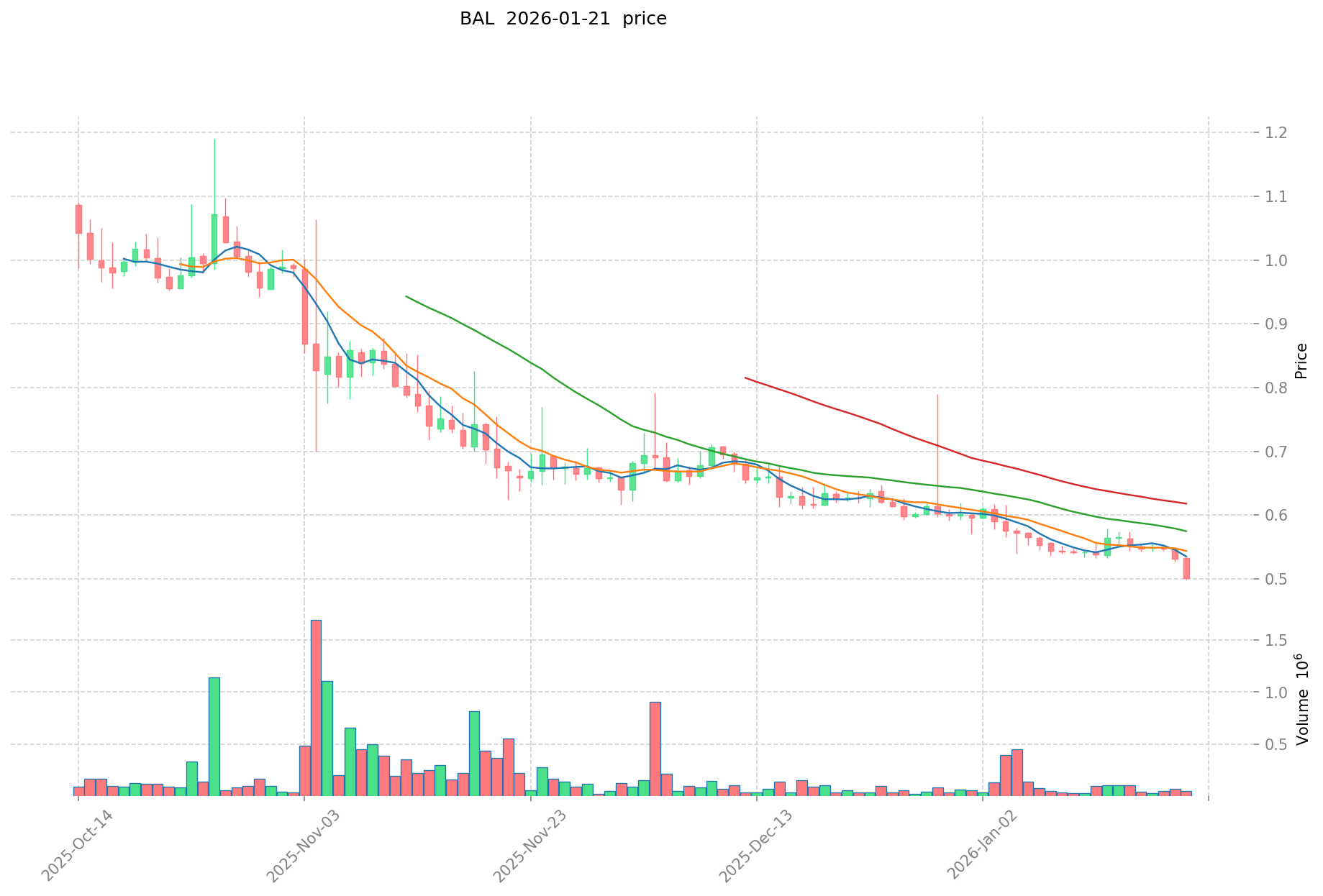
- 2026: BAL price approached lower trading ranges around $0.49734 → Reflecting current market conditions and reduced speculative activity
Current BAL Investment Market Status (January 2026)
- BAL current price: $0.4997
- 24-hour trading volume: $29,309.66
- Circulating supply: 64,580,537 BAL (representing approximately 67.17% of total supply)
- Market capitalization: $32,270,894
- Fully diluted valuation: $35,623,857
- Recent price movements: -6.25% (24H), -11.41% (7D), -21.2% (30D)
- Token holder count: 48,525 addresses
Click to view real-time BAL market price
II. Core Factors Affecting Whether BAL is a Good Investment (Is Balancer(BAL) a Good Investment)
Supply Mechanism and Scarcity (BAL investment scarcity)
-
Controlled Supply Structure → Influences Price and Investment Value
- Maximum Supply: 96,150,704 BAL
- Circulating Supply: 64,580,537 BAL (67.17% of max supply)
- Total Supply: 71,290,488 BAL
- The relatively high circulation ratio indicates a mature token distribution phase, with limited remaining supply potentially contributing to scarcity-driven value appreciation
-
Investment Significance: Scarcity remains a key factor supporting long-term investment considerations, with approximately 32.83% of maximum supply yet to enter circulation
Institutional Investment and Mainstream Adoption (Institutional investment in BAL)
- Holder Base Expansion: With 48,525 token holders recorded, BAL demonstrates a distributed ownership structure across the DeFi ecosystem
- Market Position: Trading on 16 exchanges, providing accessibility for institutional and retail participants
- Adoption Context: As an automated market-making protocol, Balancer's value proposition centers on its role in DeFi infrastructure, with investment appeal tied to decentralized finance adoption trends rather than traditional institutional custody patterns
Macroeconomic Environment's Impact on BAL Investment
-
DeFi Market Dynamics → Influences Investment Attractiveness
- As a DeFi protocol token, BAL's investment potential correlates with broader decentralized finance sector growth
- Market volatility: 24-hour price range of $0.4977-$0.5337 reflects typical crypto asset fluctuations
-
Risk Considerations: Recent price performance shows -6.25% (24H), -11.41% (7D), -21.2% (30D), and -81.54% (1Y), indicating significant volatility that investors should factor into risk assessment
-
Market Uncertainty Context: General cryptocurrency market conditions and regulatory developments in DeFi space affect BAL investment outlook
Technology and Ecosystem Development (Technology & Ecosystem for BAL investment)
-
Core Protocol Features: Balancer operates as a self-balancing automated market maker (AMM) with weighted portfolio generation and price sensor capabilities
- Inverts traditional index fund model: liquidity providers earn fees from traders who rebalance pools through arbitrage
- Creates investment opportunities through passive portfolio management with active fee generation
-
Ecosystem Applications: Investment value supported by DeFi use cases
- Automated market making functionality
- Liquidity provision mechanisms
- Portfolio rebalancing infrastructure
-
Technical Foundation: Ethereum-based infrastructure (contract address: 0xba100000625a3754423978a60c9317c58a424e3D) integrates with broader DeFi ecosystem, providing interoperability and composability benefits
-
Development Activity: Multiple active GitHub repositories (balancer-core, balancer-exchange, pool-management, balancer-sor) indicate ongoing technical development supporting long-term value considerations
III. BAL Future Investment Forecast and Price Outlook (Is Balancer (BAL) worth investing in 2026-2031)
Short-term Investment Forecast (2026, short-term BAL investment outlook)
- Conservative Forecast: $0.29 - $0.50
- Neutral Forecast: $0.50 - $0.59
- Optimistic Forecast: $0.59 and above
Mid-term Investment Outlook (2027-2029, mid-term Balancer (BAL) investment forecast)
- Market Stage Expectation: BAL may experience gradual recovery with potential volatility as the DeFi sector evolves and automated market-making protocols compete for liquidity
- Investment Return Forecast:
- 2027: $0.43 - $0.68
- 2028: $0.49 - $0.87
- 2029: $0.72 - $0.88
- Key Catalysts: Protocol upgrades, expansion of liquidity pools, increased adoption of decentralized exchanges, and broader DeFi ecosystem growth
Long-term Investment Outlook (Is BAL a good long-term investment?)
- Base Scenario: $0.45 - $0.84 (assuming steady protocol development and moderate DeFi sector expansion)
- Optimistic Scenario: $0.72 - $1.17 (assuming increased institutional adoption and significant protocol enhancements)
- Risk Scenario: Below $0.29 (in case of severe market downturns or competitive displacement)
Click to view BAL long-term investment and price forecast: Price Prediction
2026-01-21 to 2031 Long-term Outlook
- Base Scenario: $0.45 - $0.83 USD (corresponding to steady progress and gradual mainstream application growth)
- Optimistic Scenario: $0.72 - $1.17 USD (corresponding to large-scale adoption and favorable market conditions)
- Transformative Scenario: Above $1.17 USD (if ecosystem achieves breakthrough developments and mainstream adoption)
- 2031-12-31 Predicted High: $1.17 USD (based on optimistic development assumptions)
Disclaimer: This forecast is for informational purposes only and should not be considered investment advice. Cryptocurrency markets are highly volatile and subject to numerous unpredictable factors.
| Year |
Predicted High Price |
Predicted Average Price |
Predicted Low Price |
Price Change |
| 2026 |
0.594643 |
0.4997 |
0.289826 |
0 |
| 2027 |
0.683964375 |
0.5471715 |
0.42679377 |
9 |
| 2028 |
0.87410647125 |
0.6155679375 |
0.49245435 |
23 |
| 2029 |
0.8789079011625 |
0.744837204375 |
0.72249208824375 |
49 |
| 2030 |
0.8443474548795 |
0.81187255276875 |
0.5845482379935 |
62 |
| 2031 |
1.167635105392016 |
0.828110003824125 |
0.447179402065027 |
65 |
IV. Balancer (BAL) Investment Strategy and Risk Management (How to invest in DeFi tokens)
Investment Methodology (Balancer investment strategy)
Long-term Holding (HODL Balancer)
Long-term holding may be suitable for conservative investors who believe in the fundamental value proposition of automated market maker protocols. This approach involves purchasing BAL tokens and holding them through market cycles, potentially benefiting from the protocol's development and adoption over time. Investors adopting this strategy typically focus on the underlying technology and governance rights rather than short-term price movements.
Active Trading
Active trading strategies rely on technical analysis and swing trading techniques. Given BAL's recent price volatility, with 24-hour fluctuations of -6.25% and 7-day changes of -11.41%, traders may identify entry and exit points based on support and resistance levels. The token's 24-hour trading range between $0.4977 and $0.5337 demonstrates intraday price movement opportunities. However, such strategies require continuous market monitoring and technical expertise.
Risk Management (Risk management for Balancer investment)
Asset Allocation Ratio
- Conservative investors: May consider allocating 1-3% of their cryptocurrency portfolio to DeFi governance tokens like BAL, prioritizing established assets.
- Aggressive investors: Could allocate 5-10% to emerging DeFi protocols, accepting higher volatility for potential returns.
- Professional investors: May incorporate BAL into diversified DeFi strategy portfolios with position sizes determined by risk models and correlation analysis.
Risk Hedging Solutions
Multi-asset portfolio construction can help mitigate concentration risk. Investors may consider combining BAL holdings with other asset classes, including established cryptocurrencies, stablecoins, and traditional financial instruments. Hedging tools such as options or futures contracts may be available on certain trading platforms, though availability varies by jurisdiction.
Secure Storage
Given that BAL is an ERC-20 token deployed at contract address 0xba100000625a3754423978a60c9317c58a424e3D on Ethereum, investors have multiple storage options:
- Hot wallets: Software wallets for active trading, offering convenience but with online exposure.
- Cold wallets: Offline storage solutions providing enhanced security for long-term holdings.
- Hardware wallets: Physical devices designed for cryptocurrency storage, recommended for significant holdings. Popular options support Ethereum-based tokens including BAL.
V. Balancer (BAL) Investment Risks and Challenges (Risks of investing in DeFi tokens)
Market Risk
BAL exhibits significant price volatility. The token has experienced substantial price swings, with a 1-year decline of -81.54% and 30-day decrease of -21.2%. The current price of $0.4997 represents a considerable distance from its historical high of $74.45 recorded on May 4, 2021. Such volatility patterns are characteristic of DeFi governance tokens and may result from various factors including market sentiment shifts, protocol developments, and broader cryptocurrency market dynamics. Price manipulation risks may exist in markets with lower liquidity.
Regulatory Risk
Different jurisdictions maintain varying regulatory frameworks for DeFi protocols and their associated tokens. Policy uncertainty across countries may impact token utility, trading availability, and compliance requirements. Regulatory developments in major markets could influence BAL's accessibility and use cases, creating uncertainty for investors.
Technical Risk
As a DeFi protocol, Balancer faces technical challenges including:
- Network security vulnerabilities: Smart contract risks inherent in automated market maker protocols may expose the protocol to potential exploits.
- Upgrade implementation: Protocol upgrades and governance decisions may encounter technical difficulties or community disagreements.
- Ethereum network dependency: As an ERC-20 token, BAL's performance is tied to Ethereum network conditions, including transaction costs and congestion.
VI. Conclusion: Is DeFi Governance Token a Good Investment?
Investment Value Summary
Balancer (BAL) represents a governance token in the decentralized finance ecosystem, offering exposure to automated market maker technology. With a market capitalization of $32.27 million and circulating supply of 64.58 million tokens (67.17% of max supply), the token maintains presence across 16 exchanges. The current holder base of 48,525 addresses indicates community participation. However, the token has experienced significant price volatility, with substantial declines across multiple timeframes.
Investor Recommendations
✅ Beginners: Consider dollar-cost averaging strategies combined with secure wallet storage. Research the protocol's functionality and governance mechanisms before investing.
✅ Experienced investors: May explore swing trading opportunities within established risk parameters while maintaining diversified DeFi protocol exposure.
✅ Institutional investors: Could evaluate strategic positioning based on comprehensive due diligence, including protocol fundamentals, competitive landscape analysis, and risk-adjusted return expectations.
⚠️ Disclaimer: Cryptocurrency investments carry substantial risk. This content is for informational purposes only and does not constitute investment advice. Conduct independent research and consult financial professionals before making investment decisions.
VII. FAQ
Q1: Is Balancer (BAL) a good investment for beginners in 2026?
BAL may not be ideal for beginners due to its high volatility and specialized DeFi nature. The token has experienced significant price declines (-81.54% over one year, -21.2% over 30 days) and requires understanding of automated market maker protocols. Beginners should start with established cryptocurrencies, limit BAL allocation to 1-3% of their portfolio if interested, and use dollar-cost averaging strategies. Secure wallet storage and thorough protocol research are essential prerequisites before investing.
Q2: What factors make BAL different from traditional cryptocurrency investments?
BAL represents a governance token for a DeFi protocol rather than a traditional cryptocurrency. Unlike Bitcoin or Ethereum, BAL's value derives from its role in the Balancer automated market maker ecosystem, where holders can participate in protocol governance and earn fees through liquidity provision. The token inverts the traditional index fund model by allowing liquidity providers to collect fees from traders who rebalance pools, rather than paying portfolio managers. This fundamental difference means BAL's investment value is closely tied to DeFi adoption and protocol usage rather than pure store-of-value characteristics.
Q3: How does BAL's supply mechanism affect its investment potential?
BAL has a maximum supply of 96,150,704 tokens, with 64,580,537 (67.17%) currently in circulation. The relatively high circulation ratio indicates mature token distribution with approximately 32.83% remaining. This controlled supply structure provides some scarcity-driven value potential, though it's less significant than earlier-stage projects. The large percentage already circulating means limited future dilution risk, but also reduces the scarcity premium that benefits tokens with lower circulation ratios.
Q4: What are the main risks of investing in BAL?
The primary risks include: (1) Market risk - extreme volatility with an 81.54% decline over one year and current price at $0.4997 versus historical high of $74.45; (2) Regulatory risk - uncertain DeFi policy frameworks across jurisdictions may affect token utility and trading availability; (3) Technical risk - smart contract vulnerabilities, protocol upgrade challenges, and dependency on Ethereum network performance; (4) Competition risk - other automated market maker protocols competing for liquidity and users may erode BAL's market position.
Q5: What is the realistic price outlook for BAL through 2031?
Conservative forecasts suggest BAL may trade between $0.45-$0.83 through 2031 under steady development conditions. Short-term (2026) predictions range from $0.29-$0.59, mid-term (2027-2029) forecasts extend to $0.43-$0.88, while optimistic long-term scenarios reach $0.72-$1.17 by 2031. These projections assume continued DeFi sector growth, protocol enhancements, and increased adoption. However, cryptocurrency markets remain highly unpredictable, and actual prices may deviate significantly from forecasts due to market conditions, technological developments, and regulatory changes.
Q6: Should investors hold BAL long-term or trade actively?
The optimal approach depends on risk tolerance and expertise. Long-term holding (HODL) suits conservative investors who believe in automated market maker fundamentals and can withstand volatility, focusing on governance rights and protocol development rather than price movements. Active trading may benefit experienced traders who can analyze technical patterns and manage risk, given BAL's 24-hour price range ($0.4977-$0.5337) and recent volatility (-6.25% daily, -11.41% weekly). Most investors should consider BAL as a small portfolio allocation (1-10% depending on risk profile) combined with diversification across other assets.
Q7: How can investors securely store BAL tokens?
BAL is an ERC-20 token on Ethereum (contract: 0xba100000625a3754423978a60c9317c58a424e3D) with multiple storage options. Hot wallets (software wallets) offer convenience for active trading but maintain online exposure. Cold wallets provide offline storage for enhanced security. Hardware wallets represent the recommended solution for significant holdings, with popular devices supporting Ethereum-based tokens including BAL. Investors should verify contract addresses, enable two-factor authentication where available, and never share private keys or seed phrases. For long-term holdings exceeding meaningful value, hardware wallet storage significantly reduces security risks compared to exchange custody or software wallets.
* The information is not intended to be and does not constitute financial advice or any other recommendation of any sort offered or endorsed by Gate.