This comprehensive analysis examines Banana Gun (BANANA), a multi-chain trading bot infrastructure operating across Ethereum, Solana, Base, and Blast networks since September 2023. With current market capitalization of $24.93 million and price at $6.21, BANANA presents both opportunities and significant risks for cryptocurrency investors. The article evaluates BANANA's historical price performance, fundamental tokenomics featuring 45.13% circulating supply, and multi-network ecosystem development. Price forecasts through 2031 range from conservative to optimistic scenarios, with the token experiencing substantial volatility (-84.50% yearly decline). Key investment considerations include market risks from price fluctuations, dilution from unreleased tokens, technical smart contract vulnerabilities, and competitive pressures within the trading bot sector. Tailored recommendations address beginner, experienced, and institutional investors, emphasizing portfolio allocation strategies (1-10% depending on risk tole
Introduction: Banana Gun (BANANA)'s Investment Position and Market Outlook
Banana Gun (BANANA) represents a trading bot infrastructure operating across Ethereum, Solana, Base, and Blast networks. Launched in September 2023, the project has established itself within the decentralized trading tools sector. As of January 22, 2026, BANANA holds a market capitalization of approximately $24.93 million with a circulating supply of around 4.02 million tokens, while the current price stands at approximately $6.21. With over 11,900 holders and availability on 29 exchanges, the asset maintains a market share of 0.0017% in the broader cryptocurrency ecosystem. The token's fully diluted market cap reaches $55.24 million based on a maximum supply of 8.9 million tokens. This article examines BANANA's investment characteristics, historical price movements, future price considerations, and associated risks to provide analytical reference for market participants.
I. Banana Gun (BANANA) Price History Review and Current Investment Value
- 2023: Token Launch → Initial trading phase with launch price around $6.24
- 2024: Market Peak Period → BANANA experienced significant price appreciation, reaching notable valuation levels in July 2024
- 2025: Market Correction Phase → Price underwent substantial adjustment from previous peaks
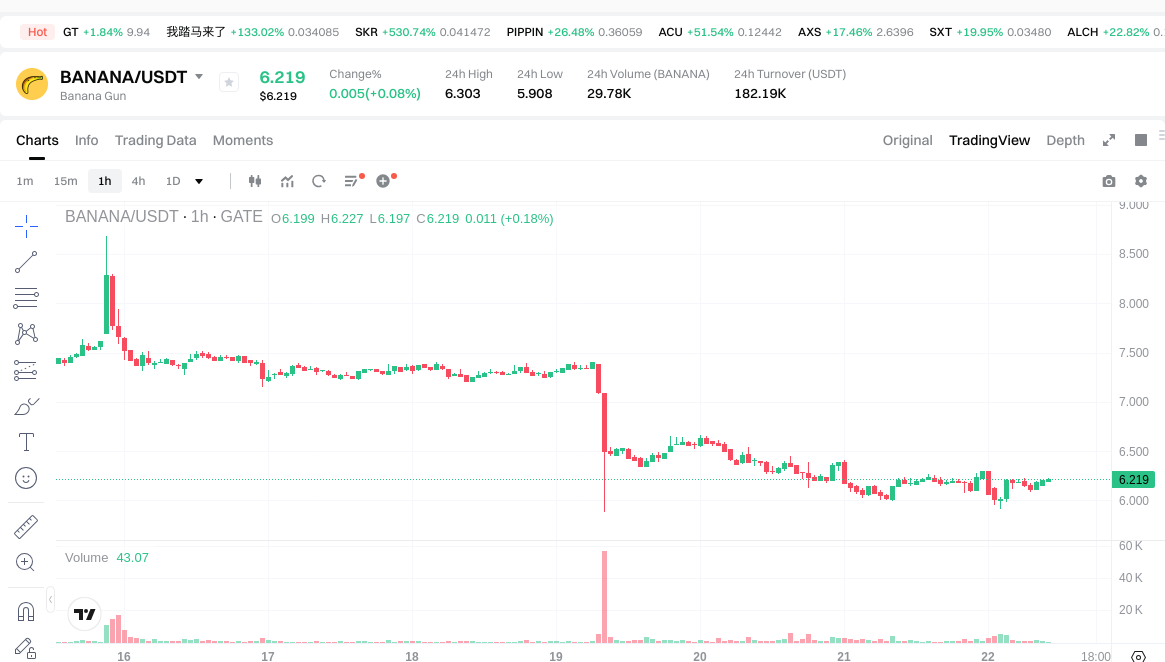
Current BANANA Investment Market Status (January 2026)
- BANANA current price: $6.207
- Market sentiment (Fear & Greed Index): Data not available in reference materials
- 24-hour trading volume: $182,681.81
- Institutional investor holdings: Data not available in reference materials
Click to view real-time BANANA market price
II. Core Factors Affecting Whether BANANA is a Good Investment (Is Banana Gun(BANANA) a Good Investment)
Supply Mechanism and Scarcity (BANANA investment scarcity)
- Fixed Supply Model → Affects price and investment value
- BANANA has a maximum supply of 8,900,000 tokens, with approximately 4,016,475.73 tokens currently in circulation, representing about 45.13% of the total supply.
- The fixed supply mechanism creates a scarcity dynamic that may influence long-term price trends as demand evolves.
- Historical patterns: Supply dynamics have contributed to price movements, with BANANA experiencing significant volatility since its launch in September 2023.
- Investment significance: The scarcity model, combined with a circulating supply ratio below 50%, represents a fundamental factor for long-term investment consideration.
Technology and Ecosystem Development (Technology & Ecosystem for BANANA investment)
- Multi-chain Trading Bot Functionality: Banana Gun operates as a trading bot across Ethereum, Solana, Base, and Blast networks, providing automated trading capabilities.
- This cross-chain functionality expands the utility and addressable market for the token within the decentralized trading ecosystem.
- DeFi Integration: As a trading bot tool, BANANA is positioned within the broader DeFi infrastructure, serving traders who require automated execution and monitoring capabilities.
- The project's documentation (available at docs.bananagun.io) provides technical specifications that support ongoing ecosystem development.
- With 11,903 holders and availability on 29 exchanges, the token has achieved a degree of distribution across the cryptocurrency market.
III. BANANA Future Investment Forecast and Price Outlook (Is Banana Gun(BANANA) worth investing in 2026-2031)
Short-term Investment Forecast (2026, short-term BANANA investment outlook)
- Conservative forecast: $3.30 - $6.22
- Neutral forecast: $6.22 - $6.22
- Optimistic forecast: $6.22 - $8.52
Mid-term Investment Outlook (2027-2029, mid-term Banana Gun(BANANA) investment forecast)
-
Market phase expectation: The mid-term outlook suggests a gradual recovery phase with potential consolidation. Price predictions indicate moderate growth trajectories, with average prices potentially ranging from $7.37 in 2027 to approximately $7.97 in 2029. The trading bot sector may experience evolving competitive dynamics during this period.
-
Investment return forecast:
- 2027: $5.60 - $8.11
- 2028: $6.19 - $8.20
- 2029: $7.41 - $10.76
-
Key catalysts: Expansion of trading bot functionalities across multiple blockchain networks, potential adoption increases on Ethereum, Solana, Base and Blast platforms, and broader market sentiment toward DeFi utility tokens.
Long-term Investment Outlook (Is BANANA a good long-term investment?)
- Base scenario: $6.74 - $10.77 (assuming steady platform development and maintained user engagement across supported networks)
- Optimistic scenario: $10.07 - $13.79 (assuming enhanced adoption rates, successful feature implementations, and favorable market conditions for trading automation tools)
- Risk scenario: $5.64 - $6.74 (considering potential competitive pressures, market downturns, or reduced demand for automated trading solutions)
View BANANA long-term investment and price prediction: Price Prediction
2026-01-22 - 2031 Long-term Outlook
- Base scenario: $6.74 - $10.77 (corresponding to steady progress and gradual mainstream application growth)
- Optimistic scenario: $10.07 - $13.79 (corresponding to large-scale adoption and favorable market environment)
- Transformative scenario: Above $13.79 (if ecosystem achieves breakthrough developments and mainstream popularization)
- 2031-12-31 predicted high: $13.79 (based on optimistic development assumptions)
Disclaimer: This forecast is based on historical data analysis and market trend projections. Cryptocurrency investments carry substantial risks. Past performance does not guarantee future results. Investors should conduct independent research and consider their risk tolerance before making investment decisions.
| Year |
Predicted High Price |
Predicted Average Price |
Predicted Low Price |
Price Change |
| 2026 |
8.51866 |
6.218 |
3.29554 |
0 |
| 2027 |
8.105163 |
7.36833 |
5.5999308 |
18 |
| 2028 |
8.20095129 |
7.7367465 |
6.1893972 |
24 |
| 2029 |
10.75794600825 |
7.968848895 |
7.41102947235 |
28 |
| 2030 |
10.76790706936875 |
9.363397451625 |
6.74164616517 |
50 |
| 2031 |
13.789943596880718 |
10.065652260496875 |
5.63676526587825 |
62 |
IV. Banana Gun Investment Strategy and Risk Management (How to invest in BANANA)
Investment Strategy (BANANA investment strategy)
Long-term Holding (HODL BANANA)
For conservative investors seeking stable exposure to decentralized trading infrastructure, a long-term holding approach may be considered. This strategy involves acquiring BANANA tokens and maintaining positions through market cycles, potentially benefiting from the protocol's development and adoption trajectory. Given the token's significant decline from its historical reference point, long-term holders should carefully evaluate fundamental factors including protocol usage metrics, revenue generation, and competitive positioning within the trading bot ecosystem.
Active Trading
Active trading strategies rely on technical analysis and short-term price movements. BANANA has demonstrated considerable volatility, with recent 7-day performance showing a -17.16% decline and 1-hour movement of +0.80%. Traders employing this approach should monitor key technical levels, with recent 24-hour price ranges between $5.908 and $6.303. Volume data indicates trading activity of approximately $182,681.81 over 24 hours, which traders should assess for liquidity considerations.
Risk Management (Risk management for BANANA investment)
Asset Allocation Ratios
Conservative Investors: Consider limiting BANANA exposure to 1-3% of total crypto portfolio allocation, maintaining majority positions in more established digital assets.
Moderate Investors: May allocate 3-7% to BANANA as part of a diversified DeFi and infrastructure token strategy, balanced with major cryptocurrencies.
Experienced Investors: Could consider 5-10% allocation based on thorough due diligence and risk tolerance, while maintaining portfolio diversification across multiple sectors.
Risk Hedging Solutions
Implementing multi-asset portfolio construction is essential for BANANA exposure. Consider:
- Combining BANANA holdings with uncorrelated assets across different blockchain ecosystems
- Maintaining stable asset positions to rebalance during significant market movements
- Diversifying across trading infrastructure tokens to reduce protocol-specific risk
- Establishing clear position sizing rules based on market capitalization and liquidity metrics
Secure Storage
Cold Wallet Solutions: For long-term BANANA holdings, hardware wallets such as Ledger or Trezor provide enhanced security against online threats. The token operates on the Ethereum network (contract: 0x38e68a37e401f7271568cecaac63c6b1e19130b4), making it compatible with major hardware wallet solutions.
Hot Wallet Considerations: For active trading purposes, reputable software wallets with strong security protocols may be utilized, though investors should minimize holdings in hot storage environments.
Best Practices:
- Verify contract addresses through official channels before transactions
- Implement multi-signature requirements for significant holdings
- Maintain secure backup procedures for recovery phrases
- Regularly review wallet security settings and software updates
V. BANANA Investment Risks and Challenges (Risks of investing in BANANA)
Market Risks
High Volatility: BANANA has experienced substantial price fluctuations, with 7-day performance showing -17.16% and 1-year performance indicating -84.50%. The token's price volatility significantly exceeds many traditional assets, requiring investors to maintain appropriate risk tolerance and capital preservation strategies.
Liquidity Considerations: With a 24-hour trading volume of approximately $182,681.81 and presence on 29 exchanges, investors should evaluate liquidity profiles before executing large transactions. Limited liquidity during certain market conditions may impact execution prices.
Market Capitalization Dynamics: BANANA maintains a market capitalization of approximately $24.93 million with a market cap to fully diluted valuation ratio of 45.13%, indicating significant token supply yet to enter circulation. This factor may influence future price dynamics as additional supply becomes available.
Regulatory Risks
Cryptocurrency regulations continue evolving across different jurisdictions, creating uncertainty for trading bot protocols and associated tokens:
- Regulatory frameworks for automated trading services remain under development in multiple regions
- Classification of utility tokens versus securities varies across jurisdictions, potentially affecting BANANA's operational environment
- Compliance requirements for decentralized trading infrastructure may evolve, impacting protocol operations
- Cross-border regulatory coordination efforts could introduce new compliance obligations
Technical Risks
Smart Contract Vulnerabilities: As an Ethereum-based token, BANANA relies on smart contract security. Potential risks include:
- Undiscovered code vulnerabilities that could be exploited
- Integration risks with third-party protocols and services
- Dependence on Ethereum network security and functionality
Protocol Development Risks: The Banana Gun trading bot operates across Ethereum, Solana, Base, and Blast networks. Technical challenges may include:
- Cross-chain integration complexity and potential failure points
- Competition from alternative trading bot solutions
- Technology obsolescence as trading infrastructure evolves
- Network upgrade compatibility requirements
Operational Continuity: With approximately 11,903 holders, the protocol's sustainability depends on continued user adoption and competitive positioning within the automated trading sector.
VI. Conclusion: Is BANANA a Good Investment?
Investment Value Summary
BANANA represents exposure to decentralized trading infrastructure with operations across multiple blockchain networks including Ethereum, Solana, Base, and Blast. The token has experienced significant price movements, with current pricing substantially below historical reference levels. The circulating supply represents approximately 45.13% of maximum supply, indicating considerable potential future dilution factors.
The protocol's position within the competitive trading bot sector, combined with its multi-chain deployment strategy, presents both opportunities and challenges. Market capitalization of approximately $24.93 million places BANANA in the mid-tier category among DeFi infrastructure tokens, requiring careful evaluation of growth potential versus execution risks.
Investor Recommendations
✅ Beginners
Approach: If considering BANANA exposure after thorough research, implement systematic accumulation strategies rather than lump-sum investments. Utilize dollar-cost averaging approaches to mitigate timing risk during volatile periods.
Security: Prioritize secure storage solutions using hardware wallets for any significant holdings. Verify all contract addresses (0x38e68a37e401f7271568cecaac63c6b1e19130b4 on Ethereum) through official channels before transactions.
Education: Develop understanding of trading bot mechanics, tokenomics, and blockchain infrastructure before committing capital. Start with minimal exposure while building knowledge.
✅ Experienced Investors
Trading Approach: Consider tactical positioning based on technical analysis and sector momentum, utilizing the token's volatility for potential trading opportunities. Monitor 24-hour ranges and volume patterns for entry and exit timing.
Portfolio Integration: Incorporate BANANA as part of a diversified DeFi infrastructure allocation, balanced against other sectors and risk profiles. Maintain position sizing discipline aligned with overall portfolio strategy.
Risk Assessment: Continuously evaluate competitive dynamics, protocol metrics, and market positioning. Implement stop-loss strategies and regular portfolio rebalancing protocols.
✅ Institutional Investors
Strategic Considerations: Evaluate BANANA within broader blockchain infrastructure thesis and decentralized trading sector allocation strategies. Assess protocol fundamentals, competitive moats, and market positioning thoroughly.
Due Diligence: Conduct comprehensive analysis of protocol economics, team execution capability, technology stack, and competitive landscape. Review token distribution, vesting schedules, and potential dilution factors.
Risk Framework: Implement institutional-grade risk management including position limits, liquidity requirements, and correlation analysis within broader digital asset portfolios.
⚠️ Important Disclaimer
Cryptocurrency investments carry substantial risk, including potential total loss of capital. BANANA's significant price volatility and historical performance patterns demonstrate the heightened risk profile of smaller-capitalization digital assets. This analysis is provided for informational purposes only and does not constitute investment, financial, legal, or tax advice. Investors should conduct independent research, consult qualified professionals, and only invest capital they can afford to lose. Past performance does not indicate future results. Regulatory environments continue evolving and may materially impact token value and utility.
VII. FAQ
Q1: What is Banana Gun (BANANA) and how does it generate value for token holders?
Banana Gun is a multi-chain trading bot infrastructure operating across Ethereum, Solana, Base, and Blast networks, launched in September 2023. The token provides utility within an automated trading ecosystem designed to facilitate decentralized trading execution. Value generation for BANANA holders derives from the protocol's positioning within the DeFi trading infrastructure sector, though investors should note that utility token value primarily depends on protocol adoption, usage metrics, and competitive positioning rather than traditional revenue-sharing mechanisms. With approximately 11,903 holders and availability on 29 exchanges, BANANA maintains a presence within the decentralized trading tools market, though its market capitalization of $24.93 million and significant price decline (-84.50% over one year) indicate substantial market challenges that require careful evaluation.
Q2: How volatile is BANANA compared to other cryptocurrencies, and what does this mean for investors?
BANANA exhibits high volatility characteristics, with recent performance showing -17.16% over seven days and -84.50% over one year from reference points. The 24-hour trading range between $5.908 and $6.303 demonstrates short-term price fluctuation patterns. This volatility substantially exceeds traditional assets and many larger-capitalization cryptocurrencies, creating both risk and opportunity profiles. For investors, such volatility necessitates appropriate position sizing (1-3% for conservative portfolios, 3-7% for moderate allocations, and 5-10% for experienced investors with high risk tolerance), implementation of stop-loss strategies, and recognition that substantial capital drawdowns may occur during adverse market conditions. The relatively modest 24-hour trading volume of $182,681.81 may amplify price volatility during periods of significant buying or selling pressure.
Q3: What are the primary risks associated with investing in BANANA?
The primary investment risks for BANANA include: (1) Market Risk - substantial price volatility and historical performance showing -84.50% decline over one year, combined with relatively limited liquidity; (2) Dilution Risk - approximately 54.87% of maximum token supply (8.9 million tokens) has not yet entered circulation, potentially creating future selling pressure; (3) Technical Risk - smart contract vulnerabilities, cross-chain integration complexity across four blockchain networks, and dependence on underlying network security; (4) Competitive Risk - numerous alternative trading bot solutions competing within the same market segment; (5) Regulatory Risk - evolving frameworks for automated trading services and token classification across jurisdictions. Investors should recognize that smaller-capitalization tokens like BANANA (market cap: $24.93 million) carry heightened risk profiles compared to established digital assets.
Q4: What is the predicted price outlook for BANANA through 2031?
Price forecasts based on technical analysis and market modeling suggest varied scenarios: 2026 - Conservative: $3.30-$6.22; Neutral: $6.22; Optimistic: $6.22-$8.52. 2027-2029 - Mid-term projections indicate potential gradual recovery with average prices ranging from $7.37 (2027) to $7.97 (2029), though accompanied by significant uncertainty. 2030-2031 - Long-term base scenario: $6.74-$10.77; optimistic scenario: $10.07-$13.79; with 2031 predicted high of $13.79 under favorable development assumptions. These forecasts assume continued protocol development, maintained user engagement, and stable market conditions. However, investors should recognize that cryptocurrency price predictions carry substantial uncertainty, and historical patterns do not guarantee future performance. The forecasts do not account for potential black swan events, regulatory changes, or fundamental shifts in the competitive landscape.
Q5: How should investors implement dollar-cost averaging (DCA) strategies for BANANA?
Dollar-cost averaging for BANANA involves systematic periodic purchases regardless of price fluctuations, which may help mitigate timing risk during volatile periods. Recommended approach: (1) Establish Budget - determine total allocation aligned with risk tolerance (1-10% of crypto portfolio depending on investor profile); (2) Set Schedule - implement weekly or monthly purchase intervals based on personal cash flow; (3) Maintain Discipline - continue systematic purchases through both price increases and decreases over predetermined timeframe (minimum 6-12 months); (4) Monitor Fundamentals - while maintaining purchase schedule, continuously evaluate protocol metrics, adoption rates, and competitive positioning to inform whether to continue, adjust, or terminate the strategy. Given BANANA's significant volatility and historical price decline, DCA strategies should be combined with strict position sizing limits and recognition that capital preservation cannot be guaranteed even with systematic accumulation approaches.
Q6: What are the key technical indicators investors should monitor for BANANA trading decisions?
For active BANANA trading, key technical indicators include: (1) Volume Analysis - current 24-hour volume of $182,681.81 provides baseline for assessing unusual trading activity that may signal trend changes; (2) Price Range Monitoring - 24-hour ranges (recent: $5.908-$6.303) help identify support and resistance levels; (3) Short-term Momentum - hourly and daily percentage changes (recent 1-hour: +0.80%, 7-day: -17.16%) indicate directional bias; (4) Moving Averages - comparing current price ($6.21) against short-term and long-term moving averages helps identify trend direction; (5) Relative Strength - comparing BANANA performance against broader cryptocurrency market indices provides context for relative strength or weakness. Traders should combine technical indicators with fundamental analysis of protocol metrics and recognize that technical analysis provides probabilistic rather than deterministic guidance. The token's relatively limited liquidity requires careful consideration of position sizing to avoid market impact during execution.
Q7: How does BANANA's circulating supply ratio (45.13%) impact investment considerations?
BANANA's circulating supply of approximately 4.02 million tokens represents 45.13% of the maximum supply of 8.9 million tokens, meaning approximately 4.88 million tokens (54.87%) remain to enter circulation. This supply dynamic creates several investment considerations: (1) Potential Dilution - future token releases may increase selling pressure and dilute existing holder value if demand does not correspondingly increase; (2) Vesting Schedules - investors should investigate token release schedules to understand timing and magnitude of future supply increases; (3) Supply-Demand Balance - current price levels ($6.21) reflect existing circulating supply, and significant future releases could materially impact equilibrium pricing; (4) Fully Diluted Valuation - the fully diluted market cap of $55.24 million (versus current market cap of $24.93 million) provides perspective on valuation assuming all tokens enter circulation. This supply structure suggests investors should maintain awareness of future dilution factors when evaluating long-term position sizing and holding strategies.
Q8: What security measures should BANANA holders implement to protect their investments?
BANANA holders should implement comprehensive security protocols: (1) Cold Storage - utilize hardware wallets (Ledger, Trezor) for long-term holdings, as BANANA operates on Ethereum (contract: 0x38e68a37e401f7271568cecaac63c6b1e19130b4) compatible with major hardware wallet solutions; (2) Address Verification - always verify contract addresses through official channels (docs.bananagun.io) before transactions to avoid phishing attempts and fraudulent contracts; (3) Multi-signature Protection - for significant holdings, implement multi-signature wallet requirements to prevent single-point-of-failure risks; (4) Hot Wallet Minimization - maintain only necessary trading amounts in software wallets or exchange accounts, limiting exposure to online security risks; (5) Recovery Backup - securely store wallet recovery phrases using physical media in multiple secure locations; (6) Regular Security Reviews - periodically update wallet software and review security settings. Given BANANA's presence on 29 exchanges, holders should carefully evaluate exchange security practices and implement two-factor authentication for all exchange accounts used for BANANA trading.
* The information is not intended to be and does not constitute financial advice or any other recommendation of any sort offered or endorsed by Gate.