This comprehensive analysis examines whether Band (BAND) represents a viable investment opportunity by evaluating its market position, technological fundamentals, and future potential. Band Protocol functions as a data infrastructure layer serving blockchain applications and AI systems, with current market capitalization of $53.94 million and circulating supply of 170.26 million tokens at $0.3168 per unit as of January 2026. The article reviews BAND's price history from its all-time high of $22.83 in April 2021 to present levels, analyzing market volatility, supply mechanics, and ecosystem adoption factors. Detailed price forecasts project varied scenarios through 2031, with short-term ranges from $0.25-$0.36 and long-term optimistic targets reaching $0.85. Investment strategies encompassing long-term holding and active trading are presented alongside risk management frameworks addressing market volatility, regulatory uncertainties, and technical considerations. Critical risk factors including 77.31% year-ove
Introduction: Band Protocol (BAND) Investment Position and Market Prospects
BAND is a notable asset in the cryptocurrency sector, having launched in September 2019 and established itself as a data infrastructure layer serving blockchain applications and AI systems. As of January 2026, Band Protocol maintains a market capitalization of approximately $53.94 million, with a circulating supply of around 170.26 million tokens and a current price hovering near $0.3168. Positioned as a data oracle solution empowering DeFi, GameFi, and AI agents, BAND has become a focal point for investors exploring "Is Band (BAND) a good investment?" This article provides a comprehensive analysis of BAND's investment attributes, historical price movements, future price projections, and associated investment risks to serve as a reference for market participants.
Band Protocol functions as the data layer that supports AI engine training and blockchain application development. By enabling developers, institutions, and users to access real-time data with reduced counterparty risk, the protocol serves multiple sectors including decentralized finance, gaming applications, and autonomous AI systems. With its infrastructure designed for both blockchain networks and large language models (LLMs), Band Protocol facilitates data accessibility across various use cases ranging from financial protocols to AI-driven platforms. The token is available on 32 exchanges and holds approximately 34,450 holders, reflecting its distribution within the cryptocurrency ecosystem.
I. Band (BAND) Price History Review and Investment Value Status
- 2021: BAND reached its peak price of $22.83 in April 2021 → Investors who entered at early stages saw substantial gains during this period
- 2019: The token recorded its lowest price of $0.203625 in November 2019 → Early adopters experienced significant volatility as the project established its market position
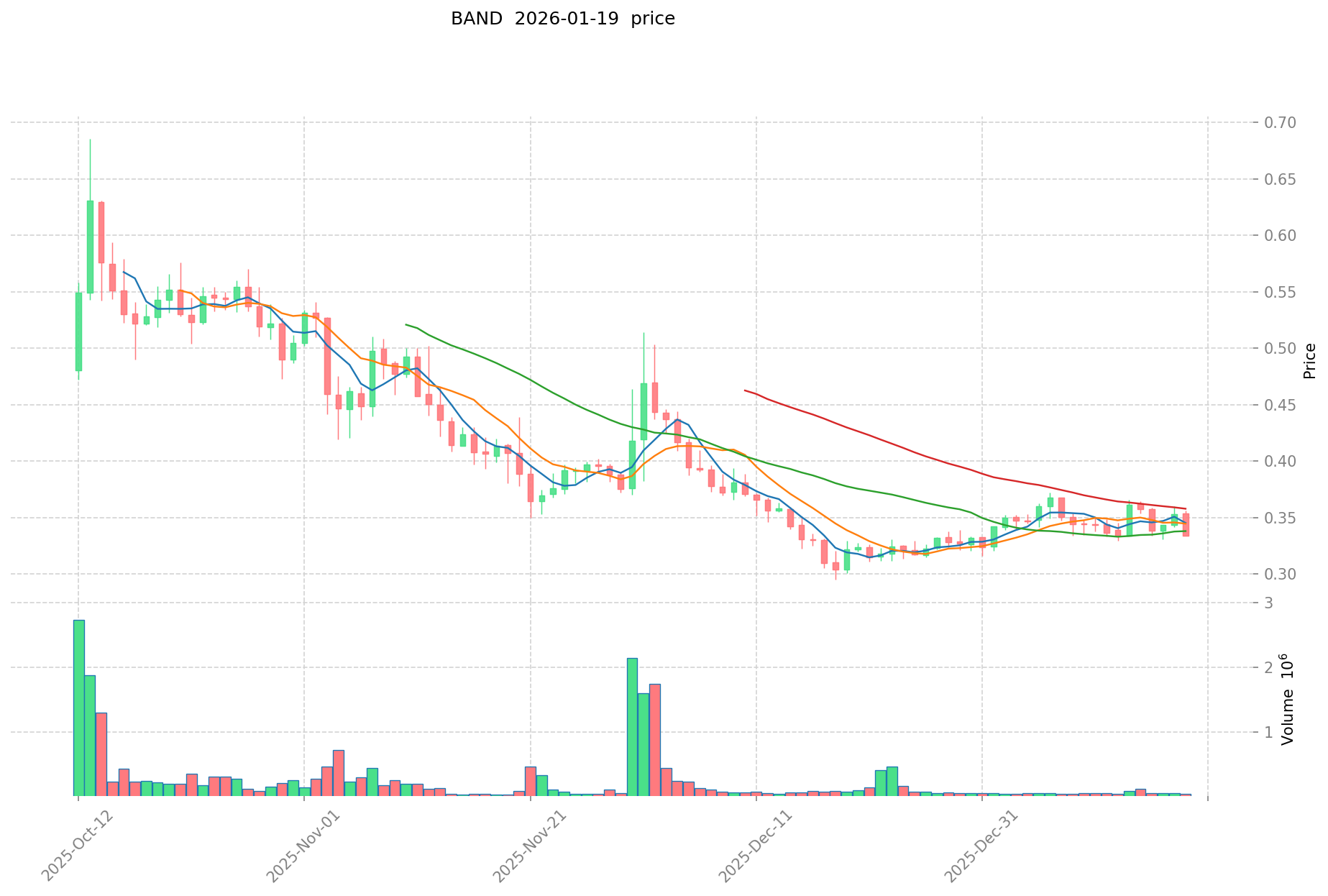
- 2025-2026: The token experienced considerable price compression → From its 2021 levels, BAND declined to $0.3168 as of January 2026, reflecting broader market adjustments and evolving competitive dynamics
Current BAND Investment Market Status (January 2026)
- BAND current price: $0.3168
- Market sentiment (Fear & Greed Index): Data indicates a neutral to cautious market environment
- 24-hour trading volume: $35,865.995279
- Circulating supply: 170,261,255.817936 BAND, representing approximately 99.67% of total supply
- Market capitalization: $53,938,765.84
- Fully diluted valuation: $54,119,699.79
- Contract address: The primary deployment is on Ethereum (0xBA11D00c5f74255f56a5E366F4F77f5A186d7f55)
Click to view real-time BAND market price
II. Core Factors Affecting Whether BAND is a Good Investment
Supply Mechanism and Scarcity
- Unlimited Maximum Supply → Band Protocol has no hard cap on maximum supply (∞), with current circulating supply of 170,261,255.82 BAND representing 99.67% of total supply (170,832,385.69 BAND)
- Historical Price Performance: BAND experienced significant price appreciation from its all-time low of $0.203625 (November 25, 2019) to its all-time high of $22.83 (April 15, 2021), though current price of $0.3168 reflects a 77.31% decline year-over-year
- Investment Implications: The unlimited supply model contrasts with traditional scarcity-based value propositions, requiring investors to focus on demand-side factors and utility adoption rather than supply constraints
- Recent Price Trends: BAND has shown notable volatility with 1-hour decline of 9.96%, 24-hour decline of 10.44%, and 7-day decline of 6.90%, while 30-day performance shows relatively modest decline of 1.99%
- Market Capitalization: Current market cap stands at approximately $53.94 million with market dominance of 0.0016%, ranking at position 500 among cryptocurrencies
- Trading Activity: 24-hour trading volume of $35,865.99 indicates moderate market liquidity, with BAND listed on 32 exchanges and held by approximately 34,450 addresses
Technology and Ecosystem Development
- Data Infrastructure Focus: Band Protocol positions itself as a data layer for training AI engines and powering blockchain applications, enabling access to real-time data with zero counterparty risk
- Multi-Sector Application: The protocol serves DeFi, GameFi, and AI agent sectors, providing data infrastructure for financial protocols and autonomous AI systems
- Technical Integration: Band operates with open, battle-tested infrastructure designed for blockchains and large language models (LLMs), with primary token deployment on Ethereum (contract address: 0xBA11D00c5f74255f56a5E366F4F77f5A186d7f55)
Market Sentiment and Forecast Analysis
- Mixed Prediction Signals: Various forecasts present divergent outlooks, with some projections suggesting potential growth while technical analysis as of December 19, 2025 showed bearish sentiment with 6 bullish versus 27 bearish technical indicators
- Price Forecast Range: Different analytical models project varied trajectories, with some estimates suggesting minimum prices ranging from $0.34 to $0.63 for 2025-2026 periods, though prediction models carry inherent uncertainty
- Investment Consideration: The substantial year-over-year decline of 77.31% and current price significantly below historical peak suggest elevated risk factors that potential investors should carefully evaluate alongside fundamental protocol developments
III. BAND Future Investment Forecast and Price Outlook (Is Band(BAND) worth investing in 2026-2030)
Short-term Investment Outlook (2026, short-term BAND investment outlook)
- Conservative forecast: $0.25 - $0.29
- Neutral forecast: $0.30 - $0.32
- Optimistic forecast: $0.32 - $0.36
Based on current market data, BAND exhibits moderate volatility patterns with recent 24-hour decline of approximately 10.44%. Short-term forecasts suggest potential stabilization around the $0.31-$0.36 range, contingent upon broader market sentiment and trading volume trends.
Mid-term Investment Outlook (2027-2028, mid-term Band(BAND) investment forecast)
- Market phase expectation: Gradual recovery phase with potential ecosystem expansion driving moderate growth
- Investment return forecast:
- 2027: $0.32 - $0.48
- 2028: $0.40 - $0.52
- Key catalysts: DeFi protocol adoption trends, AI agent integration developments, and real-time data infrastructure enhancements
Analysis indicates potential growth trajectory influenced by Band Protocol's positioning in blockchain data infrastructure and AI training applications. The mid-term outlook reflects expectations of gradual market acceptance and technical developments.
Long-term Investment Outlook (Is Band a good long-term investment?)
- Baseline scenario: $0.45 - $0.57 (assuming steady ecosystem development and moderate market conditions)
- Optimistic scenario: $0.68 - $0.82 (assuming accelerated adoption in DeFi, GameFi, and AI agent sectors)
- Risk scenario: $0.25 - $0.35 (under adverse market conditions or significant competitive pressure)
View BAND long-term investment and price forecast: Price Prediction
2026-01-19 to 2031 Long-term Outlook
- Base scenario: $0.40 - $0.70 USD (corresponding to steady progress and mainstream application development)
- Optimistic scenario: $0.70 - $0.85 USD (corresponding to large-scale adoption and favorable market environment)
- Transformative scenario: Above $0.85 USD (contingent upon breakthrough ecosystem developments and mainstream integration)
- 2031-12-31 projected high: $0.85 USD (based on optimistic development assumptions)
Disclaimer: Price forecasts are based on historical data analysis and market trends. Cryptocurrency markets involve substantial volatility and risk. Forecasts should not be construed as investment advice, and actual results may differ materially from projections.
| Year |
Predicted High Price |
Predicted Average Price |
Predicted Low Price |
Price Change |
| 2026 |
0.324141 |
0.3147 |
0.254907 |
0 |
| 2027 |
0.475936545 |
0.3194205 |
0.169292865 |
0 |
| 2028 |
0.51698207925 |
0.3976785225 |
0.250537469175 |
25 |
| 2029 |
0.676848845295 |
0.457330300875 |
0.3750108467175 |
44 |
| 2030 |
0.82227988097325 |
0.567089573085 |
0.5103806157765 |
79 |
| 2031 |
0.854462214245823 |
0.694684727029125 |
0.514066698001552 |
119 |
IV. Band Investment Strategy and Risk Management (How to invest in Band)
Investment Methodology (Band investment strategy)
Long-term Holding (HODL Band)
For conservative investors, a long-term holding strategy may be considered when evaluating Band. This approach involves purchasing Band tokens and maintaining positions over extended periods, potentially reducing exposure to short-term price fluctuations. Given Band's focus on providing data infrastructure for blockchain applications and AI systems, investors with this perspective typically assess the project's technological development and ecosystem expansion over time.
Active Trading
Active trading strategies rely on technical analysis and swing trading methods. Traders utilizing this approach may monitor Band's price movements, trading volumes, and technical indicators to identify potential entry and exit points. With Band's 24-hour trading volume of approximately $35,866 and recent price volatility showing a 10.44% decline over 24 hours, active traders need to account for liquidity conditions and market dynamics when executing their strategies.
Risk Management (Risk management for Band investment)
Asset Allocation Ratios
- Conservative investors: May consider limiting Band allocation to a smaller percentage of their overall cryptocurrency portfolio, typically alongside more established digital assets
- Aggressive investors: Might allocate a larger portion to Band, accepting higher volatility in exchange for potential growth opportunities
- Professional investors: Often employ sophisticated portfolio management techniques, potentially including Band as part of a diversified blockchain infrastructure thesis
Risk Hedging Solutions
A multi-asset portfolio approach can help manage Band-specific risks. This may include diversifying across different cryptocurrency categories and, where appropriate, utilizing hedging instruments. Investors should consider correlation patterns between Band and other assets when constructing their portfolios.
Secure Storage
Secure storage of Band tokens is essential for risk management:
- Cold wallets: Offline storage solutions that minimize exposure to online threats
- Hot wallets: For active trading purposes, with only necessary amounts kept online
- Hardware wallets: Physical devices that provide enhanced security for private keys
Given that Band operates as an ERC-20 token on Ethereum (contract address: 0xBA11D00c5f74255f56a5E366F4F77f5A186d7f55), investors should use wallets compatible with Ethereum-based assets and verify contract addresses before transactions.
V. Band Investment Risks and Challenges (Risks of investing in Band)
Market Risks
Band faces market volatility, with recent data showing a 10.44% decline over 24 hours and a 77.31% decrease over one year. The token's price has fluctuated between a 24-hour low of $0.2996 and high of $0.3565. Trading at $0.3168, Band remains substantially below its historical high of $22.83 recorded in April 2021. With a relatively modest 24-hour trading volume and market capitalization of approximately $53.94 million, the token may experience liquidity constraints during periods of market stress.
Regulatory Risks
Cryptocurrency regulatory frameworks vary across jurisdictions and continue to evolve. Band, like other digital assets, operates in an environment where policy changes in different countries could affect its accessibility, trading conditions, and adoption. Investors should monitor regulatory developments in their respective jurisdictions and in markets where Band has significant usage.
Technical Risks
As a data infrastructure protocol serving blockchain applications and AI systems, Band faces technical considerations including:
- Network security: Potential vulnerabilities in smart contracts or oracle mechanisms
- Infrastructure dependencies: Reliance on underlying blockchain networks and data sources
- Integration challenges: Technical complexities in maintaining compatibility with evolving blockchain ecosystems and AI applications
- Competitive landscape: Ongoing development of alternative data oracle solutions
VI. Conclusion: Is Band a Good Investment?
Investment Value Summary
Band positions itself as data infrastructure for blockchain applications and AI engines, serving sectors including DeFi, GameFi, and AI agents. The project's focus on providing real-time data with claimed zero counterparty risk addresses a specific need in the blockchain ecosystem. However, Band has experienced significant price volatility, with a 77.31% decline over the past year and substantial distance from its historical high. The token's market capitalization of approximately $53.94 million and circulation ratio of 99.67% indicate near-complete token distribution.
Investor Recommendations
✅ Beginners: Consider dollar-cost averaging approaches and prioritize secure wallet storage solutions. Ensure understanding of Band's use case and the oracle data infrastructure sector before investing.
✅ Experienced Investors: May employ technical analysis for swing trading opportunities while maintaining awareness of Band's volatility patterns and liquidity conditions. Portfolio diversification across multiple blockchain infrastructure projects could help manage sector-specific risks.
✅ Institutional Investors: Could evaluate Band as part of a broader blockchain data infrastructure thesis, conducting thorough due diligence on the project's technological capabilities, competitive positioning, and adoption metrics.
⚠️ Important Notice: Cryptocurrency investments involve substantial risk, including potential loss of principal. Band's price history demonstrates significant volatility. This content is for informational purposes only and does not constitute investment advice. Investors should conduct independent research and consider their risk tolerance before making investment decisions.
VII. FAQ
Q1: What is Band Protocol and how does it work?
Band Protocol is a data infrastructure layer that enables blockchain applications and AI systems to access real-time data with reduced counterparty risk. The protocol functions as a data oracle solution, connecting on-chain smart contracts and AI agents with off-chain data sources. By providing secure and reliable data feeds, Band serves multiple sectors including DeFi, GameFi, and autonomous AI systems. The protocol operates with open, battle-tested infrastructure designed for both blockchains and large language models (LLMs), with its primary token deployed as an ERC-20 asset on Ethereum (contract address: 0xBA11D00c5f74255f56a5E366F4F77f5A186d7f55).
Q2: What is BAND's current market position as of January 2026?
As of January 2026, BAND trades at approximately $0.3168 with a market capitalization of $53.94 million, ranking at position 500 among cryptocurrencies. The token has a circulating supply of 170,261,255.82 BAND, representing 99.67% of the total supply of 170,832,385.69 BAND. The 24-hour trading volume stands at $35,866, with the token listed on 32 exchanges and held by approximately 34,450 addresses. Notably, BAND currently trades 77.31% below its price from one year ago and significantly below its all-time high of $22.83 reached in April 2021.
Q3: What are the main factors influencing BAND's investment value?
Several core factors affect BAND's investment potential: (I) Supply mechanism - Band has an unlimited maximum supply model without a hard cap, requiring investors to focus on demand-side factors rather than supply constraints; (II) Technology development - The protocol's positioning in blockchain data infrastructure and AI training applications influences adoption potential; (III) Market performance - Recent volatility patterns show notable price fluctuations, with the token experiencing significant declines in short-term periods; (IV) Ecosystem expansion - Growth in DeFi, GameFi, and AI agent sectors could drive protocol adoption and utility demand.
Q4: What are the projected price forecasts for BAND through 2031?
Short-term forecasts (2026) suggest BAND may trade in the $0.25-$0.36 range under various scenarios. Mid-term projections indicate potential recovery, with 2027 estimates ranging from $0.32-$0.48 and 2028 projections of $0.40-$0.52. Long-term outlooks present three scenarios: baseline ($0.45-$0.57), optimistic ($0.68-$0.82), and risk ($0.25-$0.35). Extended forecasts to 2031 project a high of $0.85 under optimistic conditions, with average price estimates ranging from $0.31 in 2026 to $0.69 in 2031. These projections assume varying degrees of ecosystem development, adoption rates, and market conditions, though actual results may differ materially due to market volatility.
Q5: What are the primary risks associated with investing in BAND?
BAND investors face multiple risk categories: (I) Market risks - The token has demonstrated significant volatility, declining 77.31% year-over-year and showing substantial short-term price fluctuations, with relatively modest trading volume potentially leading to liquidity constraints; (II) Regulatory risks - Evolving cryptocurrency regulations across jurisdictions could affect BAND's accessibility and adoption; (III) Technical risks - Including potential smart contract vulnerabilities, infrastructure dependencies, integration challenges, and competition from alternative oracle solutions; (IV) Price risk - BAND trades substantially below its historical peak, reflecting ongoing market adjustment pressures.
Q6: How should different types of investors approach BAND?
Investment approaches vary by experience level: Beginners should consider dollar-cost averaging strategies, prioritize secure wallet storage, and ensure thorough understanding of Band's data oracle use case before investing. Experienced investors may employ technical analysis for swing trading opportunities while maintaining portfolio diversification across blockchain infrastructure projects to manage sector-specific risks. Institutional investors should conduct comprehensive due diligence on Band's technological capabilities, competitive positioning, and adoption metrics as part of a broader blockchain data infrastructure thesis. All investor categories should account for the substantial volatility demonstrated in Band's price history.
Q7: Where can BAND tokens be traded and how should they be stored?
BAND is available for trading on 32 cryptocurrency exchanges, with its primary deployment as an ERC-20 token on the Ethereum network. For secure storage, investors have multiple options: cold wallets provide offline storage that minimizes exposure to online threats; hot wallets serve active trading purposes with only necessary amounts kept online; hardware wallets offer physical devices that provide enhanced security for private keys. Since BAND operates as an Ethereum-based asset, investors should use wallets compatible with ERC-20 tokens and verify the contract address (0xBA11D00c5f74255f56a5E366F4F77f5A186d7f55) before conducting transactions.
Q8: What role does Band Protocol play in the AI and blockchain ecosystem?
Band Protocol serves as a data layer supporting both blockchain applications and AI engine training. The protocol enables developers, institutions, and users to access real-time data for various use cases ranging from financial protocols to AI-driven platforms. By providing data infrastructure for decentralized finance, gaming applications, and autonomous AI systems, Band facilitates data accessibility across multiple sectors. The protocol's infrastructure is designed to work with both blockchain networks and large language models (LLMs), positioning it at the intersection of blockchain technology and artificial intelligence applications, though adoption rates and competitive dynamics continue to evolve.
* The information is not intended to be and does not constitute financial advice or any other recommendation of any sort offered or endorsed by Gate.