BarnBridge (BOND) operates as a governance token for a DeFi volatility derivatives protocol with a current price of $0.07303 and market capitalization of approximately $714,355. This comprehensive analysis examines BOND's investment characteristics, examining its fixed supply mechanism of 10 million tokens (97.82% in circulation), governance infrastructure, and current market position across three trading exchanges. The article evaluates key investment factors including institutional adoption with 16,684 token holders, technology implementation using the Diamond Standard (EIP-2535), and macroeconomic influences on DeFi sector performance. Investment strategies accommodate different risk profiles: conservative investors may allocate 1-3% portfolio allocation, while experienced traders can leverage BOND's volatility through swing trading approaches on Gate. Comprehensive risk assessment addresses market volatility, regulatory uncertainty, and technical vulnerabilities, while detailed price scenarios and FAQ sec
Introduction: BarnBridge (BOND) Investment Position and Market Outlook
BOND is a notable asset in the cryptocurrency field. Since its launch in 2020, it has been positioned within the decentralized finance (DeFi) sector as a volatility derivatives protocol. As of February 2026, BarnBridge maintains a market capitalization of approximately $714,355, with a circulating supply of around 9.78 million tokens. The current price stands at approximately $0.07303. With its positioning as a governance and risk management token within the DeFi ecosystem, BOND has become a subject of discussion among investors considering "Is BarnBridge (BOND) a good investment?" This article provides a comprehensive analysis of BOND's investment characteristics, historical price trends, future price considerations, and associated investment risks to serve as a reference for investors.
BarnBridge operates as a volatility derivatives protocol where the BOND token functions as a governance token, enabling holders to participate in platform governance decisions. The protocol utilizes the EIP-2535 diamond standard, which provides flexibility for protocol upgrades. As an ERC-20 token, BOND is tradeable across multiple exchanges and compatible with various wallet infrastructures. The token has a maximum supply of 10 million tokens, with approximately 97.82% currently in circulation. The project is supported by 16,684 token holders as of the current date.
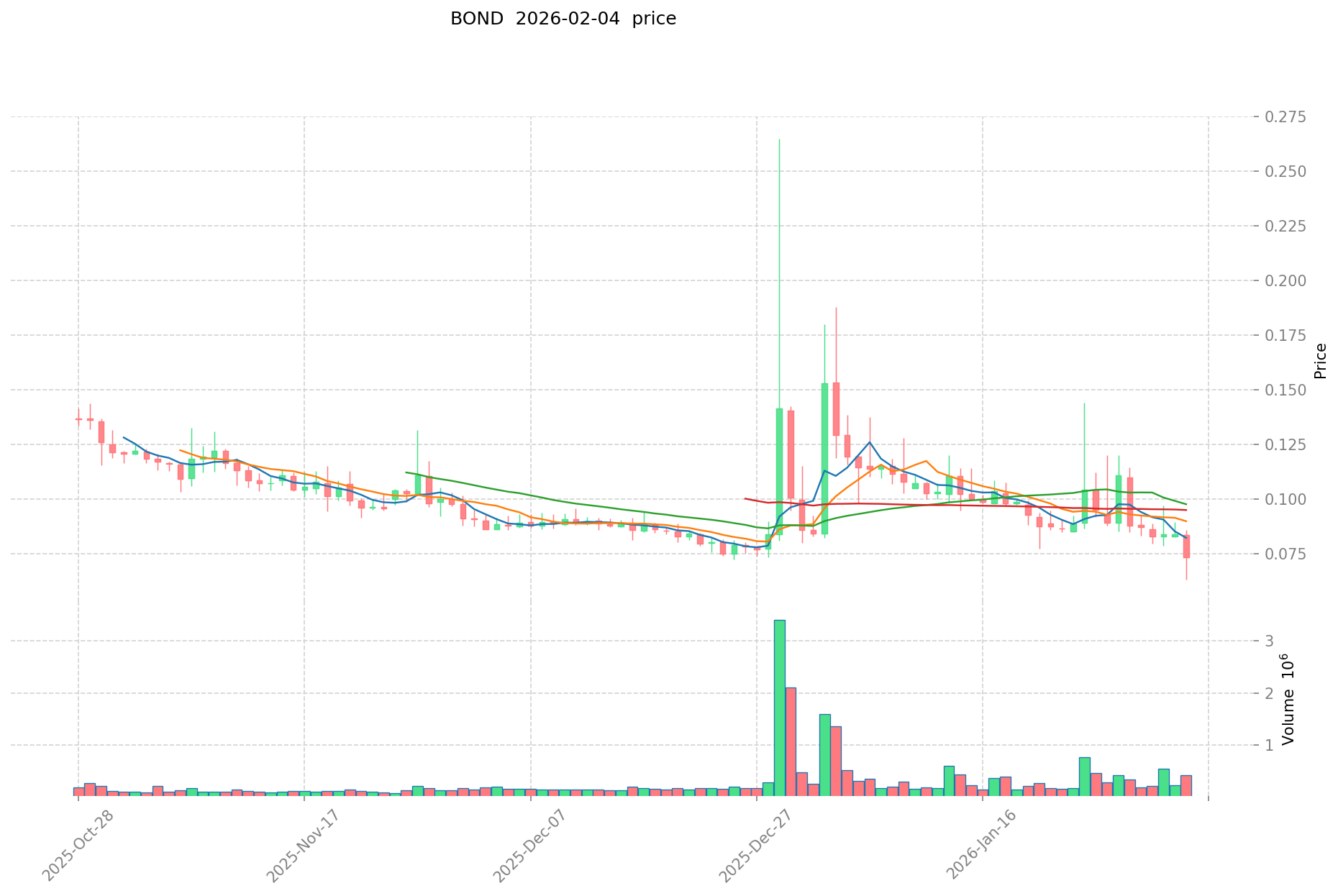
The token has experienced notable price fluctuations across different time periods. Over the past 24 hours, BOND has declined by 4.62%, while the 7-day period shows a decrease of 16.68%. The 30-day performance indicates a decline of 35.8%, and the annual performance reflects a decline of 80.34%. The token reached a price level of $185.69 on October 27, 2020, and recorded a price of $0.072459 on February 4, 2026. Current market share stands at 0.000027% of the total cryptocurrency market.
I. BarnBridge (BOND) Price History Review and Current Investment Value Status
BarnBridge (BOND) has experienced notable price fluctuations since its launch. The token was published on October 26, 2020, with an initial offering price of $85. During its early trading period, BOND demonstrated significant volatility characteristic of newly launched DeFi governance tokens.
According to available market data, BOND's price movements have been influenced by broader cryptocurrency market cycles and developments within the DeFi sector. The token's trading activity reflects changes in investor sentiment toward decentralized finance protocols and governance token utility.
As of February 4, 2026, BOND is trading at approximately $0.07303, representing a substantial decline from earlier price levels. The token's 24-hour trading volume stands at approximately $17,097.94, indicating relatively modest trading activity compared to major cryptocurrency assets.
Current BOND Investment Market Status (February 2026)
- Current BOND Price: $0.07303
- 24-Hour Price Change: -4.62%
- 24-Hour Trading Volume: $17,097.94
- Market Capitalization: Approximately $714,355.40
- Circulating Supply: 9,781,670.51 BOND (representing about 97.82% of total supply)
- Total Supply: 10,000,000 BOND
- Exchange Availability: Listed on 3 exchanges
- Token Holders: 16,684 addresses
BOND demonstrates price sensitivity across multiple timeframes. The token has declined 16.68% over the past 7 days and 35.8% over the past 30 days, reflecting bearish short-term momentum. On a yearly basis, BOND has declined 80.34%, indicating sustained downward pressure on valuation.
The token's market capitalization to fully diluted valuation ratio stands at 97.82%, suggesting that nearly all tokens are already in circulation, which limits potential supply-side pressure from future token releases.
Click to view real-time BOND market price
Market Context and Token Utility
BarnBridge operates as a volatility derivatives protocol within the DeFi ecosystem. The BOND token serves as the governance token for the platform, enabling holders to vote on protocol updates and parameter changes. The token also functions within the protocol's staking system and plays a role in security and strategy management.
The project utilizes the Diamond Standard (EIP-2535), which allows for protocol upgrades without requiring all token holders to migrate to new contract versions. This upgradeability feature is managed through the BarnBridge DAO, which exercises full control over the protocol and its built-in functionalities.
As an ERC-20 token, BOND maintains compatibility with standard Ethereum infrastructure, enabling trading on various exchanges and storage in compatible wallets. This standardization provides accessibility to a broad range of market participants globally.
The token's trading performance and market dynamics reflect both the specific developments within the BarnBridge protocol and broader trends affecting DeFi governance tokens, including changes in yield farming incentives, protocol adoption rates, and overall cryptocurrency market conditions.
II. Core Factors Affecting Whether BOND is a Good Investment (Is BarnBridge(BOND) a Good Investment)
Supply Mechanism and Scarcity (BOND investment scarcity)
- Fixed Supply Model → Influences price and investment value
- BarnBridge implements a capped supply mechanism with a maximum supply of 10,000,000 BOND tokens. As of February 04, 2026, approximately 9,781,670 BOND tokens are in circulation, representing about 97.82% of the total supply. This limited supply structure may contribute to potential scarcity dynamics in the market.
- Investment significance: The fixed supply cap and high circulation ratio may serve as factors in evaluating long-term investment considerations, though market demand and broader adoption remain critical variables.
Institutional Investment and Mainstream Adoption (Institutional investment in BOND)
- Holder Distribution: As of the latest data, BarnBridge has approximately 16,684 token holders, indicating a distributed ownership structure across the market.
- The project's governance token model enables BOND holders to participate in protocol decision-making through voting mechanisms, which may attract participants interested in decentralized governance structures.
- Market presence: BOND is currently listed on 3 exchanges, providing accessibility for market participants, though this represents a relatively limited exchange footprint compared to more widely adopted digital assets.
Macroeconomic Environment's Impact on BOND Investment
- Market Volatility Context: The cryptocurrency market remains subject to various macroeconomic factors including monetary policy shifts, interest rate adjustments, and regulatory developments that may influence investor appetite for digital assets including BOND.
- The broader DeFi sector, within which BarnBridge operates as a volatility derivatives protocol, may experience demand fluctuations based on market conditions and risk sentiment.
- Geopolitical and economic uncertainties can affect capital flows into alternative asset classes, potentially impacting trading volumes and price dynamics for governance tokens like BOND.
Technology and Ecosystem Development (Technology & Ecosystem for BOND investment)
- Diamond Standard Implementation (EIP-2535): BarnBridge utilizes the Diamond Standard, which allows protocol upgrades without requiring token migrations, potentially offering operational flexibility for ongoing development.
- Governance Infrastructure: The BarnBridge DAO provides community-controlled governance mechanisms, enabling BOND holders to influence protocol parameters and strategic directions.
- ERC-20 Compatibility: As an ERC-20 token, BOND maintains interoperability with Ethereum-based infrastructure, facilitating integration with various wallets, exchanges, and DeFi protocols.
- The protocol's focus on volatility derivatives and risk tranching represents a specialized niche within the DeFi ecosystem, with adoption dependent on market demand for such structured financial instruments.
III. BOND Future Investment Forecast and Price Outlook (Is BarnBridge(BOND) worth investing in 2026-2031)
Short-term BOND Investment Outlook (2026, short-term BOND investment outlook)
As of February 4, 2026, BarnBridge (BOND) is trading at $0.073, reflecting a 24-hour decline of 4.62% and a 30-day decrease of 35.8%. The token has experienced significant volatility, with its current price near recent lows.
- Conservative forecast: $0.049 - $0.065
- Neutral forecast: $0.065 - $0.072
- Optimistic forecast: $0.072 - $0.100
The short-term outlook for BOND in 2026 remains challenging. Market sentiment appears cautious, with the token trading substantially below its historical high. Trading volume remains relatively modest at approximately $17,098 over 24 hours, suggesting limited immediate market interest. The circulating supply represents approximately 97.82% of the maximum supply, indicating minimal inflationary pressure from token unlocks.
Mid-term BarnBridge(BOND) Investment Forecast (2027-2028, mid-term BarnBridge(BOND) investment forecast)
- Market phase expectation: Recovery and consolidation phase, with potential for moderate growth as DeFi protocols adapt to evolving market conditions
- Investment return projection:
- 2027: $0.065 - $0.098, representing a potential 17% increase from 2026 average
- 2028: $0.077 - $0.118, representing a potential 25% increase from 2027 average
- Key catalysts: Development of governance mechanisms, expansion of DeFi derivative products, broader adoption of risk management protocols in decentralized finance
The mid-term outlook for BOND depends significantly on the evolution of the DeFi sector and the project's ability to maintain relevance within the derivatives protocol landscape. Market recovery from current levels could be gradual, influenced by broader cryptocurrency market trends and regulatory developments. The ERC-20 token standard provides compatibility advantages across exchanges and wallets, potentially supporting liquidity.
Long-term Investment Outlook (Is BarnBridge a good long-term investment?)
- Baseline scenario: $0.098 - $0.131 (assuming steady progress and moderate mainstream adoption in risk management protocols)
- Optimistic scenario: $0.127 - $0.154 (assuming significant adoption, favorable market conditions, and successful protocol upgrades)
- Risk scenario: Below $0.060 (under adverse market conditions, including prolonged crypto winter or significant competitive pressure)
For detailed BOND long-term investment and price predictions, visit: Price Prediction
Long-term Outlook for 2026-2031
- Baseline scenario: $0.098 - $0.131 (corresponding to steady progress and gradual mainstream adoption)
- Optimistic scenario: $0.127 - $0.154 (corresponding to large-scale adoption and favorable market environment)
- Transformational scenario: Above $0.154 (if the ecosystem achieves breakthrough developments and widespread adoption)
- December 31, 2031 predicted high: $0.154 (based on optimistic development assumptions)
Disclaimer: These forecasts are based on current market data, historical trends, and projected scenarios. Cryptocurrency investments carry substantial risks, including high volatility and potential loss of capital. Past performance does not guarantee future results. Market conditions, regulatory changes, technological developments, and competitive dynamics may significantly impact actual outcomes. This analysis does not constitute investment advice, and investors should conduct thorough research and consider their risk tolerance before making investment decisions.
| Year |
Predicted High Price |
Predicted Average Price |
Predicted Low Price |
Price Change |
| 2026 |
0.0999271 |
0.07189 |
0.0488852 |
-1 |
| 2027 |
0.097935747 |
0.08590855 |
0.065290498 |
17 |
| 2028 |
0.11766035008 |
0.0919221485 |
0.07721460474 |
25 |
| 2029 |
0.1205099366835 |
0.10479124929 |
0.0597310120953 |
43 |
| 2030 |
0.149825288672377 |
0.11265059298675 |
0.098006015898472 |
54 |
| 2031 |
0.153548390770589 |
0.131237940829563 |
0.127300802604676 |
79 |
IV. BOND Investment Strategy and Risk Management (How to invest in DeFi governance tokens)
Investment Methodology (BOND investment strategy)
-
Long-term holding (HODL BOND): Suitable for conservative investors
Long-term holding may be appropriate for investors who believe in the potential of decentralized finance governance mechanisms and volatility derivative protocols. This strategy involves acquiring BOND tokens and maintaining positions over extended periods, focusing on the fundamental value proposition of the BarnBridge protocol rather than short-term price movements.
-
Active trading: Relies on technical analysis and swing trading
Active traders may capitalize on BOND's price fluctuations by utilizing technical indicators, chart patterns, and market sentiment analysis. Given the token's historical volatility, swing trading strategies could involve identifying support and resistance levels, momentum indicators, and volume patterns to execute trades within shorter timeframes.
Risk Management (Risk management for BOND investment)
-
Asset allocation ratio: Conservative, aggressive, and professional investor approaches
- Conservative investors: May consider allocating 1-3% of their cryptocurrency portfolio to BOND, given its volatility and smaller market capitalization
- Aggressive investors: Could allocate 5-10% to governance tokens like BOND as part of a DeFi-focused strategy
- Professional investors: May implement dynamic allocation based on market conditions, protocol developments, and governance participation opportunities
-
Risk hedging solutions: Multi-asset portfolio and hedging instruments
Diversification across different cryptocurrency categories (Layer 1 protocols, DeFi tokens, stablecoins) can help mitigate concentration risk. Investors may also consider hedging strategies using derivatives or maintaining stablecoin reserves to manage downside exposure during periods of heightened volatility.
-
Secure storage: Hot wallets, cold wallets, and hardware wallet recommendations
Given that BOND is an ERC-20 token, it can be stored in Ethereum-compatible wallets. For long-term holdings, hardware wallets such as Ledger or Trezor provide enhanced security through offline storage. For active trading, reputable software wallets with strong security features may be appropriate, while exchanges should only be used for short-term trading purposes due to custodial risks.
V. BOND Investment Risks and Challenges (Risks of investing in DeFi governance tokens)
-
Market risk: High volatility and price manipulation concerns
BOND has demonstrated considerable price volatility, with the current price representing a substantial decline from its historical peak. The token's 24-hour trading volume and relatively smaller market capitalization may expose it to liquidity constraints and potential price manipulation. Historical data shows significant percentage changes across different timeframes, indicating substantial market risk for investors.
-
Regulatory risk: Policy uncertainty across different jurisdictions
DeFi governance tokens like BOND operate in an evolving regulatory environment. Different countries maintain varying approaches to cryptocurrency regulation, and future regulatory developments could impact the token's accessibility, trading venues, or classification. Investors should monitor regulatory developments in their jurisdictions and consider how changing policies might affect governance token holdings.
-
Technical risk: Network security vulnerabilities and upgrade failures
As an Ethereum-based protocol utilizing the Diamond Standard (EIP-2535), BarnBridge faces technical risks related to smart contract vulnerabilities, network congestion, and upgrade implementation challenges. While the Diamond Standard provides flexibility for protocol upgrades without requiring token migrations, any technical issues during governance implementations or protocol updates could affect token value and functionality.
VI. Conclusion: Is DeFi governance token a Good Investment?
-
Investment value summary: BOND presents notable long-term potential within the DeFi governance ecosystem, though short-term price movements remain highly volatile.
The BarnBridge protocol's focus on volatility derivatives and governance mechanisms addresses specific needs within decentralized finance. However, the token's current market position, significant decline from historical peaks, and relatively smaller market capitalization indicate both opportunities and substantial risks for potential investors.
-
Investor recommendations:
✅ Beginners: Consider dollar-cost averaging strategies combined with secure wallet storage practices. Focus on understanding the protocol's governance mechanisms and DeFi fundamentals before significant allocation.
✅ Experienced investors: May explore swing trading opportunities while maintaining diversified portfolio allocations. Consider participating in protocol governance to better understand value drivers and ecosystem developments.
✅ Institutional investors: Strategic long-term positioning may be appropriate for those with comprehensive DeFi exposure strategies and robust risk management frameworks. Institutional participants should conduct thorough due diligence on protocol mechanics and governance structures.
⚠️ Disclaimer: Cryptocurrency investments carry substantial risk. This content is provided for informational purposes only and does not constitute investment advice. Investors should conduct independent research and consult with qualified financial advisors before making investment decisions.
VII. FAQ
Q1: What is BarnBridge (BOND) and what makes it different from other DeFi tokens?
BarnBridge (BOND) is a governance token for a volatility derivatives protocol in the DeFi ecosystem. Unlike typical DeFi tokens, BOND specifically focuses on risk management through volatility derivatives, allowing users to participate in protocol governance decisions. The project utilizes the Diamond Standard (EIP-2535), which enables protocol upgrades without requiring token migrations—a technical advantage that provides operational flexibility. As an ERC-20 token with a maximum supply of 10 million tokens, BOND maintains compatibility with standard Ethereum infrastructure while serving as both a governance mechanism and a component in the protocol's staking system.
Q2: Why has BOND's price declined significantly from its historical peak?
BOND's current price of $0.07303 represents a substantial decline from earlier price levels, with an 80.34% decrease over the past year. Several factors contribute to this decline: broader cryptocurrency market conditions, reduced interest in DeFi governance tokens compared to the 2020-2021 period, relatively modest trading volume ($17,098 over 24 hours), and limited exchange availability (3 exchanges). The token's smaller market capitalization of approximately $714,355 also makes it more susceptible to market volatility and liquidity constraints compared to larger cryptocurrency assets.
Q3: What are the primary risks associated with investing in BOND?
BOND carries three main risk categories. Market risk includes high volatility and potential price manipulation due to relatively low trading volumes and market capitalization. Regulatory risk stems from evolving cryptocurrency regulations across different jurisdictions, which could impact token accessibility and classification. Technical risk involves smart contract vulnerabilities, network security concerns, and potential issues during protocol upgrades despite the Diamond Standard implementation. The token has experienced significant percentage changes across different timeframes, indicating substantial downside potential alongside any upside opportunities.
Q4: How should investors approach BOND allocation in their portfolio?
Portfolio allocation for BOND should align with investor risk tolerance and experience level. Conservative investors may consider allocating 1-3% of their cryptocurrency portfolio to BOND, given its volatility and smaller market capitalization. Aggressive investors with higher risk tolerance could allocate 5-10% as part of a DeFi-focused strategy. Professional investors might implement dynamic allocation based on market conditions and protocol developments. Diversification across different cryptocurrency categories and maintaining stablecoin reserves for hedging purposes can help mitigate concentration risk.
Q5: What is the long-term investment outlook for BOND through 2031?
Long-term forecasts for BOND range from baseline to optimistic scenarios. The baseline scenario projects prices between $0.098-$0.131 by 2031, assuming steady progress and moderate adoption in risk management protocols. The optimistic scenario forecasts $0.127-$0.154, contingent on significant adoption and favorable market conditions. However, risk scenarios exist where prices could fall below $0.060 under adverse conditions. Key factors influencing these projections include DeFi sector evolution, protocol governance developments, regulatory environment changes, and broader cryptocurrency market trends. These forecasts carry substantial uncertainty and do not guarantee future performance.
Q6: What storage options are recommended for BOND tokens?
As an ERC-20 token, BOND can be stored in Ethereum-compatible wallets with varying security levels. For long-term holdings, hardware wallets such as Ledger or Trezor provide enhanced security through offline storage, protecting against online threats. For active trading purposes, reputable software wallets with strong security features may be appropriate, though they carry higher risk than hardware solutions. Exchanges should primarily be used for short-term trading rather than long-term storage due to custodial risks. Investors should implement proper security practices including seed phrase backup and multi-factor authentication regardless of chosen storage method.
Q7: How does BOND's governance mechanism work and why does it matter for investors?
BOND functions as a governance token enabling holders to participate in protocol decision-making through the BarnBridge DAO, which exercises full control over protocol parameters and strategic directions. This governance structure allows token holders to vote on protocol updates, parameter changes, and development priorities. For investors, governance participation provides insight into protocol evolution and value drivers while potentially influencing outcomes that affect token utility and demand. The governance mechanism also represents a fundamental aspect of the token's value proposition, distinguishing it from purely speculative assets and providing holders with direct influence over the protocol's future development trajectory.
Q8: What trading strategies are suitable for BOND given its current market conditions?
Two primary strategies may be appropriate depending on investor objectives and risk tolerance. Long-term holding (HODL) suits conservative investors who believe in the fundamental value of DeFi governance mechanisms and are willing to weather short-term volatility. This approach focuses on the protocol's long-term potential rather than price fluctuations. Active trading strategies involve utilizing technical analysis, chart patterns, and momentum indicators to capitalize on BOND's price movements. Given the token's historical volatility, swing traders may identify support and resistance levels, volume patterns, and market sentiment shifts to execute trades within shorter timeframes. Both strategies require secure storage practices and appropriate risk management measures.
* The information is not intended to be and does not constitute financial advice or any other recommendation of any sort offered or endorsed by Gate.