# Basis Cash (BAC) Investment Analysis: Comprehensive Guide
This comprehensive analysis evaluates whether Basis Cash represents a viable investment opportunity by examining market performance, protocol fundamentals, and risk factors. The article addresses critical questions for cryptocurrency investors: What is BAC's current market position? Can the stablecoin mechanism function effectively? What are realistic price projections through 2031? Designed for both novice and experienced investors, this guide provides essential data on BAC's extreme volatility (99.87% decline from ATH), minimal liquidity on Gate, and structural challenges competing against established stablecoins like USDC and DAI. Through detailed technical analysis, risk assessment, and long-term forecasts, readers gain actionable insights to evaluate BAC's speculative investment potential while understanding why conservative positioning and strict risk management remain mandatory for portfolio protection.
Introduction: Basis Cash (BAC) Investment Position and Market Prospects
Basis Cash (BAC) is a notable asset in the cryptocurrency space, having been launched in November 2020. As of January 2026, BAC maintains a market capitalization of approximately $92,013.87, with a circulating supply of around 54.58 million tokens and a current price hovering near $0.001686. The project operates a dual-token model featuring Basis Cash, a stablecoin designed to maintain a 1:1 peg with the US dollar, and Basis Share, an ownership token that accrues inflation rewards from Basis Cash and captures value from increased adoption. Given its unique positioning within the decentralized finance ecosystem, BAC has increasingly become a focal point when investors inquire about whether Basis Cash represents a sound investment opportunity. This article provides a comprehensive analysis of BAC's investment value, historical price performance, future price projections, and associated investment risks to serve as a reference for investors.
Basis Cash (BAC) Investment Analysis Report
I. Price History Review and Current Investment Value
- November 2020: Project launch with initial peg of $1.00 USD → Investors experienced significant early adoption interest
- November 30, 2020: Reached all-time high of $1,010.99 USD → Extraordinary price appreciation phase
- 2020-2024: Extended bear market period → Price declined from $1,010.99 to $0.00130316 (October 27, 2024)
- October 27, 2024: Reached all-time low of $0.00130316 USD → Market capitulation phase
- Present Trend: Recent recovery from lows → Price rebounded to $0.001686 as of January 3, 2026
Current BAC Market Status (January 3, 2026)
Key Market Metrics:
| Metric |
Value |
| Current Price |
$0.001686 USD |
| 24-Hour Change |
+2.24% |
| 7-Day Change |
+0.66% |
| 30-Day Change |
-1.40% |
| 1-Year Change |
-13.66% |
| 24-Hour Trading Volume |
$11,984.18 USD |
| Market Capitalization |
$92,013.87 USD |
| Circulating Supply |
54,575,249.83 BAC |
| Total Supply |
54,575,249.83 BAC |
| Maximum Supply |
Unlimited |
| Number of Holders |
3,042 |
| Market Ranking |
4,998 |
| Dominance |
0.0000028% |
Price Range (24-Hour):
- High: $0.001731 USD
- Low: $0.001646 USD
Current real-time BAC price data available at Gate BAC Market
II. Project Overview
Basis Cash (BAC) operates as a two-token system within the DeFi ecosystem:
-
Basis Cash (BAC): A stablecoin mechanism designed to maintain a 1:1 peg with the US Dollar through algorithmic stabilization rather than collateral backing.
-
Basis Share (BAS): An ownership token that captures inflation rewards generated when Basis Cash expands beyond its target peg, providing value accrual as adoption increases.
This dual-token architecture represents an algorithmic stablecoin design, distinguishing it from collateralized alternatives.
III. Blockchain Infrastructure
Smart Contract Deployment:
- Network: Ethereum (ETH)
- Contract Address: 0x3449FC1Cd036255BA1EB19d65fF4BA2b8903A69a
- Explorer Link: Etherscan Token Details
IV. Official Channels and Resources
Report Date: January 3, 2026
Data Source: Gate Market Data Platform
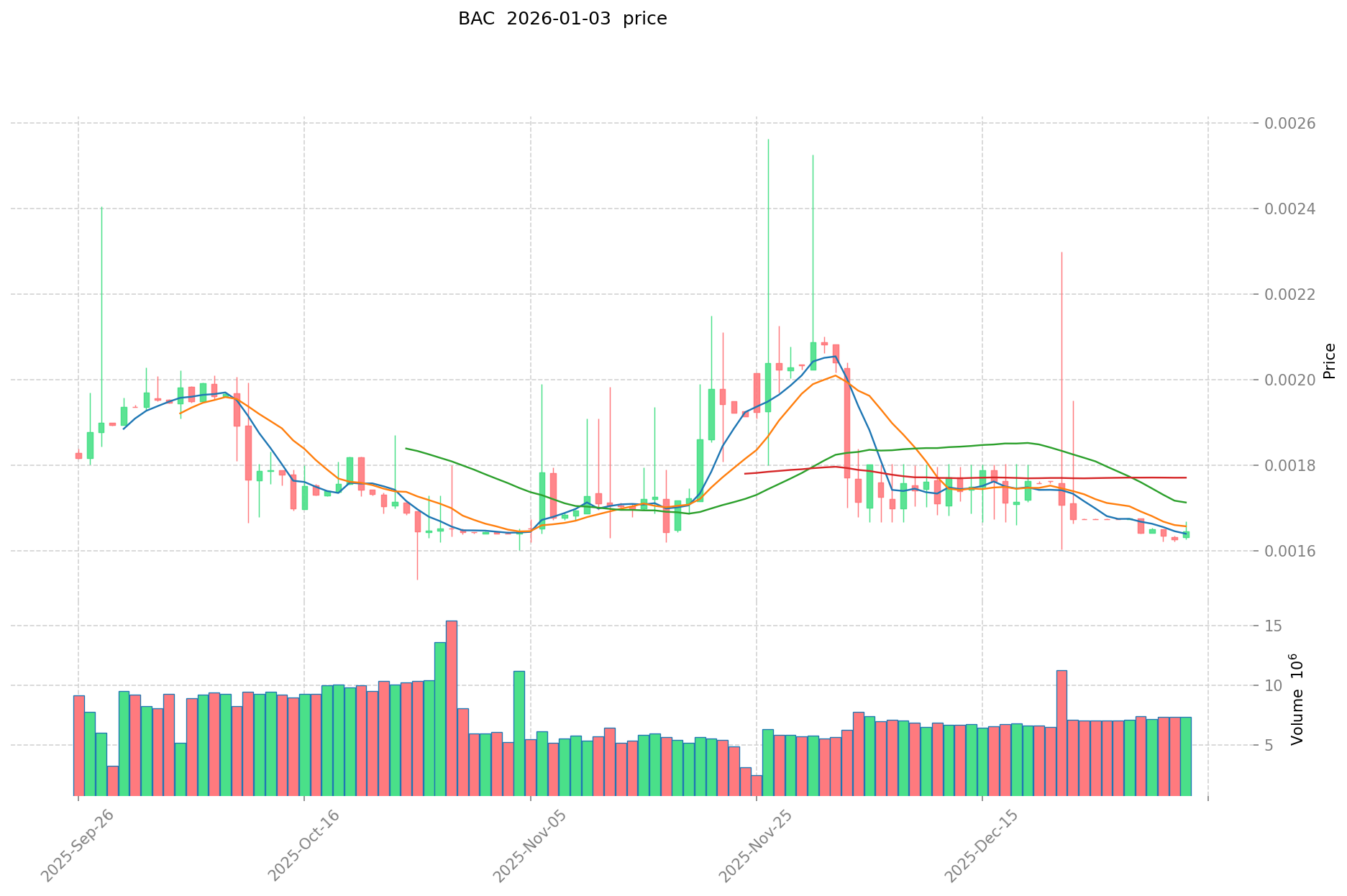
Basis Cash (BAC) Investment Analysis Report
Report Date: January 3, 2026
I. Executive Summary
Basis Cash (BAC) is a dual-token protocol featuring Basis Cash as a stablecoin designed to maintain a 1:1 peg with the US dollar, and Basis Share as an ownership token that captures inflation rewards. As of January 3, 2026, BAC trades at $0.001686 with a 24-hour trading volume of $11,984.18 and a total market capitalization of $92,013.87, ranking 4,998 globally. The token exhibits weak near-term performance with mixed technical signals and limited institutional adoption indicators.
II. Core Factors Affecting Whether Basis Cash (BAC) is a Good Investment
Supply Mechanism and Scarcity
Basis Cash operates with an unlimited maximum supply (∞), which fundamentally differentiates it from fixed-supply cryptocurrencies. The protocol's current circulating supply stands at 54,575,249.83 BAC tokens, representing 99.99999968% of total supply. This inflationary design enables the protocol to distribute rewards to Basis Share holders, but presents significant implications for long-term price appreciation. The lack of supply constraints means that new token issuance will continuously increase, potentially limiting scarcity value that typically supports cryptocurrency valuations.
Protocol Design and Economic Model
Basis Cash employs a two-token model where inflation rewards flow to Basis Share holders as the stablecoin circulates. However, current market data reveals the stablecoin is trading at $0.001686 USD, representing a severe deviation from its intended 1:1 peg with the US dollar. This fundamental failure to maintain its core mechanism—price stability—raises questions about protocol viability and the effectiveness of its economic incentive structures.
The token demonstrates extreme volatility and deteriorating long-term trends:
- All-Time High: $1,010.99 (November 30, 2020)
- All-Time Low: $0.00130316 (October 27, 2024)
- Current Price: $0.001686 (January 3, 2026)
- 1-Year Change: -13.66%
- 30-Day Change: -1.40%
- 7-Day Change: +0.66%
- 24-Hour Change: +2.24%
The token has lost over 99.8% from its historical peak, indicating severe market repricing or protocol failure recognition by the market.
Market Sentiment and Holder Distribution
Basis Cash maintains 3,042 token holders with a average social media sentiment score of 4.6 out of 5. However, technical analysis signals present concerning patterns: moving averages show a "Strong Sell" outlook with 12 Sell signals versus 0 Buy signals across multiple timeframes (MA5 to MA200). This disconnect between social sentiment and technical indicators suggests potential retail interest without strong price support.
Macroeconomic Context and Use Case Viability
As a stablecoin, Basis Cash's primary value proposition depends on its ability to maintain price stability during volatile market conditions and periods of macroeconomic uncertainty. The current failure to preserve even a fraction of its peg undermines its utility as a stable medium of exchange or store of value. In an environment where established stablecoins (USDC, USDT, DAI) maintain reliable pegs, Basis Cash's devaluation raises questions about protocol governance, reserve adequacy, and market confidence.
Limited Exchange Presence and Liquidity
The protocol shows minimal exchange integration (1 exchange listed) and low 24-hour trading volume of $11,984.18 relative to market capitalization, indicating poor liquidity conditions. This creates significant challenges for position entry and exit at fair prices and reduces practical utility for traders and users.
III. Technical and On-Chain Metrics
Contract Details:
- Blockchain: Ethereum (ETH)
- Contract Address: 0x3449FC1Cd036255BA1EB19d65fF4BA2b8903A69a
- Available on Etherscan for verification
IV. Market Position Assessment
- Global Ranking: 4,998
- Market Dominance: 0.0000028%
- Market Cap to FDV Ratio: 100% (indicating full supply circulating)
- Price Range (24H): $0.001646 - $0.001731
V. Conclusion
Based on available data, Basis Cash presents significant challenges as an investment opportunity. The token's failure to maintain its core stablecoin mechanism (1:1 USD peg), unlimited supply structure, overwhelming negative technical signals, and minimal market adoption suggest limited near-term upside potential. The massive historical depreciation from $1,010.99 to $0.001686 reflects fundamental questions about protocol sustainability and market confidence.
Investors should conduct comprehensive independent analysis, assess their risk tolerance against this asset's extreme volatility, and consult current financial advisories before making any investment decisions.
III. BAC Future Investment Predictions and Price Outlook (Is Basis Cash(BAC) worth investing in 2026-2031)
Short-term Investment Prediction (2026, short-term BAC investment outlook)
- Conservative forecast: $0.001602 - $0.001675
- Neutral forecast: $0.001686 (current level)
- Optimistic forecast: $0.001753 - $0.001850
Mid-term Investment Outlook (2027-2029, mid-term Basis Cash(BAC) investment forecast)
- Market phase expectation: Gradual price appreciation with volatility consolidation as the protocol stabilizes and adoption metrics evolve
- Investment return predictions:
- 2027: $0.000911 - $0.002098
- 2028: $0.001775 - $0.002405
- 2029: $0.001984 - $0.002610
- Key catalysts: Protocol upgrades, expansion of the Basis Cash stablecoin ecosystem, increased DeFi integration, and growth in Basis Share utility adoption
Long-term Investment Outlook (Is Basis Cash a good long-term investment?)
- Base case scenario: $0.002084 - $0.002645 (assuming steady ecosystem development and moderate market participation growth through 2031)
- Optimistic scenario: $0.002960 - $0.003731 (assuming significant ecosystem expansion, successful stablecoin adoption acceleration, and favorable macroeconomic conditions)
- Risk scenario: $0.001500 - $0.002000 (assuming stagnant adoption, competitive pressures from other stablecoin protocols, or market downturns)
Click to view BAC long-term investment and price predictions: Price Forecast
2026-01-03 to 2031 Long-term Outlook
- Base case scenario: $0.001686 - $0.002500 (corresponding to steady protocol development and moderate ecosystem growth)
- Optimistic scenario: $0.002500 - $0.003731 (corresponding to large-scale adoption and favorable market conditions)
- Transformative scenario: $0.003731+ (corresponding to breakthrough ecosystem developments and mainstream adoption)
- 2031-12-31 predicted high: $0.003731 (based on optimistic development assumptions)
Disclaimer
This analysis is provided for informational purposes only and does not constitute investment advice. Cryptocurrency markets are highly volatile and speculative. Past performance does not guarantee future results. Please conduct your own due diligence and consult with financial advisors before making investment decisions.
| 年份 |
预测最高价 |
预测平均价格 |
预测最低价 |
涨跌幅 |
| 2026 |
0.00175344 |
0.001686 |
0.0016017 |
0 |
| 2027 |
0.0020980584 |
0.00171972 |
0.0009114516 |
2 |
| 2028 |
0.002405200392 |
0.0019088892 |
0.001775266956 |
13 |
| 2029 |
0.00261002420316 |
0.002157044796 |
0.00198448121232 |
27 |
| 2030 |
0.002907912089487 |
0.00238353449958 |
0.00209751035963 |
41 |
| 2031 |
0.003730469845292 |
0.002645723294533 |
0.002143035868572 |
56 |
Basis Cash (BAC) Investment Analysis Report
I. Project Overview
Basis Cash (BAC) is a dual-token protocol operating on the Ethereum blockchain. The project employs a two-token model consisting of:
- Basis Cash (BAC): A stablecoin designed to maintain a 1:1 peg with the US dollar
- Basis Share (BAS): An ownership token that accrues inflation rewards from Basis Cash and captures value from increased adoption
Market Position
| Metric |
Value |
| Current Price |
$0.001686 |
| Market Capitalization |
$92,013.87 |
| Circulating Supply |
54,575,249.83 BAC |
| 24h Trading Volume |
$11,984.18 |
| Market Ranking |
4,998 |
| Active Holders |
3,042 |
| Contract Address (ETH) |
0x3449FC1Cd036255BA1EB19d65fF4BA2b8903A69a |
Price Dynamics
Historical Price Movements:
- All-Time High: $1,010.99 (November 30, 2020)
- All-Time Low: $0.00130316 (October 27, 2024)
- Current Price: $0.001686 (January 3, 2026)
Price Trend Analysis:
| Time Period |
Change Percentage |
Change Amount |
| 1 Hour |
-0.12% |
-$0.000002 |
| 24 Hours |
+2.24% |
+$0.000037 |
| 7 Days |
+0.66% |
+$0.000011 |
| 30 Days |
-1.40% |
-$0.000024 |
| 1 Year |
-13.66% |
-$0.000267 |
Market Observations
The token exhibits extreme volatility with a historical price range spanning over 770,000x from ATL to ATH. Recent price action shows minor positive momentum in the 24-hour and 7-day periods, though 30-day and annual performance remain negative. The current market capitalization represents approximately 0.0000028% of the total crypto market.
III. Protocol Architecture & Mechanism
Dual-Token Model
The Basis Cash protocol operates through:
- Stablecoin Component (BAC): Targets USD 1:1 parity through algorithmic mechanisms
- Governance/Share Component (BAS): Distributes inflation rewards to token holders, creating incentive alignment
Market Characteristics
- Nearly complete circulating supply (99.9999998% circulated relative to total supply)
- Unlimited maximum supply (∞), indicating no hard cap constraint
- Token launch date: November 29, 2020
- Primary trading venue: Gate
IV. Investment Strategy & Risk Management
Investment Approaches
Long-term Holding (HODL):
- Suitable for investors betting on protocol adoption and stablecoin utility
- Requires conviction in the algorithmic stablecoin model
- May be appropriate for risk-tolerant investors with extended time horizons
Active Trading:
- Dependent on technical analysis given extreme historical volatility
- Swing trading opportunities exist given multi-day price movements
- Requires careful entry/exit strategies due to illiquidity risks
Risk Management Considerations
Position Sizing:
- Conservative investors: Limit exposure to <1% of portfolio
- Active traders: Risk management protocols essential due to extreme volatility
- Institutional allocation: Strategic positioning only with dedicated risk frameworks
Security Practices:
- Non-custodial wallet usage recommended (MetaMask, Ledger, Trezor)
- For significant holdings: Hardware wallet storage on Ethereum network
- Regular security audits of smart contracts advisable
V. Investment Risks & Challenges
Market Risks
- Extreme Volatility: Historical 770,000x price variation indicates severe market inefficiency and manipulation vulnerability
- Liquidity Constraints: Daily volume of ~$12,000 against $92,013 market cap indicates thin trading conditions
- Price Discovery Issues: Limited trading venues (1 exchange listed) restricts efficient price discovery
Regulatory Risks
- Stablecoin Regulation: Increasing global regulatory scrutiny on stablecoins and algorithmic stability mechanisms
- Jurisdiction Uncertainty: Regulatory treatment varies significantly across major markets
- Compliance Evolution: Changes in financial regulations could impact protocol viability
Technical Risks
- Algorithmic Stability: Efficacy of peg maintenance mechanisms unproven during extreme market stress
- Smart Contract Risk: Potential vulnerabilities in protocol code execution
- Network Dependencies: Reliance on Ethereum network security and congestion management
Adoption Risks
- Protocol Competition: Numerous established stablecoin alternatives with greater adoption (USDC, USDT, DAI)
- User Base Constraints: Only 3,042 token holders suggests limited network effects
- Historical Underperformance: 99%+ decline from ATH indicates significant adoption challenges
VI. Conclusion: Is Basis Cash a Worthwhile Investment?
Investment Summary
Basis Cash represents a highly speculative opportunity rather than a core investment position. The protocol's extreme price volatility, minimal market liquidity, and limited holder base indicate structural challenges in achieving mainstream stablecoin adoption. While the dual-token model presents theoretical utility, practical traction remains demonstrably weak.
Investor Recommendations
✅ New Investors: If considering exposure, limit to small allocation (<0.1% of portfolio) and utilize dollar-cost averaging over extended periods. Employ hardware wallet storage exclusively.
✅ Experienced Traders: Opportunity may exist for short-term speculation around technical support levels; however, severe illiquidity presents significant exit challenges. Position sizing discipline is mandatory.
✅ Institutional Investors: Strategic allocation unsuitable given market depth constraints and regulatory uncertainties surrounding algorithmic stablecoins.
⚠️ Critical Disclaimer: Cryptocurrency investments carry substantial risk of total capital loss. Basis Cash exhibits characteristics associated with highly speculative, illiquid digital assets. This analysis is informational only and does not constitute investment advice, financial recommendation, or endorsement. Conduct independent research and consult qualified financial advisors before making investment decisions.
Data Current As Of: January 3, 2026
Basis Cash (BAC) Investment Analysis Report - FAQ
FAQ
Q1: What is Basis Cash (BAC) and how does its dual-token model work?
A: Basis Cash is a decentralized finance protocol launched in November 2020 that operates on the Ethereum blockchain with a dual-token system. Basis Cash (BAC) functions as an algorithmic stablecoin designed to maintain a 1:1 peg with the US dollar through price stabilization mechanisms rather than collateral backing. Basis Share (BAS) serves as the governance and ownership token that accrues inflation rewards generated when BAC expands beyond its target peg. This model creates incentive alignment where BAS holders benefit from increased adoption and ecosystem growth, while BAC provides price stability for transactions and value storage.
A: As of January 3, 2026, Basis Cash trades at $0.001686 USD with a 24-hour trading volume of $11,984.18 and a market capitalization of $92,013.87. The circulating supply consists of 54,575,249.83 BAC tokens with 3,042 active holders. Recent price trends show a +2.24% increase over 24 hours, +0.66% over 7 days, but -1.40% over 30 days and -13.66% over the past year. The token ranks 4,998 globally with 0.0000028% market dominance. However, this represents a critical failure of the stablecoin mechanism, as BAC trades far below its intended $1.00 USD peg.
A: Basis Cash demonstrates extreme price volatility with an all-time high of $1,010.99 reached on November 30, 2020, followed by a catastrophic collapse to an all-time low of $0.00130316 on October 27, 2024. This represents a 99.87% decline from peak valuations. The token has recovered slightly to $0.001686 as of January 2026, but remains near historical lows. This dramatic deterioration suggests fundamental recognition by the market that the protocol has failed to maintain its core stablecoin mechanism and achieve meaningful adoption. The extreme volatility indicates either severe market manipulation or a breakdown in protocol efficacy.
Q4: What are the major investment risks associated with Basis Cash?
A: Basis Cash presents multiple substantial risks for investors: (I) Market Risks—extreme historical volatility spanning over 770,000x between ATL and ATH, minimal daily trading volume creating severe liquidity constraints, and limited exchange presence restricting price discovery; (II) Fundamental Protocol Risks—failure to maintain the intended 1:1 USD peg undermines core utility, unlimited maximum supply creates ongoing inflation concerns, and only 3,042 token holders indicate weak network effects; (III) Regulatory Risks—increasing global regulatory scrutiny on stablecoins and algorithmic stability mechanisms creates potential compliance challenges; (IV) Competition Risks—established alternatives like USDC, USDT, and DAI maintain reliable pegs and superior adoption, creating structural competitive disadvantages for BAC.
Q5: What do price forecasts suggest for Basis Cash through 2031?
A: Price forecasts for 2026 estimate BAC trading between $0.001602 and $0.001850 under various scenarios. Mid-term predictions (2027-2029) suggest gradual appreciation ranging from $0.000911 to $0.002610 assuming protocol stabilization and increasing ecosystem adoption. Long-term outlooks through 2031 model three scenarios: Base Case ($0.002084-$0.002645) assumes steady ecosystem development; Optimistic Scenario ($0.002960-$0.003731) assumes significant adoption acceleration and favorable macroeconomic conditions; Risk Scenario ($0.001500-$0.002000) models stagnant adoption and competitive pressures. These forecasts indicate potential modest appreciation, though substantial uncertainties remain regarding protocol viability.
Q6: Is Basis Cash suitable for different investor types?
A: Basis Cash suitability varies dramatically by investor profile: (I) Conservative Investors should avoid BAC entirely or limit exposure to <0.1% of portfolio maximum, as extreme volatility and illiquidity create unacceptable risk profiles; (II) Experienced Traders may explore short-term speculation around technical support levels, but must implement strict position sizing discipline and recognize severe exit challenges from illiquid markets; (III) Long-term HODL Investors would require exceptional conviction in algorithmic stablecoin models and willingness to accept potential total capital loss; (IV) Institutional Investors should avoid strategic allocation given insufficient market depth, regulatory uncertainties, and protocol viability questions. All investor types should treat BAC as a speculative opportunity rather than core portfolio allocation.
Q7: What fundamental issues prevent Basis Cash from functioning as intended?
A: Basis Cash faces critical fundamental failures: The protocol's primary objective—maintaining a 1:1 USD peg—has failed catastrophically, with BAC trading at $0.001686 (99.83% below target). This deviation indicates the algorithmic stabilization mechanisms are ineffective, potentially due to insufficient demand for BAC as a functional stablecoin, inadequate reserve management, or structural flaws in incentive design. The unlimited supply model creates ongoing inflation concerns without compensatory scarcity value. Only 3,042 token holders and minimal integration across decentralized finance platforms demonstrate the protocol lacks network effects and practical utility. These failures suggest fundamental economic model challenges rather than temporary market dislocations.
Q8: What should prospective investors consider before investing in Basis Cash?
A: Prospective investors must conduct thorough independent analysis and recognize multiple critical considerations: (I) Risk Acknowledgment—acknowledge extreme volatility, illiquidity, and potential for total capital loss; (II) Portfolio Context—limit any exposure to negligible percentages (<1% maximum) of total portfolio; (III) Security Practices—use non-custodial wallets (MetaMask) or hardware storage (Ledger, Trezor) exclusively, never exchange-based custody; (IV) Time Horizon—only invest capital you can afford to lose for extended periods without needing liquidity; (V) Alternative Evaluation—compare against established stablecoins maintaining reliable pegs before committing capital; (VI) Professional Guidance—consult qualified financial advisors before investment decisions. This analysis provides informational purposes only and does not constitute investment advice, financial recommendation, or endorsement of Basis Cash as an investment.
* The information is not intended to be and does not constitute financial advice or any other recommendation of any sort offered or endorsed by Gate.