This comprehensive guide analyzes whether Bedrock (BR) represents a viable investment opportunity in the emerging liquid restaking sector. The article examines BR's market position as a multi-asset liquid restaking protocol, tracing its price evolution from launch in 2025 through January 2026, and evaluating its current valuation at $0.05625 with a $12.94M market cap. Key investment considerations include tokenomics (23% circulation ratio), institutional adoption metrics (80,605 holders across 14 exchanges), and core technology innovations enabling Bitcoin staking through the BTCFi 2.0 framework. Price forecasts project gradual appreciation from 2026-2031, with potential highs reaching $0.1369 under optimistic scenarios, though 61.61% one-year decline reflects substantial market risk. The guide provides tailored investment strategies across conservative to aggressive allocations, comprehensive risk management frameworks, and critical warnings regarding regulatory, technical, and dilution risks. Suitable for i
Introduction: Bedrock (BR) Investment Position and Market Outlook
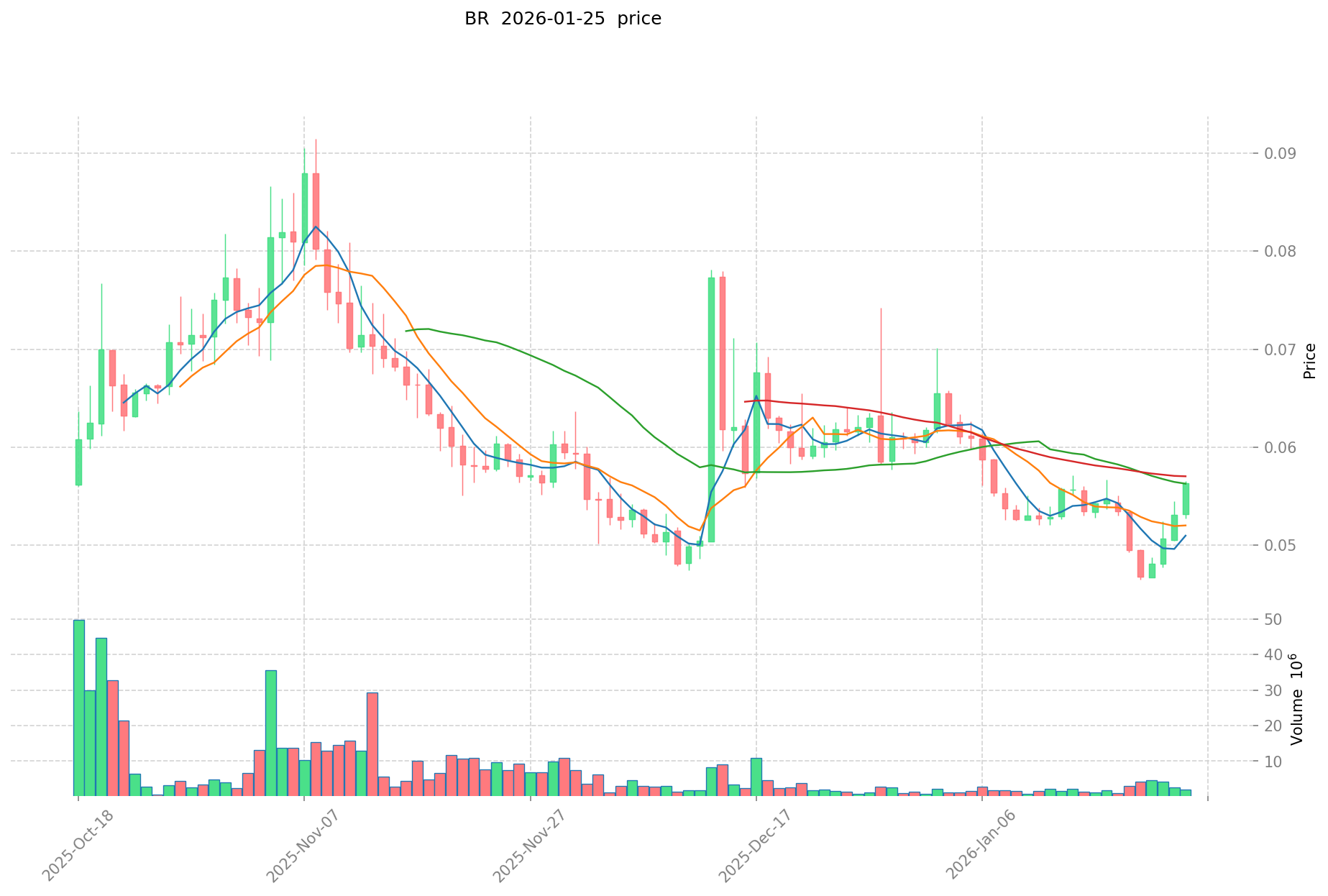
BR is an emerging asset in the cryptocurrency field, representing the native token of Bedrock, a multi-asset liquid restaking protocol. Since its launch in 2025, Bedrock has established itself in the decentralized finance (DeFi) sector with its pioneering Bitcoin staking product uniBTC. As of January 25, 2026, BR has a market capitalization of approximately $12.94 million, with a circulating supply of 230 million tokens out of a maximum supply of 1 billion tokens. The current price stands at around $0.05625. With its positioning as a liquid restaking solution supporting BTC, ETH, and DePIN assets across over 12 blockchains, BR has drawn attention from investors exploring opportunities in the BTCFi 2.0 space. When evaluating "Is Bedrock (BR) a good investment?", factors including its innovative protocol design, market performance, and tokenomics require careful examination. This article provides a comprehensive analysis of BR's investment characteristics, historical price movements, future price projections, and associated risks to offer reference points for potential investors.
I. BR Token Price History Review and Current Investment Value Status
- 2025: Token launch and initial market entry → BR experienced significant price volatility during its early trading phase
- March 2025: Price fluctuations observed → BR reached $0.2226 before declining to $0.01 within the same period
- Recent trend: Market adjustment phase → Price movement from higher levels to current consolidation range around $0.05625
Current BR Investment Market Status (January 2026)
- BR current price: $0.05625
- 24-hour trading volume: $118,514.76
- Market capitalization: $12,937,500
- Circulating supply: 230,000,000 BR (23% of total supply)
- Market cap to fully diluted valuation ratio: 23%
- Number of holders: 80,605
- Listed on 14 exchanges
Click to view real-time BR market price
II. Core Factors Affecting Whether BR is a Good Investment (Is Bedrock(BR) a Good Investment)
Supply Mechanism and Scarcity (BR investment scarcity)
- Supply Mechanism → Affects Price and Investment Value
- BR operates with a total supply cap of 1,000,000,000 tokens, with a current circulating supply of 230,000,000 tokens (23% circulation ratio)
- The fixed maximum supply introduces a degree of scarcity that may influence long-term valuation dynamics
- Historical Patterns: Price fluctuations have been observed, with historical data showing a price range between $0.01 and $0.2226
- Investment Significance: The capped supply model represents one element supporting potential long-term investment consideration, though market conditions remain variable
Institutional Investment and Mainstream Adoption (Institutional investment in BR)
- Holder Distribution: The protocol has accumulated approximately 80,605 holders, indicating a developing user base
- Market Positioning: Bedrock positions itself as the first multi-asset liquid restaking protocol, with the uniBTC product serving the Bitcoin staking market
- Ecosystem Adoption: The protocol has extended liquid restaking functionality across 12+ blockchains for BTC, ETH, and DePIN assets, suggesting infrastructure expansion
Macroeconomic Environment's Impact on BR Investment
- Market Context: As a DeFi-focused protocol, BR's investment attractiveness may be influenced by broader cryptocurrency market conditions and monetary policy trends
- Sector Positioning: The protocol's BTCFi 2.0 approach aims to redefine Bitcoin's role within the DeFi ecosystem, potentially responding to market demand for yield-generating Bitcoin products
- Risk Considerations: Market volatility remains a factor, as evidenced by price performance showing a 30-day decrease of 8% and a one-year decline of 61.61%
Technology and Ecosystem Development (Technology & Ecosystem for BR investment)
- Core Innovation: Bedrock's liquid restaking protocol allows users to maintain asset liquidity while earning staking rewards, addressing a market need in the Bitcoin ecosystem
- Product Suite: The uniBTC token serves as a liquid staking asset, enabling participation in DeFi activities while accruing staking yields
- Multi-Chain Integration: The protocol's deployment across multiple blockchains (12+) supports cross-chain liquidity and broader ecosystem participation
- DeFi Application: By integrating Bitcoin into DeFi mechanisms through the BTCFi 2.0 framework, the protocol expands potential use cases for Bitcoin-based assets
III. BR Future Investment Forecast and Price Outlook (Is Bedrock(BR) worth investing in 2026-2031)
Short-term BR Investment Outlook (2026)
- Conservative forecast: $0.0289 - $0.0566
- Neutral forecast: $0.0566 - $0.0662
- Optimistic forecast: $0.0566 - $0.0662
Mid-term Bedrock(BR) Investment Forecast (2027-2029)
-
Market stage expectation: According to the forecast table, BR is expected to experience moderate growth during 2027-2029, with the average price potentially rising from $0.0614 in 2027 to $0.0864 in 2029. This period may see continued development of the liquid restaking protocol across multiple blockchains.
-
Investment return forecast:
- 2027: $0.0374 - $0.0774
- 2028: $0.0548 - $0.1034
- 2029: $0.0751 - $0.1036
-
Key catalysts: Expansion of liquid restaking services across additional blockchain networks, growth in BTCFi 2.0 adoption, and potential increases in total value locked (TVL) across the protocol's multi-asset offerings.
Long-term Investment Outlook (Is Bedrock a good long-term investment?)
- Base scenario: $0.0570 - $0.1369 (assuming steady protocol development and maintained market presence)
- Optimistic scenario: $0.0730 - $0.1229 (assuming increased adoption of liquid restaking solutions and favorable DeFi market conditions)
- Risk scenario: Below $0.0289 (in case of adverse market conditions or competitive pressures)
View BR long-term investment and price forecast: Price Prediction
2026-01-25 - 2031 Long-term Outlook
- Base scenario: $0.0570 - $0.1369 (corresponding to steady progress and gradual mainstream application improvement)
- Optimistic scenario: $0.0730 - $0.1369 (corresponding to large-scale adoption and favorable market environment)
- Transformative scenario: Above $0.1369 (in case of breakthrough ecosystem developments and mainstream adoption)
- 2031-12-31 forecast high: $0.1369 (based on optimistic development assumptions)
Disclaimer: The above forecasts are based on historical data and market analysis models. Cryptocurrency investments carry significant risks, and actual prices may differ substantially from predictions due to market volatility, regulatory changes, technological developments, and other unforeseen factors. This content does not constitute investment advice.
| Year |
Predicted High Price |
Predicted Average Price |
Predicted Low Price |
Price Change |
| 2026 |
0.0661986 |
0.05658 |
0.0288558 |
0 |
| 2027 |
0.077350518 |
0.0613893 |
0.037447473 |
9 |
| 2028 |
0.10336116441 |
0.069369909 |
0.05480222811 |
23 |
| 2029 |
0.103638644046 |
0.086365536705 |
0.07513801693335 |
53 |
| 2030 |
0.13680301014072 |
0.0950020903755 |
0.0570012542253 |
68 |
| 2031 |
0.122856703273596 |
0.11590255025811 |
0.073018606662609 |
106 |
IV. BR Investment Strategy and Risk Management (How to invest in Bedrock)
Investment Methodology (BR investment strategy)
-
Long-term Holding (HODL BR): Suitable for conservative investors who believe in the long-term potential of multi-asset liquid restaking protocols. This approach involves purchasing BR tokens and holding them through market cycles, allowing the protocol's ecosystem development and adoption to potentially drive value appreciation over time.
-
Active Trading: Relies on technical analysis and swing trading strategies. Traders may monitor price movements, volume patterns, and market sentiment indicators to identify entry and exit points. Given BR's historical price range between $0.01 and $0.2226, active traders could potentially capitalize on price volatility while managing position sizes carefully.
Risk Management (Risk management for BR investment)
V. BR Investment Risks and Challenges (Risks of investing in Bedrock)
-
Market Risks: BR exhibits notable price volatility with a 1-year change of -61.61% and 30-day change of -8%. The token's 24-hour price range ($0.05338 to $0.05666) demonstrates short-term fluctuation patterns. The relatively low market dominance (0.0017%) suggests susceptibility to broader market movements.
-
Regulatory Risks: As a liquid restaking protocol operating across 12+ blockchains, BR faces evolving regulatory frameworks across different jurisdictions. Policy changes regarding staking mechanisms, DeFi protocols, or cross-chain operations could impact the project's operational capacity and token value.
-
Technical Risks: The protocol's multi-chain architecture introduces complexity that could present technical challenges. Network security considerations include smart contract vulnerabilities, cross-chain bridge risks, and potential upgrade complications. The BEP-20 token standard implementation requires ongoing security audits and monitoring.
VI. Conclusion: Is Bedrock a Good Investment?
-
Investment Value Summary: BR represents an emerging opportunity in the liquid restaking sector, particularly within BTCFi 2.0 infrastructure. The protocol's multi-asset approach across 12+ blockchains demonstrates technological ambition, though the token has experienced substantial price decline from its peak. Current market capitalization to fully diluted valuation ratio (23%) indicates significant token supply yet to enter circulation.
-
Investor Recommendations:
✅ Beginners: Consider dollar-cost averaging with small allocations and prioritize secure wallet storage on BSC network. Focus on understanding the protocol's liquid restaking mechanisms before committing significant capital.
✅ Experienced Investors: Evaluate swing trading opportunities based on technical indicators while maintaining diversified portfolio positions. Monitor protocol development milestones and cross-chain expansion metrics.
✅ Institutional Investors: Conduct thorough due diligence on protocol security audits, team credentials, and competitive positioning within the liquid restaking landscape before considering strategic allocations.
⚠️ Disclaimer: Cryptocurrency investments carry substantial risks. This content is provided for informational purposes only and does not constitute financial, investment, or trading advice. Conduct independent research and consult qualified financial advisors before making investment decisions.
VII. FAQ
Q1: What is Bedrock (BR) and what makes it unique in the DeFi space?
Bedrock (BR) is the native token of a multi-asset liquid restaking protocol that enables users to maintain asset liquidity while earning staking rewards across BTC, ETH, and DePIN assets. What distinguishes BR is its pioneering position as the first multi-asset liquid restaking protocol operating across 12+ blockchains, with its flagship uniBTC product specifically addressing the Bitcoin staking market through the BTCFi 2.0 framework. This innovation allows Bitcoin holders to participate in DeFi activities while simultaneously accruing staking yields, effectively solving the liquidity-vs-yield dilemma that traditionally exists in staking mechanisms.
Q2: How has BR performed as an investment since its launch in 2025?
BR has experienced significant price volatility since its market entry in 2025, with a notable decline from its peak. The token reached a high of $0.2226 in March 2025 before declining to $0.01 during the same period, and currently trades around $0.05625 as of January 2026. Over the past year, BR has declined 61.61%, with a 30-day decrease of 8%. The token's current market capitalization stands at approximately $12.94 million with 230 million tokens in circulation (23% of total supply). These metrics indicate substantial price volatility and suggest that BR remains in an early-stage development phase with considerable market risk.
Q3: What is the tokenomics structure of BR and how does it affect investment value?
BR operates with a fixed maximum supply of 1 billion tokens, with 230 million tokens currently in circulation (23% circulation ratio), resulting in a market cap to fully diluted valuation ratio of 23%. This tokenomics structure indicates that 77% of the total token supply has yet to enter the market, which could create downward price pressure as additional tokens are released. The capped supply introduces scarcity dynamics that may support long-term valuation, though the substantial unreleased supply represents a dilution risk. Currently, BR has 80,605 holders and is listed on 14 exchanges with a 24-hour trading volume of $118,514.76, suggesting moderate but developing liquidity.
Q4: What are the price forecasts for BR from 2026 to 2031?
Price forecasts for BR indicate gradual appreciation potential under base case scenarios. For 2026, predictions range from $0.0289 (low) to $0.0662 (high) with an average of $0.0566. Medium-term projections (2027-2029) suggest prices could reach $0.0374-$0.1036, with 2029 averaging around $0.0864. Long-term forecasts extend to 2031 with a potential high of $0.1369 and average of $0.1159 under optimistic conditions. These projections assume continued protocol development, increased adoption of liquid restaking solutions, and favorable DeFi market conditions. However, actual prices may differ substantially due to market volatility, regulatory changes, and technological developments.
Q5: What investment strategies are recommended for different types of BR investors?
For conservative investors, a HODL strategy allocating 1-3% of crypto portfolio to BR is recommended, focusing on long-term protocol development potential. Aggressive investors might allocate 5-10% and consider active trading strategies based on technical analysis, given BR's historical price range of $0.01-$0.2226. Professional investors may allocate up to 15% after comprehensive due diligence. Risk management should include diversified portfolios combining established cryptocurrencies with emerging DeFi tokens, position sizing based on market cap ($12.94M) and liquidity metrics, and secure storage using cold wallets for long-term holdings and hardware wallets for BR tokens stored on the BSC network.
Q6: What are the primary risks associated with investing in BR?
BR investment carries several significant risks: Market risk is evidenced by 61.61% one-year decline and high price volatility; regulatory risk stems from evolving frameworks across the 12+ blockchains where the protocol operates; technical risks include smart contract vulnerabilities, cross-chain bridge complications, and multi-chain architecture complexity; and dilution risk exists due to 77% of tokens remaining unreleased. The token's low market dominance (0.0017%) makes it susceptible to broader market movements, and its relatively low trading volume ($118,514.76 daily) may result in liquidity challenges during market stress. The protocol's early stage and competitive landscape in liquid restaking further compound investment uncertainty.
Q7: How does BR's technology and ecosystem position it for future growth?
BR's technological foundation centers on liquid restaking innovation that addresses the liquidity-yield trade-off in staking mechanisms. The protocol's multi-chain deployment across 12+ blockchains supports cross-chain liquidity and broader ecosystem participation, while the uniBTC product specifically targets the emerging BTCFi 2.0 market segment. This positioning potentially capitalizes on growing demand for yield-generating Bitcoin products within DeFi. However, the success of this technological approach depends on continued protocol development, security maintenance across multiple chains, competition from other liquid staking solutions, and actual adoption rates among Bitcoin holders seeking DeFi participation opportunities.
Q8: Is BR suitable for beginners or more appropriate for experienced investors?
BR is generally more suitable for experienced investors due to its high volatility, early-stage development status, and complex multi-chain architecture. Beginners considering BR should limit exposure to very small allocations, employ dollar-cost averaging strategies, and prioritize understanding liquid restaking mechanisms before investing. The token's 61.61% one-year decline, relatively low liquidity, and substantial unreleased token supply create risks that require sophisticated risk management. Experienced investors can better navigate these challenges through technical analysis, portfolio diversification, and monitoring of protocol development milestones. Institutional investors should conduct thorough due diligence on security audits, team credentials, and competitive positioning before considering strategic allocations.
* The information is not intended to be and does not constitute financial advice or any other recommendation of any sort offered or endorsed by Gate.