This comprehensive analysis examines whether Bitlayer (BTR) represents a viable investment opportunity within Bitcoin Layer 2 solutions. As of January 2026, BTR trades at $0.06732 with a market cap of $17.61M, backed by prominent institutional investors including Polychain Capital and Franklin Templeton. The article evaluates BTR's pioneering BitVM implementation, trust-minimized bridge infrastructure, and high-throughput Bitcoin Rollup technology as core value drivers. Price forecasts range from conservative estimates of $0.0455-$0.0679 to optimistic projections reaching $0.2206 by 2031, contingent upon ecosystem development and Bitcoin DeFi adoption. Investment strategies span from dollar-cost averaging for beginners to sophisticated portfolio allocation for institutional investors. Critical considerations include significant market volatility, regulatory uncertainties, technical implementation risks, and the phased token release schedule affecting 73.84% of unminted supply. This resource provides structure
Introduction: Bitlayer (BTR) Investment Position and Market Outlook
BTR is a noteworthy asset in the cryptocurrency space. Bitlayer is pioneering the first BitVM implementation, combining security with a smart contract engine to unlock Bitcoin DeFi potential. The project has raised $30M from investors including Polychain Capital, Franklin Templeton, Framework, ABCDE, StarkWare, and Alliance. As of January 24, 2026, BTR holds a market cap of approximately $17.61M, with a circulating supply of 261.6M tokens, and a current price around $0.06732. Ranked at 924 in the market, BTR represents about 0.0021% of the total crypto market share. With its positioning in Bitcoin's DeFi infrastructure, building trust-minimized BitVM Bridge, yield-bearing asset YBTC, and high-throughput Bitcoin Rollup, BTR has gradually become a focal point for investors discussing "Is Bitlayer (BTR) a good investment?" This article comprehensively analyzes BTR's investment value, historical trends, future price forecasts, and investment risks to provide reference for investors.
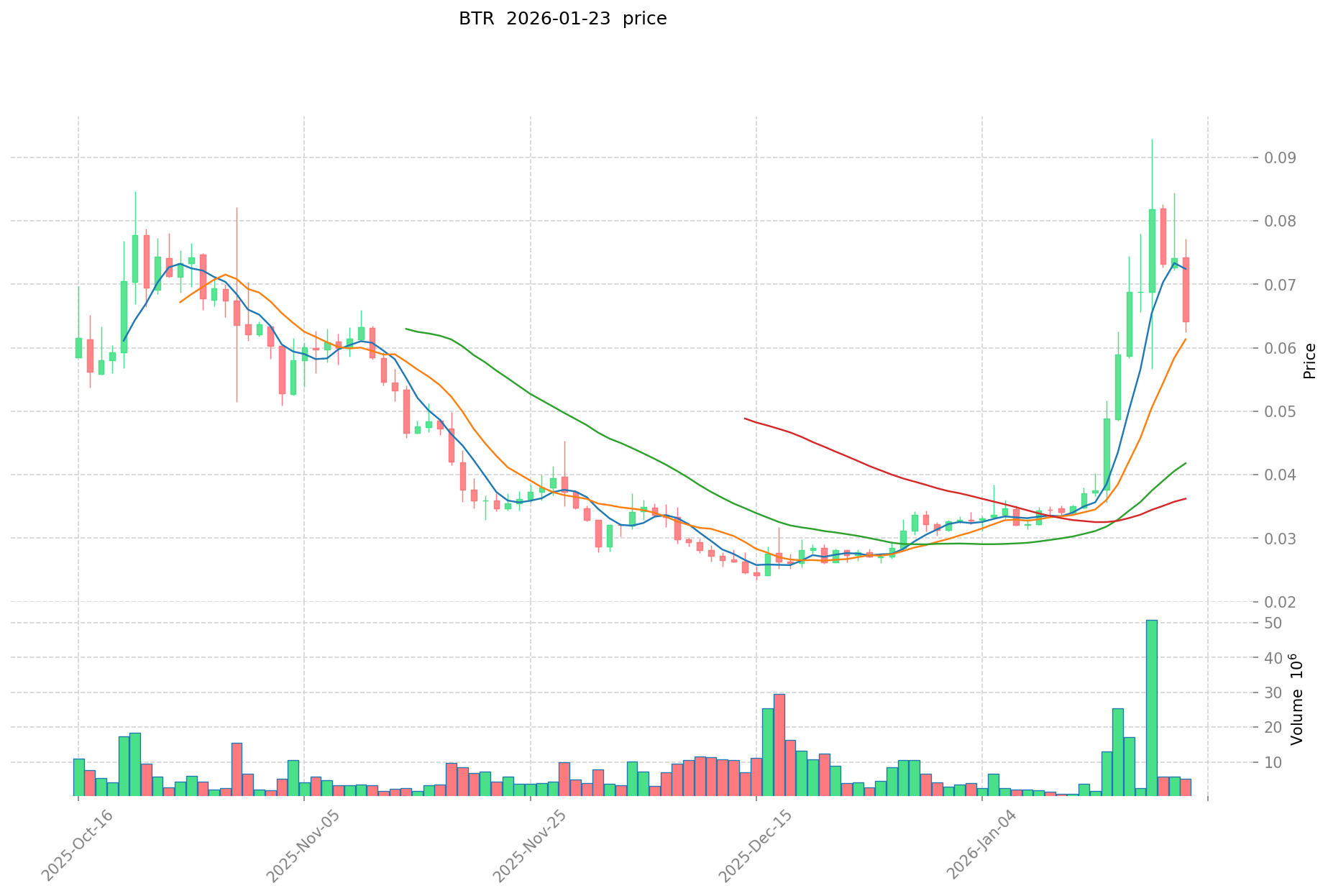
I. BTR Price History Review and Investment Value Status
- 2025: Token launched in September at initial price levels → Market experienced significant volatility throughout the year
- 2025 September: Price reached $0.176 level → BTR exhibited substantial price movements during this period
- 2025 December: Market conditions led to price adjustment → Trading at $0.02345 level
Current BTR Investment Market Status (January 2026)
- BTR current price: $0.06732
- Market sentiment (Fear & Greed Index): Moderate sentiment level observed
- 24-hour trading volume: $257,949.16
- Holders distribution: 34,677 addresses holding BTR tokens
Click to view real-time BTR market price
II. Core Factors Affecting Whether BTR is a Good Investment (Is Bitlayer(BTR) a Good Investment)
Supply Mechanism and Scarcity (BTR investment scarcity)
- Maximum Supply Constraint → Influences Price and Investment Value
- BTR has a maximum supply cap of 1,000,000,000 tokens, with current circulating supply at 261,600,000 tokens (26.16% of total supply).
- The fixed supply mechanism creates potential scarcity dynamics as adoption increases.
- Historical Patterns: Supply dynamics and market conditions have contributed to BTR price fluctuations
- BTR has experienced price movements ranging from $0.02345 to $0.176 since launch.
- As of January 24, 2026, BTR is trading at $0.06732, showing a 30-day increase of 144.019%.
- Investment Significance: Controlled supply release is a key factor supporting long-term investment considerations
- With approximately 73.84% of tokens yet to enter circulation, the token release schedule may impact future price dynamics.
Institutional Investment and Mainstream Adoption (Institutional investment in BTR)
- Institutional Backing Trends:
- Bitlayer has raised a total of $30 million from prominent investors including Polychain Capital, Franklin Templeton, Framework, ABCDE, StarkWare, and Alliance.
- The presence of established institutional investors may signal confidence in the project's long-term viability.
- Enterprise Adoption → Enhancing Investment Value
- Bitlayer's positioning as a Bitcoin Layer 2 solution with BitVM implementation targets institutional DeFi applications.
- The project focuses on building trust-minimized infrastructure including the BitVM Bridge, yield-bearing asset YBTC, and high-throughput Bitcoin Rollup.
- Policy Considerations
- Regulatory developments surrounding Bitcoin Layer 2 solutions and DeFi infrastructure may influence BTR's investment prospects.
Macroeconomic Environment's Impact on BTR Investment
- Monetary Policy and Interest Rate Changes → Altering Investment Attractiveness
- Changes in global monetary policy may affect risk appetite for crypto assets including BTR.
- Interest rate environments can influence the relative attractiveness of yield-bearing products like Bitlayer's YBTC.
- Inflation Environment and Hedging Role → "Digital Gold" Positioning
- As part of the Bitcoin ecosystem, BTR may indirectly benefit from Bitcoin's positioning as an inflation hedge.
- Geopolitical Uncertainty → Strengthening BTR Investment Demand
- Increased interest in decentralized financial infrastructure during periods of uncertainty may benefit Bitcoin Layer 2 solutions.
Technology and Ecosystem Development (Technology & Ecosystem for BTR investment)
- BitVM Implementation: Enhancing Network Performance → Strengthening Investment Appeal
- Bitlayer is pioneering the first BitVM implementation, combining security with high-speed smart contract execution.
- The trust-minimized BitVM Bridge aims to provide secure cross-chain functionality for Bitcoin assets.
- Bitcoin Rollup Technology: Expanding Ecosystem Applications → Supporting Long-term Value
- High-throughput Bitcoin Rollup infrastructure enables scalable DeFi applications on Bitcoin.
- YBTC (yield-bearing asset) introduces new utility for Bitcoin holders within the Bitlayer ecosystem.
- DeFi, NFT, and Payment Applications Driving Investment Value
- Bitlayer's infrastructure aims to bring composability and speed to Bitcoin DeFi, potentially expanding use cases.
- The project's focus on establishing comprehensive DeFi infrastructure for Bitcoin may attract developers and users.
- With 34,677 token holders and availability on 16 exchanges, BTR demonstrates growing ecosystem participation.
III. BTR Future Investment Forecast and Price Outlook (Is Bitlayer(BTR) worth investing in 2026-2031)
Short-term Investment Forecast (2026, short-term BTR investment outlook)
- Conservative forecast: $0.0455 - $0.0679
- Neutral forecast: $0.0679 - $0.0850
- Optimistic forecast: $0.0850 - $0.0957
Mid-term Investment Outlook (2027-2028, mid-term Bitlayer(BTR) investment forecast)
-
Market stage expectation: The token may experience gradual growth as the Bitlayer ecosystem develops its BitVM implementation and DeFi infrastructure. Price movements could reflect broader Bitcoin ecosystem adoption and cross-chain bridge functionality expansion.
-
Investment return forecast:
- 2027: $0.0695 - $0.0981
- 2028: $0.0657 - $0.1143
-
Key catalysts: Progress in BitVM bridge development, YBTC adoption rates, Bitcoin Rollup performance improvements, and overall Bitcoin DeFi sector growth.
Long-term Investment Outlook (Is Bitlayer a good long-term investment?)
- Base scenario: $0.0807 - $0.1481 (assuming steady ecosystem development and sustained Bitcoin DeFi interest)
- Optimistic scenario: $0.1151 - $0.2206 (assuming accelerated adoption of BitVM technology and expanded institutional participation)
- Risk scenario: Below $0.0657 (under conditions of delayed technical milestones or reduced Bitcoin DeFi market sentiment)
Click to view BTR long-term investment and price forecast: Price Prediction
2026-01-24 - 2031 Long-term Outlook
- Base scenario: $0.0807 - $0.1481 (corresponding to steady progress and gradual mainstream application growth)
- Optimistic scenario: $0.1151 - $0.2206 (corresponding to large-scale adoption and favorable market conditions)
- Transformative scenario: Above $0.2206 (if ecosystem achieves breakthrough developments and mainstream popularization)
- 2031-12-31 predicted high: $0.2206 (based on optimistic development assumptions)
Disclaimer
| Year |
Predicted High Price |
Predicted Average Price |
Predicted Low Price |
Price Change |
| 2026 |
0.0956967 |
0.06787 |
0.0454729 |
0 |
| 2027 |
0.09814002 |
0.08178335 |
0.0695158475 |
21 |
| 2028 |
0.11425133995 |
0.089961685 |
0.06567203005 |
33 |
| 2029 |
0.14805444308875 |
0.102106512475 |
0.08066414485525 |
51 |
| 2030 |
0.175112668894625 |
0.125080477781875 |
0.115074039559325 |
85 |
| 2031 |
0.220641962807227 |
0.15009657333825 |
0.115574361470452 |
122 |
IV. BTR Investment Strategy and Risk Management (How to invest in Bitlayer)
Investment Methodology (BTR investment strategy)
-
Long-term Holding (HODL BTR): Suitable for conservative investors
Long-term holding strategies focus on the fundamental value of Bitlayer's BitVM implementation and its role in Bitcoin DeFi infrastructure. Investors adopting this approach typically maintain positions through market cycles, believing in the project's technological innovation and ecosystem development potential.
-
Active Trading: Relying on technical analysis and swing operations
Active traders may leverage BTR's price volatility for short-term opportunities. This approach requires monitoring market trends, technical indicators, and trading volume patterns. Given BTR's 24-hour price fluctuations and trading activity across multiple exchanges, traders can identify potential entry and exit points based on support and resistance levels.
Risk Management (Risk management for BTR investment)
-
Asset Allocation Ratio: Conservative / Aggressive / Professional investors
- Conservative investors: Consider allocating 1-3% of crypto portfolio to BTR, focusing on established projects with lower risk profiles
- Aggressive investors: May allocate 5-10% of crypto portfolio to BTR, accepting higher volatility for potential returns
- Professional investors: Could implement dynamic allocation strategies based on market conditions, technical developments, and ecosystem growth metrics
-
Risk Hedging Solutions: Multi-asset portfolio + hedging tools
Diversification across different crypto categories can help mitigate BTR-specific risks. Investors may combine BTR holdings with established cryptocurrencies and stablecoins. Additionally, some experienced traders utilize derivatives or options strategies to hedge against significant price movements.
-
Secure Storage: Hot and cold wallets + hardware wallet recommendations
BTR tokens are deployed on BTRBTC and BSC chains. Investors should consider:
- Hardware wallets (Ledger, Trezor) for long-term storage of significant holdings
- Cold storage solutions for maximum security
- Hot wallets for active trading amounts only
- Multi-signature wallets for institutional holdings
- Regular security audits of wallet addresses and transaction permissions
V. BTR Investment Risks and Challenges (Risks of investing in Bitlayer)
-
Market Risks: High volatility, price manipulation
BTR exhibits significant price volatility, with 30-day price changes showing substantial fluctuations. The token's circulating supply represents 26.16% of total supply, which may contribute to price sensitivity. With a relatively modest market capitalization and trading volume, BTR may experience price swings driven by large transactions or changing market sentiment. Investors should be prepared for rapid price movements and potential liquidity challenges during high volatility periods.
-
Regulatory Risks: Policy uncertainties across different jurisdictions
As a Bitcoin Layer 2 solution utilizing BitVM technology, Bitlayer operates in an evolving regulatory landscape. Different countries maintain varying approaches to crypto assets and DeFi protocols. Regulatory developments regarding Bitcoin scalability solutions, cross-chain bridges, and decentralized finance could impact BTR's adoption and market performance. Investors should monitor regulatory announcements in their jurisdictions and key markets where Bitlayer operates.
-
Technical Risks: Network security vulnerabilities, upgrade failures
Bitlayer is pioneering the first BitVM implementation, which represents novel technology in the Bitcoin ecosystem. As with any emerging blockchain solution, potential risks include:
- Smart contract vulnerabilities in the BitVM bridge or Rollup infrastructure
- Technical challenges in maintaining security equivalence with Bitcoin's base layer
- Integration issues with the YBTC yield-bearing asset mechanism
- Potential complications during protocol upgrades or network transitions
- Cross-chain bridge security concerns
While the project has secured funding from prominent investors, the experimental nature of BitVM technology requires careful consideration of technical implementation risks.
VI. Conclusion: Is Bitlayer a Good Investment?
-
Investment Value Summary: BTR represents exposure to Bitcoin Layer 2 innovation and DeFi infrastructure development. The token's long-term potential is tied to Bitlayer's execution of its BitVM implementation, adoption of its trust-minimized bridge, and growth of its high-throughput Rollup solution. However, investors should anticipate significant short-term price volatility and market fluctuations.
-
Investor Recommendations:
✅ Beginners: Dollar-cost averaging + secure wallet storage
- Start with small positions to understand BTR's price behavior
- Use hardware wallets or reputable custodial solutions
- Focus on learning about BitVM technology and Bitlayer's ecosystem development
- Avoid making decisions based on short-term price movements
✅ Experienced Investors: Swing trading + portfolio allocation
- Consider BTR as part of a diversified Bitcoin ecosystem portfolio
- Monitor technical developments and ecosystem milestones
- Implement risk management strategies including stop-losses and position sizing
- Evaluate correlation with Bitcoin and broader market trends
✅ Institutional Investors: Strategic long-term allocation
- Assess Bitlayer's technological differentiation within Bitcoin Layer 2 solutions
- Consider custodial requirements and compliance frameworks
- Monitor development progress and ecosystem growth metrics
- Evaluate team execution capability and investor backing quality
⚠️ Disclaimer: Cryptocurrency investments carry high risks. This content is for informational purposes only and does not constitute investment advice. Investors should conduct their own research and consult with financial advisors before making investment decisions.
VII. FAQ
Q1: What is the current investment outlook for Bitlayer (BTR) in 2026?
As of January 24, 2026, BTR is trading at $0.06732 with moderate market sentiment. Short-term forecasts for 2026 range from conservative estimates of $0.0455-$0.0679 to optimistic projections of $0.0850-$0.0957. The token has shown a 30-day increase of 144.019%, reflecting strong recent momentum. However, investors should note that BTR exhibits significant volatility, with prices having ranged from $0.02345 to $0.176 since its September 2025 launch. The investment outlook depends heavily on Bitlayer's BitVM implementation progress, YBTC adoption rates, and overall Bitcoin DeFi sector growth.
Q2: How does Bitlayer's institutional backing affect BTR's investment potential?
Bitlayer has raised $30 million from prominent investors including Polychain Capital, Franklin Templeton, Framework, ABCDE, StarkWare, and Alliance. This institutional backing signals confidence in the project's long-term viability and provides financial resources for development. The presence of established investors like Franklin Templeton, a traditional finance giant, suggests potential for mainstream adoption. However, institutional investment alone does not guarantee price appreciation. Investors should evaluate how Bitlayer executes its roadmap, deploys these funds for ecosystem development, and achieves technological milestones in its BitVM implementation and Bitcoin Rollup infrastructure.
Q3: What are the primary risks associated with investing in BTR?
BTR investment carries three main risk categories. First, market risks include high volatility and potential price manipulation due to relatively modest market capitalization ($17.61M) and trading volume ($257,949.16 daily). Second, regulatory risks stem from evolving policies around Bitcoin Layer 2 solutions and DeFi protocols across different jurisdictions. Third, technical risks include potential smart contract vulnerabilities in the pioneering BitVM implementation, cross-chain bridge security concerns, and challenges in maintaining Bitcoin-level security equivalence. Additionally, with only 26.16% of tokens currently circulating, future token releases may impact price dynamics.
Q4: How should different investor types approach BTR investment?
Investment strategies should align with risk tolerance and experience levels. Beginners should employ dollar-cost averaging with 1-3% portfolio allocation, use secure hardware wallets, and focus on learning about BitVM technology rather than short-term trading. Experienced investors might allocate 5-10% of their crypto portfolio to BTR, implement swing trading strategies based on technical analysis, and monitor ecosystem development milestones. Institutional investors should conduct comprehensive due diligence on Bitlayer's technological differentiation, establish appropriate custodial frameworks, and adopt strategic long-term positions while monitoring team execution capability and development progress metrics.
Q5: What role does BitVM technology play in BTR's long-term investment value?
BitVM technology is central to Bitlayer's value proposition and BTR's investment thesis. As the first BitVM implementation, Bitlayer combines Bitcoin's security with smart contract functionality to enable DeFi applications on Bitcoin. The trust-minimized BitVM Bridge provides secure cross-chain functionality, while the high-throughput Bitcoin Rollup infrastructure enables scalable applications. These innovations could position Bitlayer as foundational infrastructure for Bitcoin DeFi. Long-term forecasts reaching $0.2206 by 2031 assume successful BitVM adoption and ecosystem expansion. However, as pioneering technology, BitVM carries implementation risks that investors should carefully consider.
Q6: What is the significance of BTR's supply mechanism for investment decisions?
BTR has a maximum supply cap of 1 billion tokens, with current circulating supply at 261.6 million (26.16%). This controlled supply release creates potential scarcity dynamics as adoption increases. With approximately 73.84% of tokens yet to enter circulation, the token release schedule is a critical factor affecting future price movements. Investors should monitor the token unlock schedule, as significant releases could create selling pressure. Conversely, controlled distribution aligned with ecosystem growth milestones could support gradual price appreciation. The fixed maximum supply provides a clear scarcity framework, unlike unlimited supply tokens, which may support long-term value retention.
Q7: How does Bitlayer's ecosystem development impact BTR investment value?
Ecosystem development directly influences BTR's investment value through multiple channels. Bitlayer's infrastructure includes the BitVM Bridge for secure cross-chain transactions, YBTC as a yield-bearing asset, and high-throughput Bitcoin Rollup for scalable DeFi applications. With 34,677 token holders and availability on 16 exchanges, the ecosystem shows growing participation. Key development indicators include DeFi protocol launches on Bitlayer, YBTC adoption rates, bridge transaction volumes, and developer activity. Successful ecosystem expansion could drive demand for BTR tokens for transaction fees and network participation. Conversely, delayed milestones or limited adoption may negatively impact investment returns.
Q8: What storage and security measures should BTR investors implement?
BTR tokens are deployed on BTRBTC and BSC chains, requiring appropriate security measures. Long-term holders should use hardware wallets (Ledger, Trezor) for significant holdings, implementing cold storage solutions for maximum security. Active traders should maintain only trading amounts in hot wallets while keeping the majority in secure storage. Institutional investors should consider multi-signature wallets and regular security audits. Investors must ensure wallet compatibility with BTR's blockchain networks and maintain backup seed phrases securely. Given the irreversible nature of blockchain transactions and increasing sophistication of crypto theft methods, robust security practices are essential for protecting BTR investments.
* The information is not intended to be and does not constitute financial advice or any other recommendation of any sort offered or endorsed by Gate.