This comprehensive guide evaluates whether BitMEX Token (BMEX) represents a sound investment opportunity. The article examines BMEX's position as the utility token powering the BitMEX ecosystem, currently trading at $0.10128 with a market cap of $10.10 million. It analyzes price history, revealing an 92.15% decline from its November 2022 peak, while exploring core investment factors including supply scarcity, ecosystem utility, and institutional adoption potential. The analysis provides detailed price forecasts through 2031 across conservative, neutral, and optimistic scenarios. Investment strategies are tailored for beginners, experienced traders, and institutional investors, emphasizing asset allocation and risk management approaches. Critical risks including market volatility, regulatory uncertainty, and technical dependencies are thoroughly assessed. The guide concludes that BMEX serves as a specialized niche investment suitable for portfolio diversification rather than core holdings, requiring careful ri
Introduction: BitMEX Token (BMEX) Investment Position and Market Prospects
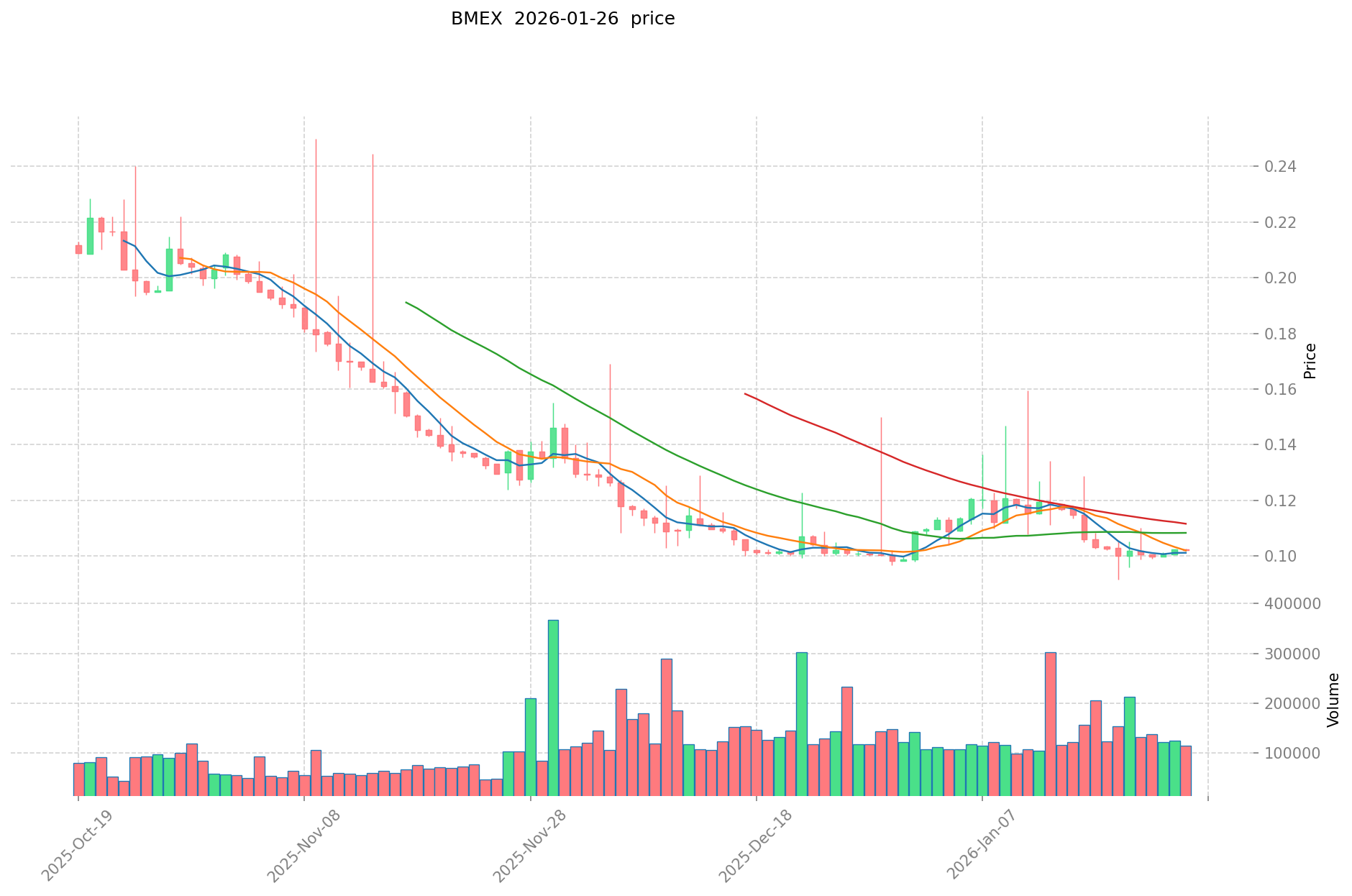
BitMEX Token (BMEX) represents a notable digital asset in the cryptocurrency sector, launched in November 2022 as the utility token powering the BitMEX ecosystem. As of January 26, 2026, BMEX maintains a market capitalization of approximately $10.10 million, with a circulating supply of 99.75 million tokens out of a maximum supply of 450 million. The current trading price stands at $0.10128, reflecting the token's ongoing market positioning within the broader crypto derivatives landscape.
Designed to fuel the growth of the BitMEX ecosystem—a platform serving institutional and professional traders since 2014—BMEX offers holders various benefits including fee discounts, enhanced staking yields, and exclusive privileges across cryptocurrency services. With a market dominance of 0.0014% and trading activity across 2 exchanges, the token occupies a specialized niche within the exchange token category. This analysis examines BMEX's investment characteristics, historical price movements, future projections, and associated risks to provide a comprehensive reference for market participants evaluating the token's potential within their portfolio considerations.
I. BMEX Price History Review and Current Investment Value Status
- 2022: Token Launch in November → BMEX debuted at $0.3032, reaching a peak of $1.29 in mid-November 2022
- 2024: Market Correction Phase → Price declined to $0.090334 in early November 2024
- 2025-2026: Recovery Period → From the November 2024 low, the token showed gradual recovery with moderate volatility
Current BMEX Investment Market Status (January 2026)
- BMEX Current Price: $0.10128
- 24-hour Trading Volume: $12,662.78
- Circulating Supply: 99.75 million BMEX (22.17% of total supply)
- Market Capitalization: $10.10 million
- Fully Diluted Valuation: $45.58 million
Click to view real-time BMEX market price
II. Core Factors Affecting Whether BMEX is a Good Investment (Is BitMEX Token(BMEX) a Good Investment)
Supply Mechanism and Scarcity (BMEX investment scarcity)
- Maximum supply capped at 450,000,000 tokens with current circulating supply of 99,749,999.99974 tokens (22.17% circulation rate) → impacts price dynamics and investment value
- Market cap to fully diluted valuation ratio stands at 22.17%, indicating substantial unreleased supply that may affect future price movements
- Investment significance: the controlled circulation rate and defined maximum supply contribute to the token's scarcity profile, serving as a fundamental consideration for long-term investment evaluation
Institutional Investment and Mainstream Adoption (Institutional investment in BMEX)
- Current holder count: 584 addresses
- BMEX serves as the utility token for the BitMEX ecosystem, providing benefits including trading fee discounts, enhanced staking yields, and exclusive privileges across the platform
- Exchange presence: currently listed on 2 exchanges, which may influence liquidity and accessibility for institutional participants
Macroeconomic Environment's Impact on BMEX Investment
- Monetary policy and interest rate fluctuations → alter investment attractiveness for crypto assets
- Inflation environments and digital asset positioning → may influence allocation decisions
- Geopolitical uncertainty → potentially affects demand for alternative investment instruments
Technology and Ecosystem Development (Technology & Ecosystem for BMEX investment)
- BMEX functions as the fuel for BitMEX ecosystem growth, designed to support platform development and user incentivization
- The token provides access to benefits within the BitMEX trading environment, which has operated as a professional crypto derivatives platform since 2014
- Ecosystem utilities include fee reduction mechanisms, staking reward opportunities, and privilege access, which may contribute to token utility value and long-term investment considerations
III. BMEX Future Investment Forecast and Price Outlook (Is BitMEX Token (BMEX) worth investing in 2026-2031)
Short-term Investment Forecast (2026, short-term BMEX investment outlook)
- Conservative forecast: $0.0668 - $0.1013
- Neutral forecast: $0.0889 - $0.1200
- Optimistic forecast: $0.1013 - $0.1388
Mid-term Investment Outlook (2027-2029, mid-term BitMEX Token (BMEX) investment forecast)
-
Market stage expectation: During the mid-term period, BMEX may experience moderate growth as the BitMEX ecosystem continues to develop and expand its user base. The token's utility features, including fee discounts and staking rewards, could contribute to sustained interest from active traders and platform participants.
-
Investment return forecast:
- 2027: $0.0744 - $0.1284
- 2028: $0.1168 - $0.1838
- 2029: $0.0940 - $0.1910
-
Key catalysts: Platform trading volume growth, expansion of token utility features within the BitMEX ecosystem, broader adoption of crypto derivatives trading, and potential enhancements to staking mechanisms.
Long-term Investment Outlook (Is BMEX a good long-term investment?)
- Base scenario: $0.1144 - $0.1906 (assuming steady ecosystem development and moderate market conditions)
- Optimistic scenario: $0.1570 - $0.2745 (assuming expanded platform features, increased trading activity, and favorable regulatory environment)
- Risk scenario: Below $0.0939 (under conditions of reduced platform activity, heightened competition, or adverse market sentiment)
Click to view BMEX long-term investment and price forecast: Price Prediction
2026-01-26 to 2031 Long-term Outlook
- Base scenario: $0.1144 - $0.2087 (corresponding to steady progress and gradual mainstream application growth)
- Optimistic scenario: $0.1570 - $0.2745 (corresponding to large-scale adoption and favorable market conditions)
- Transformational scenario: Above $0.2745 (in case of breakthrough ecosystem developments and mainstream penetration)
- 2031-12-31 predicted high: $0.2745 (based on optimistic development assumptions)
Disclaimer: The information provided is for reference purposes only and does not constitute investment advice. Cryptocurrency markets are highly volatile and subject to various risks. Past performance does not guarantee future results. Investors should conduct their own research and consider their risk tolerance before making investment decisions.
| Year |
Predicted High Price |
Predicted Average Price |
Predicted Low Price |
Price Change |
| 2026 |
0.1387536 |
0.10128 |
0.0668448 |
0 |
| 2027 |
0.128417976 |
0.1200168 |
0.074410416 |
18 |
| 2028 |
0.18384173424 |
0.124217388 |
0.11676434472 |
22 |
| 2029 |
0.1909966557888 |
0.15402956112 |
0.0939580322832 |
52 |
| 2030 |
0.208740861229824 |
0.1725131084544 |
0.156986928693504 |
70 |
| 2031 |
0.274502858172641 |
0.190626984842112 |
0.114376190905267 |
88 |
IV. BMEX Investment Strategy and Risk Management (How to invest in BitMEX Token)
Investment Methodology (BMEX investment strategy)
Long-term Holding (HODL BMEX)
For conservative investors, a long-term holding strategy may be considered when investing in BMEX. This approach involves acquiring tokens and holding them over an extended period, potentially benefiting from the development of the BitMEX ecosystem. BMEX is designed to provide fee discounts, enhanced staking yields, and exclusive privileges within the platform, which may create value over time for token holders who participate in the ecosystem.
Active Trading
Active trading strategies rely on technical analysis and swing trading approaches. Given BMEX's 24-hour price change of -0.85% and 7-day change of 2.77%, traders may identify short-term price movements. The token's 24-hour high of $0.1027 and low of $0.10044 indicate relatively modest intraday volatility. Active traders should monitor volume patterns, with current 24-hour trading volume at $12,662.78, and apply technical indicators to identify potential entry and exit points.
Risk Management (Risk management for BMEX investment)
Asset Allocation Ratios
- Conservative Investors: May consider allocating 1-3% of their crypto portfolio to BMEX, prioritizing established assets with larger market capitalizations
- Aggressive Investors: Could allocate 5-10% to BMEX as part of a diversified exchange token portfolio
- Professional Investors: May implement dynamic allocation strategies based on ecosystem development milestones and market conditions
Risk Hedging Solutions
A multi-asset portfolio approach is recommended, combining BMEX with different crypto categories to reduce concentration risk. Investors may consider pairing exchange tokens with major cryptocurrencies and stablecoins to balance volatility exposure.
Secure Storage
BMEX is an ERC-20 token (contract address: 0xb113c6cf239f60d380359b762e95c13817275277) deployed on the Ethereum network. Storage options include:
- Hot Wallets: Exchange wallets for active trading purposes
- Cold Wallets: Offline storage solutions for long-term holdings
- Hardware Wallets: Dedicated devices supporting ERC-20 tokens provide enhanced security for significant holdings
V. BMEX Investment Risks and Challenges (Risks of investing in BitMEX Token)
Market Risk
BMEX exhibits considerable price volatility. The token's 1-year performance shows a decline of -52.72%, falling from its all-time high of $1.29 (November 13, 2022) to its all-time low of $0.090334 (November 7, 2024). The current price of $0.10128 represents approximately 92.15% below the historical peak. With a relatively modest 24-hour trading volume of $12,662.78 and limited exchange listings (2 exchanges), the token may be susceptible to liquidity constraints and price fluctuations driven by relatively small trading volumes.
Regulatory Risk
Cryptocurrency exchanges and their associated tokens face evolving regulatory frameworks across different jurisdictions. Policy changes regarding crypto derivatives platforms, KYC/AML requirements, and trading restrictions may impact the utility and adoption of exchange tokens. Investors should remain aware of regulatory developments in their respective regions and in key markets where BitMEX operates.
Technical Risk
As an ERC-20 token, BMEX depends on the Ethereum network's security and performance. Potential risks include smart contract vulnerabilities, network congestion affecting transaction costs, and Ethereum protocol upgrades. Additionally, the token's utility is tied to the BitMEX platform's operational stability and ecosystem development. Any technical issues affecting the exchange or delays in implementing promised features could impact token value.
VI. Conclusion: Is BitMEX Token a Good Investment?
Investment Value Summary
BMEX represents a utility token within the BitMEX ecosystem, offering fee discounts, staking opportunities, and platform privileges. With a market capitalization of approximately $10.1 million and a circulating supply of 99.75 million tokens (22.17% of max supply), the token maintains a relatively modest market presence ranked at #1193. The token's performance over the past year has been challenging, declining by 52.72%, though recent 7-day performance shows a 2.77% increase.
Investor Recommendations
✅ Beginners: Consider dollar-cost averaging with small allocations and secure storage in hardware wallets supporting ERC-20 tokens. Focus on understanding the BitMEX platform's utility before investing.
✅ Experienced Investors: May explore swing trading opportunities based on technical analysis while maintaining diversified portfolio allocation. Monitor ecosystem development and platform adoption metrics.
✅ Institutional Investors: Could evaluate BMEX as part of a strategic exchange token portfolio, considering the platform's position in crypto derivatives markets and long-term ecosystem expansion plans.
⚠️ Disclaimer: Cryptocurrency investment involves substantial risk. BMEX has experienced significant price volatility and maintains limited liquidity compared to larger market cap assets. This content is for informational purposes only and does not constitute investment advice. Conduct thorough research and consider your risk tolerance before making investment decisions.
VII. FAQ
Q1: What is BMEX token and what makes it different from other exchange tokens?
BMEX is the utility token of the BitMEX ecosystem, launched in November 2022. Unlike many exchange tokens, BMEX specifically targets institutional and professional traders on a platform that has specialized in crypto derivatives since 2014. The token provides fee discounts, enhanced staking yields, and exclusive privileges within the BitMEX trading environment. What distinguishes BMEX from competing exchange tokens is its focus on professional derivatives trading rather than spot markets, and its integration with a platform historically known for leverage trading products. However, with a relatively modest market cap of $10.10 million and limited exchange listings (only 2 exchanges), BMEX operates in a more specialized niche compared to tokens from larger exchanges.
Q2: How has BMEX performed historically and what is its current valuation?
BMEX has experienced significant price volatility since its launch. The token debuted at $0.3032 in November 2022 and reached an all-time high of $1.29 shortly after launch, but subsequently declined by approximately 92.15% to its all-time low of $0.090334 in November 2024. As of January 26, 2026, BMEX trades at $0.10128, representing a 1-year decline of 52.72%. The token has a circulating supply of 99.75 million (22.17% of the maximum 450 million supply), resulting in a market capitalization of approximately $10.10 million and a fully diluted valuation of $45.58 million. Recent 7-day performance shows a modest recovery of 2.77%, though 24-hour trading volume remains relatively low at $12,662.78.
Q3: What are the main risk factors investors should consider before investing in BMEX?
Investors should be aware of several significant risks associated with BMEX. First, market risk is substantial—the token has declined 92.15% from its all-time high, with limited liquidity evident from low trading volume ($12,662.78 daily) and only 2 exchange listings. Second, regulatory risk affects the entire crypto derivatives sector, as changes in jurisdictional policies regarding leverage trading and exchange operations could impact platform utility and token value. Third, technical risk exists as BMEX depends on Ethereum network security (being an ERC-20 token) and the BitMEX platform's operational stability. Additionally, with 77.83% of tokens still unreleased from the maximum supply, future token unlocks could create downward price pressure. The token's market dominance of only 0.0014% indicates minimal mainstream adoption to date.
Q4: What are the price predictions for BMEX from 2026 to 2031?
Price forecasts for BMEX show moderate growth potential under various scenarios. For 2026, predictions range from $0.0668-$0.1388 depending on market conditions. Mid-term projections (2027-2029) anticipate gradual appreciation: 2027 ($0.0744-$0.1284), 2028 ($0.1168-$0.1838), and 2029 ($0.0940-$0.1910). Long-term forecasts through 2031 suggest a base scenario range of $0.1144-$0.2087, an optimistic scenario of $0.1570-$0.2745, and a risk scenario below $0.0939. The 2031 predicted high stands at $0.2745, representing potential upside but also indicating modest growth expectations compared to more established crypto assets. These projections assume continued BitMEX ecosystem development, expanded token utility features, and favorable market conditions. However, investors should note these are reference estimates only and actual performance may vary significantly based on platform adoption, competition, and broader market dynamics.
Q5: How should different investor types approach BMEX investment?
Investment strategies should align with risk tolerance and experience level. Beginners should consider starting with dollar-cost averaging, allocating only 1-3% of their crypto portfolio to BMEX, and prioritizing secure storage in hardware wallets that support ERC-20 tokens. It's essential to understand the BitMEX platform's utility features before investing. Experienced investors may explore swing trading opportunities given BMEX's price volatility (24-hour range of $0.10044-$0.1027), using technical analysis while maintaining diversified portfolio allocation across different crypto categories. They should monitor ecosystem development metrics and platform trading volume trends. Institutional investors could evaluate BMEX as part of a strategic exchange token portfolio allocation of 5-10%, assessing the platform's competitive position in crypto derivatives markets and long-term expansion plans. All investor types should implement risk management practices including portfolio diversification, position sizing appropriate to their risk tolerance, and secure storage solutions. Given BMEX's limited liquidity and significant historical volatility, this token is more suitable as a speculative allocation rather than a core portfolio holding.
Q6: What storage options are available for BMEX tokens and which is most secure?
BMEX is an ERC-20 token (contract address: 0xb113c6cf239f60d380359b762e95c13817275277) deployed on the Ethereum network, offering several storage options with varying security levels. Hardware wallets provide the highest security for long-term holdings, as they store private keys offline in dedicated physical devices that support ERC-20 tokens—this option is recommended for significant BMEX holdings. Cold wallets (offline software wallets) offer strong security for investors who prefer software solutions over hardware devices, suitable for medium to long-term storage. Hot wallets, including exchange wallets, provide convenience for active trading but carry higher security risks as they remain connected to the internet. For most investors, a combination approach is advisable: maintaining a small trading balance in hot wallets on exchanges for active positions, while securing the majority of holdings in hardware or cold storage solutions. When selecting storage, investors should verify that their chosen wallet explicitly supports ERC-20 tokens and the Ethereum network, and should always secure backup recovery phrases in multiple physical locations.
* The information is not intended to be and does not constitute financial advice or any other recommendation of any sort offered or endorsed by Gate.