This comprehensive analysis examines whether Bittensor (TAO) represents a viable investment opportunity within the decentralized machine learning sector. As of January 2026, TAO trades at $287.30 with a market capitalization of $2.76 billion, demonstrating the token's establishment as a significant AI-focused cryptocurrency. The article evaluates TAO's price history, supply mechanics offering scarcity advantages similar to Bitcoin, and institutional adoption trends across 418,915 token holders. Detailed price forecasts span 2026-2031, with base scenarios suggesting $280-$510 ranges and optimistic projections reaching $400-$690. Investment strategies address diverse investor profiles through dollar-cost averaging for beginners and active trading for experienced participants, while comprehensive risk management covers asset allocation, portfolio diversification, and secure storage solutions via hardware wallets and Gate exchange platforms. Critical risk factors including market volatility, regulatory uncertaint
Introduction: Bittensor (TAO) Investment Position and Market Outlook
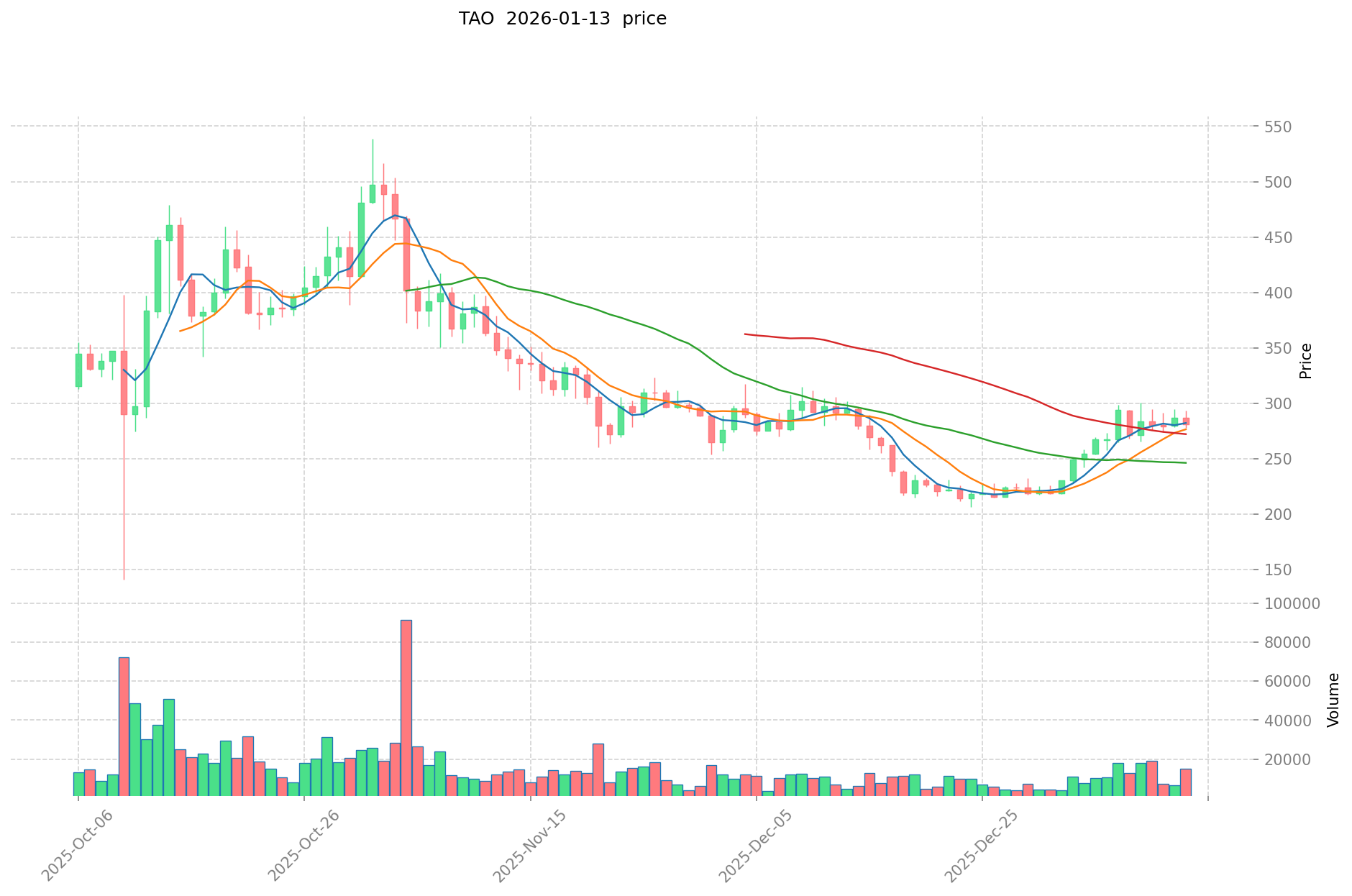
Bittensor (TAO) represents a significant asset in the cryptocurrency sector, operating as a decentralized machine learning network. As of January 14, 2026, TAO maintains a market capitalization of approximately $2.76 billion with a circulating supply of 9,597,491 tokens, currently priced at $287.30. The project has established itself within the intersection of blockchain technology and artificial intelligence, functioning as a tokenized marketplace for machine learning model development and deployment. With a market ranking of 40th and a total supply cap of 21,000,000 tokens, TAO has demonstrated notable price movements since its launch, reaching a previous peak of $795.60 in April 2024. The network's collaborative approach to machine learning infrastructure has positioned it as a topic of interest when investors consider questions such as "Is Bittensor (TAO) a good investment?" This analysis examines TAO's investment characteristics, historical performance patterns, future price considerations, and associated risk factors to provide reference information for market participants.
I. Bittensor (TAO) Price History Review and Current Investment Value
- 2023: TAO experienced early-stage price discovery, with the token trading near lower price levels as the network established its initial mining and validator infrastructure → Early investors faced volatility as the project built its decentralized machine learning ecosystem
- 2024: Significant price appreciation occurred during the first quarter, reflecting growing interest in AI-focused blockchain projects → TAO price demonstrated notable growth momentum aligned with broader market enthusiasm for artificial intelligence applications
- 2024-2025: Market consolidation phase followed earlier gains → Price movement showed adjustment from elevated levels toward more moderate valuations as the project matured
Current TAO Investment Market Status (January 2026)
- TAO current price: $287.30
- Market sentiment: TAO has shown recent price fluctuations, with 24-hour movement of +1.08% and 7-day change of -1.099%, indicating mixed short-term trading sentiment
- 24-hour trading volume: Approximately $2.68 million in trading activity
- Circulating supply: 9,597,491 TAO tokens out of a maximum supply of 21,000,000 TAO
- Market capitalization: Approximately $2.76 billion, representing 0.18% market share in the cryptocurrency sector
- Holder distribution: The project has attracted 418,915 token holders across various exchanges and wallets
Click to view real-time TAO market price
II. Core Factors Affecting Whether TAO is a Good Investment
Supply Mechanism and Scarcity (TAO Investment Scarcity)
- Fixed Supply Cap → Bittensor (TAO) has a maximum supply of 21,000,000 tokens, mirroring Bitcoin's scarcity model. This limited supply creates a deflationary characteristic that may support long-term value appreciation as demand grows.
- Current Circulation Rate → As of January 14, 2026, approximately 9,597,491 TAO tokens are in circulation, representing 45.7% of the total supply. The gradual release of remaining tokens maintains controlled inflation pressure.
- Investment Implication → The scarcity mechanism, similar to Bitcoin's tokenomics, positions TAO as a potentially valuable asset for investors who prioritize supply-constrained digital assets. This fixed-cap structure may provide fundamental support for investment value over extended periods.
Institutional Investment and Mainstream Adoption (Institutional Investment in TAO)
- Institutional Interest → Digital Currency Group and other institutional players have shown engagement with the Bittensor ecosystem, signaling growing confidence from professional investment entities in the project's long-term viability.
- Network Growth Metrics → The platform has attracted approximately 418,915 holders, indicating expanding adoption across the cryptocurrency community. This growing user base reflects increasing mainstream interest in decentralized AI infrastructure.
- Market Positioning → TAO currently ranks 40th by market capitalization with a total market cap of approximately $6.03 billion, demonstrating its establishment as a significant player in the AI-focused cryptocurrency sector.
Macroeconomic Environment's Impact on TAO Investment
- Market Correlation → Cryptocurrency markets, including TAO, often exhibit correlation with broader macroeconomic conditions. Changes in monetary policy and interest rate environments may influence investor risk appetite toward digital assets.
- Technology Sector Dynamics → As an AI-focused protocol, TAO's investment appeal may be influenced by the broader artificial intelligence industry's growth trajectory and investor sentiment toward AI technologies.
- Market Share Context → TAO maintains a 0.18% share of the total cryptocurrency market, positioning it as a mid-tier asset that may experience both opportunities and volatility relative to market-leading cryptocurrencies.
Technology and Ecosystem Development (Technology & Ecosystem for TAO Investment)
- Decentralized AI Network → Bittensor operates as an open, decentralized blockchain-based neural network that creates a peer-to-peer marketplace for machine learning. This core technology provides utility beyond speculative value by enabling collaborative development of AI models.
- Subnet Ecosystem → The platform's subnet architecture allows for diverse AI applications and specialized machine learning tasks. The expansion of these subnets represents ongoing ecosystem development that may enhance long-term investment value.
- Token Utility and Incentive Structure → TAO tokens serve as the reward mechanism for participants contributing machine learning models and computational resources. This tokenomic design creates demand driven by network usage and participant engagement.
- Trading Accessibility → TAO is available on 32 exchanges with a 24-hour trading volume of approximately $2.68 million, providing reasonable liquidity for investors seeking entry or exit positions.
III. TAO Future Investment Prediction and Price Outlook (Is Bittensor(TAO) worth investing in 2026-2031)
Short-term Investment Outlook (2026, short-term TAO investment outlook)
Based on available market projections, Bittensor (TAO) may experience varied price trajectories in 2026. According to analytical estimates, the token could fluctuate between approximately $93.75 and $775.19 during this period. A conservative scenario suggests a trading range near the lower end of forecasts, while neutral assessments indicate potential stability around $280-$290 levels. More optimistic projections point to possible appreciation toward the upper bounds, though such outcomes depend on multiple market variables including network adoption, broader crypto market sentiment, and macroeconomic conditions.
Mid-term Investment Forecast (2027-2029, mid-term Bittensor(TAO) investment forecast)
-
Market Stage Expectation: During the 2027-2029 period, TAO may enter a phase characterized by gradual price adjustments and evolving network utility. The anticipated trajectory reflects potential growth tempered by market volatility inherent to crypto assets.
-
Investment Return Forecast:
- 2027: Estimates suggest a range between $247.69 and $366.58, representing potential fluctuations from prior year levels.
- 2028: Projections indicate possible movement within $303.12 to $445.97, suggesting continued price evolution.
- 2029: Forecasts point to ranges from $274.06 to $460.75, reflecting ongoing market dynamics.
-
Key Catalysts: Factors that may influence TAO's mid-term trajectory include developments in decentralized machine learning applications, network participation levels, broader AI sector trends, and general cryptocurrency market conditions. Regulatory developments and technological advancements within the Bittensor ecosystem could also play meaningful roles.
Long-term Investment Outlook (Is TAO a good long-term investment?)
- Base Scenario: $300 - $500 (assuming steady network growth and sustained interest in decentralized AI infrastructure)
- Optimistic Scenario: $500 - $900 (contingent upon significant adoption increases, favorable market conditions, and successful ecosystem expansion)
- Risk Scenario: $200 - $300 (under conditions of prolonged market headwinds, reduced network activity, or competitive pressures)
For detailed TAO long-term investment and price predictions: Price Prediction
2026-2031 Long-term Outlook
- Base Scenario: $280 - $510 (corresponding to moderate progress and steady mainstream application growth)
- Optimistic Scenario: $400 - $690 (corresponding to large-scale adoption and favorable market environment)
- Transformative Scenario: Above $700 (in case of breakthrough ecosystem developments and mainstream penetration)
- 2031-12-31 Projected High: $690 (based on optimistic development assumptions)
Disclaimer: These projections are analytical estimates based on available data and historical patterns. Cryptocurrency markets remain highly volatile and unpredictable. Actual outcomes may differ substantially from forecasts due to numerous variables including technological developments, regulatory changes, market sentiment shifts, and macroeconomic factors. This information should not be construed as investment advice, and individuals should conduct independent research and consider their risk tolerance before making investment decisions.
| Year |
Predicted High Price |
Predicted Average Price |
Predicted Low Price |
Price Change |
| 2026 |
375.804 |
284.7 |
224.913 |
0 |
| 2027 |
366.57972 |
330.252 |
247.689 |
14 |
| 2028 |
445.9723008 |
348.41586 |
303.1217982 |
21 |
| 2029 |
460.745133264 |
397.1940804 |
274.063915476 |
38 |
| 2030 |
510.47383213008 |
428.969606832 |
304.56842085072 |
49 |
| 2031 |
690.4909276371288 |
469.72171948104 |
413.3551131433152 |
63 |
IV. Bittensor (TAO) Investment Strategy and Risk Management (How to invest in cryptocurrency)
Investment Methodology (Bittensor (TAO) investment strategy)
Long-term Holding (HODL Bittensor (TAO)): Suitable for conservative investors
For investors with a long-term perspective, holding TAO may align with the development trajectory of decentralized machine learning networks. The project's positioning as an open-source infrastructure for collaborative AI model training could potentially create sustained value over extended periods. Conservative investors might consider accumulating positions gradually during market corrections rather than attempting to time short-term price movements.
Active Trading: Relying on technical analysis and swing trading
Active traders may capitalize on TAO's price volatility, which has demonstrated fluctuations between $277.9 and $289.8 within 24-hour periods. Technical analysis tools, including support and resistance levels, moving averages, and volume indicators, can help identify potential entry and exit points. Traders should monitor the token's correlation with broader cryptocurrency market trends and sentiment shifts in the AI sector.
Risk Management (Risk management for Bittensor (TAO) investment)
Asset Allocation Ratios: Conservative / Aggressive / Professional investors
- Conservative investors: Consider allocating 2-5% of crypto portfolio to TAO, maintaining majority holdings in established assets
- Aggressive investors: May allocate 10-20% to TAO as part of a diversified altcoin strategy
- Professional investors: Could implement dynamic allocation strategies based on market conditions and fundamental developments
Risk Hedging Solutions: Multi-asset portfolio + hedging instruments
Diversification across different cryptocurrency categories (Layer 1 protocols, DeFi tokens, stablecoins) can help mitigate concentration risk. Consider maintaining stablecoin reserves for opportunistic purchases during market downturns. For advanced investors, derivative instruments may provide additional hedging capabilities, though these carry their own complexity and risks.
Secure Storage: Hot and cold wallets + hardware wallet recommendations
Given TAO's circulation among approximately 418,915 holders, secure storage practices are essential:
- Cold storage solutions: Hardware wallets (such as Ledger or Trezor models) for long-term holdings
- Hot wallets: For active trading positions, use reputable exchanges with strong security track records and two-factor authentication
- Backup protocols: Maintain multiple secure backups of private keys and recovery phrases in geographically separated locations
V. Bittensor (TAO) Investment Risks and Challenges (Risks of investing in cryptocurrency)
Market Risk: High volatility and price manipulation concerns
TAO has experienced substantial price movements, with values ranging between $21.428 and $795.6 historically. The token has declined approximately 35.47% over the past year, demonstrating significant volatility. With a 24-hour trading volume of approximately $2.68 million against a market capitalization of approximately $2.76 billion, liquidity conditions should be carefully evaluated. Lower trading volumes relative to market cap may present challenges for larger position exits.
Regulatory Risk: Policy uncertainty across different jurisdictions
As a decentralized machine learning network, Bittensor operates in a regulatory environment that continues to evolve. Different jurisdictions maintain varying approaches to cryptocurrency classification and AI technology oversight. Changes in regulatory frameworks could impact the project's operational capabilities, token utility, or market accessibility. Investors should monitor regulatory developments in their respective jurisdictions and major cryptocurrency markets.
Technical Risk: Network security vulnerabilities and upgrade failures
As a blockchain-based neural network infrastructure, Bittensor faces technical risks inherent to complex distributed systems:
- Smart contract vulnerabilities could potentially expose the network to exploits
- Protocol upgrades or changes to consensus mechanisms may encounter implementation challenges
- Competition from alternative decentralized AI platforms could impact adoption and token demand
- Dependencies on the broader blockchain ecosystem's security and performance
VI. Conclusion: Is cryptocurrency a Good Investment?
Investment Value Summary: Bittensor (TAO) presents potential opportunities related to the convergence of blockchain technology and artificial intelligence, but experiences notable short-term price fluctuations.
The project's focus on decentralized machine learning infrastructure addresses an emerging technological category. With a circulating supply of approximately 9.6 million tokens out of a maximum supply of 21 million (representing approximately 45.7% circulation), the token economics include a supply schedule that may influence long-term price dynamics. The token's distribution across more than 418,000 holders suggests some degree of community participation.
Investor Recommendations:
✅ Beginners: Consider dollar-cost averaging strategies combined with secure wallet storage practices. Prioritize education about both cryptocurrency fundamentals and the specific technology underlying Bittensor before committing significant capital.
✅ Experienced Investors: May explore swing trading opportunities while maintaining core positions. Implement portfolio diversification strategies that balance TAO exposure with other crypto assets and traditional investments.
✅ Institutional Investors: Could evaluate strategic long-term allocation as part of exposure to decentralized AI infrastructure, contingent upon thorough due diligence of technical architecture, team capabilities, and competitive positioning.
⚠️ Disclaimer: Cryptocurrency investments carry substantial risk, including the potential for complete loss of capital. This content is provided for informational purposes only and does not constitute investment advice, financial advice, trading advice, or recommendations of any kind. Individuals should conduct their own research and consult with qualified financial advisors before making investment decisions.
VII. FAQ
Q1: What is Bittensor (TAO) and how does it differ from other cryptocurrencies?
Bittensor (TAO) is a decentralized machine learning network that operates as a tokenized marketplace for AI model development and deployment. Unlike traditional cryptocurrencies that primarily serve as digital currencies or store of value, TAO functions as the utility token for an open-source blockchain infrastructure where participants contribute machine learning models and computational resources. The network features a subnet architecture allowing diverse AI applications, with TAO tokens serving as rewards for contributors. With a maximum supply of 21 million tokens (similar to Bitcoin's scarcity model), TAO combines blockchain technology with artificial intelligence infrastructure, positioning itself at the intersection of two major technological trends rather than functioning solely as a payment or investment asset.
Q2: Is Bittensor (TAO) a good investment for beginners?
For beginners, TAO presents both opportunities and considerable challenges. The token has demonstrated substantial volatility, with historical price movements ranging from $21.428 to $795.60, and a year-over-year decline of approximately 35.47% as of January 2026. While the project's focus on decentralized AI infrastructure addresses an emerging technological category, beginners should approach TAO with caution due to its volatility and the complexity of its underlying technology. A dollar-cost averaging strategy, where investors commit small amounts regularly rather than lump sums, may be more appropriate for newcomers. Beginners should prioritize education about both cryptocurrency fundamentals and Bittensor's specific technology before investing, limit TAO to a small percentage (2-5%) of their overall investment portfolio, and ensure they use secure storage methods such as hardware wallets for long-term holdings.
Q3: What are the main risks associated with investing in TAO?
TAO investment carries multiple risk categories that investors must consider. Market risk includes high volatility and liquidity concerns—with a 24-hour trading volume of approximately $2.68 million against a market capitalization of $2.76 billion, larger position exits may face challenges. Regulatory risk stems from evolving policies across jurisdictions regarding both cryptocurrency classification and AI technology oversight, which could impact TAO's operational capabilities or market accessibility. Technical risks include potential smart contract vulnerabilities, protocol upgrade failures, network security issues inherent to complex distributed systems, and competitive pressure from alternative decentralized AI platforms. Additionally, TAO's performance is correlated with broader cryptocurrency market sentiment and macroeconomic conditions, meaning external factors beyond the project's control can significantly impact token value. Investors should thoroughly assess their risk tolerance and only allocate capital they can afford to lose completely.
Q4: What is the long-term price outlook for Bittensor (TAO)?
Long-term price projections for TAO through 2031 vary significantly based on different scenarios and market conditions. In a base scenario assuming steady network growth, TAO might trade between $300-$500 by 2031, with analytical models suggesting potential average prices around $470 and highs near $690. Optimistic scenarios, contingent upon significant adoption increases and favorable market conditions, project possible ranges of $500-$900. However, risk scenarios under prolonged market headwinds suggest values could remain in the $200-$300 range. Year-by-year forecasts show potential progressive growth, with 2026 estimates ranging from $225 to $376, gradually expanding to $413-$690 by 2031. These projections reflect the project's positioning at the intersection of blockchain and AI technology, which could drive adoption, but remain highly speculative. Cryptocurrency markets are inherently unpredictable, and actual outcomes may differ substantially from forecasts due to technological developments, regulatory changes, competitive dynamics, and broader macroeconomic factors.
Q5: How should investors store their TAO tokens securely?
Secure storage of TAO tokens requires implementing appropriate custody solutions based on investment timeframe and usage patterns. For long-term holdings, cold storage solutions such as hardware wallets (Ledger or Trezor models) provide the highest security by keeping private keys offline and protected from online threats. Investors should maintain multiple secure backups of private keys and recovery phrases in geographically separated locations to prevent loss from physical damage or theft. For active trading positions, reputable cryptocurrency exchanges with strong security track records, two-factor authentication, and insurance coverage may be appropriate, though keeping large amounts on exchanges carries counterparty risk. A hybrid approach—storing the majority of holdings in cold storage while maintaining a smaller trading allocation in hot wallets—balances security and accessibility. Given that TAO is distributed among approximately 418,915 holders across 32 exchanges, investors should research each platform's security features, withdrawal policies, and insurance provisions before selecting storage solutions.
Q6: What factors could drive TAO's price appreciation in the future?
Several key factors may influence TAO's potential price appreciation. The fixed supply cap of 21 million tokens creates a deflationary characteristic that could support long-term value as demand grows, with approximately 45.7% currently in circulation. Increased adoption of Bittensor's decentralized machine learning infrastructure could drive token demand as more participants contribute models and computational resources. Growing institutional interest, evidenced by engagement from entities like Digital Currency Group, may bring additional capital and credibility to the ecosystem. Expansion of the subnet ecosystem, allowing diverse AI applications and specialized machine learning tasks, could enhance token utility beyond speculative value. Broader trends in the artificial intelligence sector, including mainstream adoption of AI technologies and increasing demand for decentralized computing resources, may create tailwinds for TAO. Additionally, favorable macroeconomic conditions, including accommodative monetary policy and increased risk appetite among investors, could benefit TAO alongside other cryptocurrency assets. However, these potential catalysts remain speculative, and actual price movements depend on the interplay of multiple variables.
Q7: How does TAO compare to other AI-focused cryptocurrency projects?
Bittensor distinguishes itself through its specific approach to decentralized machine learning infrastructure. Unlike AI tokens that primarily serve governance functions for centralized AI platforms, TAO operates as the native currency of an open, peer-to-peer neural network where participants directly contribute and benefit from machine learning activities. The project's subnet architecture enables specialized applications and diverse AI tasks within a unified framework, differentiating it from single-purpose AI protocols. With a market capitalization of approximately $2.76 billion and ranking 40th among cryptocurrencies, TAO has established meaningful market presence compared to smaller AI tokens, though it remains substantially below market leaders. The project's tokenomics, mirroring Bitcoin's scarcity model with a 21 million token cap, contrasts with some AI projects that feature unlimited or significantly larger supplies. TAO's distribution across more than 418,000 holders suggests broader community participation compared to projects with more concentrated token distributions. However, investors should evaluate TAO alongside competing decentralized AI platforms, considering factors such as technological differentiation, team expertise, partnership ecosystem, and network effects when assessing comparative investment merit.
Q8: What investment strategy is most appropriate for TAO holdings?
The optimal investment strategy for TAO depends on individual risk tolerance, investment timeline, and market expertise. Long-term holding (HODL) may suit conservative investors who believe in the project's positioning at the intersection of blockchain and AI infrastructure, with allocation recommendations of 2-5% of a cryptocurrency portfolio for conservative investors, 10-20% for aggressive investors, and dynamic allocation for professional investors based on market conditions. This approach requires patience through volatility cycles and focuses on fundamental network development rather than short-term price movements. Active trading strategies may capitalize on TAO's price fluctuations, which have shown movements between $277.9 and $289.8 within 24-hour periods, using technical analysis tools including support and resistance levels, moving averages, and volume indicators. Risk management practices should include diversification across different cryptocurrency categories (Layer 1 protocols, DeFi tokens, stablecoins), maintaining stablecoin reserves for opportunistic purchases during market downturns, and implementing position sizing appropriate to overall portfolio risk. Regardless of strategy, investors should prioritize secure storage, monitor project developments and competitive dynamics, and be prepared to adjust approaches as market conditions and fundamental factors evolve.
* The information is not intended to be and does not constitute financial advice or any other recommendation of any sort offered or endorsed by Gate.