Bless (BLESS) operates as a decentralized edge computing network providing on-demand CPU and GPU resources for AI and machine learning applications, currently trading at $0.008885 with a market capitalization of $16.36 million. This comprehensive analysis examines whether BLESS represents a viable investment opportunity by evaluating its tokenomics, historical price movements, and growth potential. The article assesses BLESS's declining performance—down 37.12% annually and 20.99% over seven days—alongside its positioned fundamentals within the emerging edge computing sector. Investment forecasts project potential price ranges from $0.00628 to $0.02216 by 2031 across conservative to optimistic scenarios. The analysis provides tailored investment strategies for beginners through institutional investors, emphasizing risk management, secure storage solutions via Gate and other established exchanges, and portfolio allocation guidelines. Critical considerations include market volatility risks, regulatory uncertaint
Introduction: Bless (BLESS) Investment Position and Market Outlook
Bless (BLESS) represents a distinctive asset in the cryptocurrency landscape, operating as a decentralized edge computing network that provides on-demand CPU and GPU power for AI, machine learning, and advanced data tools near end users. As of January 24, 2026, BLESS holds a market capitalization of approximately $16.36 million, with a circulating supply of 1.84 billion tokens and a current trading price around $0.008885. The token ranks #963 in the overall cryptocurrency market and accounts for 0.0028% market dominance. Deployed on the Binance Smart Chain (BSC) as a BEP-20 token, BLESS has attracted 5,437 holders and is listed on 18 exchanges. With its focus on decentralized computing infrastructure, BLESS has become a subject of interest among investors evaluating "Is Bless (BLESS) a good investment?" This analysis examines BLESS's investment value, historical price movements, future price projections, and associated risks to provide reference information for investors.
I. Historical Price Review and Current Investment Status of BLESS Token
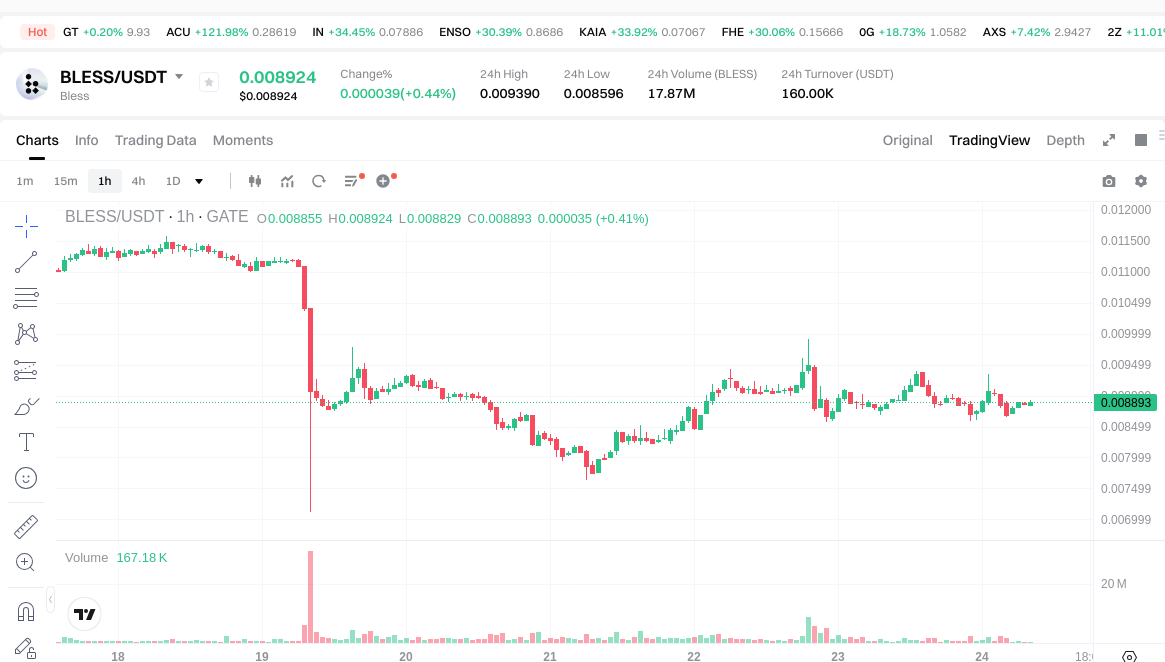
Based on available market data, BLESS has experienced notable price fluctuations since its market debut. The token reached a peak price of $0.2304 in October 2025, reflecting early market interest in the decentralized edge computing network. Subsequently, the token experienced a significant correction, declining to $0.00712 in January 2026.
Over the past year, BLESS has shown a decline of approximately 37.12%, indicating considerable volatility in its trading pattern. The 30-day performance shows a decrease of 19.48%, while the 7-day trend demonstrates a decline of 20.99%, suggesting sustained downward pressure in recent trading periods.
Current BLESS Investment Market Status (January 2026)
- Current BLESS Price: $0.008885
- 24-Hour Trading Volume: $159,786.97
- Market Capitalization: $16,363,208.34
- Circulating Supply: 1,841,666,667 BLESS (18.42% of total supply)
- Total Supply: 10,000,000,000 BLESS
- Token Holder Count: 5,437 addresses
- Listed Exchanges: 18 platforms
- 24-Hour Price Range: $0.008596 - $0.00939
Click to view real-time BLESS market price
II. Core Factors Affecting Whether BLESS is a Good Investment
Supply Mechanism and Scarcity (BLESS Investment Scarcity)
- Fixed Maximum Supply: BLESS has a maximum supply of 10,000,000,000 tokens, with current circulating supply at 1,841,666,667 tokens (18.42% of total supply) → This creates a potential scarcity dynamic that may influence price and investment value
- Supply Distribution: The relatively low circulating supply compared to maximum supply suggests significant tokens remain to be released, which investors should monitor for potential dilution effects
- Investment Significance: The controlled token release mechanism represents a key consideration for long-term investment evaluation, though future supply increases may impact scarcity dynamics
Institutional Investment and Mainstream Adoption (Institutional Investment in BLESS)
- Holder Base: The network currently has 5,437 token holders, indicating a developing community base
- Exchange Presence: BLESS is listed on 18 exchanges, demonstrating a moderate level of market accessibility and liquidity for investors
- Adoption Metrics: Current market capitalization stands at approximately $16.36 million, representing a relatively early-stage project in terms of mainstream adoption
Macroeconomic Environment's Impact on BLESS Investment
- Market Volatility: Recent price movements show significant fluctuations, with a 20.99% decline over 7 days and 19.48% decline over 30 days, reflecting sensitivity to broader market conditions
- Risk Considerations: The 37.12% decline over one year indicates exposure to macroeconomic pressures affecting the cryptocurrency sector
- Investment Context: Current trading price of $0.008885 represents a substantial distance from historical reference points, which investors should consider within the broader economic environment
Technology and Ecosystem Development (Technology & Ecosystem for BLESS Investment)
- Core Technology: BLESS operates as a decentralized edge computing network providing on-demand CPU and GPU power for AI, machine learning, and advanced data tools near end users
- Infrastructure Standard: Built on BEP-20 standard and deployed on BSC (Binance Smart Chain), providing compatibility with established blockchain infrastructure
- Application Focus: The network's positioning in edge computing and AI infrastructure sectors represents its primary value proposition for long-term investment consideration
- Ecosystem Stage: As an emerging project in the decentralized computing space, the ecosystem is in development phase, with future applications and partnerships potentially affecting investment value
III. BLESS Future Investment Forecast and Price Outlook (Is Bless(BLESS) worth investing in 2026-2031)
Short-term Investment Forecast (2026, short-term BLESS investment outlook)
- Conservative forecast: $0.00628 - $0.00885
- Neutral forecast: $0.00885 - $0.01283
- Optimistic forecast: $0.01283 and above
Mid-term Investment Outlook (2027-2029, mid-term Bless(BLESS) investment forecast)
-
Market stage expectation: The decentralized edge computing sector may experience gradual development as AI and machine learning demand continues to evolve. BLESS's position within the GPU/CPU provisioning space could face both opportunities from growing computational needs and challenges from competitive alternatives.
-
Investment return forecast:
- 2027: $0.00900 - $0.01268
- 2028: $0.01000 - $0.01247
- 2029: $0.01151 - $0.01526
-
Key catalysts: Expansion of AI and machine learning adoption, network infrastructure development, potential partnerships within the edge computing ecosystem, and broader market sentiment toward decentralized computing solutions.
Long-term Investment Outlook (Is Bless a good long-term investment?)
- Base scenario: $0.01108 - $0.01758 (assuming steady network growth and moderate adoption of decentralized edge computing services)
- Optimistic scenario: $0.01560 - $0.02216 (assuming accelerated AI/ML industry adoption and favorable market conditions for decentralized infrastructure)
- Risk scenario: Below $0.00712 (under adverse market conditions, heightened competition, or technological disruption)
View BLESS long-term investment and price forecast: Price Prediction
2026-01-24 - 2031 Long-term Outlook
- Base scenario: $0.01108 - $0.01758 (corresponding to steady progress and gradual mainstream application growth)
- Optimistic scenario: $0.01560 - $0.02216 (corresponding to large-scale adoption and favorable market environment)
- Transformative scenario: Above $0.02216 (if the ecosystem achieves breakthrough developments and mainstream prevalence)
- 2031-12-31 predicted high: $0.02216 (based on optimistic development assumptions)
Disclaimer: This analysis is for informational purposes only and does not constitute investment advice. Cryptocurrency markets are highly volatile and subject to significant risk. Past performance does not guarantee future results. Investors should conduct their own research and consult with qualified financial advisors before making investment decisions.
| Year |
Predicted High Price |
Predicted Average Price |
Predicted Low Price |
Price Change |
| 2026 |
0.0128296 |
0.008848 |
0.00628208 |
0 |
| 2027 |
0.012681396 |
0.0108388 |
0.008996204 |
21 |
| 2028 |
0.01246570388 |
0.011760098 |
0.0099960833 |
32 |
| 2029 |
0.0152622551844 |
0.01211290094 |
0.011507255893 |
36 |
| 2030 |
0.017520099919616 |
0.0136875780622 |
0.012455696036602 |
54 |
| 2031 |
0.022157451367089 |
0.015603838990908 |
0.011078725683544 |
75 |
IV. Bless Investment Strategy and Risk Management (How to invest in decentralized edge computing tokens)
Investment Methodology (Bless investment strategy)
-
Long-term Holding (HODL Bless): Suitable for conservative investors who believe in the long-term potential of decentralized edge computing infrastructure. This approach involves accumulating BLESS tokens during market corrections and holding through volatility cycles.
-
Active Trading: Relies on technical analysis and swing trading strategies. Traders may capitalize on BLESS's price fluctuations, with recent data showing 24-hour price movements between $0.008596 and $0.00939. This method requires monitoring market trends and utilizing indicators to identify entry and exit points.
Risk Management (Risk management for Bless investment)
V. Bless Investment Risks and Challenges (Risks of investing in decentralized edge computing tokens)
-
Market Risks: BLESS exhibits considerable price volatility, with 7-day price changes reaching -20.99% and 30-day changes at -19.48%. The token's relatively low market capitalization of approximately $16.36 million and circulating supply of 1.84 billion tokens (18.42% of total supply) may contribute to price instability. The 24-hour trading volume of approximately $159,787 suggests limited liquidity compared to major cryptocurrencies.
-
Regulatory Risks: Decentralized computing networks face evolving regulatory frameworks across jurisdictions. Policy uncertainties regarding data processing, cross-border computing services, and token classification may impact BLESS's operational environment and market accessibility.
-
Technical Risks: Edge computing infrastructure projects face challenges including network security vulnerabilities, scalability limitations, and protocol upgrade complexities. The successful deployment and maintenance of distributed computing nodes require robust technical implementation. Token holders should monitor project development updates and community activity across official channels.
VI. Conclusion: Is Decentralized Edge Computing a Good Investment?
-
Investment Value Summary: Bless operates in the emerging decentralized edge computing sector, providing on-demand CPU and GPU resources for AI and machine learning applications. While the project addresses growing demand for distributed computing infrastructure, the token has experienced notable price corrections, declining from its all-time high of $0.2304 (October 15, 2025) to current levels around $0.008885. The significant gap between market cap and fully diluted valuation ($88.85 million) indicates substantial future token supply entering circulation.
-
Investor Recommendations:
✅ Beginners: Implement dollar-cost averaging (DCA) strategy with small, regular purchases. Store tokens in secure hardware wallets and limit initial exposure to 1-2% of total investment portfolio.
✅ Experienced Investors: Consider swing trading opportunities during volatility periods while maintaining a core long-term position. Diversify across multiple edge computing and AI infrastructure projects to balance sector exposure.
✅ Institutional Investors: Evaluate strategic allocation as part of broader decentralized infrastructure thesis. Conduct thorough due diligence on project fundamentals, team background, and competitive positioning within the edge computing landscape.
⚠️ Disclaimer: Cryptocurrency investments carry substantial risks including potential total loss of capital. This content is for informational purposes only and does not constitute financial, investment, or trading advice. Conduct independent research and consult qualified financial advisors before making investment decisions.
VII. FAQ
Q1: Is Bless (BLESS) a good investment for beginners in 2026?
BLESS may be suitable for beginners with appropriate risk management, but should represent only 1-2% of a beginner's portfolio. The token operates in the emerging decentralized edge computing sector and currently trades at $0.008885 with a market capitalization of approximately $16.36 million. Beginners should employ dollar-cost averaging (DCA) strategies and secure storage solutions. The significant price volatility (-20.99% over 7 days, -37.12% over one year) indicates elevated risk levels requiring careful position sizing and long-term perspective.
Q2: What is the expected return on BLESS investment by 2030?
Based on current analysis, BLESS investment forecasts suggest potential returns ranging from $0.012 to $0.018 by 2030 under base scenarios, representing approximately 35-102% upside from current levels of $0.008885. Conservative estimates project $0.01108-$0.01758, while optimistic scenarios anticipate $0.01560-$0.02216. These projections assume continued development in decentralized edge computing infrastructure and growing AI/ML adoption. However, cryptocurrency markets remain highly volatile, and actual returns may significantly deviate from forecasts based on market conditions, regulatory developments, and technological progress.
Q3: How does BLESS's circulating supply affect its investment value?
BLESS currently has 1.84 billion tokens in circulation (18.42% of the 10 billion maximum supply), creating potential scarcity dynamics that may influence price appreciation. The low circulating percentage indicates approximately 8.16 billion tokens remain to be released, which represents a critical consideration for investors. Future token releases could dilute existing holdings and create downward price pressure. Investors should monitor the token release schedule and vesting mechanisms to assess potential dilution effects on their investment. The controlled supply mechanism may support price stability if released gradually alongside ecosystem growth.
Q4: What are the main risks associated with investing in BLESS?
BLESS investment carries three primary risk categories: (1) Market Risk - significant price volatility with 7-day declines reaching -20.99% and relatively low liquidity ($159,787 24-hour trading volume); (2) Regulatory Risk - evolving frameworks for decentralized computing networks across jurisdictions may impact operations and token classification; (3) Technical Risk - edge computing infrastructure faces challenges including network security vulnerabilities, scalability limitations, and protocol upgrade complexities. Additionally, the project's early-stage nature (5,437 holders, ranked #963) indicates limited mainstream adoption compared to established cryptocurrencies.
Q5: How should investors store BLESS tokens securely?
BLESS token storage should align with investment timeframes and security requirements. Long-term holders should utilize cold storage solutions such as hardware wallets (Ledger or Trezor) to minimize exposure to online threats. Active traders may maintain positions in hot wallets with mandatory two-factor authentication for accessibility while implementing security best practices. All investors must verify the official BLESS contract address (0x7c8217517ed4711fe2deccdfeffe8d906b9ae11f on BSC network) before any transactions to avoid fraudulent tokens. Consider splitting holdings between cold storage (75-90%) and hot wallets (10-25%) based on trading frequency.
Q6: What factors could drive BLESS price appreciation in the future?
BLESS price appreciation depends on multiple catalysts including: (1) Expansion of AI and machine learning adoption requiring distributed computing resources; (2) Network infrastructure development and node expansion improving service delivery; (3) Strategic partnerships within the edge computing ecosystem establishing market credibility; (4) Broader market sentiment toward decentralized infrastructure solutions; (5) Technological improvements enhancing network efficiency and reducing computational costs; (6) Increased exchange listings improving liquidity and market accessibility. The convergence of these factors could support the optimistic forecast range of $0.01560-$0.02216 by 2031, though execution risks remain substantial.
Q7: How does BLESS compare to other decentralized computing investments?
BLESS represents a specialized position within the decentralized edge computing sector, focusing on on-demand CPU and GPU provisioning near end users. The project's current market capitalization ($16.36 million) and holder base (5,437 addresses) indicate early-stage development compared to established decentralized computing networks. Built on BSC as a BEP-20 token, BLESS offers lower transaction costs compared to Ethereum-based alternatives. Investors should evaluate BLESS within a diversified portfolio of edge computing and AI infrastructure projects rather than concentrated exposure. The project's specialized focus on edge computing differentiates it from general-purpose computing networks, potentially offering niche market advantages as edge AI applications expand.
Q8: What investment strategy works best for BLESS token?
Optimal BLESS investment strategy depends on investor profile and risk tolerance. Conservative investors should implement long-term holding (HODL) strategies with 1-3% portfolio allocation, accumulating during market corrections and maintaining positions through volatility cycles. Aggressive investors may allocate 5-10% with active trading approaches utilizing technical analysis to capitalize on price fluctuations (recent 24-hour range: $0.008596-$0.00939). Professional investors could deploy up to 15% allocation with hedging strategies including diversification across multiple edge computing projects and correlation analysis with broader AI infrastructure trends. Dollar-cost averaging remains recommended across all strategies to mitigate timing risk and reduce average cost basis during volatile market conditions.
* The information is not intended to be and does not constitute financial advice or any other recommendation of any sort offered or endorsed by Gate.