This comprehensive analysis evaluates whether Bluefin (BLUE) represents a sound investment opportunity within the Sui blockchain ecosystem. BLUE serves as the native token of Bluefin, a decentralized spot and derivatives trading platform that has processed over $39 billion in trading volume since its September 2023 launch, establishing itself as Sui's largest protocol by volume. Current market metrics show BLUE trading at $0.03012 with an $11.89 million market capitalization across 270,941 holders on 13 exchanges including Gate. The article examines critical investment factors including token supply mechanics, institutional backing from Polychain and SIG, price performance ranging from $0.8694 peaks to current levels, and multi-year price forecasts through 2031. Investment strategies accommodate varying risk profiles from conservative dollar-cost averaging approaches to active trading frameworks, while comprehensive risk analysis addresses market volatility, regulatory uncertainty, and technical vulnerabiliti
Introduction: Bluefin (BLUE) Investment Position and Market Outlook
BLUE represents a significant asset within the cryptocurrency landscape, serving as the native token of Bluefin, a decentralized spot and derivatives trading platform on the Sui blockchain. Since its launch in December 2024, the platform has demonstrated substantial growth, accumulating over $39 billion in total trading volume since September 2023, positioning itself as the largest protocol on Sui by trading volume. As of January 25, 2026, BLUE maintains a market capitalization of approximately $11.89 million, with a circulating supply of 394.66 million tokens and a current trading price around $0.03012. Backed by prominent investment firms including Polychain, SIG, and Brevan Howard, the project has attracted over 270,941 holders and is listed on 13 exchanges. With a fully diluted valuation of $30.12 million and a market cap to FDV ratio of 39.47%, BLUE has become a focal point for investors evaluating "Is Bluefin (BLUE) a good investment?" This article provides a comprehensive analysis of BLUE's investment value, historical price movements, future price projections, and associated investment risks to assist investors in making informed decisions.
I. Coin (BLUE) Price History Review and Investment Value Status
- 2023: Platform launched in September on Sui blockchain → Initial trading activity commenced
- 2024: December 15 reached peak price level of $0.8694 → Price experienced significant appreciation from launch
- 2024-2025: Market adjustment period → Price declined from elevated levels to lower range
- 2025: December 19 recorded price level of $0.02864 → Market experienced correction phase
Current BLUE Investment Market Status (January 2025)
- BLUE current price: $0.03012
- 24-hour trading volume: $151,256.97
- Circulating supply: 394,658,225 BLUE
- Market capitalization: $11,887,105.74
- Total supply: 1,000,000,000 BLUE
- Holders: 270,941
- Listed on 13 exchanges
Click to view real-time BLUE market price
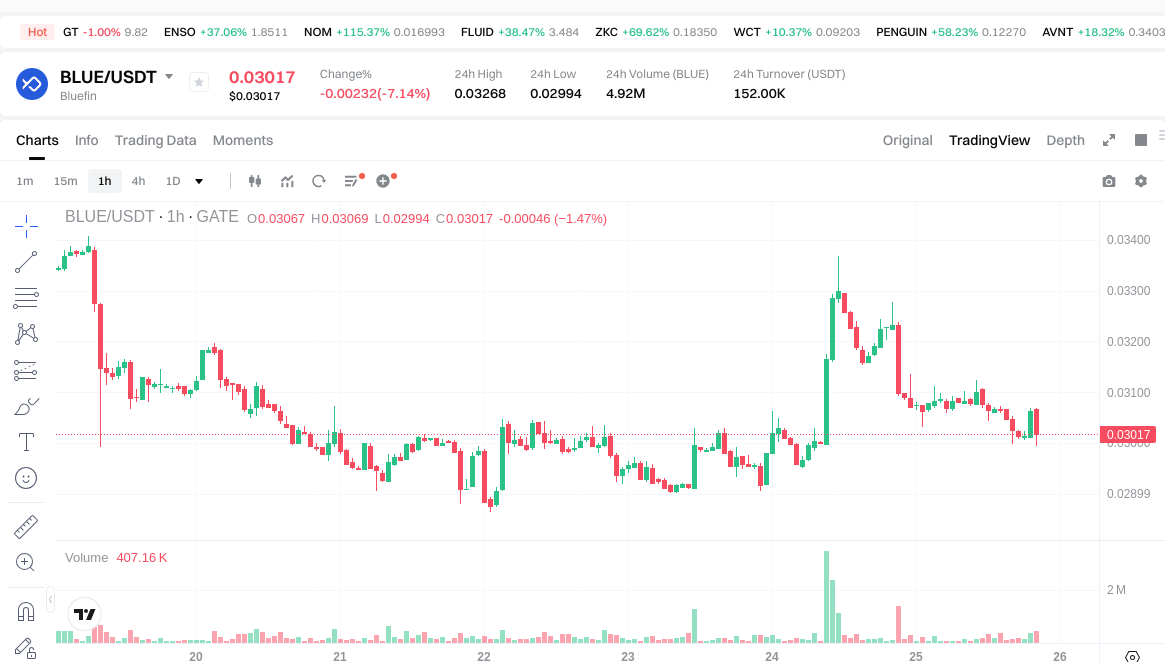
II. Core Factors Affecting Whether BLUE is a Good Investment (Is Bluefin(BLUE) a Good Investment)
Supply Mechanism and Scarcity (BLUE investment scarcity)
- Fixed Maximum Supply Mechanism → Affects Price and Investment Value
- BLUE has a maximum supply of 1,000,000,000 tokens, with approximately 394,658,225 tokens currently in circulation (39.47% of total supply). This capped supply model creates a built-in scarcity mechanism that may influence long-term valuation dynamics.
- Historical Pattern: BLUE experienced price fluctuations ranging from $0.02864 to $0.8694, demonstrating significant volatility in its trading history.
- Investment Consideration: The controlled token release schedule and finite supply cap represent structural factors that may support long-term investment thesis, though market dynamics involve multiple variables.
Institutional Investment and Mainstream Adoption (Institutional investment in BLUE)
- Institutional Backing: Bluefin is supported by prominent venture capital firms including Polychain, SIG, and Brevan Howard, indicating institutional confidence in the project's infrastructure and market positioning.
- Protocol Performance: As the largest protocol on Sui blockchain by total trading volume, Bluefin has processed over $39 billion in trades since its September 2023 launch, demonstrating substantial platform utilization.
- Holder Base: The project has attracted 270,941 token holders, reflecting a distributed ownership structure and community engagement level.
Macroeconomic Environment's Impact on BLUE Investment
- Monetary Policy Context: Broader macroeconomic conditions, including interest rate environments and liquidity cycles, influence capital allocation toward digital assets and DeFi protocols.
- Digital Asset Positioning: As a DeFi trading infrastructure project, BLUE's investment profile may be affected by shifts in risk appetite and institutional participation in decentralized finance.
- Market Uncertainty Factors: Geopolitical developments and regulatory evolution in cryptocurrency markets create external variables that impact investment considerations for platform tokens.
Technology and Ecosystem Development (Technology & Ecosystem for BLUE investment)
- Sui Blockchain Infrastructure: Bluefin operates on the Sui blockchain, leveraging its technical architecture for decentralized spot and derivatives trading functionality.
- Platform Capabilities: The protocol offers both spot and derivatives trading services, positioning it as a comprehensive DeFi trading infrastructure within the Sui ecosystem.
- DeFi Ecosystem Role: As a trading platform, Bluefin contributes to the broader decentralized finance landscape, with its adoption and volume metrics reflecting platform utility and ecosystem integration. The project's documentation is available through its learning portal, providing technical resources for users and developers.
III. BLUE Future Investment Forecast and Price Outlook (Is Bluefin(BLUE) worth investing in 2026-2031)
Short-term Investment Forecast (2026, short-term BLUE investment outlook)
- Conservative Forecast: $0.025 - $0.030
- Neutral Forecast: $0.030 - $0.035
- Optimistic Forecast: $0.035 - $0.042
Mid-term Investment Outlook (2027-2029, mid-term Bluefin(BLUE) investment forecast)
-
Market Phase Expectation: Based on historical data, BLUE may experience gradual recovery during the mid-term period as the Sui ecosystem continues developing and the decentralized trading platform gains traction among users.
-
Investment Return Forecast:
- 2027: $0.024 - $0.045
- 2028: $0.038 - $0.056
- 2029: $0.027 - $0.069
-
Key Catalysts: Platform trading volume growth, Sui blockchain adoption expansion, decentralized exchange sector development, and increased institutional backing.
Long-term Investment Outlook (Is BLUE a good long-term investment?)
- Base Scenario: $0.039 - $0.058 (assuming steady protocol development and moderate market conditions)
- Optimistic Scenario: $0.062 - $0.081 (assuming significant user adoption and favorable market environment)
- Risk Scenario: $0.027 - $0.038 (under challenging market conditions or increased competition)
Click to view BLUE long-term investment and price forecast: Price Prediction
2026-01-25 - 2031 Long-term Outlook
- Base Scenario: $0.039 - $0.058 USD (corresponding to steady progress and mainstream application growth)
- Optimistic Scenario: $0.062 - $0.081 USD (corresponding to large-scale adoption and favorable market conditions)
- Transformational Scenario: Above $0.081 USD (if ecosystem achieves breakthrough progress and mainstream adoption)
- 2031-12-31 Predicted High: $0.081 USD (based on optimistic development assumptions)
Disclaimer: The above predictions are for reference purposes only and do not constitute investment advice. Cryptocurrency markets are highly volatile and subject to various risks. Investors should conduct thorough research and consider their risk tolerance before making investment decisions.
| Year |
Predicted High Price |
Predicted Average Price |
Predicted Low Price |
Price Change |
| 2026 |
0.0419085 |
0.03015 |
0.0250245 |
0 |
| 2027 |
0.04467627 |
0.03602925 |
0.02449989 |
19 |
| 2028 |
0.0556868088 |
0.04035276 |
0.0375280668 |
33 |
| 2029 |
0.068668291692 |
0.0480197844 |
0.027371277108 |
59 |
| 2030 |
0.08051477250348 |
0.058344038046 |
0.03909050549082 |
93 |
| 2031 |
0.077066639854961 |
0.06942940527474 |
0.061792170694518 |
130 |
IV. Bluefin Investment Strategy and Risk Management (How to invest in Bluefin)
Investment Strategy (Bluefin investment strategy)
Long-term Holding (HODL Bluefin)
For conservative investors seeking steady exposure to decentralized exchange protocols on the Sui blockchain, a long-term holding strategy may be considered. This approach involves accumulating BLUE tokens during market corrections and maintaining positions through volatility cycles. Given Bluefin's position as the largest protocol on Sui by trading volume, with over $39 billion traded since September 2023, long-term holders may benefit from the platform's continued adoption and ecosystem growth. However, investors should note that BLUE has experienced significant price fluctuations, with the token currently trading substantially below its historical high.
Active Trading
Active traders may utilize technical analysis and swing trading strategies to capitalize on BLUE's price movements. With a 24-hour trading volume of approximately $151,000 and price volatility ranging from $0.02994 to $0.03268 in recent sessions, short-term trading opportunities exist. Traders should monitor key support and resistance levels, trading volume patterns, and market sentiment indicators. Technical traders may employ stop-loss orders and position sizing strategies to manage exposure during volatile periods.
Risk Management (Risk management for Bluefin investment)
Asset Allocation Proportion
- Conservative Investors: Allocate no more than 1-3% of crypto portfolio to BLUE, focusing primarily on established cryptocurrencies with larger market capitalizations
- Aggressive Investors: May allocate 5-10% to BLUE as part of a diversified DeFi protocol portfolio, accepting higher volatility for potential growth
- Professional Investors: Could consider 3-7% allocation with active risk management, leveraging platform metrics and on-chain analytics for position adjustments
Risk Hedging Solutions
Investors should implement multi-asset portfolio construction combining BLUE with established cryptocurrencies, stablecoins, and traditional assets. Consider diversification across different blockchain ecosystems rather than concentration in Sui-based protocols. Risk management tools may include setting predetermined exit points, utilizing dollar-cost averaging for entry positions, and maintaining liquidity reserves for portfolio rebalancing.
Secure Storage
- Cold Wallet Storage: For long-term holdings, use hardware wallets that support Sui blockchain tokens, storing private keys offline to minimize security risks
- Hot Wallet Solutions: For active trading, utilize reputable exchanges with robust security measures, enabling two-factor authentication and withdrawal whitelisting
- Hardware Wallet Recommendations: Consider established hardware wallet providers that have integrated Sui blockchain support, ensuring compatibility with BLUE token storage and transactions
V. Bluefin Investment Risks and Challenges (Risks of investing in Bluefin)
Market Risks
BLUE demonstrates high volatility characteristics typical of lower market cap cryptocurrencies. The token has declined approximately 7.65% in the past 24 hours and 10.54% over the past week. With a market capitalization of approximately $11.89 million and ranking around position 1121, BLUE faces liquidity constraints that can amplify price movements. The significant gap between current price ($0.03012) and historical high ($0.8694) reflects substantial downside pressure experienced since December 2024. Market manipulation risks may be elevated in tokens with lower trading volumes and market capitalizations.
Regulatory Risks
Decentralized exchange platforms operate in an evolving regulatory landscape with varying treatment across jurisdictions. Different countries maintain distinct approaches to DeFi protocols, with some implementing strict compliance requirements while others adopt more permissive frameworks. Changes in regulatory policies regarding decentralized trading platforms, derivatives offerings, or token classifications could impact Bluefin's operations and BLUE's value proposition. Investors should monitor regulatory developments in major markets that may affect platform accessibility and token utility.
Technical Risks
As a protocol operating on the Sui blockchain, Bluefin faces technical risks related to smart contract vulnerabilities, network security, and protocol upgrades. While the platform has processed significant trading volume, potential smart contract exploits or security breaches could impact user funds and platform credibility. Network congestion or technical issues on the underlying Sui blockchain may affect platform performance and user experience. Protocol upgrades or governance changes could introduce unforeseen technical challenges that impact token value and platform functionality.
VI. Conclusion: Is Bluefin a Good Investment?
Investment Value Summary
Bluefin represents a significant protocol within the Sui blockchain ecosystem, demonstrating substantial trading activity since its September 2023 launch. However, BLUE token performance has been marked by considerable volatility, with current prices reflecting significant depreciation from historical peaks. The platform's position as the largest protocol on Sui by trading volume provides some fundamental support, but the token's market capitalization and liquidity metrics suggest elevated risk factors. Long-term investment potential exists but remains subject to platform adoption trends, competitive dynamics in decentralized exchanges, and broader crypto market conditions.
Investor Recommendations
✅ Beginners: Consider dollar-cost averaging with minimal allocation (1-2% of crypto portfolio), prioritizing secure wallet storage and avoiding leverage. Focus on understanding platform fundamentals and market dynamics before increasing position sizes.
✅ Experienced Investors: May explore swing trading opportunities while maintaining disciplined position sizing (3-5% allocation). Implement technical analysis frameworks and risk management protocols including stop-losses and profit-taking strategies. Monitor on-chain metrics and platform development updates.
✅ Institutional Investors: Could evaluate strategic allocation as part of broader DeFi protocol exposure (2-4% of DeFi allocation), conducting thorough due diligence on platform security, tokenomics, and competitive positioning. Consider hedging strategies and correlation analysis with broader crypto market movements.
⚠️ Reminder: Cryptocurrency investment involves high risk and volatility. This content is for informational purposes only and does not constitute investment advice. Investors should conduct independent research and consider their risk tolerance before making investment decisions.
VII. FAQ
Q1: What is Bluefin (BLUE) and what makes it unique in the DeFi space?
Bluefin (BLUE) is the native token of Bluefin, a decentralized spot and derivatives trading platform built on the Sui blockchain. What distinguishes Bluefin is its position as the largest protocol on Sui by trading volume, having processed over $39 billion in total trades since its September 2023 launch. The platform combines both spot and derivatives trading functionality within a single decentralized infrastructure, offering comprehensive trading services to users. Backed by prominent institutional investors including Polychain, SIG, and Brevan Howard, Bluefin leverages Sui's technical architecture to provide a high-performance trading environment while maintaining decentralized principles.
Q2: What is the current market status and price performance of BLUE?
As of January 25, 2026, BLUE trades at approximately $0.03012 with a market capitalization of $11.89 million. The token has experienced significant volatility since its launch, reaching a peak price of $0.8694 in December 2024 before correcting to current levels. With 394.66 million tokens in circulation (39.47% of total supply) and 270,941 holders, BLUE maintains a distributed ownership structure. The token is listed on 13 exchanges with a 24-hour trading volume of approximately $151,257, though recent performance shows declines of 7.65% in 24 hours and 10.54% over the past week, reflecting broader market pressures and lower liquidity conditions.
Q3: What are the key risks associated with investing in BLUE?
BLUE investment involves multiple risk categories. Market risks include high volatility typical of lower market cap cryptocurrencies, with significant liquidity constraints that amplify price movements and potential manipulation risks. Regulatory risks stem from the evolving treatment of DeFi protocols across jurisdictions, with potential policy changes affecting platform operations and token utility. Technical risks involve smart contract vulnerabilities, network security concerns, and potential issues with the underlying Sui blockchain infrastructure. The substantial gap between current prices and historical highs, combined with limited trading volume relative to larger cryptocurrencies, represents additional considerations for risk-conscious investors.
Q4: What is the long-term price outlook for BLUE through 2031?
Long-term price forecasts for BLUE vary across scenarios. The base scenario projects a range of $0.039 - $0.058 by 2031, assuming steady protocol development and moderate market conditions. An optimistic scenario forecasts $0.062 - $0.081, contingent on significant user adoption and favorable market environments. A risk scenario estimates $0.027 - $0.038 under challenging conditions or increased competition. By 2031, the predicted high reaches $0.081 under optimistic assumptions, representing potential growth of approximately 130% from 2026 levels. However, these projections are subject to numerous variables including platform adoption rates, Sui ecosystem development, competitive dynamics, and broader crypto market conditions.
Q5: What investment strategies are appropriate for BLUE holders?
Investment strategies should align with risk tolerance levels. Conservative investors may consider long-term holding (HODL) with 1-3% portfolio allocation, accumulating during market corrections and maintaining positions through volatility cycles. Aggressive investors might allocate 5-10% with active trading approaches, utilizing technical analysis and swing trading strategies to capitalize on price movements. Professional investors could implement 3-7% allocation with sophisticated risk management, leveraging platform metrics and on-chain analytics. All strategies should incorporate secure storage solutions, including cold wallets for long-term holdings and reputable exchanges with robust security for active trading, along with proper position sizing and diversification across different blockchain ecosystems.
Q6: How does Bluefin's institutional backing affect investment considerations?
Institutional backing from prominent firms including Polychain, SIG, and Brevan Howard provides credibility signals for BLUE investment analysis. These venture capital firms typically conduct extensive due diligence before committing capital, suggesting confidence in Bluefin's infrastructure and market positioning. Institutional involvement may contribute to platform development resources, strategic guidance, and potential future funding rounds. However, institutional backing alone does not guarantee investment success, as token performance depends on multiple factors including platform adoption, market conditions, and competitive dynamics. Investors should evaluate institutional involvement as one component within comprehensive fundamental analysis rather than a sole investment thesis.
Q7: What role does Bluefin play in the Sui blockchain ecosystem?
Bluefin serves as the primary decentralized trading infrastructure within the Sui ecosystem, holding the position as the largest protocol by trading volume. The platform contributes to Sui's DeFi landscape by providing comprehensive spot and derivatives trading functionality, enhancing the blockchain's utility and attracting users to the ecosystem. With over $39 billion in cumulative trading volume since September 2023, Bluefin demonstrates significant protocol utilization that supports broader Sui adoption. The platform's success directly correlates with Sui blockchain development and user growth, creating interdependencies between platform performance and ecosystem expansion. Investors evaluating BLUE should consider both Bluefin-specific metrics and broader Sui ecosystem developments.
Q8: What factors should investors monitor when evaluating BLUE investment decisions?
Key monitoring factors include platform trading volume trends, user growth metrics, and market share within decentralized exchanges. On-chain analytics such as active addresses, transaction counts, and holder distribution provide insights into platform utilization and community engagement. Competitive analysis of other DeFi trading platforms, particularly on alternative blockchains, helps assess Bluefin's positioning. Sui blockchain development progress, network security updates, and ecosystem partnerships affect underlying infrastructure supporting the platform. Broader market conditions including cryptocurrency regulation developments, institutional DeFi adoption trends, and macroeconomic factors influencing risk appetite should inform investment timing and position sizing decisions. Regular review of these factors enables informed portfolio adjustments.
* The information is not intended to be and does not constitute financial advice or any other recommendation of any sort offered or endorsed by Gate.