This comprehensive analysis examines whether Blur (BLUR), an NFT marketplace aggregator token, represents a viable investment opportunity as of January 2026. The article evaluates BLUR's investment potential through multiple dimensions: current market position ($98.82M market cap, $0.03669 price), historical price performance showing 83.56% year-over-year decline yet 36.78% monthly gains, and supply mechanics with 89.78% circulation. Key analysis covers institutional adoption factors, macroeconomic influences, technological ecosystem developments, and realistic price projections through 2031. The guide provides tailored investment strategies for beginners, experienced traders, and institutional investors, alongside comprehensive risk management frameworks addressing market volatility, regulatory uncertainty, and technical vulnerabilities. Suitable for investors seeking structured evaluation of NFT marketplace sector exposure with balanced perspective on opportunities and substantial risks.
Introduction: Blur (BLUR)'s Investment Position and Market Prospects
Blur (BLUR) represents a notable asset within the cryptocurrency sector, having launched in February 2023 and establishing itself in the NFT marketplace and aggregation space. As of January 2026, Blur maintains a market capitalization of approximately $98.82 million, with a circulating supply of around 2.69 billion tokens, and the current price stands at $0.03669. Positioned as a decentralized NFT marketplace and aggregator managed by BLUR token holders, the project has attracted attention from investors evaluating whether Blur (BLUR) represents a viable investment opportunity. This article provides a comprehensive analysis of BLUR's investment attributes, historical price movements, future price projections, and associated risks to serve as a reference for investors.
Blur's architecture is designed to handle high-volume transactions, enabling advanced functionality including real-time data feeds, charting tools, batch listing and purchasing capabilities, and portfolio management features. With 53,104 holders and availability on 44 exchanges, the token demonstrates a degree of market presence. The project's fully diluted valuation stands at $110.07 million, representing 89.78% of its market cap to FDV ratio, indicating that a substantial portion of the total supply is already in circulation. Recent price trends show a 5.43% increase over 24 hours, a 12.11% gain over 7 days, and a 36.78% rise over 30 days, though the yearly performance reflects an 83.56% decline from previous levels.
I. Blur (BLUR) Price History and Current Investment Value
-
2023: BLUR token launched in February 2023, with an initial price surge reaching $5.02. The token was distributed through multiple airdrops to NFT traders and platform users, attracting significant market attention as Blur challenged OpenSea's market dominance in the NFT trading space.
-
2023-2024: Following the initial launch momentum, BLUR experienced a sustained downward trend. The token's price declined substantially from its early peak, reflecting broader cooling in the NFT market and questions about the sustainability of the platform's zero-fee trading model.
-
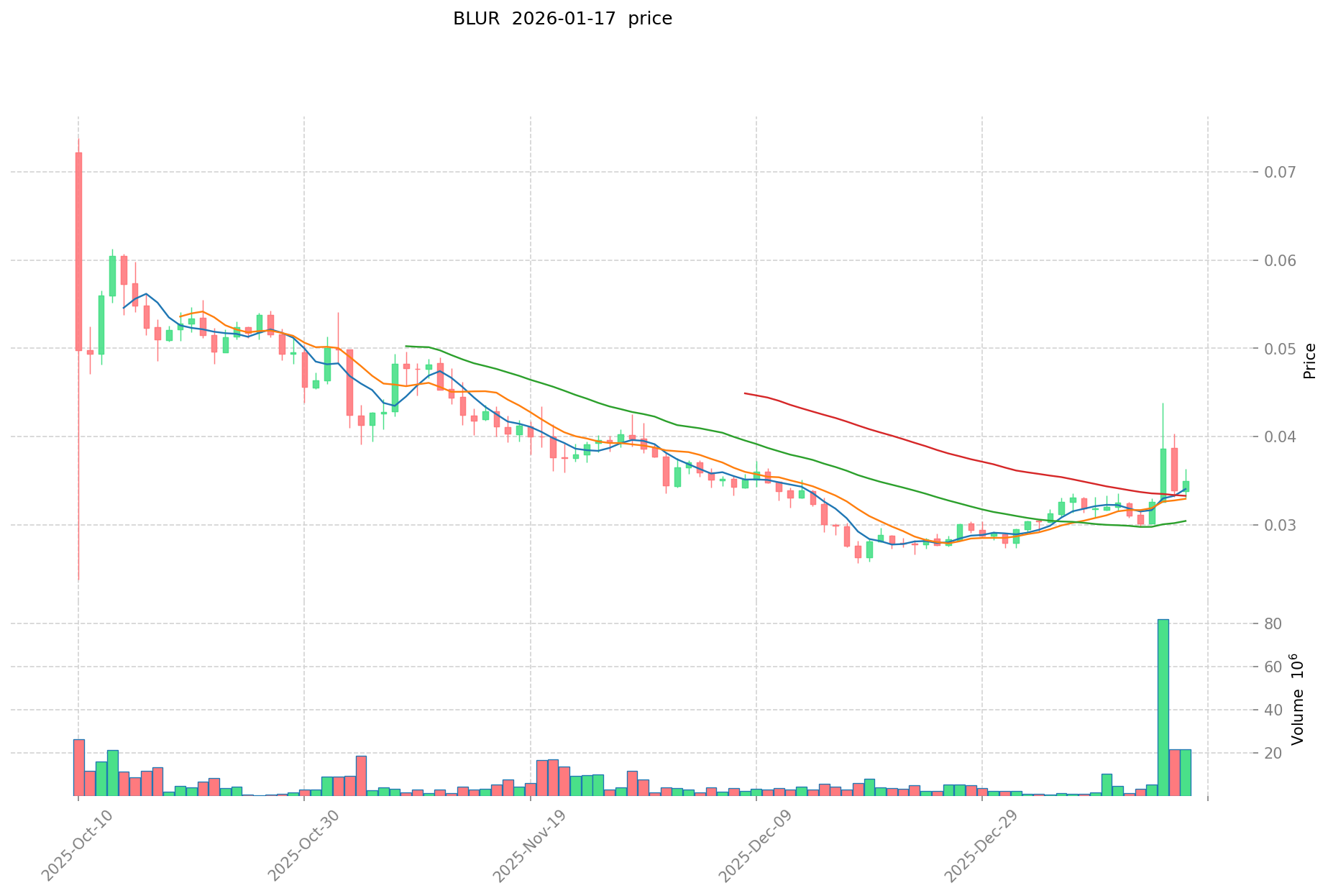
2025: The token reached a notable low point at $0.02583223 in December 2025, representing a significant decline from previous levels. This downturn occurred amid broader challenges in the NFT trading sector and ongoing evolution of the platform's economic model.
Current Investment Market Status (January 2026)
- Current BLUR Price: $0.03669 (as of January 17, 2026)
- Market Sentiment: The token has shown recent positive movement with a 5.43% increase over 24 hours and 12.11% gain over 7 days, though year-over-year performance remains down 83.56%
- 24-Hour Trading Volume: $699,044.95
- Market Position: BLUR ranks #361 by market capitalization, with a circulating supply of approximately 2.69 billion tokens (89.78% of total supply) and a market cap of $98.82 million
Click to view real-time BLUR market price
II. Core Factors Influencing Whether BLUR Is a Good Investment
Supply Mechanism and Scarcity (BLUR Investment Scarcity)
- Supply mechanism: BLUR has a maximum supply of 3,000,000,000 tokens, with approximately 2,693,278,903 tokens (89.78%) currently in circulation. This fixed supply cap may influence long-term price dynamics and investment value.
- Historical patterns: BLUR's price has experienced significant volatility, with historical data showing fluctuations between $0.02583223 and $5.02. Such patterns reflect the token's sensitivity to market conditions and supply-demand dynamics.
- Investment significance: The limited maximum supply and high circulating ratio suggest that scarcity may play a role in supporting long-term investment considerations, though market factors remain critical.
Institutional Investment and Mainstream Adoption (Institutional Investment in BLUR)
- Institutional holding trends: The token is held by approximately 53,104 addresses and is listed on 44 exchanges, indicating a degree of distribution and accessibility within the market.
- Enterprise adoption: BLUR positions itself as a decentralized NFT marketplace and aggregator managed by $BLUR holders, with features including real-time data feeds, batch listing tools, and portfolio management designed for experienced NFT traders.
- Policy influence: The decentralized governance framework allows token holders to participate in platform policy decisions, which may influence the project's responsiveness to regulatory and market developments.
Macroeconomic Environment's Impact on BLUR Investment
- Monetary policy and interest rate changes: Shifts in monetary policy and interest rates can affect risk appetite for speculative assets like BLUR, potentially altering its investment attractiveness.
- Inflation environment and hedging role: While some digital assets are discussed in the context of inflation hedging, BLUR's primary utility is tied to NFT trading rather than serving as a store of value.
- Geopolitical uncertainty: Market uncertainty may influence demand for digital assets, though BLUR's investment demand is primarily driven by its role within the NFT ecosystem.
Technology and Ecosystem Development (Technology & Ecosystem for BLUR Investment)
- Platform architecture: BLUR's infrastructure is designed to handle high transaction loads, offering features such as zero trading fees, advanced order execution, and liquidity incentives aimed at enhancing the NFT trading experience.
- Ecosystem expansion: The platform includes Blend, a peer-to-peer perpetual lending platform, which extends BLUR's utility beyond NFT trading and may contribute to its long-term value proposition.
- DeFi, NFT, and payment applications: BLUR's focus on NFT marketplace functionality and governance positions it within the broader NFT and decentralized finance sectors, with its value tied to the adoption and growth of these use cases.
III. BLUR Future Investment Prediction and Price Outlook (Is Blur(BLUR) worth investing in 2026-2031)
Short-term Investment Prediction (2026, short-term BLUR investment outlook)
- Conservative Prediction: $0.0211 - $0.0365
- Neutral Prediction: $0.0365 - $0.0422
- Optimistic Prediction: $0.0422 - $0.0481
Mid-term Investment Outlook (2027-2029, mid-term Blur(BLUR) investment forecast)
- Market Phase Expectation: BLUR may experience moderate fluctuations during this period, with technical analysis suggesting potential growth influenced by broader digital asset market trends and regulatory developments.
- Investment Return Prediction:
- 2027: $0.0275 - $0.0465
- 2028: $0.0338 - $0.0648
- 2029: $0.0333 - $0.0721
- Key Catalysts: Global digital currency regulatory dynamics, technological advancements in the NFT marketplace sector, and adoption trends within the decentralized aggregator space.
Long-term Investment Outlook (Is BLUR a good long-term investment?)
- Base Scenario: $0.0551 - $0.0744 (assuming steady development and gradual mainstream adoption)
- Optimistic Scenario: $0.0744 - $0.1087 (assuming accelerated adoption and favorable market conditions)
- Risk Scenario: Below $0.0337 (in cases of significant market downturns or regulatory challenges)
Click to view BLUR long-term investment and price prediction: Price Prediction
2026-01-17 - 2031 Long-term Outlook
- Base Scenario: $0.0365 - $0.0744 USD (corresponding to steady progress and gradual mainstream application improvement)
- Optimistic Scenario: $0.0744 - $0.1087 USD (corresponding to large-scale adoption and favorable market environment)
- Transformative Scenario: Above $0.1087 USD (in the event of breakthrough ecosystem developments and mainstream popularization)
- 2031-12-31 Predicted High: $0.1087 USD (based on optimistic development assumptions)
Disclaimer: The above predictions are based on technical analysis and historical data patterns. Cryptocurrency markets are highly volatile and subject to numerous unpredictable factors including regulatory changes, technological developments, and market sentiment shifts. These predictions should not be construed as investment advice, and investors should conduct their own research and consider their risk tolerance before making investment decisions.
| Year |
Predicted High Price |
Predicted Average Price |
Predicted Low Price |
Price Change |
| 2026 |
0.0481272 |
0.03646 |
0.0211468 |
0 |
| 2027 |
0.04652296 |
0.0422936 |
0.02749084 |
15 |
| 2028 |
0.0648360888 |
0.04440828 |
0.0337502928 |
20 |
| 2029 |
0.072101283408 |
0.0546221844 |
0.033319532484 |
48 |
| 2030 |
0.0855383407704 |
0.063361733904 |
0.05512470849648 |
72 |
| 2031 |
0.108697054512312 |
0.0744500373372 |
0.066260533230108 |
102 |
IV. Blur Investment Strategy and Risk Management (How to invest in NFT marketplace tokens)
Investment Methodology (Blur investment strategy)
Long-term Holding (HODL Blur): Suitable for conservative investors
For investors focused on the long-term development of NFT marketplace infrastructure, holding BLUR tokens may align with a position in the evolving digital collectibles ecosystem. This approach requires patience through market cycles and belief in the platform's sustained user adoption and technological improvements.
Active Trading: Relies on technical analysis and swing operations
Given Blur's price volatility, active traders may seek opportunities through:
- Monitoring 24-hour trading volume patterns (current volume: $699,044.95)
- Tracking price ranges between support and resistance levels (24H range: $0.03352 - $0.03781)
- Analyzing short-term price movements across different timeframes (1H: -1.11%, 24H: +5.43%, 7D: +12.11%)
Risk Management (Risk management for Blur investment)
Asset Allocation Ratio: Conservative / Aggressive / Professional investors
- Conservative investors: May limit NFT marketplace token exposure to 1-3% of total crypto portfolio
- Aggressive investors: Could allocate 5-10% depending on risk tolerance and market outlook
- Professional investors: May employ dynamic allocation strategies based on market conditions and platform metrics
Risk Hedging Solutions: Multi-asset portfolio + hedging tools
Diversification across different crypto sectors (DeFi, Layer 1/2, NFT infrastructure) can help mitigate concentration risk. Investors may also consider:
- Portfolio rebalancing during significant price movements
- Setting stop-loss parameters to limit downside exposure
- Monitoring correlation with broader NFT market trends
Secure Storage: Hot and cold wallets + hardware wallet recommendations
BLUR tokens (ERC-20 standard on Ethereum: 0x5283D291DBCF85356A21bA090E6db59121208b44) should be stored securely:
- Hardware wallets (Ledger, Trezor) for long-term holdings
- Reputable software wallets with multi-signature support for active trading amounts
- Avoid keeping significant amounts on exchanges to minimize custodial risk
V. Blur Investment Risks and Challenges (Risks of investing in NFT marketplace tokens)
Market Risk: High volatility and price manipulation concerns
Blur demonstrates significant price volatility:
- 1-year performance: -83.56% from previous levels
- 30-day performance: +36.78%, indicating rapid short-term fluctuations
- Historical price range: $0.02583223 (December 19, 2025) to $5.02 (February 15, 2023)
The relatively modest 24-hour trading volume compared to market cap suggests potential liquidity constraints during volatile periods. The NFT marketplace sector is particularly sensitive to broader market sentiment and digital collectibles trading activity.
Regulatory Risk: Policy uncertainty across different jurisdictions
NFT marketplace platforms face evolving regulatory frameworks:
- Classification uncertainty regarding NFT-related tokens in various jurisdictions
- Potential securities law implications depending on token utility and governance features
- Cross-border regulatory complexity affecting platform operations and token accessibility
Technical Risk: Network security vulnerabilities and upgrade failures
As an Ethereum-based platform (ERC-20 token), Blur inherits both benefits and risks:
- Smart contract vulnerabilities could affect token functionality or user funds
- Dependency on Ethereum network performance and gas fee fluctuations
- Platform architecture changes or upgrade implementations may introduce unforeseen technical issues
- Competition from other NFT marketplaces may impact user retention and platform relevance
VI. Conclusion: Is NFT marketplace token a Good Investment?
Investment Value Summary: Blur represents exposure to the NFT marketplace infrastructure sector, with long-term potential tied to digital collectibles adoption, though experiencing substantial short-term price volatility.
The token has shown considerable price fluctuation, with a -83.56% decline over one year while demonstrating recent positive momentum (+36.78% over 30 days, +12.11% over 7 days). With a circulating supply of 2.69 billion tokens (89.78% of max supply) and market capitalization of approximately $98.8 million, the asset reflects current market positioning within the NFT infrastructure space.
Investor Recommendations:
✅ Beginners: Dollar-cost averaging + secure wallet storage
- Start with small allocations to understand price behavior
- Use hardware wallets for secure storage
- Avoid emotional decision-making during volatility
✅ Experienced Investors: Swing trading + portfolio allocation
- Monitor NFT market trends and platform metrics
- Implement risk management through position sizing
- Consider correlation with broader crypto market movements
✅ Institutional Investors: Strategic long-term allocation
- Evaluate as part of diversified crypto sector exposure
- Assess platform fundamentals and competitive positioning
- Apply rigorous due diligence on governance and tokenomics
⚠️ Disclaimer: Cryptocurrency investment carries substantial risk. This content is for informational purposes only and does not constitute investment advice. Conduct thorough research and consider your financial situation before making investment decisions.
VII. FAQ
Q1: Is Blur (BLUR) a good investment for beginners in 2026?
BLUR may suit beginners as a small-allocation learning opportunity, but carries significant risks due to high volatility and sector-specific challenges. Beginners should limit exposure to 1-3% of their crypto portfolio and use dollar-cost averaging to mitigate timing risk. The token has demonstrated extreme price swings, declining 83.56% over the past year while showing recent 30-day gains of 36.78%. New investors should prioritize secure storage using hardware wallets and thoroughly research the NFT marketplace sector before investing. The platform's zero-fee model and competition from established marketplaces present ongoing challenges that require careful consideration.
Q2: What factors could drive BLUR's price growth in the long term?
Long-term price appreciation depends primarily on NFT marketplace adoption rates, platform technological improvements, and broader digital collectibles market expansion. Key catalysts include: increased trading volume on the Blur platform, successful integration of the Blend lending protocol, effective governance decisions by token holders, and favorable regulatory clarity for NFT-related assets. The platform's advanced features targeting professional traders and its decentralized aggregator functionality may attract sustained user growth. However, competition from OpenSea and emerging marketplaces, alongside the cyclical nature of NFT trading activity, will significantly influence BLUR's long-term value trajectory.
Q3: How does BLUR's tokenomics affect its investment potential?
BLUR's tokenomics feature a maximum supply of 3 billion tokens with 89.78% (approximately 2.69 billion) already in circulation, limiting future dilution concerns. This high circulating ratio means most supply-side pressure has materialized, potentially stabilizing price dynamics compared to projects with low circulation rates. The token's utility centers on platform governance, allowing holders to influence marketplace policies and development direction. However, the lack of inherent scarcity mechanisms (such as burning or staking rewards) means price appreciation relies heavily on organic demand from NFT trading activity rather than tokenomic design. Investors should evaluate whether governance rights and platform exposure justify current valuation.
Q4: What are the primary risks when investing in BLUR tokens?
BLUR faces multiple risk categories that investors must consider. Market risk includes extreme volatility evidenced by the 95% decline from all-time highs and modest daily trading volume ($699,044.95) relative to market cap, creating potential liquidity constraints. Regulatory risk stems from evolving NFT-related token classifications across jurisdictions and possible securities law implications. Technical risks include smart contract vulnerabilities on Ethereum, dependency on network performance, and platform upgrade failures. Competitive risk is substantial, with OpenSea maintaining dominant market share and new marketplaces continuously emerging. The NFT sector's cyclical nature and sensitivity to broader crypto market sentiment add additional layers of uncertainty.
Q5: How should investors implement risk management strategies for BLUR?
Effective risk management requires a multi-layered approach tailored to investor experience. Conservative investors should limit BLUR allocation to 1-3% of total crypto holdings, using dollar-cost averaging to smooth entry points. Aggressive investors may allocate 5-10% but should establish clear stop-loss parameters and rebalancing triggers. Diversification across different crypto sectors (DeFi, Layer 1/2, NFT infrastructure) helps mitigate concentration risk. Security practices are critical: use hardware wallets for long-term holdings, avoid keeping significant amounts on exchanges, and verify token contract addresses (0x5283D291DBCF85356A21bA090E6db59121208b44). Monitor platform metrics including trading volume, user activity, and competitor performance to inform ongoing allocation decisions.
Q6: What is BLUR's competitive position in the NFT marketplace sector?
BLUR positions itself as a professional-grade NFT aggregator targeting experienced traders with zero-fee trading, advanced order execution, and sophisticated tools including real-time data feeds and batch listing capabilities. Despite these features, the platform faces intense competition from OpenSea's established network effects, LooksRare's alternative incentive models, and emerging marketplaces with innovative features. Blur's market share and sustainability of its zero-fee model remain ongoing concerns, as evidenced by BLUR's significant price decline while competitor tokens have shown varied performance. The platform's success depends on retaining power users, expanding the Blend lending protocol, and differentiating through technological innovation rather than unsustainable incentives.
Q7: What technical analysis indicators should traders monitor for BLUR?
Active BLUR traders should track multiple technical indicators across different timeframes. Key support and resistance levels include the 24-hour range ($0.03352 - $0.03781) and historical lows near $0.02583. Volume analysis is critical, with current 24-hour volume ($699,044.95) serving as a baseline for identifying unusual activity. Short-term momentum indicators show mixed signals: 1-hour decline (-1.11%) versus 24-hour gain (+5.43%) and 7-day gain (+12.11%). The market cap to FDV ratio (89.78%) indicates limited supply overhang. Traders should also monitor correlation with Ethereum price movements, NFT sector indices, and broader crypto market sentiment. Given extreme historical volatility, risk-adjusted position sizing and disciplined stop-loss implementation are essential.
Q8: How do macroeconomic conditions affect BLUR's investment outlook?
Macroeconomic factors influence BLUR through multiple transmission channels. Rising interest rates typically reduce risk appetite for speculative assets like NFT marketplace tokens, potentially pressuring prices as investors shift to yield-bearing instruments. Inflationary environments have mixed effects: while some investors seek alternative assets, discretionary spending on digital collectibles may decline during economic uncertainty. Monetary policy tightening can reduce liquidity in crypto markets generally, disproportionately affecting smaller-cap tokens like BLUR. Geopolitical uncertainty may drive flight-to-quality away from niche sectors toward established cryptocurrencies. However, BLUR's performance depends more directly on NFT trading activity, platform adoption, and sector-specific developments than macro conditions, making fundamental analysis of the NFT marketplace landscape equally important.
* The information is not intended to be and does not constitute financial advice or any other recommendation of any sort offered or endorsed by Gate.