This comprehensive analysis examines BNB Attestation Service (BAS) as an investment opportunity in 2024-2031, evaluating its infrastructure role within BNB Chain's KYC and identity verification ecosystem. The article covers BAS price history ranging from $0.003613 to $0.17051, current market metrics including $9.87M capitalization and 188,600 holders, and core investment factors including supply scarcity (25% circulating), ecosystem adoption potential across RWA and DeFi sectors, and regulatory considerations. Price forecasts project conservative 2026 ranges of $0.0034-$0.0055 progressing to long-term scenarios of $0.0059-$0.0115 by 2031. The analysis provides risk management strategies, secure storage recommendations via hardware wallets, and categorized investment guidance for beginners through institutional investors. Key risks include market volatility, regulatory uncertainty, and technical vulnerabilities inherent in early-stage infrastructure projects launched January 2025.
Introduction: BNB Attestation Service (BAS) Investment Position and Market Outlook
BNB Attestation Service (BAS) represents a specialized infrastructure asset within the cryptocurrency ecosystem, serving as the native verification and reputation layer on BNB Chain. Since its launch, BAS has positioned itself within the identity verification and reputation management sectors, enabling composable on-chain KYC, identity verification, and asset attestation for applications spanning Real World Assets (RWA), Decentralized Finance (DeFi), and AI agents. As of January 26, 2026, BAS maintains a market capitalization of approximately $9.87 million, with a circulating supply of 2.5 billion tokens out of a maximum supply of 10 billion tokens. The current trading price stands at $0.003947, with the token holding approximately 188,600 holders across 12 exchanges. With its focus on building verifiable human reputation profiles through aggregating KYC data, asset proofs, on-chain behavior, social activity, and community contributions, BAS has attracted attention from investors examining "Is BNB Attestation Service (BAS) a good investment?" This article provides a comprehensive analysis of BAS's investment value, historical price movements, future price projections, and associated investment risks to inform decision-making processes.
I. BAS Price History Review and Current Investment Value Status
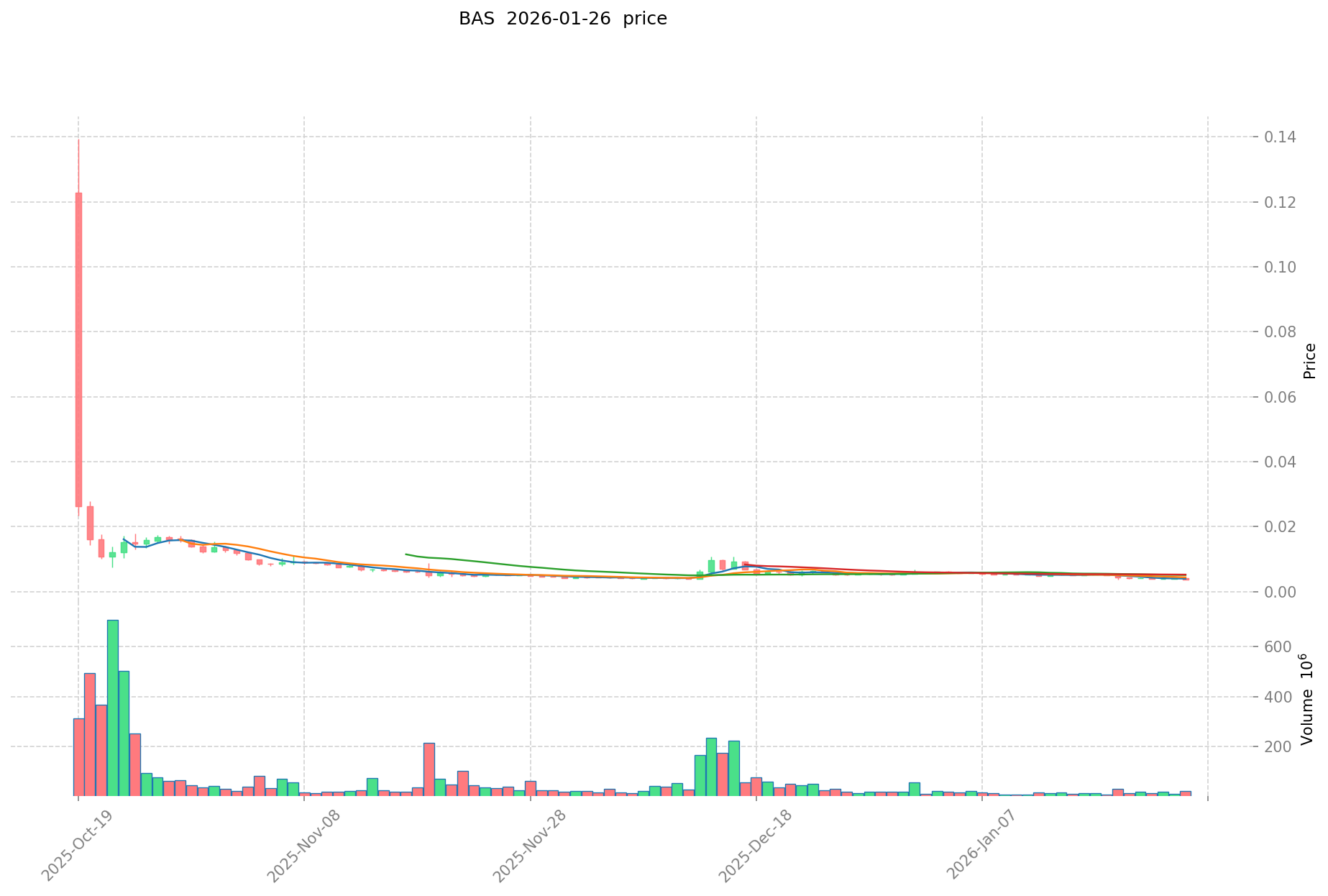
- 2025: BAS experienced significant volatility during its initial trading period, with the token price fluctuating between $0.003613 and $0.17051
- October 2025: The token reached a notable price level of $0.17051 on October 17, 2025, reflecting early market interest in the BNB Chain verification infrastructure
- January 2026: Market conditions led to price adjustments, with the token trading around $0.003613 on January 25, 2026
Current BAS Investment Market Status (January 2026)
- BAS current price: $0.003947
- 24-hour trading volume: $132,382.36
- Circulating supply: 2,500,000,000 BAS (25% of total supply)
- Market capitalization: $9,867,500
- Token holders: 188,600 addresses
- Listed exchanges: 12 platforms
Click to view real-time BAS market price
II. Core Factors Affecting Whether BAS is a Good Investment (Is BNB Attestation Service(BAS) a Good Investment)
Supply Mechanism and Scarcity (BAS investment scarcity)
- BAS implements a fixed supply model with a maximum supply of 10 billion tokens, of which 2.5 billion tokens (25%) are currently in circulation → This supply structure may influence price dynamics and investment considerations
- The token distribution suggests a gradual release mechanism, which could potentially impact supply-demand dynamics over time
- Investment consideration: The relatively low circulation ratio of 25% indicates that future token unlocks may affect market availability
Institutional Investment and Mainstream Adoption (Institutional investment in BAS)
- BAS serves as the native verification and reputation layer on BNB Chain, enabling composable on-chain KYC, identity, and asset verification for RWA, DeFi, AI agents, and other applications
- The project has attracted approximately 188,600 token holders, suggesting a growing user base engaging with the verification infrastructure
- The integration potential with real-world assets (RWA) and decentralized finance (DeFi) applications may influence its adoption trajectory within the BNB Chain ecosystem
Macroeconomic Environment's Impact on BAS Investment
- As a utility token within the BNB Chain ecosystem, BAS may be influenced by broader cryptocurrency market conditions and regulatory developments affecting blockchain-based verification services
- Market sentiment indicators suggest neutral positioning, which may reflect the evolving nature of on-chain verification and reputation systems
- The broader adoption of blockchain-based identity solutions could influence demand patterns for verification infrastructure tokens
Technology and Ecosystem Development (Technology & Ecosystem for BAS investment)
- BAS aggregates multiple data sources including KYC data, asset proofs, on-chain behavior, social activity, and community contributions to build verifiable Human Reputation Profiles
- The composable architecture allows integration across multiple use cases including RWA verification, DeFi protocols, and AI agent authentication
- The platform's focus on identity and asset verification positions it within the expanding infrastructure layer for blockchain applications, particularly in compliance-sensitive sectors
III. BAS Future Investment Forecast and Price Outlook (Is BNB Attestation Service(BAS) worth investing in 2026-2031)
Short-term Investment Forecast (2026, short-term BAS investment outlook)
- Conservative forecast: $0.0034 - $0.0039
- Neutral forecast: $0.0039 - $0.0045
- Optimistic forecast: $0.0045 - $0.0055
Mid-term Investment Outlook (2027-2029, mid-term BNB Attestation Service(BAS) investment forecast)
-
Market stage expectation: Based on historical data, BAS may experience gradual development during this period, with price fluctuations influenced by broader market conditions and adoption rates of its verification and reputation layer services on BNB Chain.
-
Investment return forecast:
- 2027: $0.0025 - $0.0064
- 2028: $0.0049 - $0.0080
- 2029: $0.0049 - $0.0091
-
Key catalysts: Expansion of on-chain KYC and identity verification adoption, integration with RWA and DeFi protocols, growth in BNB Chain ecosystem activity, and increased demand for reputation-based solutions.
Long-term Investment Outlook (Is BAS a good long-term investment?)
- Base scenario: $0.0059 - $0.0079 (assuming steady ecosystem development and maintained market position)
- Optimistic scenario: $0.0082 - $0.0115 (assuming accelerated adoption of verification services and favorable market conditions)
- Risk scenario: Below $0.0034 (under adverse market conditions or reduced adoption rates)
View BAS long-term investment and price forecast: Price Prediction
2026-01-26 - 2031 Long-term Outlook
- Base scenario: $0.0059 - $0.0079 USD (corresponding to steady progress and gradual mainstream application growth)
- Optimistic scenario: $0.0082 - $0.0115 USD (corresponding to large-scale adoption and favorable market environment)
- Transformative scenario: Above $0.0115 USD (if ecosystem achieves breakthrough developments and mainstream adoption)
- 2031-12-31 forecast high: $0.0115 USD (based on optimistic development assumptions)
Disclaimer: These forecasts are for reference purposes only and do not constitute investment advice. Cryptocurrency markets are highly volatile, and past performance does not guarantee future results. Investors should conduct their own research and consider their risk tolerance before making investment decisions.
| Year |
Predicted High Price |
Predicted Average Price |
Predicted Low Price |
Price Change |
| 2026 |
0.005509 |
0.003935 |
0.0033841 |
0 |
| 2027 |
0.00642192 |
0.004722 |
0.00250266 |
19 |
| 2028 |
0.0079679028 |
0.00557196 |
0.0049033248 |
41 |
| 2029 |
0.009071708076 |
0.0067699314 |
0.004874350608 |
71 |
| 2030 |
0.00855448531704 |
0.007920819738 |
0.00586140660612 |
100 |
| 2031 |
0.011532713538528 |
0.00823765252752 |
0.004860214991236 |
108 |
IV. BAS Investment Strategy and Risk Management (How to invest in BAS)
Investment Methodology (BAS investment strategy)
Long-term Holding (HODL BAS): Suitable for Conservative Investors
For investors with a long-term perspective, holding BAS may align with belief in the development of verification and reputation infrastructure on BNB Chain. This approach requires patience and tolerance for market fluctuations, as BAS has experienced notable price volatility since its launch in January 2025.
Active Trading: Relying on Technical Analysis and Swing Operations
Active traders may seek opportunities through technical analysis of BAS price movements. With a 24-hour trading volume of approximately $132,382 and recent price ranges between $0.003613 and $0.004063, short-term trading strategies require careful consideration of liquidity conditions and market depth across the 12 exchanges where BAS is listed.
Risk Management (Risk management for BAS investment)
Asset Allocation Ratio: Conservative / Aggressive / Professional Investors
- Conservative investors: May consider limiting BAS exposure to 1-3% of total crypto portfolio, given the token's early stage and price volatility
- Aggressive investors: Could allocate 5-10% while maintaining awareness of downside risks
- Professional investors: May conduct deeper due diligence on BAS's verification infrastructure and reputation system before determining appropriate position sizing
Diversification across different crypto categories (such as established layer-1 protocols, DeFi tokens, and infrastructure projects) may help mitigate concentration risk. For BAS specifically, investors should consider its correlation with BNB Chain ecosystem performance and broader market movements.
Secure Storage: Hot and Cold Wallets + Hardware Wallet Recommendations
As a BEP-20 token on BSC, BAS can be stored in:
- Hardware wallets: Ledger and Trezor devices supporting BSC network
- Cold storage: For long-term holdings exceeding trading needs
- Hot wallets: MetaMask and Trust Wallet for active trading, keeping only necessary amounts
Contract address verification is essential: 0x0f0df6cb17ee5e883eddfef9153fc6036bdb4e37
V. BAS Investment Risks and Challenges (Risks of investing in BAS)
Market Risk: High Volatility and Potential Price Manipulation
BAS has demonstrated substantial price volatility, with recent performance showing:
- 7-day decline: -10.36%
- 30-day decline: -26.33%
- Price range from historical low of $0.003613 (January 25, 2026) to high of $0.17051 (October 17, 2025)
With a relatively modest market capitalization of approximately $9.87 million and holder count of 188,600, the token may be susceptible to price swings from large transactions or coordinated trading activities.
Regulatory Risk: Policy Uncertainty Across Different Jurisdictions
KYC and identity verification services occupy a sensitive position in regulatory frameworks globally. BAS's focus on composable on-chain KYC and identity verification may face evolving compliance requirements as different jurisdictions develop clearer guidelines for blockchain-based identity solutions. Changes in data privacy regulations or KYC standards could impact BAS's utility and adoption trajectory.
Technical Risk: Network Security Vulnerabilities and Upgrade Failures
As infrastructure built on BNB Chain, BAS inherits both the benefits and potential risks of the underlying blockchain. Technical considerations include:
- Smart contract security of the BAS protocol
- Dependencies on BNB Chain's operational stability
- Integration risks with RWA, DeFi, and AI agent applications
- Potential vulnerabilities in verification and reputation mechanisms
The early-stage nature of the project (launched January 2025) means that the verification infrastructure is still maturing, and unforeseen technical challenges may emerge during scaling.
VI. Conclusion: Is BAS a Good Investment?
Investment Value Summary
BAS represents an infrastructure play on verification and reputation systems within the BNB Chain ecosystem. While the project addresses relevant use cases in KYC, identity verification, and reputation building across RWA, DeFi, and AI agents, the token has experienced considerable price volatility since launch. The current market capitalization of $9.87 million and circulating supply of 25% suggest early-stage development with corresponding uncertainties.
Investor Recommendations
✅ Beginners: Consider dollar-cost averaging with small allocations if interested in verification infrastructure. Prioritize secure storage using hardware wallets or reputable software wallets supporting BSC.
✅ Experienced Investors: May explore swing trading opportunities while maintaining strict risk management. Portfolio allocation should reflect BAS's volatility profile and early-stage nature.
✅ Institutional Investors: Conduct thorough due diligence on BAS's verification technology, adoption metrics, and competitive positioning before considering strategic allocation.
⚠️ Disclaimer: Cryptocurrency investment carries substantial risk. This content is for informational purposes only and does not constitute investment advice. Investors should conduct independent research and consider their risk tolerance before making investment decisions.
VII. FAQ
Q1: What is BNB Attestation Service (BAS) and what problem does it solve?
BAS is the native verification and reputation layer on BNB Chain that provides composable on-chain KYC, identity verification, and asset attestation services. It addresses the critical challenge of establishing verifiable human reputation profiles by aggregating KYC data, asset proofs, on-chain behavior, social activity, and community contributions. This infrastructure enables applications in Real World Assets (RWA), DeFi, and AI agents to implement compliance-ready verification systems while maintaining blockchain's decentralized nature. The platform serves as essential infrastructure for projects requiring identity verification without compromising user sovereignty.
Q2: Is BAS a good investment for beginners in 2026?
BAS may be considered a high-risk, speculative investment for beginners due to its significant price volatility and early-stage nature. Since its launch in January 2025, the token has experienced substantial price fluctuations ranging from $0.003613 to $0.17051, with recent 30-day performance showing a -26.33% decline. Beginners considering BAS should limit exposure to 1-3% of their total crypto portfolio, employ dollar-cost averaging strategies, and prioritize secure storage using hardware wallets. The modest market capitalization of $9.87 million and relatively low liquidity make it unsuitable for risk-averse investors seeking stability.
Q3: What are the primary factors affecting BAS's investment value?
Four core factors influence BAS's investment value: (I) Supply scarcity—with only 25% of the 10 billion total supply currently circulating, future token unlocks may impact price dynamics; (II) Ecosystem adoption—BAS's utility depends on integration with RWA, DeFi, and AI agent applications on BNB Chain; (III) Regulatory environment—evolving compliance requirements for blockchain-based KYC and identity solutions may affect demand; (IV) Technical development—the maturity and security of BAS's verification infrastructure and reputation mechanisms will determine long-term viability. Market sentiment currently shows neutral positioning, reflecting the nascent state of on-chain verification markets.
Q4: What is the price forecast for BAS from 2026 to 2031?
Price projections suggest varied scenarios based on adoption trajectories: For 2026, conservative forecasts range from $0.0034-$0.0039, neutral forecasts $0.0039-$0.0045, and optimistic scenarios $0.0045-$0.0055. Mid-term outlook (2027-2029) anticipates gradual development with prices between $0.0025-$0.0091 depending on market conditions and verification service adoption rates. Long-term forecasts (2030-2031) range from a base scenario of $0.0059-$0.0079 to an optimistic scenario of $0.0082-$0.0115, with 2031 predicted high reaching $0.0115 under favorable conditions. These forecasts assume continued ecosystem development and increased demand for reputation-based solutions but remain subject to significant market volatility and adoption uncertainties.
Q5: How should investors manage risks when investing in BAS?
Risk management for BAS requires multi-layered approaches: (I) Position sizing—conservative investors should limit BAS to 1-3% of crypto portfolios, while aggressive investors may allocate 5-10% with strict stop-loss parameters; (II) Diversification—maintain exposure across established protocols, DeFi tokens, and infrastructure projects to mitigate concentration risk; (III) Secure storage—utilize hardware wallets (Ledger/Trezor) for long-term holdings and verified hot wallets (MetaMask/Trust Wallet) with contract address 0x0f0df6cb17ee5e883eddfef9153fc6036bdb4e37 for active trading; (IV) Market monitoring—track BNB Chain ecosystem developments, regulatory changes affecting KYC services, and technical updates to the verification infrastructure. Investors should remain cognizant of BAS's early-stage status and historical volatility when establishing risk parameters.
Q6: What are the main investment risks associated with BAS?
Three primary risks characterize BAS investment: (I) Market volatility—with a modest $9.87 million market cap and recent 30-day decline of -26.33%, BAS experiences substantial price swings that may be amplified by low liquidity and potential large-holder activities; (II) Regulatory uncertainty—as BAS focuses on composable on-chain KYC and identity verification, evolving data privacy regulations and compliance requirements across jurisdictions may impact utility and adoption; (III) Technical vulnerabilities—early-stage infrastructure carries risks including smart contract security concerns, BNB Chain dependency, integration challenges with RWA/DeFi/AI applications, and potential flaws in verification mechanisms. The project's launch in January 2025 means the verification infrastructure remains in maturation phase with unforeseen challenges possible during scaling.
Q7: Where can investors buy and store BAS tokens securely?
BAS tokens are available on 12 cryptocurrency exchanges, with investors able to purchase through platforms supporting BEP-20 tokens on Binance Smart Chain. For secure storage, investors should employ: (I) Hardware wallets—Ledger and Trezor devices configured for BSC network provide cold storage for long-term holdings; (II) Software wallets—MetaMask and Trust Wallet support BAS trading while maintaining reasonable security for active positions; (III) Exchange wallets—suitable only for immediate trading purposes, not recommended for storage due to security risks. When adding BAS to wallets, investors must verify the official contract address (0x0f0df6cb17ee5e883eddfef9153fc6036bdb4e37) to avoid fraudulent tokens. Security best practices include enabling two-factor authentication, maintaining updated software, and never sharing private keys or seed phrases.
Q8: Is BAS suitable for long-term holding or short-term trading?
BAS suitability depends on investor profile and strategy: Long-term holding may appeal to investors believing in verification infrastructure development on BNB Chain, requiring patience for market fluctuations and tolerance for the 25% circulating supply potentially affecting future price dynamics. This approach aligns with conservative 3-5 year horizons targeting the $0.0059-$0.0115 range by 2031 under favorable adoption scenarios. Short-term trading suits experienced investors leveraging technical analysis, with $132,382 daily trading volume providing moderate liquidity for swing operations within recent $0.003613-$0.004063 ranges. However, limited liquidity across 12 exchanges requires careful attention to market depth and slippage. Neither strategy eliminates substantial downside risks given BAS's early-stage nature and demonstrated volatility patterns since launch.
* The information is not intended to be and does not constitute financial advice or any other recommendation of any sort offered or endorsed by Gate.