This comprehensive guide evaluates whether Bifrost (BNC) represents a viable investment opportunity for 2024 and beyond. BNC operates as a cross-chain liquidity staking infrastructure within the Polkadot ecosystem, enabling users to convert PoS tokens into liquid staking derivatives (vTokens) while maintaining DeFi participation. With institutional backing from NGC Ventures, Web3 Foundation support, and availability on Gate exchange, BNC currently trades at $0.0552 with a market cap of $2.18 million. The article analyzes historical price trends, supply mechanics, technological foundations, and provides price forecasts ranging from $0.0392 to $0.0729 for 2026. It explores investment strategies across risk levels, addresses technical and regulatory risks including market volatility and cross-chain security concerns, and delivers actionable recommendations for beginners through institutional investors seeking exposure to liquid staking derivatives.
Introduction: Bifrost (BNC) Investment Position and Market Outlook
BNC represents a significant asset in the cryptocurrency field, having been launched in October 2021 as part of the Polkadot ecosystem. The project operates as a decentralized cross-chain liquidity staking parachain, supporting derivatives across multiple blockchains. As of February 2026, BNC maintains a market capitalization of approximately $2.18 million, with a circulating supply of around 39.48 million tokens and a current price of $0.0552. With its positioning as an "Omnichain LSD Layer1" infrastructure, BNC has gradually become a focal point for investors exploring opportunities in liquid staking derivatives. The token has been supported by institutional investors including NGC Ventures, SNZ Holding, DFG, and CMS, and received grants from the Web3 Foundation. With approximately 3,546 holders and availability on 6 exchanges, BNC demonstrates modest but established market presence. This article comprehensively analyzes BNC's investment characteristics, historical performance, future price considerations, and associated risks to provide reference for investors examining the question "Is Bifrost (BNC) a good investment?"
I. Bifrost (BNC) Historical Price Review and Current Investment Value
- 2021: BNC reached a notable price level during the broader cryptocurrency market expansion → the token traded at elevated valuations reflecting strong market sentiment
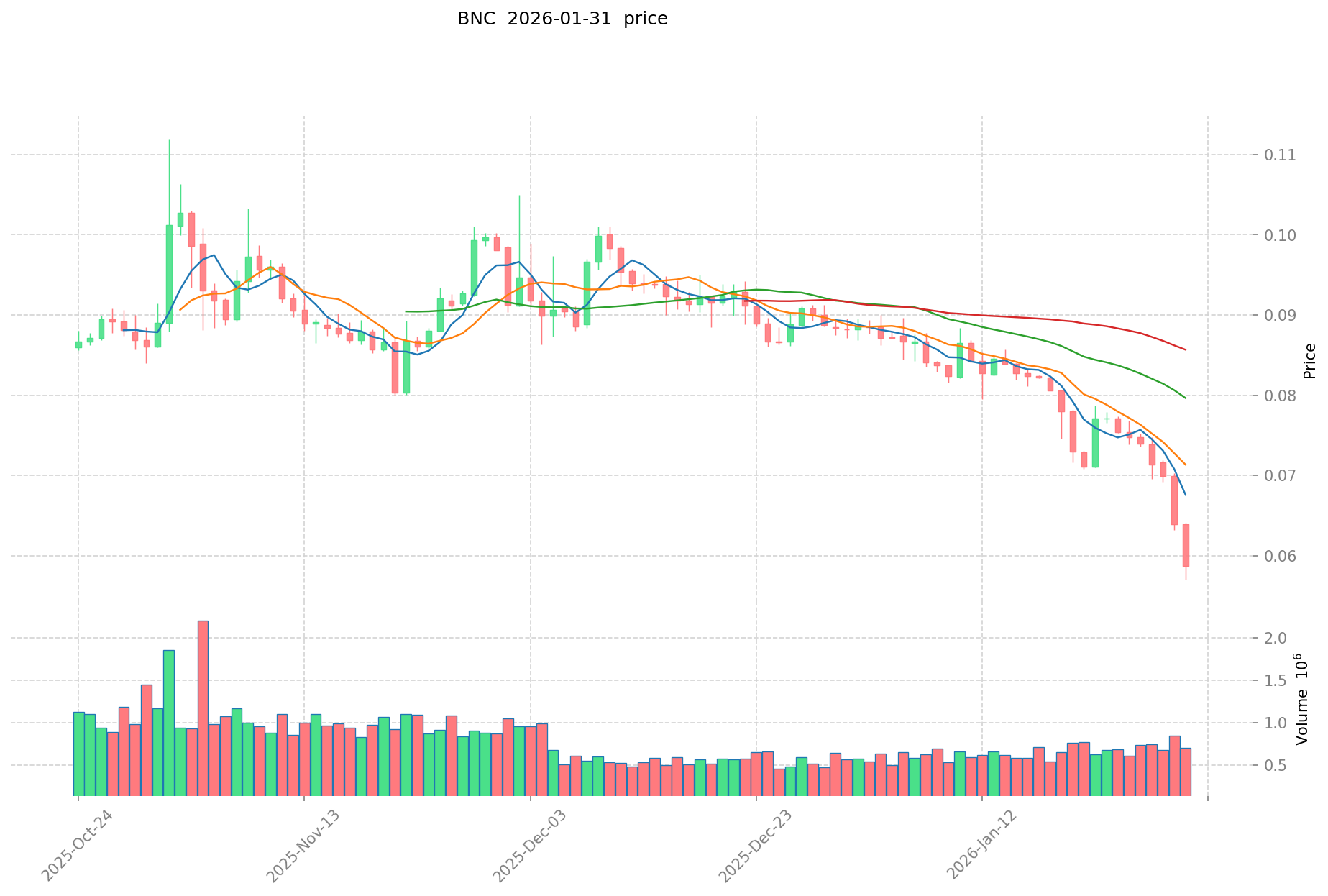
- 2023-2024: The token experienced substantial price adjustments amid shifting market conditions → BNC declined from higher price levels to lower ranges as market dynamics evolved
- 2025-2026: Market volatility continued with the token trading near lower price ranges → price movements reflected ongoing market uncertainty and sector-wide adjustments
Current BNC Investment Market Status (February 2026)
- Current BNC Price: $0.0552
- 24-Hour Trading Volume: $48,397.83
- Circulating Supply: 39,478,948.62 BNC
- Market Capitalization: $2,179,237.96
- Market Cap to Fully Diluted Valuation Ratio: 49.35%
- Total Supply: 80,000,000 BNC
- Exchange Listings: 6 exchanges
- Token Holders: 3,546 addresses
View real-time BNC market price
II. Core Factors Affecting Whether BNC is a Good Investment (Is Bifrost (BNC) a Good Investment)
Supply Mechanism and Scarcity (BNC investment scarcity)
- Maximum supply capped at 80,000,000 BNC tokens → influences price and investment value through supply constraints
- Current circulating supply stands at approximately 39,478,948 tokens, representing around 49.35% of the maximum supply
- Investment significance: controlled token release schedule may support long-term investment considerations
Institutional Investment and Mainstream Adoption (Institutional investment in BNC)
- Financial backing received from institutions including NGC Ventures, SNZ Holding, DFG, CMS, Hypersphere Ventures, Longhash Ventures, Consensus Lab, Digital Renaissance, Liebi, and Youbi Capital
- Project has received grants from Web3 Foundation and maintains membership in Substrate Builders Program and Web3 Bootcamp
- Current holder count reaches 3,546 addresses, indicating a developing user base
- Available on 6 exchanges, suggesting gradual market adoption
Macroeconomic Environment Impact on BNC Investment
- Trading volume over 24 hours recorded at $48,397.83, reflecting current market liquidity conditions
- Market capitalization of approximately $2.18 million represents 0.00016% market share in the broader crypto ecosystem
- Price volatility observed across different timeframes: -0.13% (1H), -6.09% (24H), -27.16% (7D), -37.58% (30D), and -72.72% (1Y)
Technology and Ecosystem Development (Technology & Ecosystem for BNC investment)
- Operates as a Polkadot parachain project focused on cross-chain liquidity staking infrastructure
- vToken mechanism allows conversion of PoS tokens into liquid staking derivatives (e.g., DOT to vDOT)
- Supports liquidity derivatives across over 9 blockchains, expanding cross-chain functionality
- Security model leverages Polkadot's shared security framework through relay chain integration
- Transparent on-chain governance structure allows democratic parameter adjustments
- DeFi application focus: enables users to maintain staking rewards while retaining token liquidity for use in decentralized applications and exchanges
III. BNC Future Investment Forecast and Price Outlook (Is Bifrost (BNC) worth investing in 2026-2031)
Short-term Investment Forecast (2026, short-term BNC investment outlook)
- Conservative forecast: $0.0392 - $0.0552
- Neutral forecast: $0.0552 - $0.0640
- Optimistic forecast: $0.0640 - $0.0729
Mid-term Investment Outlook (2027-2029, mid-term Bifrost (BNC) investment forecast)
- Market stage expectation: BNC is anticipated to enter a gradual recovery phase during this period, supported by ecosystem development within the Polkadot parachain environment and broader DeFi adoption trends.
- Investment return forecast:
- 2027: $0.0538 - $0.0813
- 2028: $0.0683 - $0.1069
- 2029: $0.0781 - $0.1113
- Key catalysts: Expansion of cross-chain liquidity staking functionality, growing adoption of vTokens in DeFi protocols, continued support from Web3 Foundation and strategic partnerships, broader Polkadot ecosystem growth, and potential increases in staking participation rates.
Long-term Investment Outlook (Is BNC a good long-term investment?)
- Base scenario: $0.0563 - $0.1327 (assuming steady ecosystem growth and sustained adoption of liquid staking derivatives across supported chains)
- Optimistic scenario: $0.1166 - $0.1691 (assuming accelerated adoption of Bifrost's cross-chain staking solutions, expanded integration with major DeFi platforms, and favorable market conditions for Polkadot parachains)
- Risk scenario: Below $0.0392 (under conditions of prolonged market downturn, reduced staking demand, or significant competitive pressure from alternative liquid staking protocols)
View BNC long-term investment and price forecast: Price Prediction
2026-2031 Long-term Outlook
- Base scenario: $0.0563 - $0.1327 (corresponding to steady progress and gradual mainstream application growth)
- Optimistic scenario: $0.1166 - $0.1691 (corresponding to large-scale adoption and favorable market environment)
- Transformative scenario: Above $0.1691 (in case of breakthrough ecosystem developments and mainstream penetration)
- 2031-12-31 forecast high: $0.1691 (based on optimistic development assumptions)
Disclaimer: This forecast is based on historical data and market analysis models and does not constitute investment advice. Cryptocurrency markets are highly volatile and subject to various risks. Investors should conduct independent research and consider their risk tolerance before making investment decisions.
| Year |
Predicted High Price |
Predicted Average Price |
Predicted Low Price |
Price Change |
| 2026 |
0.0728772 |
0.05521 |
0.0391991 |
0 |
| 2027 |
0.081335372 |
0.0640436 |
0.053796624 |
16 |
| 2028 |
0.10685354442 |
0.072689486 |
0.06832811684 |
31 |
| 2029 |
0.1113166788604 |
0.08977151521 |
0.0781012182327 |
62 |
| 2030 |
0.132718208086464 |
0.1005440970352 |
0.056304694339712 |
82 |
| 2031 |
0.169115171213206 |
0.116631152560832 |
0.066479756959674 |
111 |
IV. BNC Investment Strategy and Risk Management (How to invest in crypto assets)
Investment Methodology (BNC investment strategy)
-
Long-term Holding (HODL BNC): Suitable for conservative investors
Long-term holding may be appropriate for investors who believe in Bifrost's vision of providing cross-chain liquidity staking infrastructure across multiple PoS blockchains. This approach focuses on the project's fundamental development rather than short-term price movements.
-
Active Trading: Relies on technical analysis and swing trading operations
Active traders may utilize technical indicators and market trend analysis to capitalize on BNC's price fluctuations. Given the token's volatility characteristics, this approach requires continuous market monitoring and risk assessment capabilities.
Risk Management (Risk management for BNC investment)
-
Asset Allocation Ratio: Conservative, aggressive, and professional investors
- Conservative investors: Consider allocating a minimal portion (under 5%) of crypto portfolio to BNC
- Aggressive investors: May allocate a moderate portion (5-15%) depending on risk tolerance
- Professional investors: Can consider strategic allocations based on comprehensive analysis and portfolio diversification
-
Risk Hedging Solutions: Multi-asset portfolio and hedging instruments
Investors may consider diversifying across different blockchain ecosystem tokens, stablecoin positions, and various DeFi protocols to mitigate concentration risk. Portfolio construction should account for correlation with broader crypto market movements.
-
Secure Storage: Hot and cold wallets, hardware wallet recommendations
For BNC token storage, users can consider:
- Cold wallets for long-term holdings to minimize online exposure
- Hot wallets for active trading with appropriate security measures
- Hardware wallet solutions for enhanced security of significant holdings
- Multi-signature configurations for institutional-grade security requirements
V. BNC Investment Risks and Challenges (Risks of investing in crypto assets)
-
Market Risk: High volatility and price manipulation concerns
BNC has demonstrated significant price volatility, with recorded fluctuations of -0.13% (1H), -6.09% (24H), -27.16% (7D), -37.58% (30D), and -72.72% (1Y). The relatively lower market capitalization and trading volume may contribute to increased susceptibility to price swings. Market liquidity conditions can affect the ability to execute trades at desired price levels.
-
Regulatory Risk: Policy uncertainty across different jurisdictions
As a cross-chain liquidity staking protocol operating within the Polkadot ecosystem, Bifrost may face evolving regulatory frameworks regarding staking derivatives, DeFi protocols, and cross-chain operations. Different jurisdictions maintain varying approaches to crypto asset classification and compliance requirements, which could impact project operations and token utility.
-
Technical Risk: Network security vulnerabilities and upgrade failures
As a parachain project relying on Polkadot's shared security model, BNC faces technical considerations including:
- Smart contract vulnerabilities in staking derivative mechanisms
- Cross-chain bridge security considerations across the 9+ supported blockchains
- Potential issues during protocol upgrades or parachain slot renewals
- Dependencies on underlying blockchain infrastructure and validator network stability
VI. Conclusion: Is Crypto Assets a Good Investment?
-
Investment Value Summary: BNC presents potential opportunities within the liquid staking derivatives sector, though it carries significant short-term price volatility characteristics.
Bifrost operates as infrastructure for cross-chain liquidity staking across multiple PoS blockchains within the Polkadot ecosystem. The project has received support from various venture organizations and maintains partnerships within the Web3 development community. However, investment consideration should account for market positioning, competitive landscape, and ongoing technical development progress.
-
Investor Recommendations:
✅ Beginners: Dollar-cost averaging approach combined with secure wallet storage practices
New investors should focus on understanding the project fundamentals, starting with smaller position sizes, and utilizing secure storage solutions. Educational resources about liquid staking mechanisms and Polkadot ecosystem dynamics can provide foundational knowledge.
✅ Experienced Investors: Swing trading operations with diversified portfolio configuration
Those with market experience may explore tactical allocation strategies based on technical analysis, market cycles, and ecosystem developments. Portfolio diversification across different blockchain infrastructure and DeFi categories can help manage exposure.
✅ Institutional Investors: Strategic long-term allocation considerations
Institutional participants may evaluate BNC within broader liquid staking derivative exposure, assessing factors such as protocol governance, validator network distribution, and cross-chain infrastructure development roadmaps.
⚠️ Disclaimer: Cryptocurrency investments involve substantial risks. This content is provided for informational purposes only and does not constitute investment advice. Investors should conduct independent research and consider their financial circumstances before making investment decisions.
VII. FAQ
Q1: Is Bifrost (BNC) a good investment for beginners in 2026?
BNC may be suitable for beginners who understand the risks associated with highly volatile crypto assets and are willing to invest only what they can afford to lose. The token currently trades at $0.0552 with a relatively small market capitalization of $2.18 million, which indicates significant volatility potential. For new investors, a dollar-cost averaging approach with conservative position sizing (under 5% of crypto portfolio) is recommended. Beginners should first educate themselves about liquid staking derivatives, the Polkadot ecosystem, and secure storage practices before considering BNC investment. The project's backing by institutions like NGC Ventures and Web3 Foundation grants provide some credibility, but the -72.72% price decline over the past year demonstrates substantial downside risks that require careful consideration.
Q2: What is the expected BNC price range for 2026-2027?
Based on current market analysis, BNC price forecasts for 2026 range from $0.0392 (conservative) to $0.0729 (optimistic), with a neutral expectation around $0.0552-$0.0640. For 2027, projections suggest a potential range of $0.0538-$0.0813, representing an estimated 16% average increase from 2026 levels. These forecasts assume gradual ecosystem development within the Polkadot parachain environment and growing adoption of cross-chain liquidity staking solutions. However, these predictions are subject to numerous variables including broader crypto market conditions, competitive dynamics in the liquid staking sector, and Bifrost's execution of technical roadmap milestones. Investors should note that cryptocurrency price forecasts carry inherent uncertainty and should not be relied upon as guaranteed outcomes.
Q3: What are the main risks of investing in BNC?
BNC investment involves three primary risk categories. First, market risk is substantial, evidenced by recent volatility metrics showing -37.58% decline over 30 days and -72.72% over one year, with relatively low trading volume of $48,397.83 that may amplify price swings. Second, regulatory risk stems from evolving global frameworks around staking derivatives and DeFi protocols, which could impact BNC's cross-chain operations across 9+ supported blockchains. Third, technical risk includes smart contract vulnerabilities in the vToken mechanism, cross-chain bridge security considerations, dependencies on Polkadot's shared security model, and potential complications during parachain slot renewals or protocol upgrades. Additionally, the project's relatively small holder base of 3,546 addresses and limited exchange listings (6 platforms) present liquidity constraints that could affect the ability to enter or exit positions at desired prices.
Q4: How does Bifrost's vToken mechanism work and why does it matter for investment?
The vToken mechanism converts Proof-of-Stake tokens into liquid staking derivatives (for example, DOT becomes vDOT), allowing token holders to maintain staking rewards while simultaneously using their assets in DeFi applications and exchanges. This innovation addresses the traditional trade-off between staking rewards and liquidity, creating utility value for BNC within the broader ecosystem. From an investment perspective, this mechanism is significant because it establishes use cases that could drive demand for the platform as liquid staking adoption grows. The ability to provide staking derivatives across 9+ blockchains positions Bifrost as cross-chain infrastructure rather than a single-chain solution. However, investment value depends on actual adoption rates, competition from alternative liquid staking protocols, and the overall growth of the PoS staking market. Investors should monitor metrics such as total value locked (TVL) in vTokens and integration partnerships with major DeFi platforms as indicators of mechanism adoption.
Q5: What institutional backing does BNC have and why is this important?
Bifrost has received financial support from multiple institutional investors including NGC Ventures, SNZ Holding, DFG, CMS, Hypersphere Ventures, Longhash Ventures, Consensus Lab, Digital Renaissance, Liebi, and Youbi Capital. Additionally, the project has secured grants from the Web3 Foundation and participates in the Substrate Builders Program and Web3 Bootcamp. This institutional backing matters for several reasons: it provides financial resources for ongoing development, validates the project's technical approach and market potential through third-party due diligence, offers strategic guidance and industry connections, and potentially indicates longer-term commitment to the project's success. However, institutional investment alone does not guarantee positive returns or project success. The current market capitalization of only $2.18 million despite these institutional relationships suggests that broader market adoption remains limited. Investors should view institutional backing as one factor among many when evaluating BNC, rather than as a definitive indicator of investment quality.
Q6: How does BNC compare to other liquid staking derivative projects?
While specific comparative data is not provided in the reference materials, BNC distinguishes itself through several characteristics: its operation as a Polkadot parachain project leveraging Polkadot's shared security model, support for cross-chain liquidity derivatives across 9+ blockchains rather than focusing on a single chain, and integration within the broader Polkadot ecosystem. From an investment perspective, this positioning presents both opportunities and challenges. The cross-chain approach offers diversification potential and broader addressable market, but also faces competition from established protocols like Lido Finance, Rocket Pool, and others that have achieved significantly larger market capitalizations and user bases. BNC's current market cap of $2.18 million is substantially smaller than major liquid staking protocols, indicating either significant growth potential or meaningful challenges in gaining market share. Investors should research competing projects' TVL, user adoption rates, blockchain support, and fee structures to contextualize BNC's competitive position before making investment decisions.
Q7: What storage options are recommended for holding BNC tokens?
For BNC token storage, security considerations should align with investment horizon and portfolio size. Cold wallets (offline storage solutions) are recommended for long-term holdings to minimize exposure to online vulnerabilities, particularly for significant positions. Hot wallets may be suitable for active traders who require frequent transaction capability, though they should implement appropriate security measures including strong passwords, two-factor authentication, and regular security audits. Hardware wallet solutions offer enhanced security for substantial holdings by keeping private keys in isolated hardware devices. For institutional-grade security requirements, multi-signature wallet configurations can provide additional protection through distributed signing authority. Investors should avoid keeping substantial amounts on exchange platforms for extended periods, as this exposes assets to exchange-related risks including hacking, insolvency, or operational issues. Regardless of storage method chosen, maintaining secure backup procedures for recovery phrases and private keys is essential for long-term asset protection.
Q8: What catalysts could drive BNC price appreciation in 2027-2029?
Several potential catalysts could influence BNC's mid-term price trajectory. Expansion of cross-chain liquidity staking functionality to additional blockchain networks beyond the current 9+ supported chains could broaden the addressable market and user base. Growing adoption of vTokens within major DeFi protocols for use in lending platforms, decentralized exchanges, and yield farming applications would increase utility and demand. Continued support and additional grants from the Web3 Foundation along with strategic partnerships within the Polkadot ecosystem could enhance development resources and market positioning. Broader Polkadot ecosystem growth and increasing parachain activity would likely benefit infrastructure projects like Bifrost. Rising staking participation rates across supported PoS blockchains, driven by network upgrades or regulatory clarity, could increase demand for liquid staking solutions. However, realization of these catalysts is uncertain and subject to competitive dynamics, technical execution capabilities, and broader market conditions. Investors should monitor development updates, partnership announcements, and on-chain metrics to assess progress toward these potential catalysts.
* The information is not intended to be and does not constitute financial advice or any other recommendation of any sort offered or endorsed by Gate.