This comprehensive guide evaluates Boba Network (BOBA), an Ethereum Layer 2 scaling solution utilizing Optimistic Rollup technology. Currently trading at $0.03988 with a market cap of $19.68 million, BOBA serves governance functions within the Boba DAO while offering innovative features like fast exit mechanisms reducing withdrawal times from seven days to minutes. The article examines historical price performance, showing an 78.91% annual decline, alongside technical infrastructure and ecosystem development potential. Investment analysis covers multiple scenarios, with 2026-2031 price predictions ranging from conservative ($0.0271-$0.0398) to optimistic ($0.0811-$0.0969) forecasts. Strategic recommendations address diverse investor profiles through dollar-cost averaging, active trading, and proper risk management including diversification and secure storage on Gate. Critical risk factors include market volatility, regulatory uncertainty, technical vulnerabilities, and Layer 2 competition, requiring careful d
Introduction: Boba Network (BOBA) Investment Position and Market Outlook
Boba Network (BOBA) represents a Layer 2 Ethereum scaling solution developed by the Enya team as core contributors to the OMG Foundation. As of January 23, 2026, BOBA is priced at approximately $0.03988, with a market capitalization of around $19.68 million and a circulating supply of approximately 493.60 million tokens. The token holds a market ranking of 893, with a circulating supply ratio of 98.72% relative to its maximum supply of 500 million tokens.
BOBA's technical infrastructure focuses on Optimistic Rollup technology, which aims to reduce gas fees, enhance transaction throughput, and expand smart contract capabilities within the Ethereum ecosystem. The network features community-driven liquidity pools designed to facilitate faster exit mechanisms, reducing withdrawal periods from seven days to minutes. The token serves governance functions within the Boba DAO, where holders can participate in proposal submissions, voting, and vote delegation according to governance guidelines.
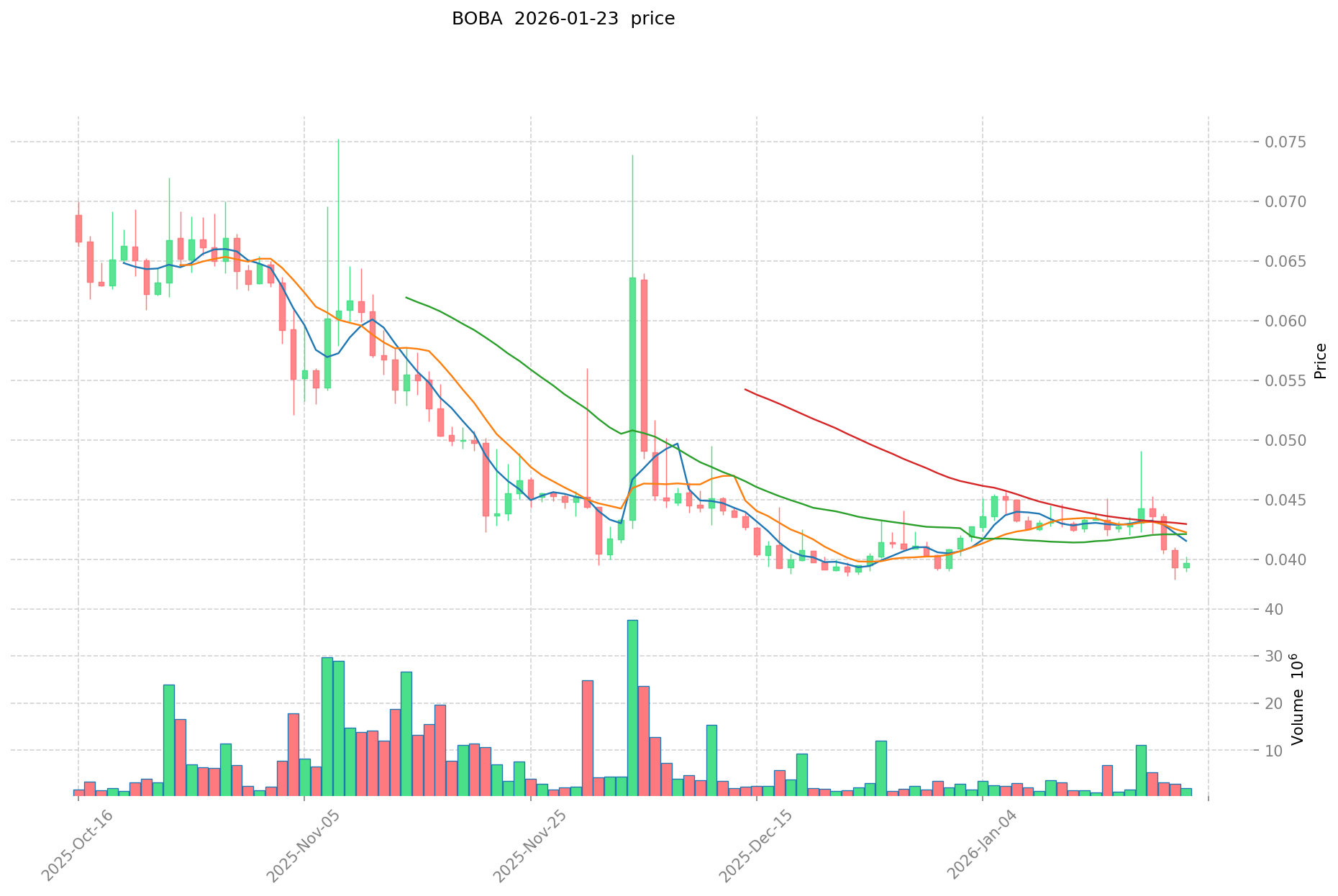
Recent price performance shows a 24-hour change of -0.07%, with a 7-day decline of 6.47%, while the 30-day trend indicates a gain of 2.52%. The annual performance reflects a decrease of 78.91%. The token trades on 12 exchanges and has approximately 11,979 holders. The 24-hour trading volume stands at around $67,381.64. This article provides an analysis of BOBA's investment characteristics, historical trends, potential price trajectories, and associated risk factors for reference purposes.
I. Boba Network (BOBA) Historical Price Review and Current Investment Value
- November 2021: BOBA reached a notable price level of $7.93 during the broader cryptocurrency market expansion, representing a period of heightened market interest in Layer 2 scaling solutions
- January 2022 - January 2026: The token experienced a substantial price correction during the extended cryptocurrency market downturn, with the price declining to $0.03839995 by January 22, 2026
- 2025-2026: Over the past year, BOBA demonstrated a price decline of approximately 78.91%, reflecting the challenging market conditions faced by many Layer 2 projects
Current BOBA Investment Market Status (January 2026)
- BOBA current price: $0.03988 (as of January 23, 2026)
- Market emotion (Fear & Greed Index): Data not available in provided materials
- 24-hour trading volume: $67,381.64
- Institutional investor holdings: Data not available in provided materials
- Market capitalization: $19,684,740.32 with a circulating supply of 493,599,306 BOBA tokens
- Circulating supply ratio: 98.72% of the maximum supply of 500,000,000 tokens
- Token holders: 11,979 addresses
- Listed on 12 exchanges
Click to view real-time BOBA market price
II. Core Factors Affecting Whether BOBA is a Good Investment (Is Boba Network(BOBA) a Good Investment)
Supply Mechanism and Scarcity (BOBA investment scarcity)
- Fixed Supply Model → Impacts Price and Investment Value
- Boba Network has a maximum supply of 500,000,000 BOBA tokens, with approximately 493,599,306 tokens currently in circulation, representing a circulating ratio of 98.72%.
- The near-complete circulation of tokens suggests limited additional supply pressure, which may contribute to price stability under sustained demand conditions.
- Historical Context: BOBA Price Fluctuations
- The token experienced significant price volatility, with its all-time high recorded at $7.93 on November 26, 2021, and its all-time low at $0.03839995 on January 22, 2026.
- As of January 23, 2026, BOBA is trading at $0.03988, reflecting a decline of approximately 78.91% over the past year.
- Investment Implications: Scarcity as a Long-Term Support Factor
- The fixed supply cap may provide structural scarcity, which could support long-term investment value if network adoption and utility expand.
- However, current price levels near historical lows suggest that scarcity alone may not be sufficient without corresponding demand growth.
Institutional Investment and Mainstream Adoption (Institutional investment in BOBA)
- Token Holder Distribution
- Boba Network currently has approximately 11,979 token holders, indicating a relatively modest holder base compared to larger blockchain ecosystems.
- Ecosystem Positioning and Utility
- BOBA serves as the governance token for Boba DAO, enabling token holders to participate in community governance by submitting proposals, voting, and delegating votes based on staking activities on the Boba Network.
- Each staked BOBA token grants one vote, aligning governance influence with network participation.
Macroeconomic Environment's Impact on BOBA Investment
- Market Capitalization and Dominance
- As of January 23, 2026, Boba Network holds a market capitalization of approximately $19.68 million, representing a market dominance of 0.00062%.
- The fully diluted market cap stands at $19.94 million, with a market cap to FDV ratio of 98.72%, indicating that most tokens are already in circulation.
- Trading Activity and Liquidity
- The 24-hour trading volume is recorded at approximately $67,381.64, suggesting relatively limited trading activity compared to more established cryptocurrencies.
- BOBA is listed on 12 exchanges, providing multiple access points for investors.
- Short-Term Price Trends
- Recent price performance shows a 24-hour decrease of 0.07%, a 7-day decline of 6.47%, and a 30-day increase of 2.52%.
- The one-hour price change is minimal at -0.00069%, indicating short-term price stability.
Technology and Ecosystem Development (Technology & Ecosystem for BOBA investment)
- Layer 2 Scaling Solution
- Boba Network functions as a Layer 2 Ethereum scaling and enhancement solution developed by the Enya team as a core contributor to the OMG Foundation.
- It utilizes Optimistic Rollup technology to reduce gas fees, increase transaction throughput, and expand smart contract capabilities.
- Fast Exit Mechanism
- Boba provides a fast exit feature supported by community-driven liquidity pools, reducing the Optimistic Rollup exit period from seven days to just a few minutes.
- This mechanism offers incentivized yield farming opportunities for liquidity providers, potentially enhancing network liquidity and user experience.
- Hybrid Compute Technology
- Boba's augmented smart contracts enable developers across the Ethereum ecosystem to build dApps that call code executed on web-scale infrastructure such as AWS Lambda.
- This capability allows for the use of algorithms that are too expensive or impractical to execute on-chain, potentially expanding the range of applications and use cases.
- Governance and Community Engagement
- BOBA tokens are used for governance within the Boba DAO, facilitating community initiatives and determining the future direction of the network.
- Token holders are eligible to submit proposals, vote, and delegate votes according to governance guidelines, promoting decentralized decision-making.
- Multi-Chain Presence
- BOBA tokens are deployed on multiple blockchain networks, including Ethereum (ETH) and Boba Network's native chain (BOBAEVM), providing cross-chain accessibility and potential interoperability benefits.
III. BOBA Future Investment Prediction and Price Outlook (Is Boba Network(BOBA) worth investing in 2026-2031)
Short-term Investment Prediction (2026, short-term BOBA investment outlook)
- Conservative Forecast: $0.0271 - $0.0398
- Neutral Forecast: $0.0398 - $0.0494
- Optimistic Forecast: $0.0494 and above
Mid-term Investment Outlook (2027-2029, mid-term Boba Network(BOBA) investment forecast)
- Market Stage Expectation: BOBA may experience gradual growth during the mid-term period, influenced by developments in Layer 2 scaling solutions and broader Ethereum ecosystem adoption.
- Investment Return Prediction:
- 2027: $0.0335 - $0.0607
- 2028: $0.0500 - $0.0721
- 2029: $0.0518 - $0.0811
- Key Catalysts: Expansion of Boba Network's ecosystem partnerships, improvements in transaction throughput and gas fee optimization, and increased adoption of Optimistic Rollup technology.
Long-term Investment Outlook (Is BOBA a good long-term investment?)
- Baseline Scenario: $0.0559 - $0.0911 (assuming steady development of Layer 2 infrastructure and moderate market conditions)
- Optimistic Scenario: $0.0473 - $0.0969 (assuming enhanced ecosystem growth and favorable regulatory environment for blockchain scaling solutions)
- Risk Scenario: Below $0.0473 (under conditions of increased competition from alternative Layer 2 solutions or adverse market sentiment)
Click to view BOBA long-term investment and price prediction: Price Prediction
2026-01-23 - 2031 Long-term Outlook
- Baseline Scenario: $0.0398 - $0.0811 (corresponding to steady progress and gradual mainstream application enhancement)
- Optimistic Scenario: $0.0811 - $0.0969 (corresponding to large-scale adoption and favorable market conditions)
- Transformative Scenario: Above $0.0969 (if the ecosystem achieves breakthrough developments and mainstream popularization)
- 2031-12-31 Predicted High: $0.0969 (based on optimistic development assumptions)
Disclaimer: The above predictions are based on historical data analysis and current market trends. Cryptocurrency markets are highly volatile and subject to numerous unpredictable factors. These forecasts should not be considered as financial advice. Investors should conduct their own research and risk assessment before making investment decisions.
| Year |
Predicted High Price |
Predicted Average Price |
Predicted Low Price |
Price Change |
| 2026 |
0.0493768 |
0.03982 |
0.0270776 |
0 |
| 2027 |
0.060653824 |
0.0445984 |
0.0334488 |
11 |
| 2028 |
0.07209777344 |
0.052626112 |
0.0499948064 |
31 |
| 2029 |
0.081070525536 |
0.06236194272 |
0.0517604124576 |
56 |
| 2030 |
0.09107961734256 |
0.071716234128 |
0.05593866261984 |
79 |
| 2031 |
0.096863531624983 |
0.08139792573528 |
0.047210796926462 |
104 |
IV. BOBA Investment Strategy and Risk Management (How to invest in Layer 2 Scaling Solutions)
Investment Methodology (BOBA investment strategy)
Long-term Holding (HODL BOBA)
For conservative investors seeking exposure to Ethereum Layer 2 scaling solutions, a long-term holding strategy may be considered. This approach involves:
- Dollar-Cost Averaging (DCA): Implementing systematic purchases over time to mitigate entry point risk
- Portfolio Allocation: Maintaining BOBA as part of a diversified crypto portfolio, typically representing a modest percentage of total holdings
- Staking Participation: Utilizing on-chain staking mechanisms to generate passive returns while holding
This strategy suits investors who believe in the long-term adoption of Layer 2 solutions and can withstand short-term price fluctuations.
Active Trading
For experienced traders comfortable with higher risk profiles, active trading strategies include:
- Technical Analysis: Utilizing chart patterns, support/resistance levels, and momentum indicators to identify entry and exit points
- Swing Trading: Capitalizing on price movements within identified trading ranges
- News-Based Trading: Responding to protocol upgrades, partnership announcements, or broader market developments
Risk Management (Risk management for BOBA investment)
Asset Allocation Ratios
Depending on investor profile:
- Conservative Investors: 1-3% of crypto portfolio allocated to BOBA
- Moderate Investors: 3-7% allocation with regular rebalancing
- Aggressive Investors: Up to 10-15% allocation with active monitoring
Risk Hedging Strategies
- Diversified Portfolio: Combining BOBA with other Layer 2 solutions, major cryptocurrencies, and stablecoins
- Stop-Loss Orders: Implementing predetermined exit points to limit potential losses
- Position Sizing: Adjusting investment amounts based on market volatility and personal risk tolerance
Secure Storage Solutions
- Hot Wallets: For active trading portions, use reputable exchanges with strong security practices
- Cold Storage: For long-term holdings, hardware wallets such as Ledger or Trezor are recommended
- Multi-Signature Wallets: For larger holdings, consider multi-sig solutions for enhanced security
- Recovery Phrase Management: Store seed phrases in secure, offline locations with appropriate backup procedures
V. BOBA Investment Risks and Challenges (Risks of investing in Layer 2 Scaling Solutions)
Market Risk
- High Volatility: BOBA has demonstrated significant price fluctuations, with 24-hour changes and weekly movements reflecting substantial market sensitivity
- Liquidity Concerns: With a 24-hour trading volume of approximately $67,381, liquidity may be limited compared to major cryptocurrencies, potentially impacting execution prices
- Market Capitalization: At approximately $19.68 million in circulating market cap, BOBA represents a smaller-cap asset with associated volatility risks
Regulatory Risk
- Jurisdictional Uncertainty: Regulatory frameworks for Layer 2 solutions vary across different countries and continue to evolve
- Securities Classification: Potential classification changes could impact trading availability and compliance requirements
- Governance Token Status: The utility of BOBA as a governance token may face varying regulatory interpretations
Technical Risk
- Smart Contract Vulnerabilities: As with any blockchain protocol, potential security vulnerabilities in smart contracts could pose risks
- Network Upgrade Risks: Protocol upgrades and migrations may introduce unforeseen technical challenges
- Dependency on Ethereum: As a Layer 2 solution, BOBA's functionality depends on Ethereum's base layer security and performance
- Competition Risk: The Layer 2 ecosystem includes multiple competing solutions, potentially impacting market share
Project-Specific Considerations
- Token Distribution: With approximately 98.72% of maximum supply already in circulation, understanding existing holder distribution patterns is relevant
- Exchange Availability: Currently listed on 12 exchanges, which may limit accessibility compared to more widely available assets
VI. Conclusion: Is Layer 2 Scaling Solutions a Good Investment?
Investment Value Summary
BOBA represents an investment in Ethereum Layer 2 scaling infrastructure, offering exposure to solutions addressing blockchain scalability challenges. The project's Optimistic Rollup approach and fast exit mechanisms demonstrate technical innovation in the space. However, investors should carefully weigh the project's market position, technical development progress, and competitive landscape.
The token's price performance has shown considerable variation across different timeframes, reflecting both broader market conditions and project-specific developments. With nearly full token supply circulation and governance utility, BOBA's value proposition centers on participation in network governance and the broader adoption of Layer 2 solutions.
Investor Recommendations
✅ Beginner Investors
- Approach: Start with small allocations using dollar-cost averaging
- Storage: Prioritize secure wallet solutions and practice proper key management
- Education: Research Layer 2 technology fundamentals before investing
- Diversification: Maintain BOBA as a minor component within a broader portfolio
✅ Experienced Investors
- Strategy: Consider tactical trading alongside strategic holdings
- Portfolio Integration: Incorporate BOBA within a diversified Layer 2 exposure strategy
- Risk Management: Implement stop-loss mechanisms and regular portfolio rebalancing
- Active Monitoring: Track protocol developments, governance proposals, and competitive dynamics
✅ Institutional Investors
- Due Diligence: Conduct comprehensive technical and market analysis
- Strategic Positioning: Evaluate Layer 2 solutions as part of blockchain infrastructure thesis
- Custody Solutions: Utilize institutional-grade custody services
- Governance Participation: Consider active involvement in protocol governance if alignment exists
⚠️ Important Disclaimer
Cryptocurrency investments carry substantial risk. BOBA's price history demonstrates significant volatility. Market conditions can change rapidly, and past performance does not indicate future results. This analysis is provided for informational purposes only and does not constitute financial, investment, or trading advice. Investors should conduct independent research, consider their financial situation, risk tolerance, and investment objectives, and consult with qualified financial advisors before making investment decisions. Only invest amounts you can afford to lose entirely.
VII. FAQ
Q1: What is Boba Network and how does its Layer 2 technology work?
Boba Network is an Ethereum Layer 2 scaling solution utilizing Optimistic Rollup technology. The network reduces gas fees, increases transaction throughput, and expands smart contract capabilities by processing transactions off-chain while maintaining Ethereum's security. A distinctive feature is the community-driven fast exit mechanism, which reduces the typical seven-day withdrawal period to minutes through incentivized liquidity pools. Additionally, Boba's hybrid compute technology enables smart contracts to call web-scale infrastructure like AWS Lambda, allowing developers to execute algorithms that would be impractical or too expensive to run on-chain.
Q2: How does the BOBA token function within the ecosystem?
BOBA serves as the governance token for the Boba DAO, enabling decentralized protocol management. Token holders can submit proposals, vote on network decisions, and delegate voting rights according to governance guidelines. Each staked BOBA token grants one vote, creating a direct relationship between network participation and governance influence. With approximately 98.72% of the 500 million maximum supply already in circulation (493.60 million tokens), the tokenomics reflect a near-complete distribution, which may contribute to price stability under sustained demand conditions while limiting future supply-side pressure.
Q3: What are the primary risks associated with investing in BOBA?
BOBA presents several investment risks: (1) Market Risk - High volatility with annual decline of 78.91% and limited liquidity with only $67,381 in 24-hour trading volume; (2) Technical Risk - Potential smart contract vulnerabilities and dependency on Ethereum's base layer performance; (3) Competition Risk - Multiple competing Layer 2 solutions in the ecosystem that may impact market share; (4) Regulatory Uncertainty - Evolving regulatory frameworks for Layer 2 solutions and governance tokens across different jurisdictions. The token's small market capitalization of approximately $19.68 million also indicates higher volatility risk compared to larger-cap assets.
Q4: What is BOBA's price prediction for 2026-2031?
Price forecasts suggest gradual growth potential under different scenarios. For 2026, conservative estimates range from $0.0271-$0.0398, neutral forecasts span $0.0398-$0.0494, and optimistic projections exceed $0.0494. The mid-term outlook (2027-2029) anticipates progressive increases: 2027 at $0.0335-$0.0607, 2028 at $0.0500-$0.0721, and 2029 at $0.0518-$0.0811. Long-term projections for 2031 suggest a baseline scenario of $0.0559-$0.0911, with optimistic scenarios reaching $0.0473-$0.0969. The predicted high for 2031 is $0.0969, representing approximately 104% growth from current levels. These forecasts depend on Layer 2 adoption rates, ecosystem development, and broader market conditions.
Q5: What investment strategy should I adopt for BOBA?
Investment strategies vary by investor profile. Long-term holders should consider dollar-cost averaging with systematic purchases, maintain BOBA as part of a diversified portfolio (1-3% for conservative, 3-7% for moderate, up to 10-15% for aggressive investors), and participate in on-chain staking for passive returns. Active traders can employ technical analysis, swing trading within identified ranges, and news-based trading around protocol developments. Risk management should include diversification across Layer 2 solutions, stop-loss orders, appropriate position sizing, and secure storage solutions—using hot wallets for trading portions and cold storage (hardware wallets like Ledger or Trezor) for long-term holdings.
Q6: How does BOBA compare to other Layer 2 scaling solutions?
While specific competitive analysis requires broader market comparison, BOBA distinguishes itself through several features: the fast exit mechanism that reduces withdrawal times from seven days to minutes, hybrid compute capabilities allowing integration with web-scale infrastructure, and a governance model that directly ties staking to voting power. However, with only 11,979 token holders and listing on 12 exchanges, BOBA's adoption remains modest compared to larger Layer 2 ecosystems. The network's technical approach through Optimistic Rollups places it within a competitive category that includes other established solutions, making ecosystem development and partnership expansion critical factors for market differentiation.
Q7: Is BOBA suitable for institutional investors?
Institutional consideration of BOBA requires comprehensive evaluation. The token offers exposure to Ethereum Layer 2 infrastructure with governance participation opportunities, which may align with blockchain infrastructure investment theses. However, several factors warrant careful assessment: limited liquidity ($67,381 daily volume) may impact large position execution, the relatively small market cap ($19.68 million) indicates higher volatility risk, and the current holder base (11,979 addresses) suggests early-stage adoption. Institutional investors should conduct thorough technical and market due diligence, evaluate custody solutions for secure storage, implement robust risk management frameworks, and assess whether active governance participation aligns with investment objectives before establishing positions.
Q8: What catalysts could drive BOBA's future price appreciation?
Several potential catalysts may influence BOBA's price trajectory: (1) Ecosystem Expansion - Growth in partnerships and dApp deployments on the Boba Network; (2) Technical Improvements - Protocol upgrades enhancing transaction throughput and reducing fees; (3) Layer 2 Adoption - Broader market acceptance of Optimistic Rollup solutions addressing Ethereum scaling challenges; (4) Governance Developments - Successful implementation of community proposals demonstrating effective decentralized management; (5) Exchange Listings - Increased availability on additional trading platforms improving liquidity; (6) Market Conditions - Recovery in broader cryptocurrency markets supporting altcoin valuations. The realization of these catalysts depends on execution capability, competitive positioning, and overall market sentiment toward Layer 2 infrastructure solutions.
* The information is not intended to be and does not constitute financial advice or any other recommendation of any sort offered or endorsed by Gate.