This comprehensive analysis examines whether Boom (BOOM) represents a viable investment opportunity by evaluating the AI-powered data incentive layer token across multiple dimensions. The article reviews BOOM's price history, current market metrics showing a significant decline from October 2025 highs to current levels of $0.001371, and detailed price forecasts spanning 2026-2031 across conservative, neutral, and optimistic scenarios. Key evaluation factors include the token's supply mechanics with 21.42% circulating supply creating future dilution risks, ecosystem positioning supporting gaming and real-world assets on Binance Smart Chain, and substantial volatility requiring careful risk management. The analysis presents tailored investment strategies for beginners through institutional investors, detailed risk assessments encompassing market, regulatory, and technical factors, and real-time market data accessible on Gate exchange. Designed for investors seeking data-driven guidance on BOOM's investment pote
Introduction: Boom (BOOM)'s Investment Position and Market Outlook
Boom (BOOM) represents a data incentive layer in the cryptocurrency sector, bridging off-chain activity and on-chain economies through AI-powered infrastructure. As of February 2026, BOOM maintains a market capitalization of approximately $293,622.50, with a circulating supply of 214,166,667 tokens and a current price around $0.001371. With its positioning as a decentralized infrastructure supporting gaming, social networks, real-world assets, and capital markets, BOOM has become a subject of discussion among investors evaluating "Is Boom (BOOM) a good investment?" The token holds a market ranking of 3549 and is traded on 6 exchanges, with a holder base of 18,467 addresses. This article provides a comprehensive analysis of BOOM's investment characteristics, historical price movements, future price outlook, and associated risks to serve as a reference for investors.
I. Boom (BOOM) Price History Review and Investment Value Status
- 2025: Market capitalization reached $7,163,875 with circulating supply of approximately 214,166,667 tokens → Investors experienced substantial volatility in returns
- October 2025: Price reached $0.050738 → BOOM experienced significant upward price movement
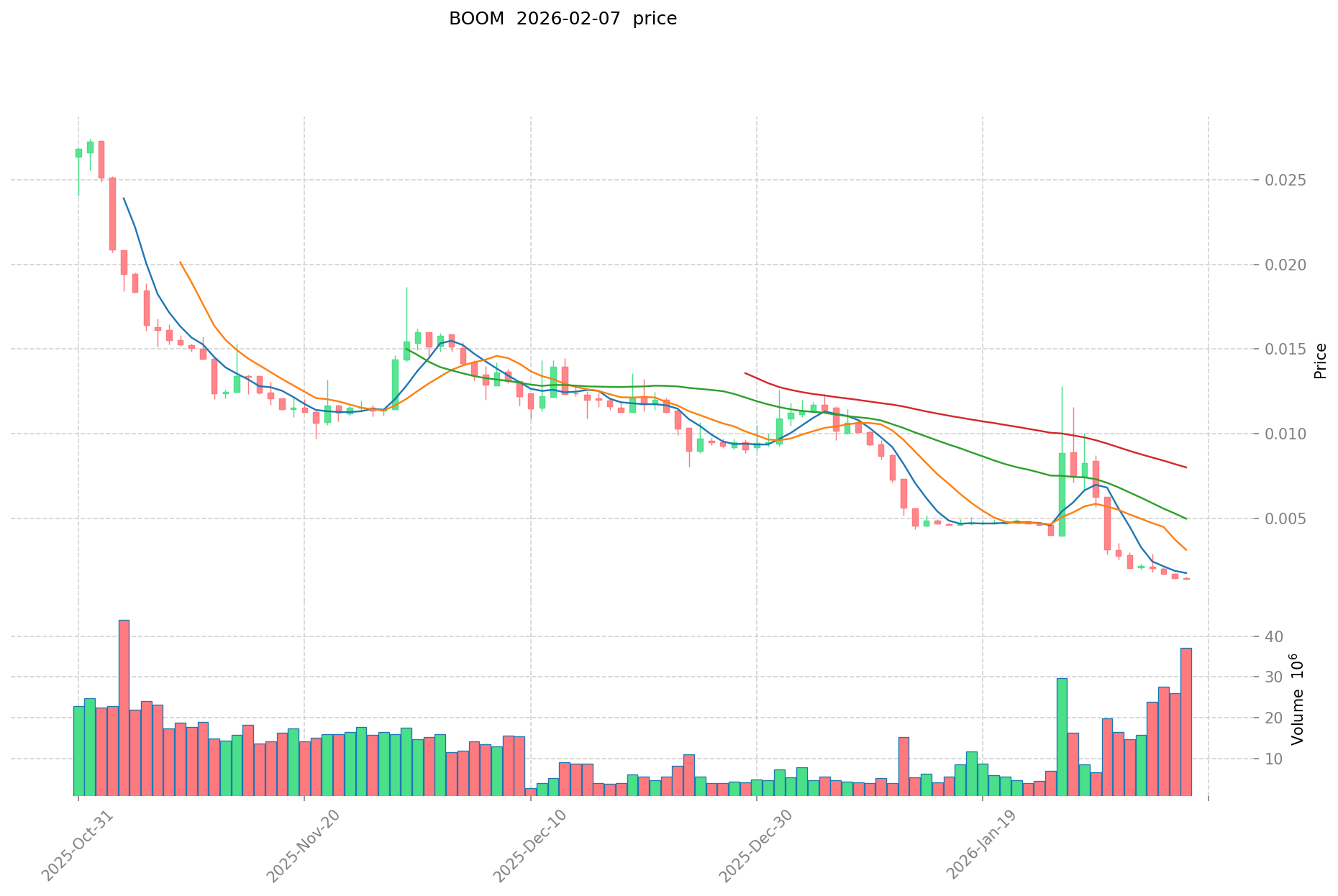
- February 2026: Price declined to $0.001371 → Market correction resulted in price movement from elevated levels to lower trading ranges
Current BOOM Investment Market Status (February 2026)
- BOOM current price: $0.001371
- Market sentiment: Reflected through market dominance of 0.000054%
- 24-hour trading volume: $39,762.38
- Circulating market cap: $293,622.50
Click to view real-time BOOM market price
II. Core Factors Influencing Whether BOOM is a Good Investment
Supply Mechanism and Scarcity (BOOM Investment Scarcity)
- BOOM operates with a fixed maximum supply of 1,000,000,000 tokens, with approximately 214,166,667 tokens currently in circulation, representing 21.42% of the total supply
- The token follows an ERC-20 standard mechanism deployed on the Binance Smart Chain (BSC)
- The circulating supply ratio indicates that a substantial portion of tokens remains unvested, which may create potential selling pressure as more tokens enter circulation
- Investment consideration: The token's scarcity model differs from traditional fixed-supply assets, as the majority of supply has yet to enter the market, warranting careful evaluation of future dilution effects
- As of February 7, 2026, BOOM trades at $0.001371, with a 24-hour trading volume of $39,762.38
- The token has experienced significant price volatility, with declines of 50.37% over 7 days, 86.86% over 30 days, and 97.093% over 1 year
- Market capitalization stands at $293,622.50, with a fully diluted valuation of $1,371,000
- The market cap to FDV ratio of 21.42% suggests substantial potential dilution risk as additional tokens enter circulation
- BOOM currently ranks 3,549 by market capitalization, holding a 0.000054% market share
Technology and Ecosystem Development (Technology & Ecosystem for BOOM Investment)
- BOOM positions itself as an AI-powered data incentive layer designed to bridge off-chain activity and on-chain economies
- The project's infrastructure aims to support gaming, social networks, real-world assets, and capital markets through decentralized infrastructure
- The token operates on BSC infrastructure, utilizing smart contract functionality for its ecosystem applications
- Holder base: The token has attracted 18,467 holders as of the latest data
- Exchange presence: BOOM is listed on 6 exchanges, indicating moderate accessibility for potential investors
Market Sentiment and Risk Considerations
- Current market sentiment indicator shows a bearish outlook (market_emotion: 1)
- Price trend analysis reveals consistent downward pressure across multiple timeframes, with the token currently trading near its historical low of $0.001371
- The token reached a previous high of $0.050738 on October 7, 2025, representing a significant decline from peak valuations
- 24-hour price range: $0.001372 - $0.001485, indicating moderate intraday volatility
- Investment risk assessment: The substantial price declines across all measured timeframes suggest heightened volatility and downside risk that potential investors should carefully evaluate
III. BOOM Future Investment Forecast and Price Outlook (Is Boom (BOOM) worth investing in 2026-2031)
Short-term Investment Forecast (2026, short-term BOOM investment outlook)
- Conservative forecast: $0.001332 - $0.001402
- Neutral forecast: $0.001402 - $0.001547
- Optimistic forecast: $0.001547 - $0.001837
Mid-term Investment Outlook (2027-2029, mid-term Boom (BOOM) investment forecast)
-
Market stage expectation: BOOM may experience gradual recovery as the project develops its AI-powered data incentive layer infrastructure. The token's price movement could be influenced by ecosystem expansion and adoption in gaming, social networks, and real-world asset sectors.
-
Investment return forecast:
- 2027: $0.001393 - $0.001959
- 2028: $0.001002 - $0.001932
- 2029: $0.001582 - $0.002698
-
Key catalysts: Potential ecosystem breakthroughs, partnership implementations, technical upgrades, and broader adoption of the AI-powered data incentive infrastructure across supported sectors.
Long-term Investment Outlook (Is BOOM a good long-term investment?)
- Baseline scenario: $0.001185 - $0.003123 (assuming steady development and moderate ecosystem growth through 2030)
- Optimistic scenario: $0.002593 - $0.003188 (assuming accelerated adoption and favorable market conditions through 2031)
- Risk scenario: Below $0.001002 (in case of prolonged market downturns or ecosystem development setbacks)
Click to view BOOM long-term investment and price forecast: Price Prediction
2026-02-07 - 2031 Long-term Outlook
- Base scenario: $0.001185 - $0.002280 USD (corresponding to steady progress and gradual mainstream application improvement)
- Optimistic scenario: $0.002593 - $0.003188 USD (corresponding to large-scale adoption and favorable market environment)
- Transformative scenario: Above $0.003188 USD (such as breakthrough progress in ecosystem and mainstream popularization)
- 2031-12-31 forecast high: $0.003188 USD (based on optimistic development assumptions)
Disclaimer: Price forecasts are based on historical data and market analysis models. Cryptocurrency markets are highly volatile and subject to various external factors. These projections should not be considered as investment advice. Investors should conduct their own research and risk assessment before making investment decisions.
| Year |
Predicted High Price |
Predicted Average Price |
Predicted Low Price |
Price Change |
| 2026 |
0.00183662 |
0.001402 |
0.0013319 |
2 |
| 2027 |
0.0019593651 |
0.00161931 |
0.0013926066 |
18 |
| 2028 |
0.001932484554 |
0.00178933755 |
0.001002029028 |
30 |
| 2029 |
0.0026983210254 |
0.001860911052 |
0.0015817743942 |
35 |
| 2030 |
0.003123073973019 |
0.0022796160387 |
0.001185400340124 |
66 |
| 2031 |
0.003187587106914 |
0.002701345005859 |
0.002593291205625 |
97 |
IV. Boom Investment Strategy and Risk Management (How to invest in AI-powered data incentive tokens)
Investment Methodology (Boom investment strategy)
Long-term Holding (HODL Boom): This approach may be suitable for conservative investors who believe in the long-term potential of AI-powered data incentive infrastructure. Given Boom's focus on bridging off-chain activity and on-chain economies across gaming, social networks, real-world assets, and capital markets, investors with a multi-year horizon might consider gradual accumulation strategies.
Active Trading: For traders relying on technical analysis and swing trading, Boom's price volatility presents potential opportunities. With 24-hour price changes of 4.43% and significant fluctuations over longer periods (7-day change of -50.37%, 30-day change of -86.86%), active traders should employ strict stop-loss mechanisms and position sizing discipline.
Risk Management (Risk management for Boom investment)
Asset Allocation Ratios:
- Conservative investors: Consider limiting exposure to 1-3% of total portfolio
- Moderate investors: May allocate 5-10% depending on risk tolerance
- Experienced crypto investors: Could consider up to 15-20% with appropriate hedging
Risk Hedging Approaches: Investors might consider diversifying across multiple asset classes and blockchain ecosystems. Given Boom's deployment on BSC (Binance Smart Chain), portfolio construction should account for smart contract platform risk and avoid over-concentration in single-chain assets.
Secure Storage:
- Hot wallets: Suitable for active trading amounts only
- Cold storage: Recommended for majority of long-term holdings
- Hardware wallets: Provide enhanced security for significant positions
V. Boom Investment Risks and Challenges (Risks of investing in AI-powered data incentive tokens)
Market Risks: Boom has demonstrated substantial price volatility, with the current price of $0.001371 representing a decline from its historical high of $0.050738 recorded on October 7, 2025. The token has experienced a 1-year decline of approximately 97.09%. With a relatively modest 24-hour trading volume of $39,762 and market capitalization of approximately $293,622, the asset exhibits characteristics typical of smaller-cap cryptocurrencies, including potential liquidity constraints and heightened price sensitivity.
Regulatory Risks: As an AI-powered data incentive layer operating across multiple sectors including gaming, social networks, and capital markets, Boom may face evolving regulatory scrutiny across different jurisdictions. The decentralized infrastructure supporting real-world assets and capital markets could be subject to varying compliance requirements depending on regional regulatory frameworks.
Technical Risks: Operating as an ERC-20 token on the BSC network, Boom faces standard smart contract vulnerabilities and potential network congestion issues. The project's infrastructure connecting off-chain activities to on-chain economies introduces additional technical complexity that may present integration challenges or potential points of failure. With approximately 18,467 holders, the relatively concentrated holder base could present additional risks related to token distribution.
VI. Conclusion: Is AI-Powered Data Incentive Layer a Good Investment?
Investment Value Summary: Boom presents an innovative approach to bridging off-chain activity with on-chain economies through AI-powered infrastructure. However, the token has experienced significant price volatility, with substantial declines across multiple timeframes. The circulating supply represents 21.42% of the maximum supply of 1 billion tokens, suggesting potential future dilution considerations.
Investor Recommendations:
✅ Beginners: Consider dollar-cost averaging (DCA) strategies with small position sizes and prioritize secure wallet storage. Avoid investing more than you can afford to lose given the high volatility profile.
✅ Experienced Investors: May employ swing trading strategies while maintaining strict risk management protocols. Consider portfolio diversification across different blockchain ecosystems and use cases.
✅ Institutional Investors: Should conduct thorough due diligence on the project's technical infrastructure, team credentials, and competitive positioning within the AI and data incentive sector before any strategic allocation.
⚠️ Disclaimer: Cryptocurrency investments carry substantial risk. This content is for informational purposes only and does not constitute investment advice. Always conduct your own research and consult with qualified financial advisors before making investment decisions.
VII. FAQ
Q1: What is Boom (BOOM) and what makes it different from other cryptocurrency projects?
Boom (BOOM) is an AI-powered data incentive layer designed to bridge off-chain activity and on-chain economies. What distinguishes BOOM from other projects is its specialized focus on creating decentralized infrastructure that supports multiple sectors including gaming, social networks, real-world assets, and capital markets. Operating as an ERC-20 token on the Binance Smart Chain (BSC), BOOM aims to incentivize data sharing and facilitate the connection between traditional off-chain activities and blockchain-based economic systems through artificial intelligence technology.
Q2: Has BOOM shown significant price volatility, and what are the current market statistics?
Yes, BOOM has demonstrated substantial price volatility throughout its trading history. As of February 7, 2026, the token trades at $0.001371, representing a decline of approximately 97.09% from its historical high of $0.050738 reached on October 7, 2025. The token has experienced a 50.37% decline over 7 days, 86.86% over 30 days, and 97.09% over 1 year. With a current market capitalization of $293,622.50 and a 24-hour trading volume of $39,762.38, BOOM exhibits characteristics typical of smaller-cap cryptocurrencies, including heightened price sensitivity and potential liquidity constraints.
Q3: What percentage of BOOM's total supply is currently in circulation, and what are the implications?
Currently, approximately 214,166,667 BOOM tokens are in circulation, representing 21.42% of the maximum supply of 1,000,000,000 tokens. This circulating supply ratio indicates that 78.58% of the total token supply has yet to enter the market, which carries important implications for investors. The substantial portion of unvested tokens creates potential future dilution risk, as the release of additional tokens into circulation could exert downward pressure on price. The market cap to fully diluted valuation (FDV) ratio of 21.42% reflects this consideration, suggesting investors should carefully evaluate the impact of future token unlocks on their investment thesis.
Q4: What are the predicted price ranges for BOOM in the short-term and mid-term future?
For the short-term (2026), BOOM's price forecasts vary by scenario: conservative estimates range from $0.001332 to $0.001402, neutral forecasts suggest $0.001402 to $0.001547, and optimistic projections indicate $0.001547 to $0.001837. For the mid-term outlook, 2027 projections range from $0.001393 to $0.001959, 2028 estimates span $0.001002 to $0.001932, and 2029 forecasts suggest $0.001582 to $0.002698. These projections assume gradual ecosystem development and adoption across BOOM's supported sectors, though actual results may vary significantly based on market conditions, technological progress, and competitive dynamics. Investors should note that cryptocurrency price predictions are inherently uncertain and should not be relied upon as the sole basis for investment decisions.
Q5: What are the primary risks associated with investing in BOOM?
BOOM presents several key investment risks that potential investors should carefully evaluate. Market risks include substantial price volatility, with the token experiencing a 97.09% decline over the past year, limited liquidity evidenced by a modest 24-hour trading volume of $39,762, and a relatively concentrated holder base of 18,467 addresses. Technical risks involve standard smart contract vulnerabilities inherent to BSC-based tokens and the complexity of bridging off-chain and on-chain activities through AI infrastructure. Regulatory risks stem from BOOM's operations across multiple sectors including gaming, capital markets, and real-world assets, which may face varying compliance requirements across jurisdictions. Additionally, the significant proportion of unvested tokens (78.58% of maximum supply) creates ongoing dilution risk as tokens enter circulation.
Q6: What investment strategies are appropriate for different types of investors considering BOOM?
Investment strategies for BOOM vary based on investor experience and risk tolerance. For beginners, a dollar-cost averaging (DCA) approach with small position sizes (1-3% of total portfolio) is recommended, prioritizing secure cold storage and investing only what can be afforded to lose. Experienced investors may employ active trading strategies using technical analysis to capitalize on BOOM's volatility, while maintaining strict stop-loss mechanisms and limiting exposure to 5-10% of portfolio. Institutional investors should conduct comprehensive due diligence on BOOM's technical infrastructure, team credentials, and competitive positioning before considering strategic allocation. Regardless of experience level, all investors should implement proper risk management, diversify across multiple asset classes and blockchain ecosystems, and avoid over-concentration in single projects or platforms.
Q7: On which exchanges can BOOM be traded, and what does this indicate about accessibility?
BOOM is currently listed on 6 exchanges, which indicates moderate accessibility for potential investors. While specific exchange names vary, the presence on multiple platforms provides investors with options for acquiring and trading the token. However, the relatively limited number of exchanges compared to more established cryptocurrencies, combined with the modest 24-hour trading volume of $39,762.38, suggests that liquidity may be constrained during periods of high market activity. Investors should be aware that trading on smaller or less-established exchanges may carry additional risks related to security, regulatory compliance, and counterparty reliability. When selecting an exchange for BOOM trading, investors should prioritize platforms with robust security measures, transparent operations, and adequate liquidity to execute trades at desired price points.
Q8: What factors could potentially drive BOOM's price performance in the coming years?
Several key factors may influence BOOM's future price trajectory through 2031. Positive catalysts include successful implementation of the AI-powered data incentive infrastructure, ecosystem expansion across gaming, social networks, real-world assets, and capital markets, strategic partnerships that increase adoption and utility, and broader market recovery in the cryptocurrency sector. Technical upgrades to the platform and increased integration with off-chain data sources could enhance BOOM's value proposition. Conversely, negative factors include the ongoing release of unvested tokens creating dilution pressure, competitive threats from alternative data incentive projects, regulatory challenges across BOOM's diverse operational sectors, and potential technical vulnerabilities or security breaches. Market sentiment, overall blockchain adoption trends, and macroeconomic conditions affecting risk assets will also play significant roles in determining BOOM's long-term price performance.
* The information is not intended to be and does not constitute financial advice or any other recommendation of any sort offered or endorsed by Gate.