This comprehensive guide examines whether Boson (BOSON) represents a viable investment opportunity within the decentralized commerce sector. The analysis evaluates the token's historical performance, revealing a 98% decline from its $5.36 peak to current levels around $0.0238. Core considerations include limited market liquidity ($20,317 daily volume), modest market capitalization ($3.44 million), and 11,098 token holders across 4 exchanges including Gate. The article explores BOSON's positioning in agentic economy infrastructure through its dACP platform and MCP-compatible framework, while assessing critical risks including market volatility, regulatory uncertainty, and technical vulnerabilities. Investment recommendations differentiate between beginner, experienced, and institutional investors, emphasizing risk management strategies and hardware wallet security. Long-term price forecasts through 2031 range from $0.0412 to $0.0611 under base and optimistic scenarios, though substantial downside risks remain.
Introduction: Boson (BOSON) Investment Position and Market Outlook
Boson (BOSON) represents a notable asset in the cryptocurrency sector, having launched in April 2021 with a focus on decentralized commerce infrastructure. As of January 30, 2026, BOSON holds a market capitalization of approximately $3.44 million, with a circulating supply of around 144.70 million tokens, and a current price of $0.0238. Positioned as a decentralized commerce layer for the agentic economy, BOSON has developed no-code, low-cost tools enabling agents to exchange assets through its dACP infrastructure, which offers MCP-compatible integration with existing agent frameworks. With approximately 11,098 holders and trading presence on 4 exchanges, the token has experienced notable price fluctuations since its initial offering at $0.75. This article provides a comprehensive analysis of BOSON's investment characteristics, historical price movements, future price considerations, and associated risks to serve as a reference for those examining "Is Boson (BOSON) a good investment?" The analysis draws upon available market data, project developments, and observable trends in the decentralized commerce sector.
I. Boson (BOSON) Price History Review and Investment Value Status
Historical Price Trends and Investment Returns
- 2021: BOSON reached a price level of 5.36 USD on April 10 → early investors experienced substantial gains
- 2025: The token traded around 0.07593 USD → representing a decline exceeding 98% from previous peak levels
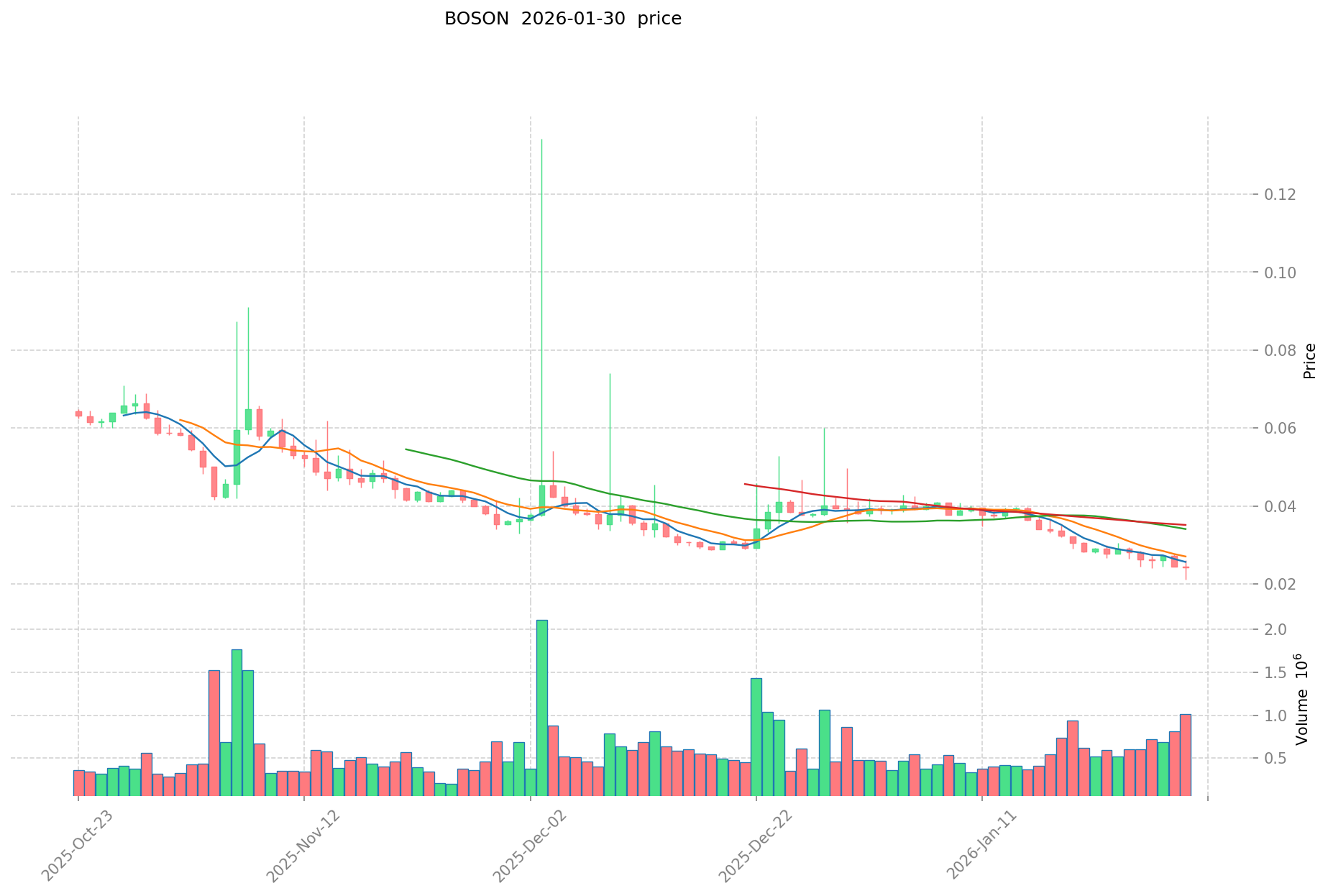
- 2026: As of January 29, the token recorded a price near 0.02213851 USD → reflecting continued downward pressure in market valuation
Current Investment Market Status (January 2026)
- Current BOSON price: 0.0238 USD
- 24-hour trading volume: 20,317.36 USD
- Market capitalization: 3,443,855.59 USD
- Circulating supply: 144,699,814.72 BOSON (72.35% of total supply)
- Total supply: 200,000,000 BOSON
- Market cap ranking: #1743
- Price changes: +0.64% (1H), -2.85% (24H), -20.16% (7D), -41.16% (30D), -89.05% (1Y)
View real-time BOSON market price
II. Core Factors Influencing Whether BOSON is a Good Investment (Is Boson(BOSON) a Good Investment)
Supply Mechanism and Scarcity (BOSON investment scarcity)
- Maximum supply capped at 200,000,000 BOSON → influences price dynamics and investment considerations
- Current circulating supply of approximately 144.7 million tokens represents 72.35% of total supply → indicates ongoing token distribution
- Investment consideration: The fixed supply cap may provide a reference point for evaluating long-term tokenomics
Institutional Investment and Mainstream Adoption (Institutional investment in BOSON)
- Current holder count of 11,098 addresses → reflects existing community participation
- Listed on 4 exchanges with 24-hour trading volume of $20,317 → indicates current market liquidity levels
- The project's focus on decentralized commerce infrastructure and MCP-compatible agent frameworks → represents a specific technical positioning in the Web3 commerce sector
Macroeconomic Environment's Impact on BOSON Investment
- Broader crypto market conditions and regulatory developments → continue to shape digital asset investment landscapes
- Market volatility patterns observed across price trends: -2.85% (24H), -20.16% (7D), -41.16% (30D), -89.05% (1Y) → reflect recent price movements
- Current market capitalization of approximately $3.44 million with 0.00016% market dominance → indicates current market positioning
Technology and Ecosystem Development (Technology & Ecosystem for BOSON investment)
- Boson dACP platform enables agents to exchange assets through decentralized commerce infrastructure → provides core technical functionality
- MCP-compatible infrastructure designed for integration with existing agent frameworks → supports technical interoperability
- No-code tools aimed at facilitating decentralized agent commerce deployment → targets user accessibility in the decentralized commerce sector
III. BOSON Future Investment Forecast and Price Outlook (Is Boson(BOSON) worth investing in 2026-2031)
Short-term Investment Forecast (2026, short-term BOSON investment outlook)
- Conservative forecast: $0.0216 - $0.0238
- Neutral forecast: $0.0238 - $0.0289
- Optimistic forecast: $0.0289 - $0.0342
Mid-term Investment Outlook (2027-2029, mid-term Boson(BOSON) investment forecast)
- Market stage expectation: The mid-term outlook suggests a phase of gradual expansion as the decentralized commerce layer develops its agent-based ecosystem infrastructure.
- Return on investment forecast:
- 2027: $0.0159 - $0.0406
- 2028: $0.0219 - $0.0497
- 2029: $0.0270 - $0.0571
- Key catalysts: Integration with agent frameworks, adoption of MCP-compatible infrastructure, and expansion of decentralized commerce applications.
Long-term Investment Outlook (Is Boson a good long-term investment?)
- Base scenario: $0.0412 - $0.0556 (assuming steady development of the agent-based commerce ecosystem)
- Optimistic scenario: $0.0463 - $0.0611 (assuming increased adoption of decentralized commerce solutions and favorable market conditions)
- Risk scenario: Below $0.0216 (under unfavorable market dynamics or limited ecosystem growth)
View BOSON long-term investment and price forecast: Price Prediction
2026-01-30 - 2031 Long-term Outlook
- Base scenario: $0.0412 - $0.0556 (corresponding to steady progress and gradual mainstream application enhancement)
- Optimistic scenario: $0.0463 - $0.0611 (corresponding to large-scale adoption and favorable market environment)
- Transformative scenario: Above $0.0611 (if the ecosystem achieves breakthrough development and mainstream adoption)
- 2031-12-31 forecast high: $0.0611 (based on optimistic development assumptions)
Disclaimer: Price forecasts are based on historical data analysis and market projections. Cryptocurrency markets are highly volatile and subject to numerous variables. These projections should not be considered as financial advice or guarantees of future performance.
| Year |
Predicted High Price |
Predicted Average Price |
Predicted Low Price |
Price Change |
| 2026 |
0.0342144 |
0.02376 |
0.0216216 |
0 |
| 2027 |
0.04058208 |
0.0289872 |
0.01594296 |
21 |
| 2028 |
0.0497420352 |
0.03478464 |
0.0219143232 |
46 |
| 2029 |
0.05705550576 |
0.0422633376 |
0.027048536064 |
77 |
| 2030 |
0.0556185522816 |
0.04965942168 |
0.0412173199944 |
108 |
| 2031 |
0.061061224897728 |
0.0526389869808 |
0.046322308543104 |
121 |
IV. Boson Investment Strategy and Risk Management (How to invest in Boson)
Investment Methodology (Boson investment strategy)
Long-term Holding (HODL Boson): Suitable for Conservative Investors
Long-term holding represents a passive investment approach that may be appropriate for investors who believe in the fundamental value proposition of Boson Protocol's decentralized commerce infrastructure. This strategy typically involves acquiring BOSON tokens and maintaining positions through market cycles, rather than attempting to time short-term price movements.
Active Trading: Relying on Technical Analysis and Swing Trading
Active trading strategies involve more frequent position adjustments based on technical indicators, chart patterns, and market momentum. Given BOSON's 24-hour trading volume of approximately $20,317 and recent price volatility (24-hour change of -2.85%, 7-day change of -20.16%), traders may identify opportunities in short-term price fluctuations. However, the relatively modest daily trading volume may impact liquidity considerations for larger position sizes.
Risk Management (Risk management for Boson investment)
Asset Allocation Ratio: Conservative / Aggressive / Professional Investors
- Conservative Investors: May consider allocating a small percentage (typically 1-3%) of their overall portfolio to BOSON, treating it as a speculative position within a broader diversified investment strategy.
- Aggressive Investors: Those with higher risk tolerance might allocate 5-10% to BOSON, recognizing both the potential upside and significant downside risks.
- Professional Investors: Experienced cryptocurrency investors may employ dynamic allocation strategies, adjusting exposure based on market conditions, technical signals, and fundamental developments in the Boson Protocol ecosystem.
Risk Hedging Solutions: Multi-asset Portfolio + Risk Mitigation Tools
Investors may consider diversifying across multiple digital assets rather than concentrating solely in BOSON. This approach could include exposure to different categories of cryptocurrencies, stablecoins for capital preservation, and potentially derivatives instruments for more sophisticated hedging strategies. Position sizing relative to total portfolio value remains a fundamental risk management principle.
Secure Storage: Hot and Cold Wallets + Hardware Wallet Recommendations
Given that BOSON operates as an ERC-20 token on the Ethereum blockchain (contract address: 0xC477D038d5420C6A9e0b031712f61c5120090de9), investors have multiple storage options:
- Hot Wallets: Software wallets and exchange accounts offer convenience for active trading but carry higher security risks.
- Cold Wallets: Hardware wallets provide enhanced security for long-term holdings by keeping private keys offline.
- Hardware Wallet Recommendations: Reputable hardware wallet solutions compatible with Ethereum-based tokens can provide a balance between security and accessibility.
Investors should carefully evaluate the security features of their chosen storage solution and consider distributing holdings across multiple wallet types based on their trading frequency and security requirements.
V. Boson Investment Risks and Challenges (Risks of investing in Boson)
Market Risk: High Volatility and Price Manipulation Concerns
BOSON has demonstrated substantial price volatility across multiple timeframes. The token currently trades at $0.0238, representing significant declines from various historical reference points: -20.16% over 7 days, -41.16% over 30 days, and -89.05% over one year. The current price stands considerably below the all-time high of $5.36 recorded on April 10, 2021, and recently approached the all-time low of $0.02213851 on January 29, 2026.
The token's modest 24-hour trading volume of approximately $20,317 and market capitalization of approximately $3.44 million suggest relatively limited liquidity compared to larger cryptocurrency projects. This liquidity profile may potentially increase price volatility and affect the ability to execute larger transactions without significant price impact.
Regulatory Risk: Policy Uncertainty Across Different Jurisdictions
Cryptocurrency regulatory frameworks continue to evolve across different jurisdictions, creating potential uncertainty for token holders. Changes in regulatory approaches toward decentralized commerce platforms, token classifications, or broader cryptocurrency market regulations could impact BOSON's operational environment and token value. Investors should remain aware of regulatory developments in their respective jurisdictions and how these may affect their holdings.
Technical Risk: Network Security Vulnerabilities and Upgrade Failures
As an Ethereum-based token and protocol, BOSON faces several categories of technical risk:
- Smart Contract Risk: Potential vulnerabilities in the token contract or associated protocol smart contracts could expose holders to security risks.
- Network Dependency: As an ERC-20 token, BOSON's functionality depends on the Ethereum network's security, scalability, and performance characteristics.
- Protocol Development Risk: The successful evolution of Boson Protocol's decentralized commerce infrastructure depends on ongoing development, successful implementation of technical upgrades, and adoption by users and agents.
Investors should consider these technical factors when evaluating their risk exposure to BOSON tokens.
VI. Conclusion: Is Boson a Good Investment?
Investment Value Summary: BOSON presents a speculative investment opportunity in the emerging field of decentralized commerce and agentic economy infrastructure. The token has experienced significant price volatility, with substantial declines from historical highs. Current market metrics indicate modest trading activity and a relatively small market capitalization compared to established cryptocurrency projects.
Investor Recommendations:
✅ Beginners: Consider dollar-cost averaging strategies combined with secure hardware wallet storage. New investors should start with small position sizes that represent only a minor portion of their overall investment portfolio, allowing them to gain exposure while managing downside risk.
✅ Experienced Investors: May employ swing trading strategies to capitalize on price volatility, while maintaining a diversified portfolio that includes BOSON as one component within a broader cryptocurrency allocation. Technical analysis and risk management protocols should guide position sizing and entry/exit decisions.
✅ Institutional Investors: Could evaluate BOSON as a strategic long-term allocation within a venture-style portfolio approach focused on decentralized commerce infrastructure, recognizing the early-stage nature of the project and adjusting position sizing accordingly.
⚠️ Disclaimer: Cryptocurrency investment carries substantial risk. Market volatility, regulatory uncertainty, and technical challenges can result in significant capital loss. This content is provided for informational purposes only and does not constitute investment advice. Investors should conduct their own research, consider their risk tolerance, and consult with qualified financial advisors before making investment decisions.
VII. FAQ
Q1: What is Boson Protocol (BOSON) and what problem does it solve?
Boson Protocol is a decentralized commerce infrastructure layer designed for the agentic economy, enabling agents to exchange assets through its dACP (decentralized Agent Commerce Protocol) platform. The project launched in April 2021 with a focus on creating no-code, low-cost tools that facilitate decentralized commerce. Its MCP-compatible infrastructure integrates with existing agent frameworks, positioning BOSON as a bridge between traditional commerce applications and decentralized Web3 ecosystems. The protocol aims to solve the challenge of enabling autonomous agents to conduct commerce transactions in a trustless, decentralized manner without relying on centralized intermediaries.
Q2: How has BOSON's price performed since its launch?
BOSON has experienced substantial price volatility since its initial offering. The token reached its all-time high of $5.36 on April 10, 2021, shortly after launch when the initial offering price was $0.75. However, as of January 30, 2026, BOSON trades at approximately $0.0238, representing a decline exceeding 98% from its peak levels. Recent performance shows negative trends across multiple timeframes: -2.85% over 24 hours, -20.16% over 7 days, -41.16% over 30 days, and -89.05% over one year. The token recently approached its all-time low of $0.02213851 on January 29, 2026, indicating continued downward price pressure.
Q3: What are the tokenomics of BOSON?
BOSON has a fixed maximum supply capped at 200,000,000 tokens, with a current circulating supply of approximately 144.70 million tokens (72.35% of total supply). The token operates as an ERC-20 asset on the Ethereum blockchain with contract address 0xC477D038d5420C6A9e0b031712f61c5120090de9. As of January 30, 2026, BOSON has a market capitalization of approximately $3.44 million and ranks #1743 among cryptocurrencies. The token has approximately 11,098 holders and is listed on 4 exchanges with a 24-hour trading volume of around $20,317. The fixed supply mechanism provides scarcity characteristics, though the ongoing token distribution from the remaining 27.65% of non-circulating supply may influence future price dynamics.
Q4: What are the main risks associated with investing in BOSON?
BOSON presents several investment risk categories that potential investors should carefully evaluate. Market risk includes high volatility evidenced by substantial price declines and relatively modest daily trading volume of approximately $20,317, which may affect liquidity for larger transactions. Regulatory risk stems from evolving cryptocurrency frameworks across different jurisdictions that could impact decentralized commerce platforms. Technical risks include potential smart contract vulnerabilities, dependency on Ethereum network performance, and execution risk related to protocol development and adoption. The token's small market capitalization of $3.44 million and limited exchange presence compared to established projects may also contribute to increased volatility and liquidity concerns.
Q5: What is the long-term price forecast for BOSON through 2031?
Long-term price forecasts for BOSON suggest potential gradual appreciation under various scenarios, though these projections carry significant uncertainty. The base scenario estimates a range of $0.0412 - $0.0556 by 2031, assuming steady development of the agent-based commerce ecosystem. The optimistic scenario projects $0.0463 - $0.0611, contingent on increased adoption of decentralized commerce solutions and favorable market conditions. Yearly forecasts indicate: 2026 ($0.0216 - $0.0342), 2027 ($0.0159 - $0.0406), 2028 ($0.0219 - $0.0497), 2029 ($0.0270 - $0.0571), 2030 ($0.0412 - $0.0556), and 2031 ($0.0463 - $0.0611). However, a risk scenario suggests prices could remain below $0.0216 under unfavorable conditions. These forecasts are subject to market volatility, regulatory developments, and ecosystem adoption rates.
Q6: How should different types of investors approach BOSON?
Investment approaches vary based on investor experience and risk tolerance. Beginners should consider dollar-cost averaging strategies with small position sizes (1-3% of portfolio) representing only a minor portion of overall investments, combined with secure hardware wallet storage. Experienced investors may employ swing trading strategies to capitalize on volatility while maintaining BOSON as one component within a diversified cryptocurrency allocation, using technical analysis and strict risk management protocols. Institutional investors could evaluate BOSON as a strategic long-term allocation within a venture-style portfolio focused on decentralized commerce infrastructure, adjusting position sizing according to the project's early-stage nature. All investors should prioritize secure storage solutions, with hardware wallets recommended for long-term holdings.
Q7: What storage options are available for BOSON tokens?
As an ERC-20 token on the Ethereum blockchain, BOSON offers multiple storage options with varying security levels. Hot wallets include software wallets and exchange accounts that provide convenience for active trading but carry higher security risks due to internet connectivity. Cold wallets, particularly hardware wallet solutions, offer enhanced security for long-term holdings by keeping private keys offline and isolated from potential online threats. Reputable hardware wallet providers compatible with Ethereum-based tokens can provide an optimal balance between security and accessibility. Investors should evaluate storage solutions based on their trading frequency, holding period, and security requirements, potentially distributing holdings across multiple wallet types to balance convenience and protection.
Q8: What factors should investors monitor when evaluating BOSON's investment potential?
Key monitoring factors include technological development indicators such as adoption of the dACP infrastructure, integration success with agent frameworks, and deployment of no-code tools within the ecosystem. Market metrics warrant attention, including trading volume trends, holder count growth, exchange listings, and overall market capitalization movements. Regulatory developments affecting decentralized commerce platforms and cryptocurrency markets across different jurisdictions may impact project viability. Ecosystem growth indicators such as the number of active agents using the platform, transaction volumes on the network, and partnerships with other Web3 projects provide insight into real-world adoption. Broader cryptocurrency market conditions and Bitcoin's price movements often correlate with altcoin performance, making macroeconomic monitoring relevant for BOSON investment timing decisions.
* The information is not intended to be and does not constitute financial advice or any other recommendation of any sort offered or endorsed by Gate.