Brevis (BREV) is the native token of a smart verifiable computing platform using zero-knowledge proofs to enable trustless off-chain execution with on-chain verification, currently trading at $0.3093 with a $77.3 million market cap across 28 exchanges including Gate. The token launched in January 2026 with significant early volatility, ranging from $0.5393 to $0.3019, while maintaining only 25% circulating supply (250M of 1B tokens), creating both scarcity advantages and future dilution risks. BREV addresses critical blockchain scalability challenges through its ProverNet marketplace and staking mechanisms, with key catalysts including Q2 2026 slashing activation and planned migration to a dedicated Brevis rollup where BREV serves as the native gas token. Conservative price forecasts suggest 2026 ranges of $0.55-$0.70, while long-term outlooks project $1.50-$5.00 by 2030 contingent upon ecosystem adoption. Investors should implement dollar-cost averaging strategies with 1-15% portfolio allocation depending on
Introduction: Brevis (BREV)'s Investment Position and Market Prospects
BREV is an emerging asset in the cryptocurrency sector, serving as the native token of Brevis, a smart verifiable computing platform. As of January 18, 2026, BREV holds a market capitalization of approximately $77.33 million with a circulating supply of 250 million tokens out of a maximum supply of 1 billion tokens. The current price stands at around $0.3093, with a 24-hour trading volume of approximately $2.51 million across 28 exchanges. With its positioning as a foundational infrastructure provider for scalable, trustless computation across blockchain, data, and AI systems through zero-knowledge proofs, BREV has attracted attention from market participants evaluating "Is Brevis (BREV) a good investment?" The token ranks #422 by market capitalization, representing approximately 0.0091% market dominance in the cryptocurrency space. This article provides a comprehensive analysis of BREV's investment characteristics, historical price movements, future price outlook, and associated risks to offer reference for potential investors.
I. Brevis (BREV) Price History Review and Current Investment Value Status
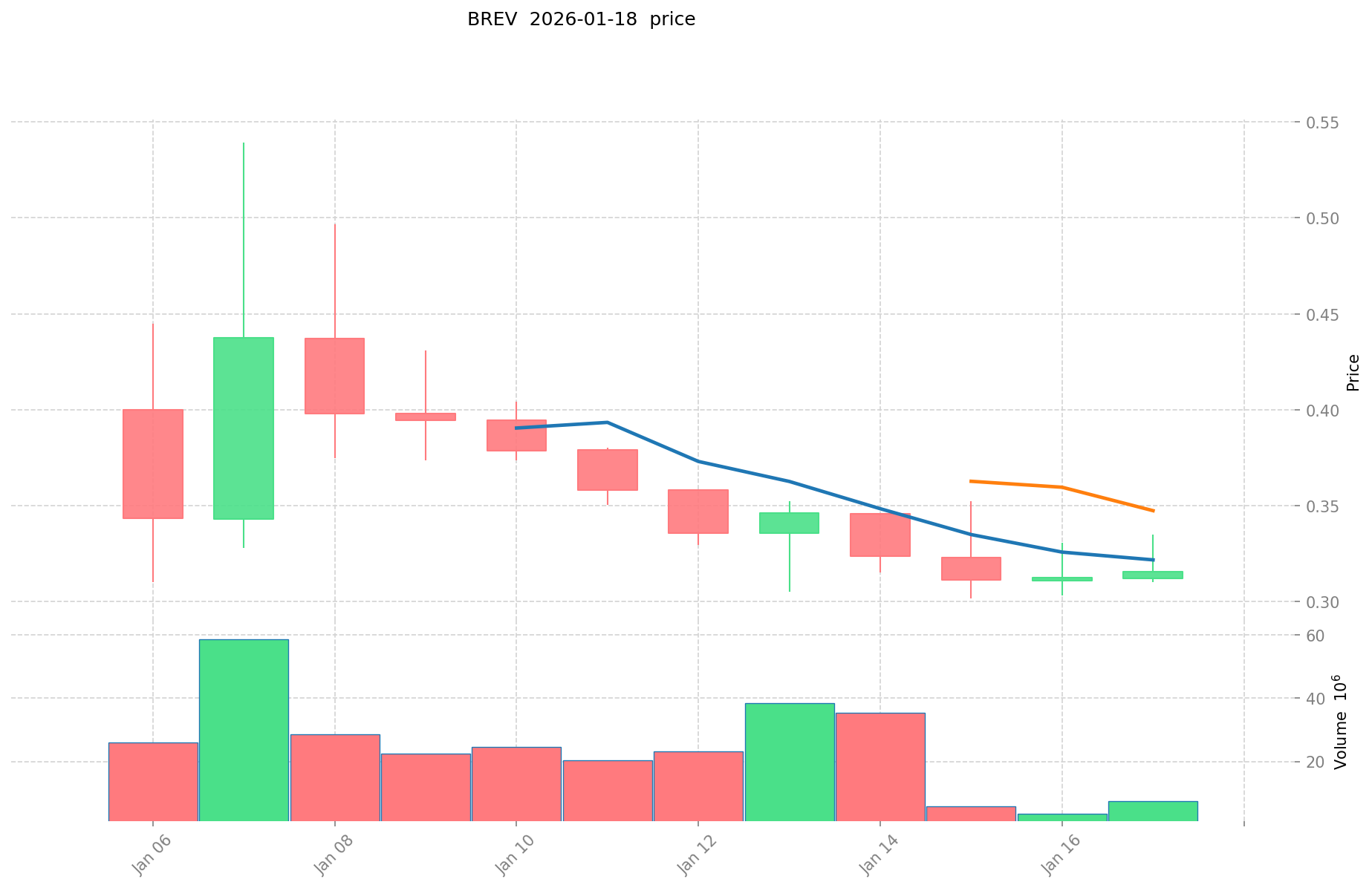
- 2026-01-07: BREV reached a notable price level of $0.5393, representing a significant milestone following its market debut.
- 2026-01-05: Token officially launched on major exchanges including Binance and OKX, initiating public trading activity.
- 2026-01-15: BREV experienced downward price movement to $0.3019, reflecting broader market adjustments during the period.
Current BREV Investment Market Status (January 2026)
- BREV current price: $0.3093
- 24-hour trading volume: $2,511,743.18
- Price changes: -1.99% (24H), -17.29% (7D), -23.94% (30D)
- Market capitalization: $77.32 million
- Circulating supply: 250 million BREV (25% of maximum supply)
- Total supply: 1 billion BREV
- Number of exchanges listed: 28 exchanges
- Token holders: 15,423 addresses
- Market capitalization ranking: #422
Click to view real-time BREV market price
II. Core Factors Influencing Whether BREV is a Good Investment (Is Brevis(BREV) a Good Investment)
Supply Mechanism and Scarcity (BREV investment scarcity)
- BREV has a maximum supply of 1,000,000,000 tokens with 250,000,000 currently in circulation (25% circulating supply)
- The controlled token release schedule indicates only a quarter of total supply is currently available, suggesting potential future dilution as remaining tokens unlock
- Investment significance: The current 25% circulation rate creates a supply constraint that may support near-term price discovery, though investors should monitor the remaining 75% unlock schedule for long-term valuation impacts
Institutional Investment and Mainstream Adoption (Institutional investment in BREV)
- BREV has gained accessibility through listings on major exchanges including Binance, Bybit, and Gate.com, with a total of 28 exchange listings as of January 2026
- The project has established integrations with key protocols including PancakeSwap, Uniswap, MetaMask, and Linea, demonstrating adoption within the DeFi ecosystem
- As of January 2026, BREV has attracted 15,423 token holders, indicating early-stage community formation following its initial listing in early January 2026
Macroeconomic Environment Impact on BREV Investment
- BREV operates within the broader cryptocurrency market which remains sensitive to global monetary policy shifts and risk appetite fluctuations
- The token's short trading history since its January 2026 launch limits historical correlation analysis with macroeconomic indicators
- Market volatility remains elevated, with BREV experiencing significant price swings between its recorded range of $0.3019 to $0.5393 within its first weeks of trading
Technology and Ecosystem Development (Technology & Ecosystem for BREV investment)
- ProverNet Launch: Brevis introduced its decentralized prover marketplace in January 2026, enabling network participants to generate and verify zero-knowledge proofs across multiple blockchains
- Staking Activation: BREV staking functionality was launched on January 8, 2026, allowing token holders to delegate tokens to provers or operate infrastructure nodes while earning rewards
- The roadmap includes a planned Q2 2026 activation of staking/slashing mechanisms for provers and delegators, with a future migration from Base to a dedicated Brevis rollup where BREV will serve as the native gas token
- The platform's zero-knowledge technology enables decentralized applications to securely access and compute data across multiple blockchains, positioning BREV within the growing ZK-infrastructure sector
- Cross-chain data attestation capabilities expand the potential use cases for DeFi, NFT platforms, and Web3 applications requiring trustless data verification
III. BREV Future Investment Forecast and Price Outlook (Is Brevis(BREV) worth investing in 2026-2030)
Short-term Investment Forecast (2026, short-term BREV investment outlook)
Based on current technical patterns and market structure, BREV demonstrates distinct price trajectories across different scenarios.
- Conservative forecast: $0.55 - $0.70
- Neutral forecast: $0.70 - $0.90
- Optimistic forecast: $0.90 and above
The conservative range assumes moderate token unlock pressure and sustained developer interest in the project. The neutral scenario reflects steady adoption growth without speculative surges. The optimistic outlook considers accelerated DePIN narrative momentum and potential enterprise-level integrations.
Mid-term Investment Outlook (2027-2028, mid-term Brevis(BREV) investment forecast)
- Market phase expectation: Transition from early adoption to mainstream integration phase, with increasing institutional interest in verifiable computation infrastructure
- Investment return forecast:
- 2027: $0.40 - $0.64 (based on steady adoption indicators)
- 2028: $1.00 - $2.00 (reflecting progressive value accumulation rather than speculative spikes)
- Key catalysts: ProverNet adoption rates, exchange listings expansion, and positioning as a core component in decentralized computing stack
The mid-term outlook suggests BREV may experience gradual value accumulation. If Brevis becomes a fundamental component of the decentralized computing infrastructure, the upper range could materialize.
Long-term Investment Outlook (Is BREV a good long-term investment?)
- Baseline scenario: $1.50 - $2.00 (reflecting stable but moderate growth in the verifiable computing sector)
- Optimistic scenario: $3.00 - $5.00 (contingent upon strong execution, favorable competitive positioning, and decentralized computation becoming standard in Web3 and AI systems)
- Risk scenario: Below $1.00 (under conditions of intensified competition, technical setbacks, or prolonged market downturns)
For detailed long-term investment analysis and price forecasts: Price Prediction
2026-2031 Long-term Outlook
- Baseline scenario: $0.47 - $0.69 USD (corresponding to steady progress and gradual mainstream application growth)
- Optimistic scenario: $1.50 - $5.00 USD (corresponding to large-scale adoption and favorable market conditions)
- Transformative scenario: Above $5.00 USD (contingent upon breakthrough ecosystem developments and mainstream proliferation)
- 2031-12-31 forecasted high: $0.69 USD (based on optimistic development assumptions from provided data)
Disclaimer: Price predictions are based on historical data analysis and current market indicators. Cryptocurrency markets involve significant volatility and risk. The forecasts presented should not be construed as financial advice. Token unlock schedules (70% of tokens remain locked) and regulatory developments may materially impact actual price performance. Investors should conduct independent research and consider their risk tolerance before making investment decisions.
| Year |
Predicted High Price |
Predicted Average Price |
Predicted Low Price |
Price Change |
| 2026 |
0.326904 |
0.3084 |
0.16962 |
0 |
| 2027 |
0.3335346 |
0.317652 |
0.28906332 |
2 |
| 2028 |
0.374432295 |
0.3255933 |
0.198611913 |
5 |
| 2029 |
0.4340158689 |
0.3500127975 |
0.185506782675 |
13 |
| 2030 |
0.552740209812 |
0.3920143332 |
0.360653186544 |
26 |
| 2031 |
0.68967081639876 |
0.472377271506 |
0.31176899919396 |
52 |
IV. Brevis Investment Strategy and Risk Management (How to invest in Brevis)
Investment Methodology (Brevis investment strategy)
Investors considering Brevis (BREV) may adopt different approaches based on their risk tolerance and investment horizon:
-
Long-term Holding (HODL Brevis): This strategy suits conservative investors who believe in the long-term potential of zero-knowledge proof technology and decentralized computing infrastructure. Given Brevis's mission to build an "Infinite Compute Layer" that enables off-chain execution with on-chain verification, patient investors may accumulate positions during market downturns and hold through volatility cycles.
-
Active Trading: More experienced traders may leverage technical analysis and momentum indicators to capitalize on price fluctuations. With BREV experiencing significant volatility (17.29% decline over 7 days and 23.94% over 30 days as of January 18, 2026), swing trading opportunities may present themselves. Traders should monitor key support levels around $0.3019 (recent low) and resistance near $0.5393 (historical high reached on January 7, 2026).
Risk Management (Risk management for Brevis investment)
Asset Allocation Ratios:
- Conservative investors: Allocate 1-3% of cryptocurrency portfolio to BREV
- Moderate investors: Consider 3-7% allocation within broader crypto holdings
- Aggressive/Professional investors: May allocate 7-15% depending on conviction and risk capacity
Risk Hedging Strategies:
- Diversification across multiple blockchain infrastructure projects and asset categories
- Position sizing based on volatility metrics and correlation analysis
- Setting stop-loss orders to limit downside exposure during significant drawdowns
- Periodic rebalancing to maintain target allocation percentages
Secure Storage Solutions:
- Hot Wallets: For active trading portions, use reputable exchanges with strong security track records
- Cold Wallets: For long-term holdings, transfer BREV tokens to hardware wallets supporting BEP-20 and ERC-20 standards
- Hardware Wallet Recommendations: Consider devices compatible with Ethereum and BSC networks, as BREV operates on both chains (contract address: 0x086f405146ce90135750bbec9a063a8b20a8bffb)
- Enable multi-signature authentication and maintain secure backup of recovery phrases
V. Brevis Investment Risks and Challenges (Risks of investing in Brevis)
Market Risks:
- High volatility: BREV has demonstrated substantial price swings, declining 23.94% from its launch price over 30 days
- Limited liquidity: With a circulating supply of 250 million tokens (25% of max supply) and market capitalization of approximately $77.3 million, lower liquidity may amplify price movements
- Market manipulation concerns: Relatively new tokens with lower trading volumes may be susceptible to coordinated trading activities
Regulatory Risks:
- Policy uncertainty: Zero-knowledge proof technologies and decentralized computing networks face evolving regulatory frameworks across different jurisdictions
- Compliance requirements: Future regulations regarding off-chain computation verification and data privacy may impact Brevis's operational model
- Cross-border considerations: Operating on multiple chains (Ethereum and BSC) may expose the project to diverse regulatory environments
Technical Risks:
- Network security vulnerabilities: As a platform handling verifiable computations through ZK proofs, any smart contract exploits or cryptographic weaknesses could undermine user confidence
- Technology upgrade challenges: The complexity of implementing "Infinite Compute Layer" infrastructure may encounter technical delays or implementation difficulties
- Competition risk: Other zero-knowledge proof platforms and Layer 2 scaling solutions may offer similar or superior functionality
- Token unlock schedule: With only 25% of tokens currently circulating, future unlocks could create selling pressure
VI. Conclusion: Is Brevis a Good Investment?
Investment Value Summary:
Brevis presents an investment opportunity centered on zero-knowledge proof technology and decentralized computing infrastructure. The project's focus on enabling off-chain execution with on-chain verification addresses scalability challenges in blockchain systems. However, investors should note that BREV has experienced considerable price fluctuations since launch, with a 23.94% decline over its first 30 days of trading.
The token's current market capitalization of approximately $77.3 million and circulating supply representing 25% of maximum supply indicate early-stage investment characteristics. Price performance shows volatility, ranging from a high of $0.5393 to a low of $0.3019 within a short timeframe.
Investor Recommendations:
✅ New Investors: Consider dollar-cost averaging (DCA) strategies to build positions gradually, reducing exposure to short-term volatility. Prioritize secure storage using hardware wallets compatible with Ethereum and BSC networks.
✅ Experienced Investors: May explore swing trading opportunities based on technical analysis while maintaining a core long-term position. Implement strict risk management including position sizing and stop-loss parameters. Monitor developments in zero-knowledge proof technology adoption and Brevis ecosystem growth.
✅ Institutional Investors: Could evaluate BREV as part of a strategic allocation to blockchain infrastructure and verifiable computing technologies. Conduct thorough due diligence on technical architecture, team credentials, and competitive positioning. Consider the 25% circulating supply and potential impact of future token unlocks.
⚠️ Important Notice: Cryptocurrency investments carry substantial risk including potential total loss of capital. This analysis is provided for informational purposes only and does not constitute financial advice. Investors should conduct independent research and consult qualified financial advisors before making investment decisions. Past performance does not guarantee future results.
VII. FAQ
Q1: What is Brevis (BREV) and what makes it unique as an investment?
Brevis (BREV) is the native token of a smart verifiable computing platform that enables off-chain execution with on-chain verification through zero-knowledge proof technology. As an investment, BREV is distinguished by its focus on building an "Infinite Compute Layer" for blockchain infrastructure, allowing decentralized applications to securely access and compute data across multiple blockchains. The platform launched its ProverNet decentralized prover marketplace and staking functionality in January 2026, positioning itself within the growing zero-knowledge infrastructure sector. With a market capitalization of approximately $77.33 million and presence on 28 exchanges, BREV represents an early-stage opportunity in verifiable computing infrastructure, though investors should note its significant volatility since launch.
Q2: How has BREV performed since its market debut in January 2026?
BREV has experienced substantial volatility since launching on major exchanges on January 5, 2026. The token reached a notable high of $0.5393 on January 7, 2026, but subsequently declined to $0.3019 by January 15, 2026. As of January 18, 2026, BREV trades at approximately $0.3093, representing declines of 1.99% over 24 hours, 17.29% over 7 days, and 23.94% over 30 days. This price action reflects typical early-stage token behavior characterized by high volatility and price discovery following initial exchange listings. The 24-hour trading volume stands at approximately $2.51 million, indicating moderate liquidity levels for a newly launched asset.
Q3: What portion of BREV's total supply is currently circulating?
Currently, only 250 million BREV tokens are in circulation, representing 25% of the maximum supply of 1 billion tokens. This means 75% of the total token supply (750 million BREV) remains locked and will be released according to the project's unlock schedule. This controlled release mechanism creates near-term supply constraints that may support price discovery; however, investors should carefully monitor the token unlock timeline as future releases of the remaining 75% could create selling pressure and impact token valuation. The relatively low circulating supply ratio is characteristic of early-stage projects and represents both an opportunity for scarcity-driven appreciation and a risk factor for potential dilution.
Q4: What are the key price catalysts for BREV in 2026-2027?
Several factors could drive BREV's price performance in the near to mid-term. Technical catalysts include the adoption rate of ProverNet (the decentralized prover marketplace launched in January 2026), the planned Q2 2026 activation of staking and slashing mechanisms, and the future migration from Base to a dedicated Brevis rollup where BREV will serve as the native gas token. Market factors include potential expansion to additional exchange listings beyond the current 28 platforms, growing institutional interest in verifiable computation infrastructure, and broader adoption of zero-knowledge proof technology across DeFi and Web3 applications. Conservative price forecasts suggest a range of $0.55-$0.70 for 2026, while optimistic scenarios project $0.90 and above contingent upon accelerated ecosystem development.
Q5: What investment strategies are appropriate for BREV?
Investment approaches should align with individual risk tolerance and time horizons. Conservative investors may adopt a long-term holding (HODL) strategy with 1-3% portfolio allocation, accumulating positions during market downturns while believing in the long-term potential of zero-knowledge infrastructure. Moderate investors might allocate 3-7% and combine holding with selective trading around technical levels. Active traders may capitalize on BREV's volatility through swing trading strategies, monitoring support near $0.3019 and resistance around $0.5393. Regardless of strategy, investors should implement strict risk management including position sizing based on volatility, stop-loss orders, and secure storage solutions using hardware wallets compatible with Ethereum and BSC networks where BREV operates.
Q6: What are the primary risks associated with investing in BREV?
BREV investment carries multiple risk dimensions. Market risks include high volatility (23.94% decline over 30 days), limited liquidity given its $77.3 million market cap, and potential manipulation concerns for newly launched tokens. Regulatory risks encompass evolving frameworks for zero-knowledge technologies and cross-border compliance challenges across Ethereum and BSC networks. Technical risks include smart contract vulnerabilities, competition from established zero-knowledge platforms and Layer 2 solutions, and implementation challenges in building complex verifiable computing infrastructure. The token unlock schedule presents dilution risk, with 75% of tokens yet to enter circulation. Additionally, BREV's short trading history limits historical analysis for correlation with broader market movements and macroeconomic indicators.
Q7: How does BREV compare to other blockchain infrastructure investments?
BREV occupies a specialized niche within blockchain infrastructure focused specifically on verifiable computation through zero-knowledge proofs. Unlike general-purpose Layer 1 blockchains or standard Layer 2 scaling solutions, Brevis targets the specific problem of trustless off-chain computation with on-chain verification. This positions BREV within the growing ZK-infrastructure sector alongside projects focused on zero-knowledge proof generation and verification. With a market cap ranking of #422 and 0.0091% market dominance, BREV represents a small-cap opportunity compared to established infrastructure projects. The platform's integrations with PancakeSwap, Uniswap, MetaMask, and Linea demonstrate early ecosystem adoption, while its 15,423 token holders indicate nascent community formation. Investors evaluating BREV should compare its technical approach, team execution, and adoption metrics against competing verifiable computing platforms.
Q8: What is the long-term outlook for BREV through 2030?
Long-term forecasts suggest potential appreciation contingent upon successful execution and sector growth. Baseline scenarios project prices between $1.50-$2.00 by 2030, reflecting steady progress in verifiable computing adoption. Optimistic scenarios envision $3.00-$5.00 if Brevis achieves strong competitive positioning and decentralized computation becomes standard infrastructure for Web3 and AI systems. Predicted average price for 2030 stands at approximately $0.39, with a high estimate of $0.55, representing 26% growth from current levels. However, risk scenarios acknowledge potential decline below $1.00 under conditions of intensified competition, technical setbacks, or prolonged market downturns. The 70% of tokens remaining locked presents both opportunity (controlled supply) and risk (future dilution). These projections assume continued development of ProverNet, successful rollup migration, and growing demand for trustless cross-chain data verification.
* The information is not intended to be and does not constitute financial advice or any other recommendation of any sort offered or endorsed by Gate.