This comprehensive analysis examines Camino Network (CAM), a Layer 1 blockchain targeting the $11 trillion travel industry, currently trading at $0.01642 with institutional backing from over 100 travel companies. The article evaluates CAM's investment potential through multiple dimensions: historical price performance showing significant volatility, core factors including tokenomics and mainstream adoption, market opportunities from 200+ brands building on the platform, and detailed price forecasts through 2031. Investors receive actionable strategies for different risk profiles—from conservative 1-3% allocation recommendations to active trading approaches—alongside comprehensive risk management frameworks addressing market volatility, regulatory uncertainty, and technical vulnerabilities. The analysis provides essential guidance for beginners, experienced traders, and institutional investors evaluating CAM's role in blockchain-enabled travel industry transformation.
Introduction: Camino Network (CAM) Investment Position and Market Prospects
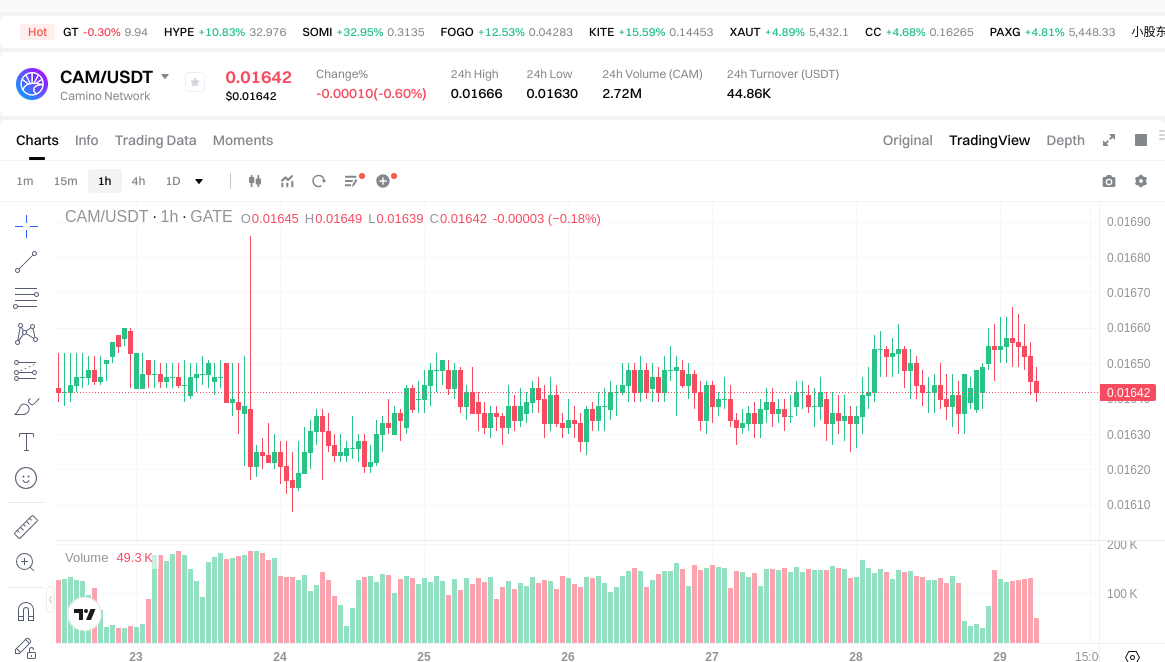
CAM is a cryptocurrency asset in the digital asset space. Launched in 2025, it has been developed specifically for the travel industry sector. As of January 29, 2026, CAM has a market capitalization of approximately $5.24 million, with a circulating supply of around 318.95 million tokens, and the current price is maintained at approximately $0.01642. With its positioning as a Layer 1 blockchain designed for the $11 trillion travel industry, CAM has gradually become a focal point for investors discussing "Is Camino Network (CAM) a good investment?" The network is operated by over 100 established travel companies and has received $10 million in funding support. Currently, over 200 brands are building dApps and web3 travel B2B and B2C products on the platform. This article will comprehensively analyze CAM's investment value, historical trends, future price predictions, and investment risks to provide reference for investors.
I. Camino Network (CAM) Price History Review and Current Investment Value Status
- 2025: On January 29, CAM reached a notable price level of $0.19806 → early participants experienced significant returns
- 2025: Throughout the year, market dynamics shifted → CAM price fluctuated between various levels as the project developed
- Late 2025 into 2026: Market adjustment phase → price declined from earlier peaks to approximately $0.01642
Current CAM Investment Market Status (January 2026)
- CAM current price: $0.01642
- 24-hour trading volume: $44,932.19
- Market capitalization: $5,237,140.01
- Circulating supply: 318,948,843.29 CAM (31.89% of total supply)
Click to view real-time CAM market price
As of January 29, 2026, CAM trades at $0.01642, representing price movement over recent periods. The token shows variation across different timeframes: -0.54% over 1 hour, -0.48% over 24 hours, +0.54% over 7 days, -1.08% over 30 days, and -85.19% over 1 year. With a market ranking of 1509 and trading volume of approximately $44,932, CAM maintains active market participation. The circulating supply represents approximately 32% of the maximum supply of 1 billion tokens, with a market cap to fully diluted valuation ratio of 31.89%.
II. Core Factors Influencing Whether CAM is a Good Investment
Supply Mechanism and Scarcity (CAM investment scarcity)
- Supply Structure → Camino Network has a maximum supply of 1,000,000,000 CAM tokens, with a current circulating supply of approximately 318,948,843 tokens (31.89% of total supply). This controlled release mechanism may influence price dynamics and investment considerations over time.
- Token Distribution → The tokenomics include 4.30% (43 million CAM) allocated for seed investment with a 3-year lockup period, and 5% (50 million CAM) used in pre-sale stages. Such vesting schedules could affect supply pressure and market liquidity in the coming periods.
- Investment Consideration → The relatively low circulating supply ratio compared to maximum supply suggests that future token releases may impact scarcity dynamics, which investors should monitor as a factor in long-term value assessment.
Institutional Investment and Mainstream Adoption (Institutional investment in CAM)
- Industry Backing → Camino Network is operated by over 100 established travel companies and has received $10 million in funding, indicating institutional support within the travel sector.
- Enterprise Adoption → Major brands such as the Lufthansa Group (valued at €35 billion) have joined the network. Over 200 brands are reportedly building dApps and web3 travel products on the platform, which may contribute to ecosystem development.
- Sector-Specific Focus → The network targets the $11 trillion travel industry, aiming to address pain points including payment fees, settlement delays, and reconciliation complexities. The extent of mainstream adoption within this specific sector may influence investment prospects.
Macroeconomic Environment Impact on CAM Investment
- Market Cycle Dependency → According to available analyses, bullish scenarios for Camino Network depend on favorable macroeconomic and cryptocurrency cycle environments, suggesting sensitivity to broader market conditions.
- Industry-Specific Factors → As a blockchain focused on the travel industry, CAM's investment outlook may be influenced by recovery trends and digital transformation initiatives within tourism and hospitality sectors.
- Regulatory Considerations → The regulatory environment for blockchain applications in travel and payment systems could affect adoption rates and, consequently, investment dynamics.
Technology and Ecosystem Development (Technology & Ecosystem for CAM investment)
- Unified API Architecture → Camino Network implements a unified request-response model designed to replace thousands of traditional APIs, potentially streamlining backend operations for travel booking, loyalty programs, hotel, airline, cruise, and rental car systems.
- Ecosystem Connectivity → The platform's "connect to one, connect to all" approach aims to link millions of travel suppliers, which could support long-term value propositions if adoption continues to expand.
- Active Transaction Processing → The network is processing real business transactions with ongoing development of B2B and B2C products, indicating operational activity beyond conceptual stages. The continued growth and functionality of these applications may serve as indicators for assessing investment potential.
III. CAM Future Investment Forecast and Price Outlook (Is Camino Network (CAM) worth investing in 2026-2031)
Short-term Investment Forecast (2026, short-term CAM investment outlook)
Based on current market dynamics and technical indicators, CAM's short-term trajectory in 2026 reflects cautious optimism. Multiple forecasting models suggest the following scenarios:
- Conservative forecast: $0.0097 - $0.0165 USD
- Neutral forecast: $0.0165 - $0.0179 USD
- Optimistic forecast: $0.0179 - $0.0192 USD
These projections incorporate CAM's current trading pattern around $0.0164, with 24-hour volatility indicating modest downward pressure of -0.48%. The token's circulating supply of approximately 318.95 million CAM (31.89% of total supply) provides room for controlled market movement without excessive dilution risks.
Mid-term Investment Outlook (2027-2028, mid-term Camino Network (CAM) investment forecast)
-
Market phase expectation: CAM is anticipated to enter a gradual expansion phase during 2027-2028, potentially driven by increased adoption within the travel industry sector. The network's positioning as a specialized Layer 1 blockchain for the $11 trillion travel industry may attract strategic partnerships and B2B implementations.
-
Investment return forecast:
- 2027: $0.0173 - $0.0262 USD (representing potential growth of 8% from 2026 average)
- 2028: $0.0181 - $0.0286 USD (representing potential growth of 34% from 2026 average)
-
Key catalysts: The successful integration of major travel brands (such as the reported involvement of Lufthansa Group valued at €35 billion), expansion of dApp ecosystem with over 200 brands building on the network, and the practical resolution of industry pain points including high payment fees and settlement inefficiencies may serve as growth drivers.
Long-term Investment Outlook (Is CAM a good long-term investment?)
- Base scenario: $0.0220 - $0.0349 USD by 2029-2031 (assuming steady network adoption and moderate market conditions)
- Optimistic scenario: $0.0286 - $0.0443 USD by 2030-2031 (assuming accelerated enterprise adoption and favorable macro environment)
- Risk scenario: Below $0.013 USD (considering potential market corrections or adoption challenges)
View CAM long-term investment and price forecast: Price Prediction
2026-01-29 - 2031 Long-term Outlook
- Base scenario: $0.0220 - $0.0314 USD (corresponding to steady progress and incremental mainstream application growth)
- Optimistic scenario: $0.0286 - $0.0414 USD (corresponding to large-scale adoption and favorable market environment)
- Transformative scenario: Above $0.0443 USD (subject to breakthrough ecosystem developments and mainstream penetration)
- 2031-12-31 projected high: $0.0443 USD (based on optimistic development assumptions)
Disclaimer: These forecasts are derived from technical analysis models and available market data. Cryptocurrency investments carry substantial risk. Price predictions should not be construed as financial advice. Market conditions, regulatory developments, and technological factors may significantly impact actual outcomes. Investors should conduct independent research and consider their risk tolerance before making investment decisions.
| Year |
Predicted High Price |
Predicted Average Price |
Predicted Low Price |
Price Change |
| 2026 |
0.0192231 |
0.01643 |
0.0096937 |
0 |
| 2027 |
0.0262050285 |
0.01782655 |
0.0172917535 |
8 |
| 2028 |
0.028620526025 |
0.02201578925 |
0.018052947185 |
34 |
| 2029 |
0.0313945154705 |
0.0253181576375 |
0.022026797144625 |
54 |
| 2030 |
0.04140025136884 |
0.028356336554 |
0.02240150587766 |
72 |
| 2031 |
0.044295433331003 |
0.03487829396142 |
0.031390464565278 |
112 |
IV. CAM Investment Strategy and Risk Management (How to invest in Camino Network)
Investment Methodology (CAM investment strategy)
Long-term Holding (HODL CAM): Suitable for conservative investors
For investors with a long-term perspective, holding CAM may align with the network's development trajectory in the travel industry. The project's backing by over 100 established travel companies and involvement of major brands provides fundamental support. However, investors should consider the current circulating supply ratio of approximately 31.89% and the potential impact of future token releases on price dynamics.
Active Trading: Based on technical analysis and swing trading
Active traders may consider CAM's price movements within established ranges. As of January 29, 2026, CAM is trading at $0.01642, with 24-hour high and low points at $0.01666 and $0.0163 respectively. The token has shown varied performance across different timeframes: -0.54% (1H), -0.48% (24H), +0.54% (7D), -1.08% (30D), and -85.19% (1Y). Technical traders should note the relatively low 24-hour trading volume of approximately $44,932, which may affect liquidity and execution.
Risk Management (Risk management for CAM investment)
Asset Allocation Ratio: Conservative / Aggressive / Professional investors
- Conservative investors: May consider allocating 1-3% of their crypto portfolio to CAM, given the token's early stage and industry-specific focus
- Aggressive investors: Could allocate 5-10% while maintaining awareness of the token's volatility and relatively limited exchange availability (currently listed on 1 exchange)
- Professional investors: May implement dynamic allocation strategies based on market conditions and project development milestones
Risk Hedging Solutions: Multi-asset portfolio + hedging instruments
Investors may consider diversifying across multiple sectors within the crypto space to reduce concentration risk. Given CAM's specific focus on the travel industry, portfolio construction should account for sector-specific risks. The market capitalization of approximately $5.24 million and market cap to fully diluted valuation ratio of 31.89% suggest significant potential dilution risks that require careful monitoring.
Secure Storage: Hot/cold wallets + hardware wallet recommendations
CAM holders should prioritize security measures appropriate to their holdings. For substantial amounts, hardware wallets provide enhanced security. Users should verify official wallet compatibility through Camino Network's official channels and maintain custody of private keys. Given the token's use of the CAM algorithm, investors should ensure their chosen storage solution supports this specification.
V. CAM Investment Risks and Challenges (Risks of investing in Camino Network)
Market Risk: High volatility and price dynamics
CAM exhibits considerable price fluctuations, as evidenced by its annual performance decline and historical price range. The token's 24-hour market dominance of 0.00051% indicates limited market presence, which may contribute to price volatility. The relatively low trading volume may result in wider bid-ask spreads and potential challenges in executing larger orders without significant price impact.
Regulatory Risk: Policy uncertainty across jurisdictions
As a blockchain network targeting the travel industry, CAM may face regulatory considerations from both cryptocurrency and travel industry regulators. The involvement of major travel companies, including those operating in heavily regulated aviation and hospitality sectors, introduces complexity regarding compliance requirements. Changes in cryptocurrency regulations or travel industry standards across different jurisdictions could affect network adoption and token utility.
Technical Risk: Network security vulnerabilities and upgrade challenges
As a Layer 1 blockchain network, CAM faces inherent technical risks related to network security, consensus mechanism reliability, and smart contract vulnerabilities. The project's approach to consolidating travel industry APIs into a unified model represents a complex technical undertaking that may encounter implementation challenges. Investors should monitor network performance metrics, validator participation, and the successful execution of planned technical upgrades.
VI. Conclusion: Is Camino Network a Good Investment?
Investment Value Summary: CAM represents a specialized blockchain project targeting the travel industry with backing from established companies. The token's performance indicates early-stage development characteristics with significant volatility.
Investor Recommendations:
✅ Beginners: Consider smaller allocations and secure wallet storage. Focus on understanding the project's fundamentals and the travel industry's blockchain adoption trajectory before committing significant capital.
✅ Experienced Investors: May employ measured position-building strategies while monitoring project development milestones, partnership announcements, and network adoption metrics. Technical analysis should account for limited liquidity conditions.
✅ Institutional Investors: Could evaluate CAM within a broader travel technology and blockchain infrastructure thesis, considering the long-term potential of blockchain integration in the travel industry while maintaining appropriate risk parameters.
⚠️ Disclaimer: Cryptocurrency investment involves substantial risk. This content is for informational purposes only and does not constitute investment advice. Investors should conduct their own research and consult with financial advisors before making investment decisions.
VII. FAQ
Q1: Is Camino Network (CAM) a good investment for beginners in 2026?
CAM may be suitable for beginners who approach it with caution and modest capital allocation. As of January 29, 2026, CAM trades at $0.01642 with a market capitalization of approximately $5.24 million, positioning it as a small-cap cryptocurrency with specialized focus on the travel industry. Beginners should consider allocating only 1-3% of their crypto portfolio to CAM, given its early-stage development and high volatility characteristics. The token has experienced an 85.19% decline over the past year, which underscores the importance of risk management. New investors should prioritize understanding the project's fundamentals, including its backing by over 100 travel companies and the $10 million funding it has received, before committing capital. Secure storage through hardware wallets and thorough research of the project's development milestones are essential steps for beginners considering CAM investment.
Q2: What factors could drive CAM price growth in the next 3-5 years?
Several key factors could influence CAM's price trajectory through 2031. The primary growth catalyst centers on mainstream adoption within the $11 trillion travel industry, particularly as the network aims to streamline operations for booking systems, loyalty programs, and payment settlements. The involvement of major brands such as the Lufthansa Group (valued at €35 billion) and over 200 brands building dApps on the platform provides fundamental support for potential growth. Technical forecasts suggest a range of $0.0220-$0.0443 by 2031, assuming steady to accelerated adoption scenarios. Additionally, the controlled token release mechanism—with only 31.89% of the 1 billion maximum supply currently circulating—may create scarcity dynamics as the ecosystem matures. However, investors should note that these projections depend heavily on favorable macroeconomic conditions, successful resolution of travel industry pain points (such as high payment fees and settlement delays), and the broader cryptocurrency market cycle.
Q3: What are the main risks associated with investing in CAM?
Investing in CAM carries several significant risks that potential investors must carefully evaluate. Market risk is substantial, evidenced by the token's 85.19% annual decline and relatively low 24-hour trading volume of approximately $44,932, which can result in high volatility and wider bid-ask spreads. The token's market dominance of only 0.00051% indicates limited market presence and potential liquidity challenges for larger transactions. Regulatory risk represents another concern, as CAM operates at the intersection of cryptocurrency and travel industry regulations, with potential compliance requirements across multiple jurisdictions affecting major travel companies. Technical risks include network security vulnerabilities inherent to Layer 1 blockchains and the complexity of consolidating thousands of traditional travel APIs into a unified system. Additionally, token dilution risk exists as only 31.89% of the maximum supply currently circulates, with seed investments locked for 3 years potentially creating future supply pressure. The project's success depends heavily on continued adoption by travel industry partners, which remains uncertain.
Q4: How does CAM's tokenomics structure affect its investment potential?
CAM's tokenomics structure presents both opportunities and challenges for investors. The network has a maximum supply of 1,000,000,000 CAM tokens, with approximately 318,948,843 tokens (31.89%) currently in circulation. This relatively low circulating ratio suggests potential for future token releases that could impact supply dynamics and price pressure. The token distribution includes 4.30% (43 million CAM) allocated for seed investment with a 3-year lockup period and 5% (50 million CAM) used in pre-sale stages. These vesting schedules indicate that controlled releases will occur over time, which investors should monitor as they may affect short to medium-term price movements. The market cap to fully diluted valuation ratio of 31.89% reveals significant potential dilution risk that requires careful consideration in investment decisions. However, the structured release mechanism could also support price stability by preventing sudden supply shocks. Investors evaluating CAM should assess how future token unlocks align with network adoption milestones and whether increasing demand from travel industry applications can absorb additional supply without adverse price impact.
Q5: What makes CAM different from other cryptocurrency investments?
CAM distinguishes itself through its sector-specific focus on the $11 trillion travel industry, operating as a Layer 1 blockchain designed exclusively for travel-related applications. Unlike general-purpose blockchains, CAM implements a unified request-response model aimed at replacing thousands of traditional APIs used in travel booking, loyalty programs, hotel, airline, cruise, and rental car systems. The network's "connect to one, connect to all" approach creates potential network effects by linking millions of travel suppliers. CAM benefits from backing by over 100 established travel companies and has attracted major brands including the Lufthansa Group to build on its platform. This industry-specific positioning means CAM's investment prospects are closely tied to blockchain adoption within the travel sector, rather than broader cryptocurrency market trends alone. The network is actively processing real business transactions with over 200 brands developing B2B and B2C products, indicating operational activity beyond conceptual stages. However, this specialization also means CAM's success depends heavily on continued travel industry digitalization and the willingness of traditional travel companies to adopt blockchain solutions.
Q6: What investment strategy works best for CAM in current market conditions?
Given CAM's current market position and characteristics as of January 29, 2026, investors should consider strategies aligned with their risk tolerance and investment horizon. For long-term investors (HODL strategy), CAM may suit those who believe in the travel industry's blockchain transformation trajectory and can withstand significant volatility. Conservative long-term holders should limit CAM to 1-3% of their crypto portfolio, while aggressive investors might allocate 5-10% if confident in the project's fundamentals. The backing by over 100 travel companies provides fundamental support for this approach. Active traders employing swing trading strategies should carefully analyze CAM's technical patterns within its established ranges—currently trading between $0.0163 and $0.01666 on a 24-hour basis—while accounting for limited liquidity conditions that may affect execution. Dollar-cost averaging could help mitigate volatility risks for those building positions over time. Regardless of strategy, investors should implement proper risk management through secure storage solutions (hardware wallets for substantial holdings), diversification across multiple crypto sectors to reduce concentration risk, and regular monitoring of project development milestones including partnership announcements and network adoption metrics.
Q7: How should investors evaluate CAM's progress and determine exit points?
Investors should establish clear monitoring frameworks and exit criteria when investing in CAM. Key performance indicators to track include network adoption metrics such as the number of active travel companies using the platform (currently over 100), growth in dApp deployments (currently over 200 brands building), and transaction volume processing on the network. Price-based metrics should consider CAM's movement relative to technical forecast ranges: conservative ($0.0097-$0.0165), neutral ($0.0165-$0.0179), and optimistic ($0.0179-$0.0192) for 2026. Fundamental milestones to monitor include major partnership announcements, successful integration of additional travel brands, resolution of technical challenges in API consolidation, and expansion into new travel industry segments. Investors should establish predetermined exit points based on both gains and losses—for example, taking partial profits if CAM reaches upper forecast ranges, or implementing stop-losses if the price falls below critical support levels around $0.013. Regular assessment of the broader travel industry's digital transformation progress and cryptocurrency regulatory developments should inform hold-or-sell decisions. Additionally, monitoring the circulating supply ratio and future token unlock schedules can help anticipate potential supply-driven price pressures that might warrant position adjustments.
Q8: Is CAM suitable for institutional investment portfolios?
CAM presents a specialized opportunity for institutional investors evaluating travel technology and blockchain infrastructure investments, though it requires careful positioning within portfolio parameters. The project's backing by established travel companies and involvement of major brands like the Lufthansa Group (€35 billion valuation) provides institutional credibility. With a current market capitalization of approximately $5.24 million, CAM represents a micro-cap exposure that institutional investors might consider as part of a broader venture-stage blockchain investment strategy rather than core holdings. Institutions should evaluate CAM within the context of the travel industry's $11 trillion market size and assess the potential for blockchain-based payment and settlement solutions to capture meaningful market share. The network's focus on resolving industry pain points such as high payment fees, settlement delays, and reconciliation complexities aligns with institutional investment theses around efficiency improvements through technology. However, institutional investors must account for significant risks including limited liquidity (24-hour trading volume of approximately $44,932), single exchange listing, and the early-stage nature of travel industry blockchain adoption. Appropriate due diligence should include assessment of the network's technical architecture, validator composition, governance structure, and realistic timelines for mainstream adoption before committing institutional capital.
* The information is not intended to be and does not constitute financial advice or any other recommendation of any sort offered or endorsed by Gate.