This comprehensive analysis examines whether Cardano (ADA) represents a sound investment opportunity in 2026. As the 11th-ranked cryptocurrency with a market cap of $14.39 billion trading at $0.3922, ADA combines research-driven technology and proof-of-stake efficiency with notable volatility. The article evaluates Cardano's fixed supply cap of 45 billion tokens, institutional adoption drivers including 70 million ADA treasury allocations for stablecoin and oracle infrastructure, and ecosystem development across DeFi and NFT platforms. Price projections span conservative ($0.24-$0.40 in 2026) to optimistic scenarios ($0.56-$1.97 through 2031). Critical investment considerations include market risks (59.55% annual decline), regulatory uncertainties, and technical implementation challenges balanced against long-term technological potential. Suitable for diversified portfolios with appropriate risk management, though substantial volatility demands careful position sizing and secure storage practices on Gate exch
Introduction: Cardano (ADA)'s Investment Position and Market Outlook
ADA is a significant asset in the cryptocurrency sector. Launched in October 2017, it has achieved notable progress in blockchain technology and financial applications. As of January 13, 2026, Cardano maintains a market capitalization of approximately $14.39 billion with a circulating supply of around 36.68 billion tokens, and the current price stands at $0.3922. Ranked 11th by market capitalization and accounting for 0.53% of the total crypto market share, ADA has become a focal point when investors discuss "Is Cardano (ADA) a good investment?" The platform operates as a layered blockchain protocol designed for digital fund transfers and financial applications, with its architecture allowing flexibility for maintenance and upgrades. This article provides a comprehensive analysis of Cardano's investment value, historical price movements, future price predictions, and associated investment risks to serve as a reference for investors.
I. Cardano (ADA) Price History Review and Current Investment Value
- 2017: ADA launched at $0.0026, marking the beginning of the Cardano ecosystem.
- 2021: Cardano reached a significant milestone in March 2021, with price appreciation followed by trading around $1.6 in early June. The market capitalization reached approximately $52 billion, ranking 6th among cryptocurrencies.
- 2021: In September 2021, ADA reached a notable peak during the market cycle, demonstrating substantial growth from earlier periods.
- 2024: The asset experienced considerable volatility, with price declining approximately 60% during the year, reflecting broader market conditions.
Current ADA Investment Market Status (January 2026)
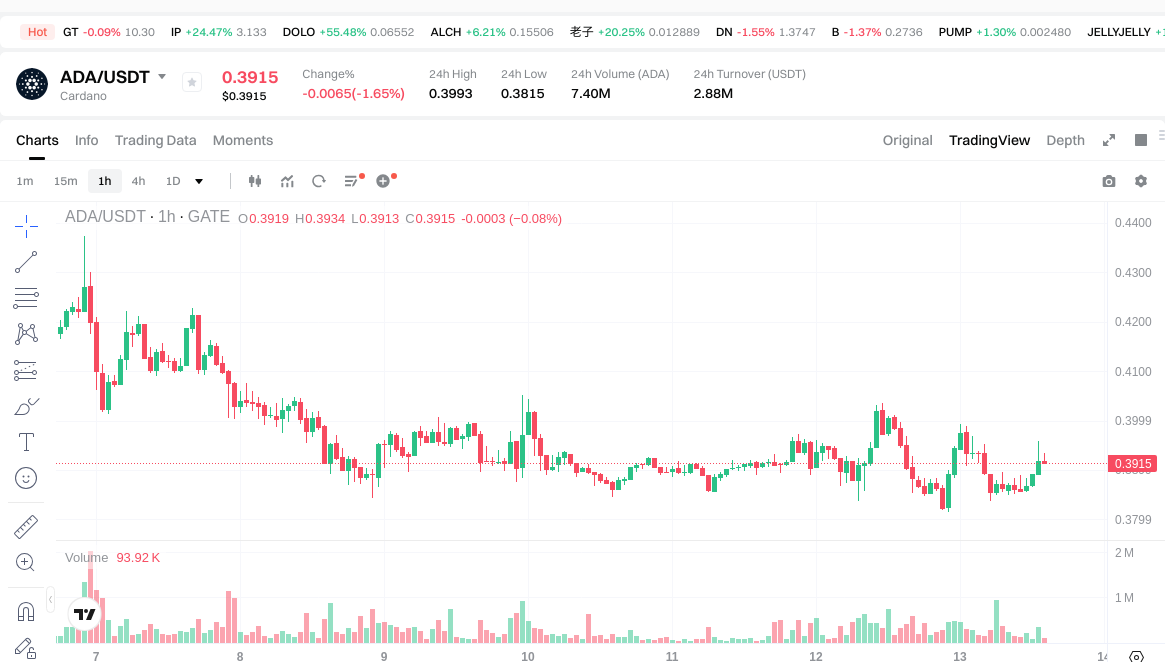
- ADA Current Price: $0.3922
- 24-Hour Trading Volume: Approximately $2.88 billion in trading activity
- Market Capitalization: $14.39 billion, with a circulating supply of 36.68 billion ADA tokens
- Market Share: 0.53% of the total cryptocurrency market
- Price Movement: 24-hour change of -1.73%, with 7-day decline of -7.38%
Click to view real-time ADA market price
II. Core Factors Influencing Whether ADA is a Good Investment
Supply Mechanism and Scarcity (ADA Investment Scarcity)
- Supply characteristics → Influence on price and investment value
- Cardano has a maximum supply of 45,000,000,000 ADA tokens with approximately 36,683,447,622 tokens currently in circulation, representing 81.52% of the total supply
- The fixed supply cap creates a defined scarcity framework that distinguishes ADA from assets with unlimited issuance
- Investment significance: The predetermined supply ceiling may support long-term value considerations as adoption increases
Institutional Investment and Mainstream Adoption (Institutional Investment in ADA)
- On January 8, Cardano's governance approved a 70 million ADA treasury allocation to support stablecoin integrations (USDC/USDT), oracle infrastructure (Pyth Network), and cross-chain functionality
- Enhanced infrastructure development may facilitate institutional participation and ecosystem expansion
- The research-driven approach and proof-of-stake consensus mechanism have attracted attention from investors seeking energy-efficient blockchain solutions
- Cardano's focus on regulatory-friendly design positions it for potential enterprise and government adoption scenarios
Macroeconomic Environment's Impact on ADA Investment
- Broader cryptocurrency market conditions influence ADA performance, with analyst observations noting that when Bitcoin maintains key support levels and Ethereum advances, alternative tokens like ADA may experience corresponding movements
- Market volatility remains a characteristic factor, with ADA experiencing price fluctuations that align with general crypto asset behavior patterns
- Early 2026 data shows ADA rebounded from support levels around $0.33–$0.35, demonstrating technical resilience during market corrections
- The cryptocurrency's performance reflects sensitivity to macroeconomic conditions affecting digital asset valuations generally
Technology and Ecosystem Development (Technology & Ecosystem for ADA Investment)
- Cardano distinguishes itself through a research-driven, peer-reviewed development approach emphasizing academic rigor
- The platform utilizes a layered architecture separating settlement and computation functions, designed to enhance system flexibility and upgrade capability
- Proof-of-stake consensus mechanism offers energy efficiency compared to proof-of-work alternatives
- Ecosystem applications span DeFi protocols, NFT platforms, and smart contract functionality supporting decentralized applications
- Development roadmap focuses on identity solutions, scalable smart contracts, and cross-chain interoperability to expand utility
- Platform maturation with growing DeFi and NFT deployments represents ongoing ecosystem evolution
III. ADA Future Investment Prediction and Price Outlook (Is Cardano(ADA) worth investing in 2026-2031)
Short-term Investment Prediction (2026, short-term ADA investment outlook)
Based on available market analysis, short-term projections for Cardano (ADA) in 2026 suggest varied scenarios:
- Conservative prediction: $0.24 - $0.40
- Neutral prediction: $0.39 - $0.49
- Optimistic prediction: $0.49 - $0.66
Technical indicators point to ADA trading within a consolidation range following its late-2025 retracement. The asset faces notable resistance levels at $1.00 and $1.30, with current support potentially establishing around the $0.32-$0.40 zone. Market participants appear to be pricing in potential regulatory developments and ecosystem advancement, though near-term catalysts remain subject to broader market conditions.
Mid-term Investment Outlook (2027-2028, mid-term Cardano(ADA) investment forecast)
- Market Stage Expectation: Gradual recovery phase with potential ecosystem maturation and enhanced DeFi integration
- Investment Return Prediction:
- 2027: $0.41 - $0.66
- 2028: $0.31 - $0.65
- Key Catalysts: Network upgrades including Ouroboros Linear Leios implementation, cross-chain collaboration developments, regulatory classification outcomes, and DeFi protocol adoption trends
The mid-term outlook reflects uncertainty regarding ADA's ability to reclaim previous cycle highs. Historical patterns suggest the asset may face challenges in surpassing its 2021 peak of approximately $3.10 during this timeframe, though incremental progress in ecosystem development could support moderate appreciation.
Long-term Investment Outlook (Is ADA a good long-term investment?)
- Baseline Scenario: $0.35 - $0.70 (assuming steady ecosystem development and maintained market position)
- Optimistic Scenario: $0.56 - $1.97 (assuming accelerated adoption, successful technical implementations, and favorable regulatory environment)
- Risk Scenario: $0.25 - $0.40 (assuming extended consolidation, competitive pressures, or adverse market conditions)
Click to view ADA long-term investment and price prediction: Price Prediction
2026-01-13 to 2031 Long-term Outlook
- Baseline Scenario: $0.35 - $0.96 (corresponding to steady progress and gradual mainstream application enhancement)
- Optimistic Scenario: $0.56 - $1.97 (corresponding to large-scale adoption and favorable market environment)
- Transformative Scenario: Above $3.00 (contingent on breakthrough ecosystem developments and mainstream proliferation)
- 2031-12-31 Predicted High: $0.96 (based on optimistic development assumptions)
Disclaimer: The information presented represents analytical projections based on historical data, technical indicators, and market sentiment analysis as of January 2026. Cryptocurrency markets demonstrate substantial volatility, and actual outcomes may vary materially from predictions. These projections do not constitute financial advice, investment recommendations, or guarantees of future performance. Market participants should conduct independent research, consider multiple perspectives, and consult qualified financial advisors before making investment decisions. Factors including but not limited to regulatory developments, macroeconomic conditions, technological progress, competitive dynamics, and broader market sentiment may significantly impact actual price movements. Past performance does not indicate future results.
| Year |
Predicted High Price |
Predicted Average Price |
Predicted Low Price |
Price Change |
| 2026 |
0.489625 |
0.3917 |
0.238937 |
0 |
| 2027 |
0.656587125 |
0.4406625 |
0.4054095 |
12 |
| 2028 |
0.64737727875 |
0.5486248125 |
0.307229895 |
39 |
| 2029 |
0.69966122338125 |
0.598001045625 |
0.3229205646375 |
52 |
| 2030 |
0.700737625263375 |
0.648831134503125 |
0.564483087017718 |
65 |
| 2031 |
0.958193819434215 |
0.67478437988325 |
0.35088787753929 |
71 |
IV. ADA Investment Strategy and Risk Management (How to invest in Cardano)
Investment Methodology (ADA investment strategy)
Investors can consider different approaches when investing in ADA:
-
Long-term holding (HODL ADA): This strategy suits conservative investors who believe in Cardano's long-term technological development and ecosystem growth. Holding ADA over extended periods may help smooth out short-term price fluctuations.
-
Active trading: This approach relies on technical analysis and swing trading techniques. Traders monitor price movements, support and resistance levels, and market trends to execute short-to-medium term trades.
Risk Management (Risk management for ADA investment)
-
Asset allocation ratio: Conservative investors might allocate 5-10% of their portfolio to ADA, moderate investors 10-20%, while aggressive investors may consider higher allocations. Professional investors should determine positions based on comprehensive risk assessment and portfolio objectives.
-
Risk hedging approach: Diversification across multiple digital assets and traditional assets can help manage exposure. Some investors use stablecoins or derivatives as hedging instruments to mitigate downside risks.
-
Secure storage: Cold wallets provide offline storage with enhanced security for long-term holdings. Hot wallets offer convenience for active trading but require careful security practices. Hardware wallets from established providers are recommended for significant holdings.
V. ADA Investment Risks and Challenges (Risks of investing in Cardano)
-
Market risks: ADA has shown notable price volatility, with 24-hour changes reaching -1.73% and 7-day movements of -7.38% as of January 13, 2026. The 1-year performance indicates a -59.55% decline. Price movements can be influenced by broader cryptocurrency market trends and trading activities.
-
Regulatory risks: Different jurisdictions maintain varying regulatory frameworks for cryptocurrencies. Policy changes or new regulations in major markets could impact ADA's trading, usage, and overall market dynamics.
-
Technical risks: As with blockchain platforms, potential concerns include network security vulnerabilities, smart contract bugs, and technical challenges during protocol upgrades. While Cardano's layered architecture is designed for flexibility and maintainability, implementation of new features carries inherent technical risks.
VI. Conclusion: Is Cardano a Good Investment?
-
Investment value summary: ADA demonstrates characteristics of both growth potential and notable volatility. The project's technology platform approach and layered architecture represent long-term developmental direction, though short-term price movements have shown significant fluctuations.
-
Investor recommendations:
✅ Beginners: Consider dollar-cost averaging with secure wallet storage
✅ Experienced investors: May explore swing trading combined with diversified portfolio allocation
✅ Institutional investors: Could evaluate strategic long-term positioning based on comprehensive due diligence
⚠️ Notice: Cryptocurrency investment carries substantial risks. This content is for informational purposes only and does not constitute investment advice.
VII. FAQ
Q1: Is Cardano (ADA) a good investment for beginners in 2026?
ADA may be suitable for beginners who understand cryptocurrency risks and adopt conservative investment strategies. As of January 2026, Cardano trades at $0.3922 with a market capitalization of $14.39 billion, ranking 11th among cryptocurrencies. The platform's research-driven approach, proof-of-stake consensus mechanism, and layered architecture provide technological foundations for long-term development. However, beginners should note that ADA experienced a -59.55% decline over the past year, demonstrating significant volatility. Recommended approaches include dollar-cost averaging to smooth out price fluctuations, allocating only 5-10% of portfolio to ADA, and utilizing secure cold wallet storage for holdings. Understanding that cryptocurrency investments carry substantial risks and conducting independent research before investing is essential.
Q2: What is Cardano's maximum supply and how does it affect investment value?
Cardano has a fixed maximum supply of 45 billion ADA tokens, with approximately 36.68 billion tokens (81.52%) currently in circulation. This predetermined supply cap creates a scarcity framework that distinguishes ADA from cryptocurrencies with unlimited issuance. The fixed supply ceiling means no additional tokens can be created beyond this limit, potentially supporting long-term value considerations as adoption increases. Unlike proof-of-work systems requiring continuous token issuance for mining rewards, Cardano's proof-of-stake mechanism distributes existing tokens through staking rewards. This supply structure may appeal to investors seeking assets with defined scarcity characteristics, though supply alone does not guarantee price appreciation—actual value depends on adoption, utility, and broader market conditions.
Q3: What are the key risks of investing in ADA?
Investing in ADA involves three primary risk categories. Market risk remains significant, with recent data showing -1.73% change in 24 hours, -7.38% over 7 days, and -59.55% annually, reflecting substantial price volatility influenced by broader cryptocurrency market trends. Regulatory risk stems from varying jurisdictional frameworks for digital assets—policy changes in major markets could impact ADA's trading, usage, and market dynamics. Technical risk includes potential network security vulnerabilities, smart contract bugs, and challenges during protocol upgrades, though Cardano's layered architecture is designed to mitigate these concerns. Additionally, competitive pressures from other blockchain platforms and macroeconomic factors affecting overall crypto market sentiment present ongoing challenges. Investors should implement appropriate risk management strategies including portfolio diversification, position sizing based on risk tolerance, and secure storage practices.
Q4: How does Cardano's technology differentiate it from other cryptocurrencies?
Cardano distinguishes itself through several technological approaches. The platform employs a research-driven, peer-reviewed development methodology emphasizing academic rigor, contrasting with many blockchain projects' faster development cycles. Its layered architecture separates settlement and computation functions—the Cardano Settlement Layer handles ADA transfers while the Cardano Computation Layer manages smart contracts—enabling independent upgrades and enhanced flexibility. The Ouroboros proof-of-stake consensus mechanism provides energy efficiency compared to proof-of-work alternatives like Bitcoin. Recent governance approvals allocated 70 million ADA to support stablecoin integrations (USDC/USDT), oracle infrastructure (Pyth Network), and cross-chain functionality, demonstrating ecosystem expansion efforts. The platform's focus on regulatory-friendly design and formal verification methods positions it for potential enterprise and government adoption scenarios, though practical implementation and widespread adoption remain ongoing processes.
Q5: What price predictions exist for ADA through 2031?
Price projections for ADA vary based on different scenarios and market conditions. For 2026, conservative predictions suggest $0.24-$0.40, neutral predictions indicate $0.39-$0.49, and optimistic scenarios project $0.49-$0.66. Mid-term outlooks for 2027 range from $0.41-$0.66, while 2028 projections span $0.31-$0.65. Long-term baseline scenarios through 2031 estimate $0.35-$0.96, optimistic scenarios project $0.56-$1.97, with transformative scenarios suggesting potential above $3.00 contingent on breakthrough developments. The predicted high for December 31, 2031 stands at $0.96 under optimistic assumptions. These projections reflect technical analysis, historical patterns, and ecosystem development expectations, though actual outcomes may vary materially. Factors including regulatory developments, macroeconomic conditions, technological progress, and competitive dynamics significantly impact price movements. These predictions do not constitute financial advice or guarantees of future performance.
Q6: Should I invest in ADA for the long term or short term?
The investment timeframe depends on individual risk tolerance, financial goals, and market outlook. Long-term holding (HODL) suits conservative investors believing in Cardano's technological development and ecosystem growth potential over multiple years, helping smooth short-term price volatility. This approach aligns with dollar-cost averaging and position building during market consolidation phases. Short-term active trading relies on technical analysis, support/resistance levels, and market trends for swing trades, requiring more market monitoring and higher risk tolerance. Current market conditions show ADA trading in consolidation ranges with support around $0.32-$0.40 and resistance at $1.00-$1.30. Historical data indicates ADA experienced significant volatility with a -59.55% annual decline, suggesting challenging conditions for short-term traders. Conservative investors might consider 5-10% portfolio allocation, moderate investors 10-20%, with positions sized according to comprehensive risk assessment. Both approaches require secure storage practices and understanding that cryptocurrency investments carry substantial risks.
Q7: What recent developments could impact ADA's investment value?
Several recent developments may influence ADA's trajectory. On January 8, Cardano's governance approved a 70 million ADA treasury allocation supporting stablecoin integrations (USDC/USDT), oracle infrastructure (Pyth Network), and cross-chain functionality—potentially facilitating institutional participation and ecosystem expansion. The development roadmap includes Ouroboros Linear Leios implementation and network upgrades aimed at enhancing scalability and interoperability. Growing DeFi protocol deployments and NFT platform development represent ongoing ecosystem evolution. However, market conditions show ADA rebounded from support levels around $0.33-$0.35 in early 2026 after considerable volatility, with technical indicators suggesting consolidation phases. The asset's performance remains sensitive to broader cryptocurrency market trends, regulatory classification outcomes, and macroeconomic factors affecting digital asset valuations. While technological progress continues, the gap between current prices ($0.3922) and historical peaks (approximately $3.10 in 2021) indicates substantial distance for potential recovery.
Q8: Where can I securely store my ADA investments?
ADA storage options include cold wallets, hot wallets, and hardware wallets, each serving different needs. Cold wallets provide offline storage with enhanced security for long-term holdings, protecting assets from online threats and hacking attempts—recommended for investors planning to hold ADA for extended periods without frequent trading. Hot wallets offer convenience for active trading and regular transactions but require careful security practices including strong passwords, two-factor authentication, and awareness of phishing attempts. Hardware wallets from established providers (such as Ledger or Trezor) combine security benefits of cold storage with user-friendly interfaces, suitable for significant holdings requiring both protection and occasional access. For active traders, reputable cryptocurrency exchanges like Gate.com offer secure custody with trading functionality, though keeping large amounts on exchanges carries counterparty risks. Best practices include diversifying storage methods based on usage patterns, regularly updating wallet software, maintaining secure backup phrases offline, and never sharing private keys or seed phrases. Beginners should prioritize security over convenience and consider starting with hardware wallets for learning proper storage practices.
* The information is not intended to be and does not constitute financial advice or any other recommendation of any sort offered or endorsed by Gate.