This comprehensive guide evaluates whether Cartesi (CTSI) is a worthwhile investment in 2024-2031, analyzing a Layer-2 infrastructure solution currently trading at $0.03435 with a $30.96 million market cap. The article examines CTSI's tokenomics, including its 901.45 million circulating supply (90.15% of total), historical performance from its $1.74 peak in May 2021, and technical differentiation through Linux-based off-chain computing. Price forecasts range from $0.0257-$0.0459 (2026) to $0.0567 (2031 optimistic scenario), with analysis of market risks including -74.5% annual decline and limited market capitalization. Investment strategies encompass long-term HODL approaches and active trading, alongside risk management through portfolio allocation (1-15% depending on investor type) and secure storage on Gate and hardware wallets. The analysis addresses regulatory, technical, and competitive risks while providing guidance for newcomers, experienced investors, and institutions evaluating CTSI's ecosystem deve
Introduction: Cartesi (CTSI) Investment Position and Market Outlook
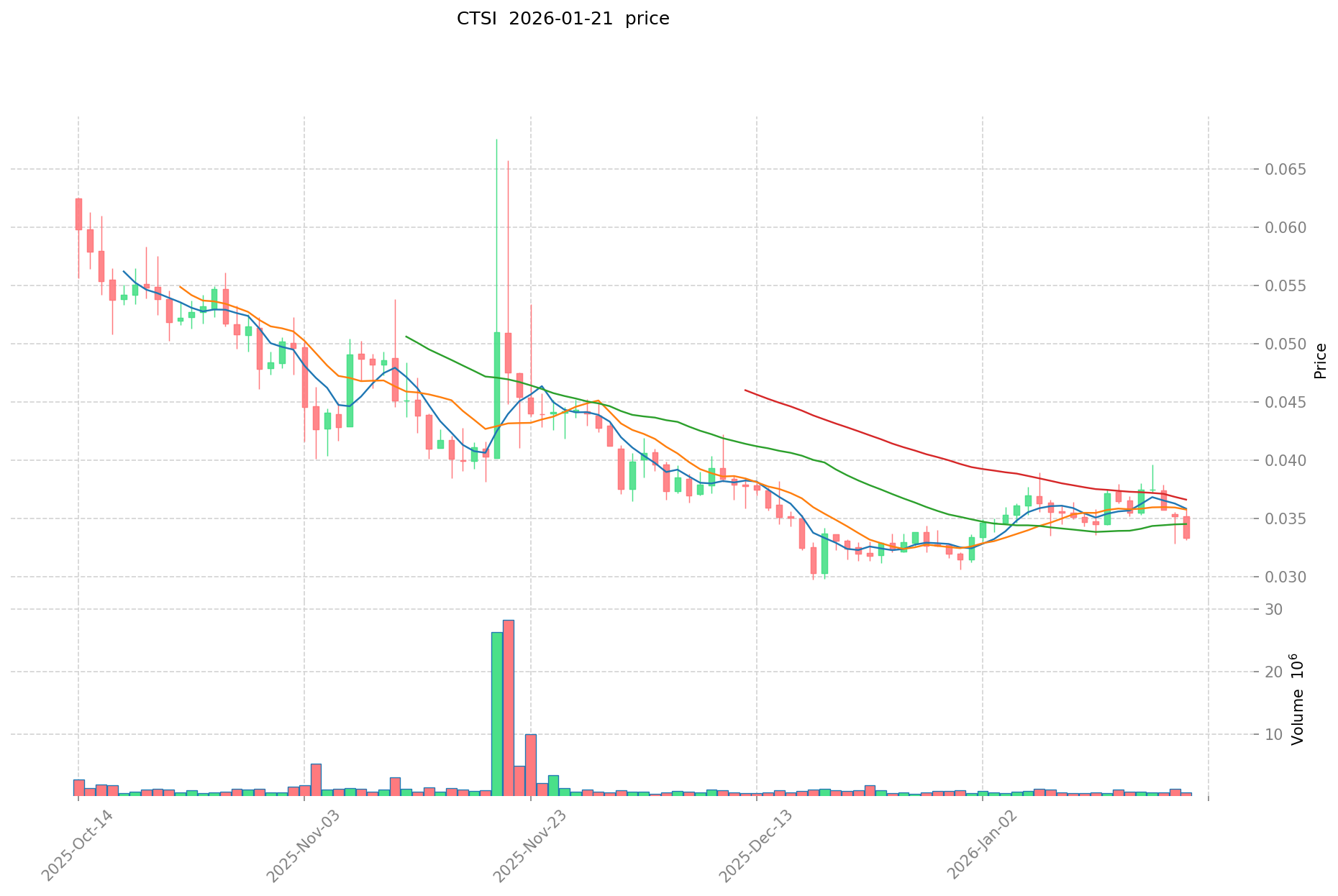
CTSI is a notable asset in the cryptocurrency sector, having been launched in April 2020. As a Layer-2 infrastructure solution, Cartesi aims to provide off-chain computing services in a Linux environment for decentralized applications without compromising security or decentralization. As of January 21, 2026, Cartesi holds a market capitalization of approximately $30.96 million, with a circulating supply of around 901.45 million tokens. The current price is maintained at approximately $0.03435. With its positioning as a development infrastructure enabling complex computations for dApps, CTSI has gradually become a focal point for investors discussing "Is Cartesi (CTSI) a good investment?" This article will comprehensively analyze CTSI's investment value, historical performance trends, future price projections, and associated investment risks to provide reference for investors.
I. CTSI Price History Review and Current Investment Value
- 2021: Token reached significant valuation milestone in May → Price achieved notable level of $1.74
- 2025: Market experienced downward adjustment → CTSI price declined to lower trading range around $0.026
- Recent period: Price showed recovery from previous lows → Trading between $0.026 and current levels
Current CTSI Investment Market Status (January 2026)
- CTSI current price: $0.03435
- Market sentiment (Fear & Greed Index): Data shows neutral sentiment
- 24-hour trading volume: $26,674.10
- Market capitalization: $30,964,921.95
- Circulating supply: 901,453,331.79 CTSI (90.15% of total supply)
- Total supply: 1,000,000,000 CTSI
Click to view real-time CTSI market price
II. Core Factors Affecting Whether CTSI is a Good Investment (Is Cartesi(CTSI) a Good Investment)
Supply Mechanism and Scarcity (CTSI investment scarcity)
- Fixed supply mechanism → Impacts price and investment value
- Historical pattern: CTSI reached a price level of $1.74 in May 2021, while the current circulating supply stands at approximately 901.45 million tokens, representing about 90.15% of the maximum supply of 1 billion tokens
- Investment significance: The circulating supply ratio approaching the maximum supply indicates limited future dilution, which may serve as a factor in long-term investment considerations
Institutional Investment and Mainstream Adoption (Institutional investment in CTSI)
- Holder base: As of current data, CTSI has approximately 20,269 holders, indicating a degree of distribution across the market
- Exchange presence: CTSI is listed on 31 exchanges, providing accessibility for investors across different platforms
- Adoption considerations: The project's focus on providing Layer-2 infrastructure for decentralized applications represents a technical niche within the blockchain ecosystem
Macroeconomic Environment's Impact on CTSI Investment
- Monetary policy and interest rate changes → Alter investment attractiveness
- Inflation environment's hedging role → "Digital gold" positioning
- Geopolitical uncertainty → Enhances CTSI investment demand
Technology and Ecosystem Development (Technology & Ecosystem for CTSI investment)
- Layer-2 infrastructure design: Cartesi enables complex computations to run in Linux environments off-chain without compromising decentralization or security → Enhances technical differentiation
- Developer-friendly environment: Provides familiar development tools and eliminates artificial restrictions, potentially expanding the developer ecosystem → Long-term value support
- Sidechain data storage: dApps can temporarily store data on the Cartesi sidechain governed by Proof-of-Stake (PoS) consensus algorithm, reducing constant communication with the underlying blockchain → Improves scalability for potential applications
III. CTSI Future Investment Forecast and Price Outlook (Is Cartesi(CTSI) worth investing in 2026-2031)
Short-term Investment Forecast (2026, short-term CTSI investment outlook)
- Conservative Forecast: $0.0257 - $0.0343
- Neutral Forecast: $0.0343 - $0.0380
- Optimistic Forecast: $0.0380 - $0.0459
Mid-term Investment Outlook (2027-2029, mid-term Cartesi(CTSI) investment forecast)
-
Market Stage Expectation: The mid-term outlook suggests a gradual recovery phase following recent price corrections, with anticipated ecosystem development potentially supporting price stabilization and moderate growth through 2029.
-
Investment Return Forecast:
- 2027: $0.0233 - $0.0413
- 2028: $0.0358 - $0.0541
- 2029: $0.0375 - $0.0526
-
Key Catalysts: Layer-2 infrastructure adoption trends, Linux-based off-chain computing solutions development, ecosystem expansion activities, and broader decentralized application market conditions.
Long-term Investment Outlook (Is Cartesi a good long-term investment?)
- Base Scenario: $0.0340 - $0.0500 (assuming steady infrastructure development and moderate ecosystem growth)
- Optimistic Scenario: $0.0500 - $0.0590 (assuming accelerated dApp adoption and favorable market conditions for Layer-2 solutions)
- Risk Scenario: $0.0230 - $0.0340 (under challenging market conditions or delayed technology adoption)
View CTSI long-term investment and price forecast: Price Prediction
2026-01-21 - 2031 Long-term Outlook
- Base Scenario: $0.0340 - $0.0500 (corresponding to steady progress and gradual mainstream application growth)
- Optimistic Scenario: $0.0500 - $0.0590 (corresponding to large-scale adoption and favorable market environment)
- Transformative Scenario: Above $0.0590 (if ecosystem achieves breakthrough developments and mainstream adoption)
- 2031-12-31 Predicted High: $0.0567 (based on optimistic development assumptions)
Disclaimer: Price forecasts are subject to market volatility and various risk factors. This analysis does not constitute investment advice.
| Year |
Predicted High Price |
Predicted Average Price |
Predicted Low Price |
Price Change |
| 2026 |
0.0459352 |
0.03428 |
0.02571 |
0 |
| 2027 |
0.041310828 |
0.0401076 |
0.023262408 |
16 |
| 2028 |
0.05414325462 |
0.040709214 |
0.03582410832 |
18 |
| 2029 |
0.0526431200841 |
0.04742623431 |
0.0374667251049 |
38 |
| 2030 |
0.059040919092519 |
0.05003467719705 |
0.034023580493994 |
45 |
| 2031 |
0.056719310070575 |
0.054537798144784 |
0.039267214664244 |
58 |
IV. CTSI Investment Strategy and Risk Management (How to invest in Cartesi)
Investment Strategy (CTSI investment strategy)
Long-term Holding (HODL CTSI)
For conservative investors seeking exposure to blockchain infrastructure projects, long-term holding may be suitable. CTSI focuses on providing off-chain computing services within a Linux environment, which represents a technical approach to scaling decentralized applications. Long-term holders should monitor the project's development progress, ecosystem growth, and adoption metrics.
Active Trading
Active traders may employ technical analysis and swing trading strategies when trading CTSI. The token has exhibited price volatility, with recent data showing a 24-hour change of -1.8% and a 7-day change of -7.58%. Traders should establish clear entry and exit points, utilize stop-loss orders, and monitor trading volume patterns. The 24-hour trading volume of $26,674 suggests moderate liquidity levels.
Risk Management (Risk management for CTSI investment)
Asset Allocation Ratios
- Conservative investors: May consider allocating 1-3% of their crypto portfolio to infrastructure tokens like CTSI, maintaining majority positions in established assets
- Moderate investors: Could allocate 3-7% to Layer-2 and infrastructure projects, balancing growth potential with portfolio stability
- Experienced investors: Might allocate 5-15% based on comprehensive research and risk tolerance, while maintaining diversification
Risk Hedging Approaches
Investors should consider diversifying across multiple asset categories, including Layer-1 protocols, DeFi tokens, and stablecoins. Portfolio rebalancing at regular intervals can help manage exposure to volatile assets. Some investors may employ derivatives or hedging instruments where available on supported exchanges.
Secure Storage
- Cold Wallets: For long-term holdings, consider storing CTSI in hardware wallets that support ERC-20 tokens, as CTSI operates on the Ethereum network
- Hot Wallets: For active trading, use reputable software wallets with strong security features and two-factor authentication
- Hardware Wallet Options: Popular devices supporting ERC-20 tokens can be considered for secure offline storage
- Exchange Storage: Keep only necessary amounts on exchanges for trading purposes, limiting exposure to exchange-related risks
V. CTSI Investment Risks and Challenges (Risks of investing in Cartesi)
Market Risks
High Volatility: CTSI has demonstrated significant price fluctuations, with a one-year change of -74.5%. The token's price range shows considerable variation, with a historical high of $1.74 (May 2021) and a historical low of $0.02607 (October 2025). Current price levels at $0.03435 reflect substantial distance from historical peaks.
Limited Market Capitalization: With a market cap of approximately $30.96 million and a market dominance of 0.0010%, CTSI represents a relatively small market position. Lower market capitalization tokens may experience heightened price sensitivity to trading activity and market sentiment shifts.
Regulatory Risks
Different jurisdictions maintain varying approaches to cryptocurrency regulation. Policy developments regarding Layer-2 solutions, smart contract platforms, and token classifications may impact CTSI's operational environment. Investors should stay informed about regulatory changes in their respective regions and how these may affect holding and trading activities.
Technical Risks
Network Security Considerations: As a Layer-2 infrastructure project, CTSI's security depends on both its own architecture and the underlying Ethereum network. Smart contract vulnerabilities, consensus mechanism issues, or infrastructure failures could potentially affect the protocol's operation.
Development and Upgrade Risks: The project's continued advancement relies on successful technical development, protocol upgrades, and ecosystem expansion. Implementation challenges, delayed roadmap milestones, or technical setbacks could influence market perception and token value.
Competition: The blockchain scalability sector includes numerous projects pursuing similar objectives through various technical approaches. Competitive dynamics within the Layer-2 and infrastructure space may affect CTSI's market position.
VI. Conclusion: Is Cartesi a Good Investment?
Investment Value Summary
CTSI represents an infrastructure-focused project in the blockchain space, targeting off-chain computing solutions for decentralized applications. The token's circulating supply of 901.45 million represents 90.15% of the maximum supply of 1 billion tokens, indicating relatively high circulation compared to total supply.
The project's technical approach focuses on providing Linux-environment computing capabilities while maintaining decentralization and security. However, current market performance shows significant decline from historical highs, with the token trading considerably below its all-time high price level.
Investor Recommendations
✅ Newcomers: Consider starting with small allocations, employing dollar-cost averaging strategies, and storing assets in secure wallets. Thorough research of the project's technical fundamentals and market position is advisable before investing.
✅ Experienced Investors: May evaluate swing trading opportunities based on technical indicators and market conditions, while maintaining diversified portfolio allocations across multiple projects and asset categories.
✅ Institutional Investors: Should conduct comprehensive due diligence on technical architecture, team credentials, development progress, and competitive positioning before considering strategic allocations.
⚠️ Notice: Cryptocurrency investments carry substantial risk, including potential loss of principal. This content is provided for informational purposes only and does not constitute investment advice. Market conditions, project developments, and regulatory environments can change rapidly. Investors should conduct independent research, consider their financial situation and risk tolerance, and consult with qualified financial advisors before making investment decisions.
VII. FAQ
Q1: What makes Cartesi (CTSI) different from other Layer-2 solutions?
Cartesi distinguishes itself by enabling complex computations to run in a Linux environment off-chain while maintaining decentralization and security. Unlike many Layer-2 solutions that focus primarily on transaction scaling, CTSI provides developers with familiar Linux-based tools and removes artificial development restrictions, allowing dApps to perform computationally intensive operations without the limitations of traditional smart contract environments.
Q2: Is CTSI suitable for long-term holding given its current market position?
CTSI may be considered for long-term holding by investors who believe in blockchain infrastructure development and Layer-2 adoption. However, the token currently trades significantly below its all-time high ($0.03435 vs. $1.74 in May 2021) and has experienced a -74.5% decline over one year. Conservative investors should allocate only 1-3% of their crypto portfolio to infrastructure tokens like CTSI, while maintaining diversification across more established assets.
Q3: What are the main risks associated with investing in CTSI?
The primary risks include high price volatility (24-hour change of -1.8% and 7-day change of -7.58%), relatively small market capitalization ($30.96 million with 0.0010% market dominance), regulatory uncertainties affecting Layer-2 solutions, technical risks related to smart contract vulnerabilities, and intense competition in the blockchain scalability sector. Investors should be prepared for potential principal loss and conduct thorough due diligence before investing.
Q4: How does CTSI's circulating supply affect its investment value?
CTSI has a circulating supply of 901.45 million tokens, representing 90.15% of the maximum supply of 1 billion tokens. This high circulation ratio indicates limited future dilution potential, which may serve as a positive factor for long-term investors. With approximately 90% of tokens already in circulation, the risk of significant supply-side selling pressure from new token releases is relatively reduced compared to projects with lower circulation ratios.
Q5: What price forecasts exist for CTSI through 2031?
Short-term forecasts for 2026 range from $0.0257 to $0.0459, with mid-term projections suggesting gradual recovery through 2029 ($0.0375-$0.0526). Long-term outlooks through 2031 present a base scenario of $0.0340-$0.0500, an optimistic scenario of $0.0500-$0.0590, and a transformative scenario above $0.0590. The predicted high for 2031 is $0.0567, though these forecasts are subject to significant market volatility and various risk factors.
Q6: How can investors securely store CTSI tokens?
Since CTSI operates on the Ethereum network as an ERC-20 token, investors can use hardware wallets that support ERC-20 tokens for long-term cold storage. For active trading, reputable software wallets with two-factor authentication are recommended. Popular hardware wallet devices can provide secure offline storage, while exchange storage should be limited to amounts necessary for immediate trading purposes to minimize exposure to exchange-related risks.
Q7: What role does CTSI's ecosystem development play in its investment potential?
CTSI's ecosystem development is critical to its long-term investment potential. The project's focus on providing developer-friendly infrastructure through familiar Linux tools, Proof-of-Stake consensus for sidechain data storage, and scalability improvements for decentralized applications represents its core value proposition. Successful ecosystem expansion, increased dApp adoption, and mainstream acceptance of Cartesi's off-chain computing solutions would serve as key catalysts for potential price appreciation through 2029 and beyond.
Q8: Who should consider investing in CTSI and what allocation strategies are appropriate?
Newcomers should start with small allocations and employ dollar-cost averaging strategies after thorough research. Conservative investors may allocate 1-3% of their crypto portfolio to CTSI, moderate investors 3-7%, and experienced investors 5-15% based on comprehensive analysis and risk tolerance. Institutional investors should conduct extensive due diligence on technical architecture, development progress, and competitive positioning before considering strategic allocations. All investors must remember that cryptocurrency investments carry substantial risk, including potential loss of principal.
* The information is not intended to be and does not constitute financial advice or any other recommendation of any sort offered or endorsed by Gate.