This comprehensive analysis examines CARV as a potential investment opportunity in 2024-2031, evaluating a modular identity and data layer protocol serving gaming and AI sectors. Currently priced at $0.095 with a $48.22 million market cap, CARV demonstrates significant institutional backing from Tribe Capital and Animoca Brands, alongside integration with 900+ applications and 9.5 million registered users. The article systematically analyzes price history showing 87.67% decline since October 2024 launch, tokenomics with 1 billion fixed supply, and institutional credibility supporting long-term growth potential. Key sections address investment strategies for different investor profiles, risk management approaches, and regulatory considerations specific to gaming and AI infrastructure. Price forecasts range from conservative ($0.079-$0.114 for 2026) to optimistic scenarios ($0.157-$0.201 by 2031), while identifying market volatility, regulatory uncertainty, and technical risks as primary concerns. Comprehensive
Introduction: CARV's Investment Position and Market Prospects
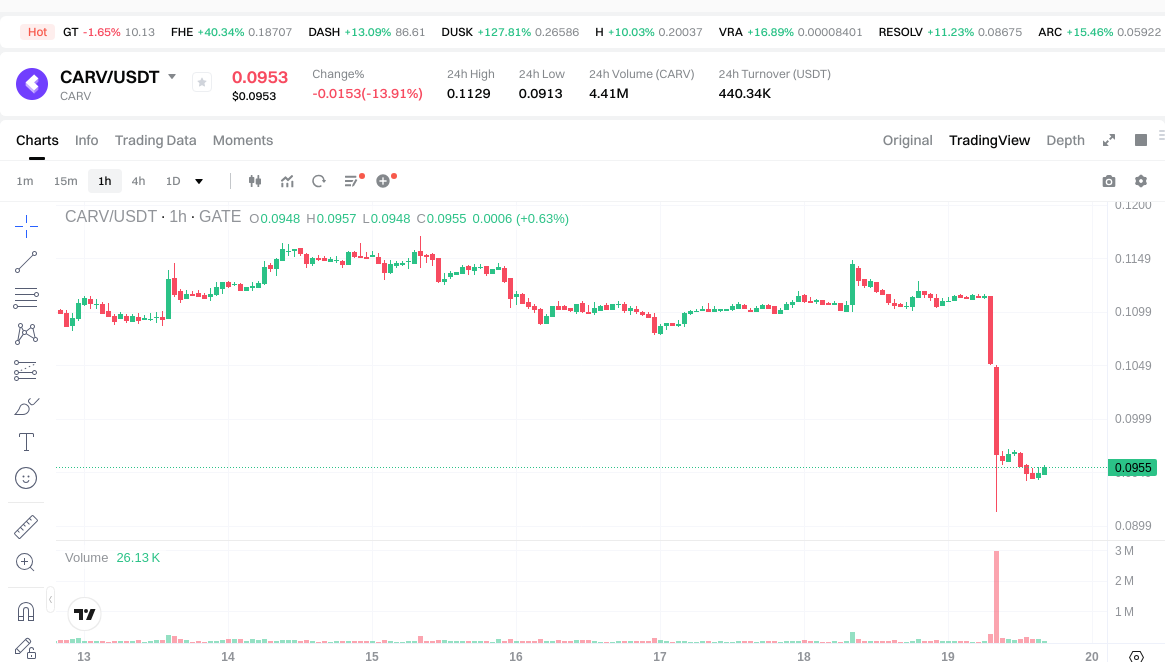
CARV represents a notable digital asset in the cryptocurrency sector, focusing on modular identity and data layer infrastructure for gaming, artificial intelligence, and related sectors. As of January 19, 2026, CARV maintains a market capitalization of approximately $48.22 million, with a circulating supply of 507.62 million tokens out of a total supply of 1 billion tokens. The current price stands at $0.095, reflecting recent market dynamics.
The CARV Protocol functions as a modular data layer facilitating data exchange and value distribution across gaming and AI applications. The project has integrated with over 900 games and AI applications, serving more than 9.5 million registered users, including 2.8 million unique on-chain CARV ID holders. The platform has secured $50 million in funding from institutional investors including Tribe Capital, Temasek Vertex, and Animoca Brands, with team members having backgrounds at organizations such as Coinbase, Google, and Electronic Arts.
CARV ranks 532nd by market capitalization, with a market share of 0.0028% in the broader cryptocurrency market. The token has experienced notable price fluctuations since its launch in October 2024, with trading activity across 33 exchanges and a holder base of 238,090 addresses. This analysis examines CARV's investment characteristics, historical performance, market positioning, and associated considerations for those evaluating digital asset allocations.
I. CARV Price History Review and Investment Value Status
- 2024: CARV token launched in October with an initial offering price of $0.75, attracting attention from institutional investors including Tribe Capital, Temasek Vertex, and Animoca Brands.
- 2024: Following its launch, CARV experienced price fluctuations, with observable volatility in the cryptocurrency market during the fourth quarter.
- 2026: As of January 2026, CARV has shown price movements with a decline of approximately 87.67% over the past year, reflecting broader market dynamics and sector-specific challenges.
Current CARV Investment Market Status (January 2026)
- CARV current price: $0.095
- Market sentiment (Fear & Greed Index): Data indicates a cautious market environment with recent price declines.
- 24-hour trading volume: $438,077.48
- Token holders: Approximately 238,090 addresses hold CARV tokens, indicating a distributed ownership structure.
Click to view real-time CARV market price
II. Core Factors Affecting Whether CARV is a Good Investment
Supply Mechanism and Scarcity (CARV investment scarcity)
- CARV operates with a maximum supply of 1,000,000,000 tokens, with approximately 507,620,477 tokens currently in circulation, representing around 50.76% of the total supply.
- The fixed maximum supply introduces a scarcity element that could influence price dynamics over time, particularly as adoption grows.
- Historical data shows CARV reached a price of $1.5757 in October 2024, while the current price stands at $0.095 as of January 2026, reflecting significant volatility.
- Investment consideration: The controlled supply mechanism may provide long-term value support if demand for CARV's modular data layer expands across gaming and AI sectors.
Institutional Investment and Mainstream Adoption (Institutional investment in CARV)
- CARV has secured $50 million in funding from notable investors including Tribe Capital, Temasek Vertex, and Animoca Brands.
- The project is supported by teams with backgrounds from Coinbase, Google, and Electronic Arts, adding credibility to its development roadmap.
- CARV serves over 9.5 million registered players with 2.8 million unique on-chain CARV ID holders, demonstrating growing user adoption.
- The protocol integrates with 900+ games and AI applications, supporting approximately 30% of Web3 gaming infrastructure.
- CARV is listed on 33 exchanges and holds 238,090 token holders, indicating expanding market accessibility.
Technology and Ecosystem Development (Technology & Ecosystem for CARV investment)
- CARV Protocol functions as a modular data layer facilitating data exchange across gaming, AI, and other sectors, encompassing data verification, identity authentication, storage, and value distribution.
- In early 2025, CARV launched the CARV Agentic Chain Testnet for high-performance AI operations and released the D.A.T.A. Framework to enable AI agents with data perception capabilities.
- The project established 12 new partnerships including Open Ledger, Boom, Jump Jennie, Elderglade, Hooked, Unibase, XPIN, SirenAI, World 3, EureXa AI, and OKZOO, expanding integration across gaming, education, and AI applications.
- CARV has issued over 8 million CARV IDs, operates 60,000+ verifier nodes, and integrates with 1,000+ projects, building infrastructure for agent-driven economies.
- The CARV ID/Agent ID system utilizes ERC-7231 standards, enabling verifiable consent-based AI interactions across multiple chains, with CARV ranking among the top three in unique active wallets across 40+ blockchain networks.
III. CARV Future Investment Forecast and Price Outlook (Is CARV(CARV) worth investing in 2026-2031)
Short-term Investment Forecast (2026, short-term CARV investment outlook)
- Conservative forecast: $0.079 - $0.095
- Neutral forecast: $0.095 - $0.105
- Optimistic forecast: $0.105 - $0.114
Mid-term Investment Outlook (2027-2029, mid-term CARV(CARV) investment forecast)
-
Market stage expectation: The mid-term outlook suggests a gradual development phase with varied price movements across different scenarios. The token may experience fluctuations as the ecosystem matures and market conditions evolve.
-
Investment return forecast:
- 2027: $0.070 - $0.144
- 2028: $0.108 - $0.159
- 2029: $0.106 - $0.163
-
Key catalysts: Ecosystem expansion in gaming and AI integration, potential partnerships with Web3 gaming platforms, development of the modular identity and data layer technology, and broader adoption of CARV ID across multiple blockchain networks.
Long-term Investment Outlook (Is CARV a good long-term investment?)
- Base scenario: $0.119 - $0.152 (assuming steady ecosystem development and moderate market conditions)
- Optimistic scenario: $0.157 - $0.201 (assuming successful scaling of gaming and AI integrations with favorable market conditions)
- Risk scenario: Below $0.080 (under adverse market conditions or significant project setbacks)
Click to view CARV long-term investment and price forecast: Price Prediction
2026-2031 Long-term Outlook
- Base scenario: $0.095 - $0.157 USD (corresponding to steady progress and gradual mainstream application adoption)
- Optimistic scenario: $0.157 - $0.201 USD (corresponding to large-scale adoption and favorable market environment)
- Transformative scenario: Above $0.201 USD (if ecosystem achieves breakthrough developments and mainstream popularization)
- 2031-12-31 forecast high: $0.201 USD (based on optimistic development assumptions)
Disclaimer: Price forecasts are based on historical data analysis and market prediction models. Cryptocurrency markets are highly volatile and subject to numerous external factors. These projections should not be considered as financial advice, and actual results may vary significantly from predictions. Investors should conduct their own research and assess their risk tolerance before making investment decisions.
| Year |
Predicted High Price |
Predicted Average Price |
Predicted Low Price |
Price Change |
| 2026 |
0.113645 |
0.0955 |
0.079265 |
0 |
| 2027 |
0.14431005 |
0.1045725 |
0.070063575 |
10 |
| 2028 |
0.159284832 |
0.124441275 |
0.10826390925 |
30 |
| 2029 |
0.163142511525 |
0.1418630535 |
0.106397290125 |
49 |
| 2030 |
0.16165294946325 |
0.1525027825125 |
0.11895217035975 |
60 |
| 2031 |
0.20105966846448 |
0.157077865987875 |
0.130374628769936 |
65 |
IV. CARV Investment Strategy and Risk Management (How to invest in CARV)
Investment Methodology (CARV investment strategy)
Long-term Holding (HODL CARV): Suitable for Conservative Investors
For investors seeking steady growth in the modular data layer sector, long-term holding of CARV may be considered as part of a diversified portfolio. This approach requires patience through market cycles and focuses on the protocol's fundamental development in gaming and AI data infrastructure. Investors adopting this strategy should monitor CARV's partnerships, user growth metrics, and technological advancements in its identity and data layer.
Active Trading: Based on Technical Analysis and Swing Operations
Active traders may leverage CARV's price movements by utilizing technical indicators and market sentiment analysis. Given the token's historical volatility range between $0.0913 and $1.5757, swing trading opportunities may emerge during periods of significant price fluctuation. Traders should establish clear entry and exit points, monitor 24-hour trading volume (currently $438,077), and consider the token's correlation with broader gaming and AI sector trends.
Risk Management (Risk management for CARV investment)
Asset Allocation Ratio: Conservative / Aggressive / Professional Investors
- Conservative Investors: May consider allocating 1-3% of their crypto portfolio to CARV, maintaining majority holdings in established assets
- Aggressive Investors: Could allocate 5-10% to CARV as part of a higher-risk, higher-reward strategy focused on emerging protocols
- Professional Investors: May implement dynamic allocation strategies based on market conditions, protocol development milestones, and sector rotation
Risk Hedging Solutions: Multi-asset Portfolio + Risk Management Tools
Investors should consider diversifying across multiple sectors within crypto markets rather than concentrating solely in gaming or AI-related tokens. Portfolio construction may include a mix of layer-1 protocols, established DeFi tokens, and emerging infrastructure projects like CARV. Additionally, maintaining stablecoin reserves can provide liquidity for opportunistic purchases during market downturns.
Secure Storage: Hot/Cold Wallets + Hardware Wallet Recommendations
CARV tokens should be stored securely based on holding duration and trading frequency. For long-term holdings, hardware wallets such as Ledger or Trezor provide enhanced security. Active traders may utilize reputable exchange wallets with two-factor authentication enabled. Given that CARV is deployed on Base, investors should ensure their chosen wallet solution supports this network.
V. CARV Investment Risks and Challenges (Risks of investing in CARV)
Market Risk: High Volatility and Price Dynamics
CARV has demonstrated significant price volatility, with current data showing a 14.35% decrease over 24 hours and a 37.28% decline over 30 days. The token has experienced substantial price movements since its launch, trading within a wide range. This volatility characteristic is common among emerging protocols and requires investors to maintain appropriate risk tolerance. Market sentiment shifts, changes in gaming and AI sector trends, and broader crypto market conditions can all contribute to price fluctuations.
Regulatory Risk: Policy Uncertainty Across Jurisdictions
The data infrastructure and gaming sectors face evolving regulatory landscapes globally. Different jurisdictions maintain varying approaches to data privacy, gaming regulations, and cryptocurrency classification. CARV's operations across gaming and AI sectors may be subject to multiple regulatory frameworks. Investors should monitor regulatory developments in key markets and consider how changes in data protection laws, gaming regulations, or cryptocurrency policies might impact the protocol's operations and token utility.
Technical Risk: Network Security and Protocol Development
As a modular data layer protocol, CARV faces technical challenges inherent to blockchain infrastructure projects. Potential risks include smart contract vulnerabilities, network congestion on Base, integration challenges with gaming and AI platforms, and execution risks related to protocol upgrades. The protocol's security depends on continuous auditing and development efforts. Investors should evaluate the team's technical capabilities and track record in addressing security concerns and implementing planned upgrades.
VI. Conclusion: Is CARV a Good Investment?
Investment Value Summary: CARV represents an emerging protocol in the gaming and AI data infrastructure space, with partnerships across multiple gaming platforms and significant user engagement metrics. The token's long-term potential relates to the growth of Web3 gaming and AI data markets. However, short-term price movements have shown considerable volatility, with recent periods experiencing substantial declines.
Investor Recommendations:
✅ Beginners: Consider dollar-cost averaging (DCA) strategies combined with secure wallet storage. Start with small position sizes to understand market dynamics while learning about the protocol's fundamentals and the broader gaming/AI data sector.
✅ Experienced Investors: May implement swing trading strategies during volatility periods while maintaining a core long-term position. Consider portfolio weighting based on personal risk tolerance and correlation with other gaming/AI sector holdings.
✅ Institutional Investors: Could evaluate CARV as part of strategic exposure to gaming and AI data infrastructure, conducting thorough due diligence on protocol economics, partnership sustainability, and competitive positioning within the modular data layer space.
⚠️ Notice: Cryptocurrency investments carry substantial risk, including potential loss of principal. This content is provided for informational purposes only and does not constitute investment advice. Investors should conduct independent research and consult qualified financial advisors before making investment decisions.
VII. FAQ
Q1: What is CARV and what makes it different from other gaming infrastructure tokens?
CARV is a modular identity and data layer protocol designed for gaming and AI applications, currently priced at $0.095 with a market cap of $48.22 million. Unlike traditional gaming tokens, CARV focuses on data verification, identity authentication, storage, and value distribution across 900+ integrated games and AI applications. The protocol serves over 9.5 million registered users with 2.8 million unique on-chain CARV ID holders, positioning itself as infrastructure rather than a single-game token. Its modular approach allows seamless integration across multiple blockchain networks, with CARV ID/Agent ID utilizing ERC-7231 standards for verifiable consent-based interactions.
Q2: Is CARV a good investment for beginners in 2026?
For beginners, CARV presents both opportunities and challenges. The token has experienced significant volatility, declining 87.67% from its October 2024 launch price of $0.75 to the current $0.095. Conservative forecasts for 2026 range from $0.079 to $0.114, indicating potential for both gains and further declines. Beginners should consider dollar-cost averaging (DCA) strategies with small position sizes (1-3% of crypto portfolio), focusing on long-term holding rather than active trading. The protocol's fundamentals—including $50 million in institutional funding, partnerships with 900+ applications, and backing from Tribe Capital, Temasek Vertex, and Animoca Brands—provide a foundation for potential growth, but volatility remains substantial.
Q3: What are the main risks of investing in CARV?
Three primary risk categories affect CARV investments. Market risk includes high volatility, with recent data showing a 14.35% decrease over 24 hours and 37.28% decline over 30 days, reflecting the token's price sensitivity to gaming and AI sector trends. Regulatory risk stems from evolving data privacy laws, gaming regulations, and cryptocurrency policies across different jurisdictions, potentially impacting CARV's operations across its integrated platforms. Technical risk involves smart contract vulnerabilities, network security on Base blockchain, integration challenges with gaming/AI platforms, and execution risks during protocol upgrades. The token's wide historical trading range between $0.0913 and $1.5757 demonstrates substantial price fluctuation potential.
Q4: What is CARV's price forecast for 2026-2031?
Price forecasts suggest varied scenarios across different timeframes. For 2026, conservative estimates range from $0.079-$0.095, neutral forecasts $0.095-$0.105, and optimistic projections $0.105-$0.114. Mid-term outlook (2027-2029) shows projected ranges of $0.070-$0.144 (2027), $0.108-$0.159 (2028), and $0.106-$0.163 (2029). Long-term projections for 2031 suggest a base scenario of $0.119-$0.152, optimistic scenario of $0.157-$0.201, and a potential high of $0.201 under favorable conditions. These forecasts depend on ecosystem expansion, gaming/AI integration success, and broader market conditions. However, cryptocurrency markets remain highly volatile, and actual results may vary significantly from these predictions.
Q5: How should different types of investors approach CARV?
Investment strategies should align with investor profiles and risk tolerance. Conservative investors may allocate 1-3% of their crypto portfolio to CARV, focusing on long-term holding (HODL) while maintaining majority holdings in established assets. Aggressive investors could allocate 5-10% as part of a higher-risk strategy, potentially implementing swing trading during volatility periods with 24-hour volume currently at $438,077. Professional investors may utilize dynamic allocation strategies based on protocol milestones, sector rotation, and market conditions. All investors should prioritize secure storage using hardware wallets (Ledger, Trezor) for long-term holdings or exchange wallets with two-factor authentication for active trading, ensuring Base network compatibility.
Q6: What are the key factors that could drive CARV's future growth?
Several catalysts could influence CARV's trajectory through 2031. Ecosystem expansion includes integration with additional gaming and AI platforms beyond the current 900+ applications, potentially increasing the 9.5 million registered user base. Technological development such as the CARV Agentic Chain Testnet and D.A.T.A. Framework could enhance AI agent capabilities and data perception. Partnership growth with platforms like Open Ledger, Boom, Jump Jennie, and others expands market reach across gaming, education, and AI sectors. The protocol's infrastructure supporting 60,000+ verifier nodes and 8 million+ CARV IDs demonstrates scaling capability. Additionally, CARV's ranking among top three in unique active wallets across 40+ blockchain networks indicates growing adoption potential.
Q7: How does CARV's tokenomics affect its investment potential?
CARV operates with a maximum supply of 1 billion tokens, with approximately 507.62 million (50.76%) currently in circulation as of January 2026. This fixed supply introduces scarcity dynamics that could support price appreciation as demand increases through gaming and AI adoption. The gradual token release schedule prevents immediate supply shocks while allowing for ecosystem growth funding. Current holder distribution across 238,090 addresses indicates relatively broad ownership, though concentration levels should be monitored. The token's listing on 33 exchanges provides liquidity, though trading volume of $438,077 suggests moderate market depth. Investors should consider that approximately 49.24% of tokens remain locked or unvested, representing potential future supply that could impact price dynamics.
Q8: What competitive advantages does CARV have in the gaming and AI data sector?
CARV's competitive positioning stems from several distinctive features. Its modular architecture enables seamless integration across multiple platforms rather than siloed single-application systems, differentiating it from game-specific tokens. The protocol supports approximately 30% of Web3 gaming infrastructure, demonstrating significant market penetration. Institutional backing from Tribe Capital, Temasek Vertex, and Animoca Brands provides financial stability and strategic connections. The team's backgrounds at Coinbase, Google, and Electronic Arts bring technical expertise and industry relationships. CARV's ERC-7231-based identity system enables verifiable consent-based AI interactions across chains, addressing privacy concerns in data-driven applications. The protocol's 60,000+ verifier nodes create a decentralized validation network, enhancing security and scalability compared to centralized data solutions.
* The information is not intended to be and does not constitute financial advice or any other recommendation of any sort offered or endorsed by Gate.