This comprehensive analysis evaluates whether Casper (CSPR) represents a sound investment opportunity in 2024 and beyond. Currently trading at $0.005041 with a $69.43 million market cap, CSPR operates as a Proof-of-Stake Layer-1 blockchain focusing on real-world asset tokenization. The article examines historical price trends, technical infrastructure featuring Zug Consensus and multi-VM support, and market fundamentals including 346,932 token holders across 12 exchanges on Gate and other platforms. Key investment considerations include volatile price performance, infinite supply structure, and enterprise adoption potential. The analysis presents tiered price forecasts through 2031, risk management strategies for different investor profiles, and detailed technical features supporting regulated asset applications. Essential guidance addresses market risks, regulatory uncertainties, and secure storage solutions for informed investment decision-making.
Introduction: Casper (CSPR) Investment Position and Market Outlook
CSPR is a notable asset in the cryptocurrency sector. Launched in March 2021, Casper has established itself as a Proof-of-Stake Layer-1 blockchain focused on bringing real-world assets on-chain. As of January 18, 2026, Casper maintains a market capitalization of approximately $69.43 million, with a circulating supply of around 13.77 billion tokens, and a current trading price near $0.005041. With its positioning as a blockchain infrastructure for tokenized assets featuring upgradable smart contracts and native multi-VM support, Casper has become a subject of interest among investors exploring the question "Is Casper (CSPR) a good investment?" This article provides a comprehensive analysis of Casper's investment characteristics, historical performance, future price outlook, and associated risks to serve as a reference for potential investors.
I. Casper (CSPR) Historical Price Review and Investment Value Status
-
2021: Casper mainnet launched in March 2021, with CSPR experiencing significant volatility throughout the year. The token reached a notable price level of 1.36 USD on May 12, 2021, representing substantial gains for early investors who acquired tokens at the March 2021 launch price of 0.0094 USD.
-
2021-2025: Following the peak in May 2021, CSPR entered an extended period of price consolidation and decline, reflecting broader market trends in the blockchain infrastructure sector. The token navigated through multiple market cycles, with prices adjusting downward from the 2021 levels.
-
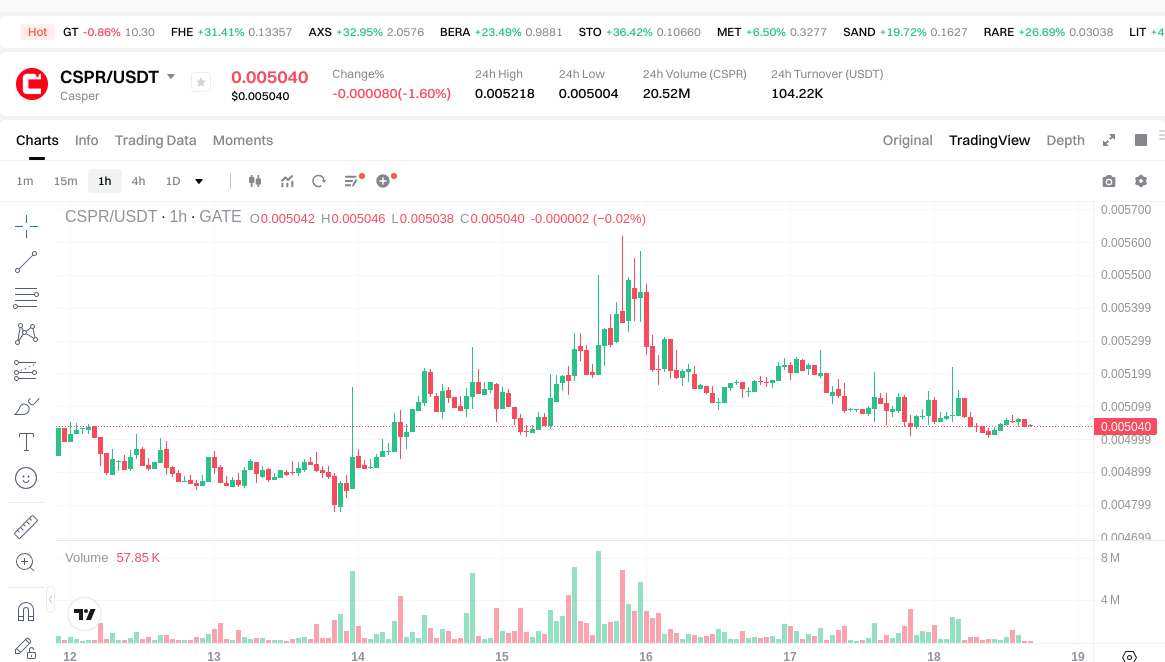
2026: As of January 1, 2026, CSPR recorded a price level of 0.004149 USD, marking a low point in its trading history. The current price of 0.005041 USD as of January 18, 2026, represents a modest recovery from this recent low point.
Current CSPR Investment Market Status (January 2026)
- Current CSPR Price: 0.005041 USD (as of January 18, 2026)
- 24-Hour Trading Volume: 104,320.54 USD
- Circulating Supply: 13.77 billion CSPR (representing 96.59% of total supply)
- Market Capitalization: 69.43 million USD
- Market Cap Ranking: 442
- 24-Hour Price Movement: -1.38%
- 7-Day Price Movement: +1.16%
- 30-Day Price Movement: +10.14%
- 1-Year Price Movement: -72%
- Holder Count: 346,932 addresses
- Exchange Availability: Listed on 12 cryptocurrency exchanges
Click to view real-time CSPR market price
II. Core Factors Influencing Whether CSPR is a Good Investment
Supply Mechanism and Scarcity (CSPR Investment Scarcity)
- Supply Mechanism: Casper (CSPR) has a circulating supply of approximately 13.77 billion tokens, with a total supply of 14.26 billion and no maximum supply cap (infinite supply). This supply structure may influence long-term price dynamics and investment value considerations.
- Supply Dynamics: The circulating supply represents approximately 96.59% of the total supply, indicating a relatively high token distribution in the market. The absence of a maximum supply cap suggests potential ongoing token issuance, which investors should consider when evaluating scarcity-related investment characteristics.
- Investment Implications: The supply mechanism represents a fundamental factor in long-term investment considerations. The infinite supply model differs from fixed-supply assets and may have implications for value retention characteristics over extended periods.
Institutional Investment and Mainstream Adoption (Institutional Investment in CSPR)
- Holder Distribution: As of January 2026, CSPR has approximately 346,932 token holders, indicating a degree of community adoption and distribution across the network.
- Exchange Presence: CSPR is listed on 12 cryptocurrency exchanges, including Gate.com, which provides accessibility for investors seeking exposure to the asset.
- Enterprise Focus: Casper's infrastructure targets real-world asset tokenization with features such as upgradable smart contracts, protocol-level access control, and multi-VM support. These enterprise-oriented capabilities may influence institutional consideration of the network for specific use cases.
Macroeconomic Environment's Impact on CSPR Investment
- Market Positioning: As a Layer-1 blockchain focused on enterprise applications and real-world asset tokenization, CSPR's investment profile may be influenced by broader trends in blockchain adoption, institutional crypto integration, and regulatory developments affecting asset tokenization.
- Volatility Considerations: CSPR demonstrated significant price volatility, with a one-year decline of 72% as of January 18, 2026. Such volatility patterns are common in cryptocurrency markets and represent important risk factors for investment consideration.
- Market Conditions: The cryptocurrency sector's correlation with broader technology markets and risk asset sentiment may influence CSPR's investment dynamics. Economic policy changes, interest rate environments, and institutional crypto adoption trends represent contextual factors for investment evaluation.
Technology and Ecosystem Development (Technology & Ecosystem for CSPR Investment)
- Consensus Mechanism: Casper operates on Zug Consensus, a deterministic protocol offering instant finality. This technical feature may be relevant for financial transactions, regulated assets, and enterprise workflows requiring transaction finality.
- Multi-VM Architecture: Casper supports multiple virtual machines operating in parallel, allowing applications with different technical requirements to function natively on the same chain without relying on Layer-2 solutions. This architectural approach represents a technical differentiator in the Layer-1 blockchain space.
- Developer Accessibility: The network supports development in Rust, WebAssembly (WASM), and provides SDKs for mainstream programming languages including JavaScript, Python, and Go. This approach aims to reduce technical barriers for developers familiar with traditional programming environments.
- Ecosystem Applications: Casper's focus on real-world asset tokenization positions it for potential use cases in financial transactions, regulated assets, and enterprise workflows. The development and adoption of such applications represent factors that may influence the network's long-term investment characteristics.
III. CSPR Future Investment Forecast and Price Outlook (Is Casper(CSPR) worth investing in 2026-2031)
Short-term Investment Forecast (2026, short-term CSPR investment outlook)
- Conservative forecast: $0.0044 - $0.0050
- Neutral forecast: $0.0050 - $0.0053
- Optimistic forecast: $0.0053 - $0.0055
Mid-term Investment Outlook (2027-2029, mid-term Casper(CSPR) investment forecast)
- Market stage expectation: CSPR may experience gradual recovery and moderate growth during this period, with price movements influenced by adoption trends in real-world asset tokenization and enterprise blockchain solutions.
- Investment return forecast:
- 2027: $0.0033 - $0.0069
- 2028: $0.0054 - $0.0071
- 2029: $0.0054 - $0.0084
- Key catalysts: Expansion of enterprise partnerships, growth in real-world asset tokenization applications, and continued development of the Casper ecosystem including upgrades to improve network performance and efficiency.
Long-term Investment Outlook (Is CSPR a good long-term investment?)
- Base scenario: $0.0056 - $0.0089 (assuming steady ecosystem development and moderate adoption in enterprise blockchain solutions)
- Optimistic scenario: $0.0084 - $0.0102 (assuming accelerated adoption of real-world asset tokenization and favorable regulatory environment for enterprise blockchain)
- Risk scenario: $0.0033 - $0.0054 (under conditions of limited enterprise adoption or heightened competitive pressure from alternative Layer-1 solutions)
View CSPR long-term investment and price forecast: Price Prediction
2026-01-18 to 2031 Long-term Outlook
- Base scenario: $0.0061 - $0.0089 USD (corresponding to steady progress and gradual mainstream application growth)
- Optimistic scenario: $0.0084 - $0.0102 USD (corresponding to large-scale adoption and favorable market conditions)
- Transformative scenario: Above $0.0102 USD (in case of breakthrough developments in the ecosystem and mainstream adoption)
- 2031-12-31 forecast high: $0.0091 USD (based on optimistic development assumptions)
Disclaimer: Price forecasts are based on historical data analysis and market trend projections. Cryptocurrency markets are highly volatile and subject to various risks. These forecasts do not constitute investment advice, and investors should conduct their own research and risk assessment before making investment decisions.
| Year |
Predicted High Price |
Predicted Average Price |
Predicted Low Price |
Price Change |
| 2026 |
0.005292 |
0.00504 |
0.0043848 |
0 |
| 2027 |
0.00692244 |
0.005166 |
0.00325458 |
2 |
| 2028 |
0.0071321796 |
0.00604422 |
0.0053793558 |
19 |
| 2029 |
0.008367013746 |
0.0065881998 |
0.005402323836 |
30 |
| 2030 |
0.01024432127901 |
0.007477606773 |
0.00560820507975 |
48 |
| 2031 |
0.009126792946785 |
0.008860964026005 |
0.006114065177943 |
75 |
IV. Casper Investment Strategy and Risk Management (How to invest in Casper)
Investment Methodology (Casper investment strategy)
Long-term Holding (HODL Casper)
Long-term holding represents a strategic approach suitable for conservative investors who believe in Casper's fundamental value proposition. This methodology focuses on accumulating CSPR tokens during market downturns and maintaining positions through volatility cycles. The network's focus on real-world asset tokenization and enterprise-grade infrastructure may provide foundational support for gradual value appreciation over extended timeframes.
Active Trading
Active trading strategies rely on technical analysis and momentum-based operations. Traders may leverage Casper's price movements, which have demonstrated notable volatility patterns. The token's 24-hour trading volume of approximately $104,320 USD suggests moderate liquidity conditions that active traders should consider when executing entry and exit positions. Technical indicators, chart patterns, and market sentiment analysis become essential tools for short-to-medium-term position management.
Risk Management (Risk management for Casper investment)
Asset Allocation Ratios
- Conservative Investors: May consider allocating 1-3% of their cryptocurrency portfolio to CSPR, prioritizing established assets while maintaining limited exposure to mid-cap tokens
- Aggressive Investors: Could allocate 5-10% to Casper, accepting higher volatility in pursuit of potential growth opportunities
- Professional Investors: Might employ dynamic allocation strategies ranging from 3-15%, adjusting positions based on technical indicators, fundamental developments, and broader market conditions
Risk Hedging Approaches
Diversification across multiple blockchain ecosystems can help mitigate concentrated exposure to Casper's specific risks. Investors may consider:
- Maintaining positions in different Layer-1 protocols to reduce protocol-specific risk
- Incorporating stablecoins or fiat-backed assets to preserve capital during drawdown periods
- Utilizing portfolio rebalancing strategies to maintain target allocation percentages
- Considering derivative instruments where available for sophisticated risk management
Secure Storage Solutions
Cold Storage Options: Hardware wallets provide enhanced security for long-term CSPR holdings by maintaining private keys offline. Recommended approaches include:
- Hardware wallet solutions that support CSPR token standards
- Multi-signature wallet configurations for institutional holdings
- Regular security audits and backup procedures
Hot Wallet Considerations: For active trading requirements, hot wallets offer convenience with trade-offs in security. Users should:
- Limit hot wallet balances to active trading amounts only
- Enable all available security features including two-factor authentication
- Use reputable wallet providers with established security track records
V. Casper Investment Risks and Challenges (Risks of investing in Casper)
Market Risk
Casper demonstrates substantial price volatility characteristics common to cryptocurrency assets. The token has experienced significant price fluctuations, with the current price at $0.005041 representing a considerable decline from previous levels. The 24-hour price range between $0.005004 and $0.005218 illustrates ongoing volatility. Market participants should recognize that price movements can be influenced by factors including:
- Broader cryptocurrency market sentiment and correlation effects
- Trading volume fluctuations and liquidity conditions
- Market maker activities and large holder movements
- Speculative trading patterns and momentum effects
Regulatory Risk
The regulatory landscape for cryptocurrency assets remains in development across different jurisdictions. Casper's focus on real-world asset tokenization may subject the network to evolving regulatory frameworks concerning:
- Securities classification and compliance requirements in various jurisdictions
- Cross-border transaction regulations and reporting obligations
- Enterprise adoption constraints related to regulatory uncertainty
- Potential licensing requirements for network validators or service providers
Investors should monitor regulatory developments in their respective jurisdictions and assess potential impacts on Casper's operational model and adoption trajectory.
Technical Risk
As a Proof-of-Stake Layer-1 blockchain, Casper faces various technical considerations:
- Network Security: Potential vulnerabilities in smart contract implementations or consensus mechanisms that could be exploited
- Protocol Upgrades: The network's upgradable smart contract feature, while providing flexibility, introduces complexity in governance and implementation processes
- Multi-VM Architecture: While native support for multiple virtual machines offers advantages, it also increases the technical complexity and potential attack surface
- Validator Concentration: Potential centralization risks if validator participation becomes concentrated among limited participants
VI. Conclusion: Is Casper a Good Investment?
Investment Value Summary
Casper presents a distinctive positioning within the Layer-1 blockchain ecosystem, focusing on real-world asset tokenization and enterprise-grade infrastructure. The network's technical features, including instant finality through Zug Consensus and multi-VM support, address specific use cases in regulated asset management and enterprise workflows.
However, the token demonstrates considerable price volatility, with current market conditions reflecting significant challenges. The market capitalization of approximately $69.4 million positions CSPR as a mid-cap asset with corresponding liquidity considerations. The circulating supply represents approximately 96.59% of total supply, suggesting limited additional dilution concerns from token unlocks.
Investor Recommendations
✅ Beginner Investors: Consider implementing a dollar-cost averaging strategy with modest position sizing. Prioritize secure storage solutions using hardware wallets or reputable custody services. Allocate only capital that can withstand complete loss without impacting financial stability.
✅ Experienced Investors: May evaluate tactical allocation strategies based on technical analysis and fundamental developments. Consider portfolio diversification across multiple blockchain ecosystems to mitigate concentrated exposure. Monitor network adoption metrics, developer activity, and partnership announcements for position management signals.
✅ Institutional Investors: Could assess Casper's real-world asset tokenization capabilities within broader digital asset allocation frameworks. Evaluate technical infrastructure compatibility with institutional custody requirements and regulatory compliance considerations. Consider strategic positioning sized appropriately within diversified digital asset portfolios.
⚠️ Important Notice: Cryptocurrency investments carry substantial risk, including potential complete loss of capital. This analysis provides informational content only and does not constitute investment advice, financial guidance, or recommendations to buy, sell, or hold any assets. Investors should conduct independent research and consult qualified financial advisors before making investment decisions.
VII. FAQ
Q1: What is Casper (CSPR) and what makes it different from other Layer-1 blockchains?
Casper is a Proof-of-Stake Layer-1 blockchain launched in March 2021, specifically designed for bringing real-world assets on-chain with enterprise-grade infrastructure. What distinguishes Casper from other Layer-1 protocols is its unique combination of technical features: Zug Consensus providing instant finality for transactions, native multi-VM support allowing different virtual machines to operate in parallel without requiring Layer-2 solutions, and upgradable smart contracts with protocol-level access control. These features position Casper particularly for financial transactions, regulated assets, and enterprise workflows that require deterministic transaction finality and flexible technical infrastructure.
Q2: What is the current price and market performance of CSPR?
As of January 18, 2026, CSPR trades at approximately $0.005041 USD with a market capitalization of $69.43 million, ranking 442nd by market cap. The token has experienced significant volatility, declining 72% over the past year while showing modest recovery with a +10.14% gain over the past 30 days. The circulating supply stands at 13.77 billion tokens (96.59% of total supply), with approximately 346,932 token holders and availability on 12 cryptocurrency exchanges. The 24-hour trading volume of $104,320 USD indicates moderate liquidity conditions for market participants.
Q3: Is Casper (CSPR) a good long-term investment?
Casper's long-term investment potential depends on multiple factors and carries substantial risk. The network's focus on real-world asset tokenization and enterprise infrastructure provides a specific value proposition, but faces considerable challenges including significant price volatility, competition from established Layer-1 protocols, and regulatory uncertainties. Long-term price forecasts range from $0.0056-$0.0089 USD in base scenarios to $0.0084-$0.0102 USD in optimistic scenarios through 2031, though these projections carry inherent uncertainty. Conservative investors might consider 1-3% portfolio allocation, while more aggressive investors could allocate 5-10%, but only with capital they can afford to lose completely. The token's infinite supply model and 72% one-year decline present important risk considerations that potential investors should carefully evaluate.
Q4: What are the main risks of investing in Casper?
Investing in Casper carries several significant risks: (I) Market risk - substantial price volatility with a 72% annual decline and ongoing price fluctuations affecting capital preservation; (II) Regulatory risk - uncertainty around evolving regulations for real-world asset tokenization and securities classification across jurisdictions; (III) Technical risk - potential vulnerabilities in smart contracts, consensus mechanisms, and the complex multi-VM architecture; (IV) Liquidity risk - moderate trading volume of approximately $104,320 USD daily may present challenges for large position exits; (V) Competition risk - facing established Layer-1 protocols and emerging blockchain solutions in the enterprise infrastructure space. These risks could result in complete capital loss and should be thoroughly assessed before making investment decisions.
Q5: How should I invest in Casper and what strategies are recommended?
Investment strategies for Casper depend on investor experience and risk tolerance: For long-term holding (HODL), consider dollar-cost averaging during market downturns and maintaining positions through volatility cycles, suitable for conservative investors believing in the fundamental value proposition. For active trading, utilize technical analysis and momentum-based strategies while being mindful of moderate liquidity conditions. Regarding asset allocation: conservative investors should limit exposure to 1-3% of crypto portfolio, aggressive investors may allocate 5-10%, and professional investors might employ dynamic 3-15% allocation based on market conditions. Essential risk management includes diversification across multiple blockchain ecosystems, secure storage using hardware wallets for long-term holdings, and limiting hot wallet balances to active trading amounts only.
Q6: What is the price forecast for CSPR from 2026 to 2031?
Price forecasts for CSPR through 2031 present multiple scenarios with inherent uncertainty: Short-term (2026) conservative forecasts range $0.0044-$0.0050, neutral forecasts $0.0050-$0.0053, and optimistic forecasts $0.0053-$0.0055. Mid-term outlooks suggest 2027 ($0.0033-$0.0069), 2028 ($0.0054-$0.0071), and 2029 ($0.0054-$0.0084) ranges. Long-term base scenarios project $0.0056-$0.0089 USD, while optimistic scenarios suggest $0.0084-$0.0102 USD by 2031, assuming steady ecosystem development and adoption in enterprise blockchain solutions. Key catalysts include expansion of enterprise partnerships, growth in real-world asset tokenization applications, and continued network upgrades. However, these forecasts do not constitute investment advice, and cryptocurrency markets remain highly volatile with outcomes potentially diverging significantly from projections.
Q7: What technical features make Casper suitable for enterprise use cases?
Casper's technical architecture incorporates several enterprise-oriented features: Zug Consensus provides instant finality, critical for financial transactions and regulated assets requiring deterministic transaction outcomes. The native multi-VM architecture allows applications with different technical requirements to operate in parallel on the same chain without Layer-2 dependencies, enhancing operational efficiency. Upgradable smart contracts enable protocol evolution without requiring hard forks, reducing operational disruptions. Protocol-level access control supports compliance requirements for regulated entities. Developer accessibility through support for Rust, WebAssembly, and SDKs for mainstream languages (JavaScript, Python, Go) reduces technical barriers for traditional development teams. These features collectively position Casper for enterprise workflows requiring regulatory compliance, transaction finality, and flexible technical infrastructure.
Q8: How does Casper's supply mechanism affect its investment value?
Casper's supply mechanism presents important considerations for investment evaluation: The circulating supply of 13.77 billion tokens represents 96.59% of the 14.26 billion total supply, indicating high token distribution with limited near-term dilution from unlocks. However, CSPR has no maximum supply cap, implementing an infinite supply model that differs fundamentally from fixed-supply assets like Bitcoin. This means ongoing token issuance is possible, potentially affecting long-term scarcity characteristics and value retention dynamics. For investors, the infinite supply model represents a structural factor that may influence price appreciation potential over extended periods, as it contrasts with deflationary or capped-supply tokenomics common in other cryptocurrency assets. This supply structure should be weighed against other fundamental factors when evaluating Casper's long-term investment characteristics.
* The information is not intended to be and does not constitute financial advice or any other recommendation of any sort offered or endorsed by Gate.