This comprehensive guide evaluates whether Catizen (CATI) represents a viable investment opportunity within the GameFi sector. Launched in September 2024 on the TON blockchain, CATI operates a play-to-airdrop gaming model with a current market cap of $23.55 million, trading near $0.06026 with 1.63 million holders across 31 exchanges. The analysis examines CATI's price trajectory from its $1.1274 peak to current levels, assessing investment fundamentals including tokenomics, ecosystem development, and macroeconomic factors affecting gaming tokens. Price forecasts range from conservative scenarios of $0.0475-$0.0602 for 2026 to optimistic long-term projections reaching $0.1535 by 2031. The guide provides tailored investment strategies for different risk profiles—from conservative dollar-cost averaging approaches to active trading tactics—while highlighting critical risks including extreme volatility, regulatory uncertainty, smart contract vulnerabilities, and market manipulation susceptibility. Comprehensive ri
Introduction: Catizen (CATI) Investment Position and Market Outlook
CATI is a notable asset in the cryptocurrency space, launched in September 2024 with a focus on GameFi innovation. As of January 22, 2026, Catizen holds a market capitalization of approximately $23.55 million, with a circulating supply of around 390.86 million tokens and a current price hovering near $0.06026. Positioned as a casual gaming platform with a PLAY-TO-AIRDROP model, CATI has gradually become a point of discussion among investors evaluating "Is Catizen (CATI) a good investment?" The token is available on 31 exchanges and has attracted over 1.63 million holders. This article will comprehensively analyze CATI's investment value, historical trends, future price forecasts, and investment risks to provide reference for investors.
I. CATI Price History Review and Current Investment Value
- September 2024: Token launch at $0.08 → Price experienced significant volatility in early trading
- September 2024: Reached peak level of $1.1274 shortly after launch → CATI price demonstrated strong initial market interest
- 2024-2025: Market adjustment phase → Price declined from $1.1274 to lower levels
- October 2025: Price reached $0.0342 level → Represented a notable correction from earlier price points
- January 2026: Current trading range → Price stabilized around $0.06026
Current CATI Investment Market Status (January 2026)
- CATI current price: $0.06026
- 24-hour trading volume: $236,311.73
- Token holders: 1,633,969 addresses
- Circulating supply: 390,863,956.9 CATI (39.09% of total supply)
- Market capitalization: $23,553,462
- Fully diluted valuation: $60,260,000
- Listed on 31 exchanges
Click to view real-time CATI market price
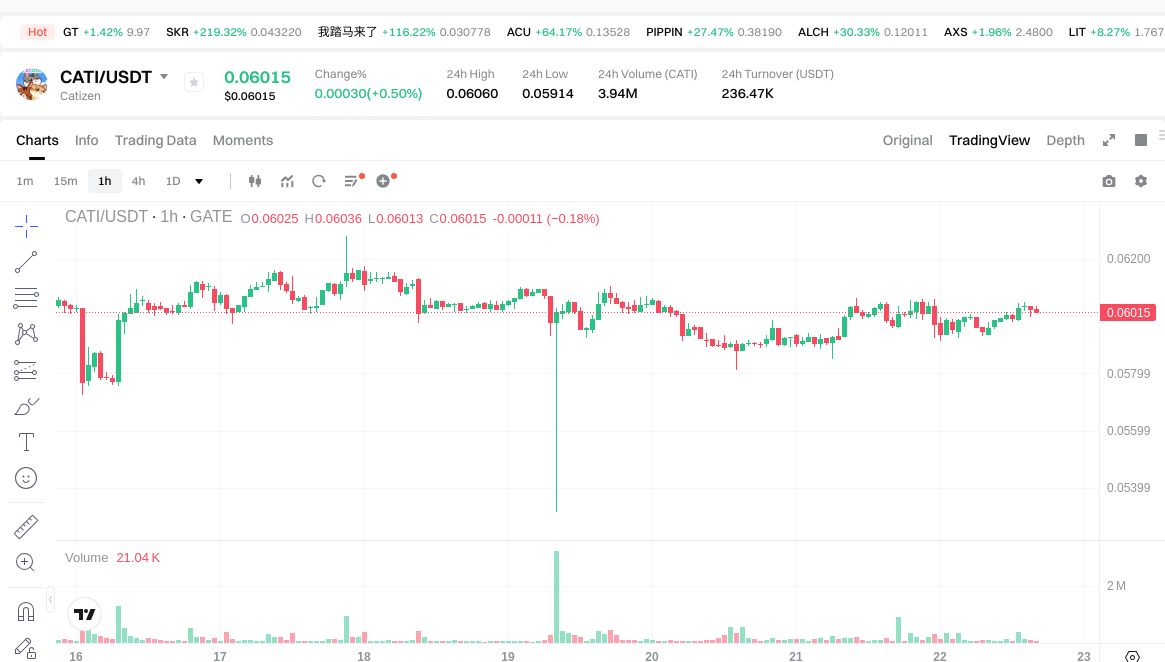
II. Core Factors Affecting Whether CATI is a Good Investment (Is Catizen(CATI) a Good Investment)
Supply Mechanism and Scarcity (CATI investment scarcity)
- Fixed maximum supply of 1,000,000,000 tokens → impacts price and investment value
- Current circulating supply stands at approximately 390.86 million tokens, representing 39.09% of total supply
- Investment significance: scarcity mechanism provides potential support for long-term investment considerations
Institutional Investment and Mainstream Adoption (Institutional investment in CATI)
- Current holder base exceeds 1.63 million addresses, indicating broad retail participation
- Listed on 31 cryptocurrency exchanges, demonstrating multi-platform accessibility
- The token's integration within the GameFi economy and Play-to-Airdrop model represents an innovative approach to gaming-based cryptocurrency adoption
Macroeconomic Environment's Impact on CATI Investment
- Monetary policy and interest rate changes → alter investment attractiveness across digital asset markets
- As a gaming-focused token, CATI's performance may be influenced by broader shifts in risk appetite and discretionary spending patterns
- Market volatility and regulatory developments in cryptocurrency markets affect investor sentiment toward gaming tokens
Technology & Ecosystem Development (Technology & Ecosystem for CATI investment)
- Built on TON blockchain using Jetton standard → provides technical infrastructure for token operations
- GameFi economy integration: the Play-to-Airdrop model aims to reward player engagement with token incentives
- Ecosystem scale: the project targets over 100 million users within its gaming universe, which could influence long-term adoption and utility
- Casual gaming applications combined with token rewards create a use case within the entertainment and gaming sectors
III. CATI Future Investment Forecast and Price Outlook (Is Catizen(CATI) worth investing in 2026-2031)
Short-term Investment Outlook (2026, short-term CATI investment outlook)
- Conservative Forecast: $0.0475 - $0.0602
- Neutral Forecast: $0.0602 - $0.0667
- Optimistic Forecast: $0.0667 - $0.0734
Mid-term Investment Outlook (2027-2029, mid-term Catizen(CATI) investment forecast)
-
Market Phase Expectation: During this phase, CATI may experience gradual growth as the GameFi sector evolves and user adoption within the Catizen ecosystem potentially expands. Market sentiment and broader crypto trends could influence price movements.
-
Investment Return Forecast:
- 2027: $0.0648 - $0.0821
- 2028: $0.0395 - $0.1050
- 2029: $0.0682 - $0.1220
-
Key Catalysts: Platform developments, expansion of the PLAY-TO-AIRDROP model, increased user engagement, partnerships within the gaming and blockchain sectors, and overall market conditions in the GameFi space.
Long-term Investment Outlook (Is Catizen a good long-term investment?)
- Base Scenario: $0.0762 - $0.1249 (assuming steady platform development and moderate user growth)
- Optimistic Scenario: $0.1154 - $0.1535 (assuming significant ecosystem expansion and favorable market conditions)
- Risk Scenario: Below $0.0762 (under adverse market conditions or challenges in user retention)
For detailed CATI long-term investment and price predictions, visit: Price Prediction
2026-2031 Long-term Outlook
- Base Scenario: $0.0475 - $0.1249 (corresponding to steady progress and gradual mainstream application growth)
- Optimistic Scenario: $0.0682 - $0.1535 (corresponding to large-scale adoption and favorable market environment)
- Transformative Scenario: Above $0.1535 (if the ecosystem achieves breakthrough developments and mainstream adoption)
- 2031-12-31 Predicted High: $0.1535 (based on optimistic development assumptions)
Disclaimer: This analysis is for informational purposes only and does not constitute investment advice. Cryptocurrency investments carry substantial risk, and past performance does not guarantee future results. Investors should conduct their own research and consult with financial professionals before making investment decisions.
| Year |
Predicted High Price |
Predicted Average Price |
Predicted Low Price |
Price Change |
| 2026 |
0.0733952 |
0.06016 |
0.0475264 |
0 |
| 2027 |
0.082136448 |
0.0667776 |
0.064774272 |
10 |
| 2028 |
0.10498440384 |
0.074457024 |
0.03946222272 |
23 |
| 2029 |
0.1220201709312 |
0.08972071392 |
0.0681877425792 |
48 |
| 2030 |
0.124927122062208 |
0.1058704424256 |
0.076226718546432 |
75 |
| 2031 |
0.153480380384392 |
0.115398782243904 |
0.079625159748293 |
91 |
IV. Catizen Investment Strategy and Risk Management (How to invest in CATI)
Investment Methodology (Catizen investment strategy)
Long-term Holding (HODL CATI)
For conservative investors seeking steady exposure to the GameFi and play-to-airdrop ecosystem, a long-term holding strategy may be considered. This approach involves:
- Dollar-Cost Averaging (DCA): Regular purchases of CATI tokens at predetermined intervals to mitigate timing risk and reduce the impact of short-term price volatility
- Fundamental Analysis Focus: Monitoring the growth of Catizen's user base, development milestones, and ecosystem expansion rather than short-term price movements
- Multi-year Horizon: Aligning investment timeframe with the project's roadmap and broader GameFi sector maturation
This strategy suits investors who believe in the long-term viability of the play-to-airdrop model and Catizen's position within the casual gaming blockchain space.
Active Trading
For more experienced market participants, active trading strategies may include:
- Technical Analysis: Utilizing chart patterns, support/resistance levels, and momentum indicators to identify entry and exit points
- Swing Trading: Capturing medium-term price movements based on market cycles and news events affecting the GameFi sector
- Risk-Reward Assessment: Setting clear profit targets and stop-loss levels for each trade to manage downside exposure
Active trading requires continuous market monitoring, understanding of cryptocurrency market dynamics, and disciplined execution of trading plans.
Risk Management (Risk management for CATI investment)
Asset Allocation Ratios
Different investor profiles may consider varied allocation approaches:
- Conservative Investors: Limiting CATI exposure to 1-3% of total cryptocurrency portfolio, which itself represents a small portion of overall investment assets
- Moderate Investors: Allocating 3-7% of cryptocurrency portfolio to CATI, balanced with established assets and diversified across multiple blockchain gaming projects
- Aggressive Investors: Potentially dedicating 7-15% of cryptocurrency holdings to CATI, accepting higher volatility in pursuit of growth opportunities in the GameFi sector
These ranges reflect the high-risk nature of individual altcoin investments and should be adjusted based on personal risk tolerance and financial circumstances.
Risk Hedging Solutions
- Multi-Asset Portfolio: Combining CATI with less correlated assets across different cryptocurrency categories (layer-1 protocols, DeFi tokens, stablecoins) to reduce concentration risk
- Defensive Positioning: Maintaining portions of portfolio in stablecoins or traditional assets to preserve capital during market downturns
- Diversification Within GameFi: Spreading exposure across multiple gaming tokens rather than concentrating in a single project
- Regular Rebalancing: Periodically adjusting positions to maintain target allocation percentages as prices fluctuate
Secure Storage
- Cold Wallets: For long-term holdings, hardware wallets (such as Ledger or Trezor) provide offline storage isolated from internet-based threats
- Hot Wallets: For active trading or ecosystem participation, secure mobile or desktop wallets with multi-factor authentication; given CATI's deployment on TON blockchain, TON-compatible wallets should be utilized
- Exchange Security: If keeping assets on exchanges for trading purposes, selecting platforms with robust security measures, insurance funds, and established track records
- Backup Protocols: Maintaining secure backups of recovery phrases and private keys in multiple physical locations
V. Catizen Investment Risks and Challenges (Risks of investing in CATI)
Market Risks
High Volatility: CATI has demonstrated significant price fluctuation since launch. Historical data shows the token has experienced substantial movements, with price changes reflecting broader cryptocurrency market sentiment and GameFi sector dynamics. Such volatility can result in rapid gains or losses within short timeframes.
Liquidity Concerns: While CATI is listed on multiple exchanges, trading volume and market depth may vary significantly across platforms. Lower liquidity during certain periods can lead to wider bid-ask spreads and potential slippage during larger transactions.
Market Manipulation Risk: Like many altcoins with relatively limited market capitalization, CATI may be susceptible to coordinated trading activities that could artificially influence price movements. Investors should be aware of potential pump-and-dump schemes or coordinated selling pressure.
Regulatory Risks
Jurisdictional Uncertainty: Different countries maintain varying approaches to cryptocurrency regulation, particularly concerning gaming tokens and play-to-earn models. Changes in regulatory frameworks could impact:
- Token classification and legal status
- Taxation treatment of GameFi rewards and token transactions
- Operational restrictions for projects combining gaming and cryptocurrency elements
- Cross-border transaction capabilities and exchange listing eligibility
Compliance Evolution: As global regulatory standards continue developing, projects like Catizen may need to adapt their models, potentially affecting tokenomics, distribution mechanisms, or operational structure. Regulatory scrutiny of play-to-airdrop mechanisms could introduce operational challenges.
Technical Risks
Smart Contract Vulnerabilities: While deployed on the TON blockchain, CATI's smart contract infrastructure carries inherent risks of undiscovered bugs or security vulnerabilities that could be exploited, potentially resulting in token loss or protocol disruption.
Blockchain Dependency: CATI's performance and utility are tied to the TON network's continued operation and development. Network congestion, technical issues, or changes to the underlying blockchain could impact token functionality and user experience.
Upgrade Implementation: Future protocol upgrades or changes to the Catizen ecosystem may encounter technical difficulties during deployment, potentially causing temporary disruptions or unintended consequences affecting token value.
Integration Risks: The project's reliance on integrating gaming mechanics with blockchain technology introduces complexity that could result in technical challenges, user experience issues, or scalability limitations as the user base grows.
VI. Conclusion: Is CATI a Good Investment?
Investment Value Summary
Catizen (CATI) represents an entry point into the emerging play-to-airdrop gaming model within the cryptocurrency ecosystem. The project's approach to combining casual gaming with tokenized rewards presents potential growth opportunities tied to GameFi sector expansion. However, the token has experienced considerable price volatility since its launch, reflecting both early-stage project dynamics and broader cryptocurrency market conditions. The investment proposition centers on the project's ability to sustain user engagement, expand its ecosystem, and navigate the competitive landscape of blockchain gaming.
Investor Recommendations
✅ Beginners
- Limit initial exposure to a small percentage of overall cryptocurrency portfolio
- Employ dollar-cost averaging to build positions gradually rather than committing large amounts at once
- Prioritize secure storage using TON-compatible wallets with proper backup procedures
- Invest time in understanding GameFi mechanics and the play-to-airdrop model before committing capital
- Only invest amounts that can be lost without impacting financial stability
✅ Experienced Investors
- Consider CATI as part of a diversified GameFi portfolio rather than a concentrated position
- Utilize technical analysis to identify favorable entry and exit points for swing trading strategies
- Monitor ecosystem developments, user growth metrics, and competitive positioning within the gaming token space
- Implement stop-loss orders and profit-taking strategies to manage risk during volatile periods
- Evaluate correlation with broader cryptocurrency markets and sector-specific trends
✅ Institutional Investors
- Assess CATI within the context of broader exposure to blockchain gaming and entertainment sectors
- Conduct thorough due diligence on project governance, tokenomics sustainability, and regulatory compliance
- Consider position sizing relative to liquidity constraints and trading volume capabilities
- Evaluate long-term strategic fit with portfolio objectives and risk parameters
- Implement structured entry and exit strategies aligned with institutional investment mandates
⚠️ Disclaimer: Cryptocurrency investments carry substantial risk, including the possibility of total capital loss. CATI, like all digital assets, is subject to extreme price volatility, regulatory uncertainty, and technical risks. This content is provided for informational purposes only and does not constitute financial, investment, or legal advice. Readers should conduct independent research and consult with qualified financial advisors before making investment decisions. Past performance does not indicate future results.
VII. FAQ
Q1: What is Catizen (CATI) and how does it generate value for investors?
Catizen (CATI) is a GameFi token launched in September 2024 that operates on the TON blockchain, utilizing a play-to-airdrop model within a casual gaming ecosystem. The token generates potential value through its integration of gaming rewards with blockchain incentives, where over 1.63 million token holders participate in the ecosystem. CATI's value proposition centers on attracting users through gaming engagement and distributing token rewards, creating utility demand within the platform. The project targets over 100 million users in its gaming universe, with the token serving as the primary reward and economic unit. As of January 2026, CATI maintains a market capitalization of approximately $23.55 million with availability on 31 exchanges, providing liquidity for investors. The investment case depends on sustained user growth, ecosystem expansion, and the broader adoption of play-to-airdrop mechanics in the GameFi sector.
Q2: How volatile has CATI's price been since launch, and what are the risks?
CATI has demonstrated extreme volatility since its September 2024 launch, with the token initially peaking at $1.1274 shortly after debut before declining to $0.0342 by October 2025—a drop exceeding 96%. As of January 2026, the price has partially recovered to approximately $0.06026, still representing an overall decline of approximately 95% from its all-time high. This volatility pattern exposes investors to substantial downside risk, including potential total capital loss. Market risks include low liquidity periods with wider bid-ask spreads, susceptibility to coordinated trading activities given the relatively small market capitalization, and correlation with broader cryptocurrency market sentiment. Additionally, regulatory uncertainty surrounding GameFi tokens, smart contract vulnerabilities, and dependence on TON blockchain stability present technical risks. Investors should only allocate capital they can afford to lose entirely and implement strict risk management protocols.
Q3: What are the predicted price ranges for CATI in 2026 and beyond?
For 2026, CATI price forecasts suggest a conservative range of $0.0475 to $0.0602, a neutral range of $0.0602 to $0.0667, and an optimistic range of $0.0667 to $0.0734. Looking toward mid-term horizons, 2027 projections estimate $0.0648 to $0.0821, 2028 forecasts $0.0395 to $0.1050, and 2029 predictions range from $0.0682 to $0.1220. Long-term projections through 2031 present a base scenario of $0.0762 to $0.1249, an optimistic scenario of $0.1154 to $0.1535, and a risk scenario below $0.0762. The 2031 predicted high reaches $0.1535 under favorable assumptions. These forecasts assume various levels of ecosystem development, user adoption, and favorable market conditions. However, these predictions carry substantial uncertainty and should not be interpreted as guaranteed outcomes, as actual performance depends on numerous unpredictable factors including competitive dynamics, regulatory developments, and macroeconomic conditions.
Q4: What investment strategies are appropriate for different investor profiles?
Conservative investors should limit CATI exposure to 1-3% of their cryptocurrency portfolio using dollar-cost averaging to build positions gradually, focusing on long-term holding aligned with ecosystem development milestones. This approach suits those believing in the multi-year viability of play-to-airdrop models. Moderate investors may allocate 3-7% of crypto holdings to CATI, balancing exposure with established assets and diversifying across multiple GameFi projects, potentially employing swing trading strategies based on sector cycles. Aggressive investors accepting higher volatility might dedicate 7-15% of cryptocurrency portfolios to CATI, utilizing technical analysis for active trading with clear profit targets and stop-loss levels. All strategies require secure storage using TON-compatible cold wallets for long-term holdings or secure hot wallets with multi-factor authentication for active trading. Regardless of profile, investors should maintain diversification across asset categories, implement regular portfolio rebalancing, and never invest amounts that would impact financial stability if lost completely.
Q5: What regulatory and compliance risks should CATI investors consider?
CATI faces significant regulatory uncertainty as global authorities continue developing frameworks for cryptocurrency, particularly concerning gaming tokens and play-to-earn models. Key risks include jurisdictional variations in token classification, which could affect legal status, taxation treatment of GameFi rewards, and operational restrictions for projects combining gaming and cryptocurrency elements. Different countries maintain divergent approaches, potentially impacting cross-border transaction capabilities and exchange listing eligibility. As regulatory standards evolve, Catizen may need to adapt its play-to-airdrop model, potentially affecting tokenomics, distribution mechanisms, or operational structure. Regulatory scrutiny could introduce compliance requirements that increase operational costs or limit certain functionalities. Changes in securities classification, gaming regulations, or anti-money laundering requirements could materially impact the project's viability and token value. Investors should monitor regulatory developments in their jurisdictions and assess how evolving compliance landscapes might affect their holdings and tax obligations related to CATI investments.
Q6: How does CATI's tokenomics and supply mechanism impact investment potential?
CATI operates with a fixed maximum supply of 1 billion tokens, providing a scarcity mechanism that theoretically supports long-term value retention. As of January 2026, approximately 390.86 million tokens are in circulation, representing 39.09% of total supply, with the remaining 60.91% subject to future release schedules. This partial circulation creates potential dilution risk as additional tokens enter the market through ecosystem rewards, team allocations, or planned distributions. The gradual supply increase could exert downward price pressure if demand fails to keep pace with new token availability. However, the fixed cap prevents unlimited inflation, differentiating CATI from projects with uncapped supplies. The play-to-airdrop model distributes tokens as gaming rewards, creating ongoing selling pressure from users converting rewards to fiat but simultaneously driving platform engagement that could generate sustained demand. Investment value depends on whether the rate of new user acquisition and ecosystem utility growth can absorb token supply increases. Investors should track circulating supply changes and vesting schedules to assess potential dilution impact on their holdings.
Q7: What technical infrastructure and ecosystem developments support CATI's long-term prospects?
CATI is built on the TON blockchain using the Jetton token standard, providing technical infrastructure designed for high-throughput gaming applications with low transaction costs. The project's integration of casual gaming with blockchain rewards represents an innovative approach within the GameFi sector, targeting over 100 million users in its gaming ecosystem. Long-term prospects depend on successful scaling of user onboarding, retention of active players converting to token holders, and continuous development of engaging gaming content that incentivizes platform participation. Ecosystem expansion relies on partnerships within gaming and blockchain sectors, potential integration with additional platforms, and evolution of the play-to-airdrop model to maintain competitive differentiation. Technical risks include smart contract vulnerabilities, dependence on TON network stability and development trajectory, and scalability challenges as user base grows. Investment potential is tied to the project's ability to execute its roadmap, maintain technological competitiveness against rival GameFi platforms, and successfully bridge traditional gaming audiences with cryptocurrency adoption through user-friendly interfaces and compelling incentive structures.
Q8: What are the key catalysts and risk factors that could significantly impact CATI's price?
Positive catalysts include substantial growth in active user base exceeding projections, strategic partnerships with established gaming companies or blockchain platforms, successful expansion into new gaming verticals or geographic markets, technological upgrades improving user experience or scalability, and favorable regulatory clarity for GameFi tokens. Broader cryptocurrency bull markets and increased mainstream interest in play-to-earn models could provide tailwinds. Risk factors include failure to retain users or declining engagement metrics, competitive pressure from rival GameFi projects with superior incentive structures, adverse regulatory actions targeting gaming tokens or play-to-earn mechanisms, technical vulnerabilities or security breaches affecting user confidence, and broader cryptocurrency market downturns reducing risk appetite. Additional concerns include token unlock events creating selling pressure, team or advisor departures affecting development continuity, and macroeconomic conditions reducing discretionary spending on gaming entertainment. Investors should monitor on-chain metrics such as active addresses, transaction volumes, and token velocity alongside traditional price indicators to assess ecosystem health and potential directional changes in CATI's investment outlook.
* The information is not intended to be and does not constitute financial advice or any other recommendation of any sort offered or endorsed by Gate.