CEEK Smart VR Token is a blockchain-based cryptocurrency launched in 2018, operating on Ethereum and Binance Smart Chain to connect content creators with audiences through AR/VR experiences. Currently trading at $0.0045 with a market capitalization of $4.50 million, CEEK has experienced significant volatility, declining 84.64% over the past year from an all-time high of $1.19. The token presents both opportunities and substantial risks: its nearly complete circulation (99.95% of total supply) eliminates dilution concerns, while its small-cap status and limited liquidity of $14,441 daily trading volume create vulnerability to price fluctuations. Investment potential depends on platform adoption, AR/VR sector growth, and technological differentiation, with long-term forecasts ranging from conservative $0.004-$0.005 to optimistic scenarios near $0.010 by 2031. Conservative investors should limit exposure to under 1% of portfolios, while experienced traders may pursue tactical positions; CEEK remains a high-risk
Introduction: CEEK Smart VR Token (CEEK) Investment Position and Market Prospects
CEEK Smart VR Token (CEEK) represents a specialized digital asset within the cryptocurrency sector, initially launched in 2018. The project operates at the intersection of blockchain technology and virtual reality, focusing on connecting content creators with audiences through AR/VR experiences. As of January 29, 2026, CEEK maintains a market capitalization of approximately $4.50 million, with a circulating supply of 999.50 million tokens out of a maximum supply of 1 billion tokens. The current trading price stands at $0.0045, with 22,682 token holders participating in the ecosystem.
The platform enables artists, athletes, and digital content creators to share resources through blockchain-integrated VR/AR wearable devices, establishing a payment framework that bridges virtual and real-world transactions. CEEK tokens facilitate various platform activities including rewards, voting mechanisms, competitions, and purchases of virtual goods and immersive experiences. With a nearly complete circulation ratio of 99.95%, the token presents specific characteristics that merit examination when evaluating "Is CEEK Smart VR Token (CEEK) a good investment?"
This analysis examines CEEK's investment value proposition, historical price performance, future price forecasting scenarios, and associated risk factors to provide a comprehensive reference framework for those considering exposure to this digital asset within the virtual reality and content creation sectors.
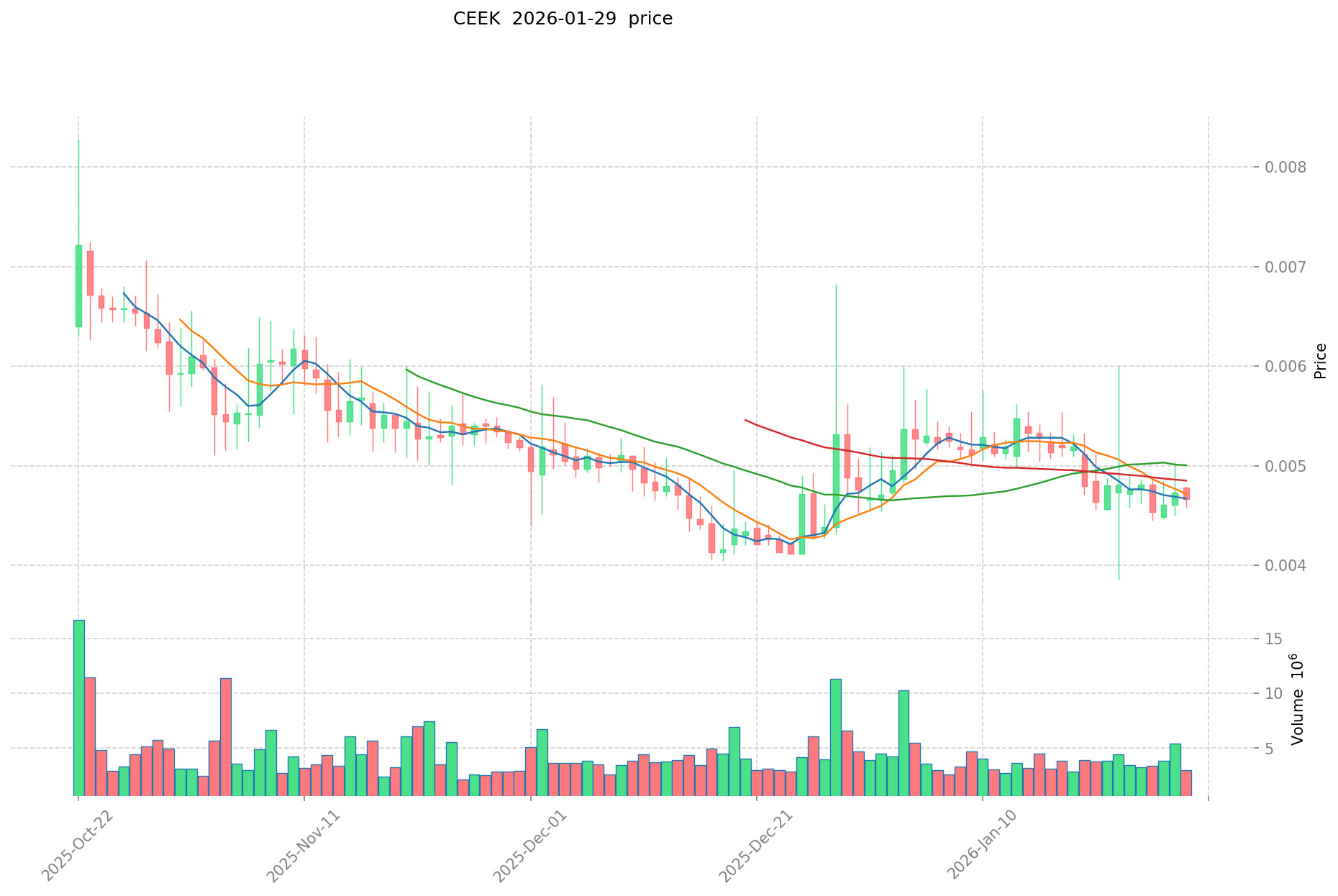
I. CEEK Price History Review and Current Investment Value
- 2021: All-time high period → Price reached $1.19 on November 29, 2021, representing significant gains for early investors
- 2020: Market bottom formation → Price touched $0.00074146 on February 14, 2020, marking a low base for subsequent recovery
- 2018: Initial market entry → Token launched at $0.03, providing early entry opportunities for initial participants
- 2025-2026: Prolonged decline phase → Price decreased from higher levels to current $0.0045, reflecting broader market conditions
Current CEEK Investment Market Status (January 2026)
- CEEK current price: $0.0045
- Market performance: 24-hour decline of 3.91%, 7-day decline of 5.7%, 1-year decline of 84.64%
- 24-hour trading volume: $14,441.39
- Market capitalization: Approximately $4.50 million, ranking #1596 globally
- Circulating supply: 999,499,882 CEEK (99.95% of total supply)
- Holder count: 22,682 addresses
Click to view real-time CEEK market price
II. Key Factors Influencing Whether CEEK Smart VR Token (CEEK) is a Good Investment
Supply Mechanism and Scarcity (CEEK investment scarcity)
- Fixed supply cap at 1,000,000,000 tokens with 999,499,882 tokens in circulation (99.95% of total supply) → influences price dynamics and investment considerations
- Market capitalization to fully diluted valuation ratio stands at 99.95%, indicating minimal future dilution impact
- Investment perspective: the high circulation ratio suggests limited supply-side expansion, which may support price stability under sustained demand conditions
Institutional Investment and Mainstream Adoption (Institutional investment in CEEK)
- Current holder base includes 22,682 addresses, reflecting active community participation
- CEEK platform enables content creators, music artists, and athletes to connect with audiences through virtual reality experiences, potentially expanding mainstream use cases
- Token utility spans multiple functions including rewards, voting, competitions, virtual goods, and transaction settlements within the platform ecosystem
Macroeconomic Environment Impact on CEEK Investment
- 24-hour trading volume of $14,441.39 indicates moderate liquidity levels that may be influenced by broader market conditions
- Recent price performance shows negative trends: -2.94% (1H), -3.91% (24H), -5.7% (7D), -5.11% (30D), and -84.64% (1Y)
- Current market share of 0.00014% suggests exposure to both crypto-specific dynamics and general risk sentiment
Technology and Ecosystem Development (Technology & Ecosystem for CEEK investment)
- Platform architecture utilizes blockchain-based middleware enabling smart contract integration with external data sources and assets
- Multi-chain deployment across Ethereum (ETH) and Binance Smart Chain (BSC) networks enhances accessibility and interoperability
- AR/VR wearable device integration and content creation studios provide infrastructure for immersive digital experiences, supporting long-term ecosystem expansion
- Smart contract functionality facilitates on-chain transactions for audiovisual content, virtual reality experiences, and digital assets within the platform
III. CEEK Future Investment Forecast and Price Outlook (Is CEEK Smart VR Token(CEEK) worth investing in 2026-2031)
Short-term Investment Forecast (2026, short-term CEEK investment outlook)
- Conservative forecast: $0.00423 - $0.0045
- Neutral forecast: $0.0045 - $0.005
- Optimistic forecast: $0.005 - $0.006525
Mid-term Investment Outlook (2027-2028, mid-term CEEK Smart VR Token(CEEK) investment forecast)
- Market stage expectation: The token may experience gradual growth as the AR/VR content platform continues to develop, with potential fluctuations reflecting broader market conditions and adoption rates.
- Investment return forecast:
- 2027: $0.003693375 - $0.007882875
- 2028: $0.00468838125 - $0.007568386875
- Key catalysts: Platform adoption by content creators, expansion of virtual reality experiences, blockchain integration developments, and overall cryptocurrency market sentiment.
Long-term Investment Outlook (Is CEEK a good long-term investment?)
- Baseline scenario: $0.003637848965625 - $0.00927294834375 (assuming moderate platform growth and stable market conditions through 2029)
- Optimistic scenario: $0.008376896212256 - $0.010007651174062 (assuming increased adoption of AR/VR technology and strong platform partnerships through 2030-2031)
- Risk scenario: Below $0.003 (in case of significant market downturns, technological competition, or reduced platform engagement)
View CEEK long-term investment and price forecast: Price Prediction
2026-01-29 - 2031 Long-term Outlook
- Baseline scenario: $0.0045 - $0.008 USD (corresponding to steady progress and gradual mainstream application improvement)
- Optimistic scenario: $0.008 - $0.010007651174062 USD (corresponding to large-scale adoption and favorable market environment)
- Transformative scenario: Above $0.012 USD (if ecosystem achieves breakthrough progress and mainstream popularization)
- 2031-12-31 forecast high: $0.010007651174062 USD (based on optimistic development assumptions)
Disclaimer: Price forecasts are based on historical data and market analysis and do not constitute investment advice. Cryptocurrency markets are highly volatile and subject to various risks. Investors should conduct independent research and consider their risk tolerance before making investment decisions.
| Year |
Predicted High Price |
Predicted Average Price |
Predicted Low Price |
Price Change |
| 2026 |
0.006525 |
0.0045 |
0.00423 |
0 |
| 2027 |
0.007882875 |
0.0055125 |
0.003693375 |
22 |
| 2028 |
0.007568386875 |
0.0066976875 |
0.00468838125 |
48 |
| 2029 |
0.00927294834375 |
0.0071330371875 |
0.003637848965625 |
58 |
| 2030 |
0.010007651174062 |
0.008202992765625 |
0.00459367594875 |
82 |
| 2031 |
0.009378481628939 |
0.009105321969843 |
0.008376896212256 |
102 |
IV. CEEK Investment Strategy and Risk Management (How to invest in CEEK Smart VR Token)
Investment Methodology (CEEK investment strategy)
Long-term Holding (HODL CEEK)
For conservative investors seeking exposure to the AR/VR and blockchain entertainment sector, a long-term holding strategy may be considered. CEEK's platform focuses on connecting content creators with audiences through virtual reality experiences, which represents a niche within the broader metaverse and digital entertainment space. Given the token's circulation ratio of approximately 99.95%, the supply dynamics are relatively stable, with minimal additional dilution expected. However, investors should note the significant price decline of 84.64% over the past year, which reflects broader market challenges and sector-specific headwinds. Long-term holders would need to assess whether the underlying technology and adoption metrics justify sustained accumulation despite recent price performance.
Active Trading Strategy
Active traders may approach CEEK through technical analysis and swing trading methodologies. The token has demonstrated notable volatility, with 24-hour price fluctuations ranging between $0.0045 and $0.004785. Short-term price movements show recent declines across multiple timeframes: -2.94% (1H), -3.91% (24H), -5.7% (7D), and -5.11% (30D). This volatility pattern may present opportunities for traders skilled in identifying support and resistance levels. The relatively low 24-hour trading volume of approximately $14,441 suggests limited liquidity, which can amplify price swings but may also result in slippage for larger orders. Traders should implement strict stop-loss mechanisms and avoid over-leveraging positions given these liquidity constraints.
Risk Management (Risk management for CEEK investment)
Asset Allocation Ratios
-
Conservative Investors: Given CEEK's market capitalization ranking of 1,596 and market dominance of only 0.00014%, conservative portfolios should limit exposure to no more than 0.5-1% of total crypto holdings. The token's classification as a small-cap asset with limited exchange availability (listed on 1 exchange according to available data) suggests elevated risk profiles.
-
Aggressive Investors: Those with higher risk tolerance and conviction in the AR/VR entertainment sector might allocate 2-5% of their crypto portfolio to CEEK, recognizing the speculative nature of this allocation. The historical price range from an all-time low of $0.00074146 (February 2020) to an all-time high of $1.19 (November 2021) demonstrates extreme volatility.
-
Professional Investors: Institutional or professional investors typically require deeper liquidity and lower volatility profiles. CEEK's current trading characteristics may not align with institutional investment criteria, though small strategic positions (under 1%) could serve as sector exposure within diversified metaverse or entertainment technology portfolios.
Risk Hedging Approaches
Investors can implement several hedging strategies to manage CEEK-specific risks:
-
Multi-Asset Portfolio Construction: Combining CEEK exposure with more established cryptocurrencies (such as major layer-1 protocols) and potentially inverse correlation assets can reduce portfolio-wide volatility.
-
Sector Diversification: Rather than concentrating in single AR/VR tokens, investors might spread exposure across multiple metaverse and entertainment-focused projects to mitigate platform-specific risks.
-
Defensive Positioning: During periods of heightened market uncertainty, reducing CEEK allocation or maintaining stablecoin reserves allows for tactical rebalancing during price dislocations.
Secure Storage Solutions
Given that CEEK operates with contract addresses on both Ethereum (0xb056c38f6b7dc4064367403e26424cd2c60655e1) and Binance Smart Chain (0xe0f94ac5462997d2bc57287ac3a3ae4c31345d66), investors should implement appropriate custody measures:
-
Cold Storage: For long-term holdings, hardware wallets supporting ERC-20 and BEP-20 tokens provide optimal security. Devices should be sourced directly from manufacturers and initialized with secure, offline seed phrase generation.
-
Hot Wallet Management: For active trading positions, reputable software wallets with multi-signature capabilities can balance accessibility with security. However, only trading allocations should remain in hot storage.
-
Hardware Wallet Recommendations: Industry-standard hardware wallets compatible with Ethereum and BSC networks offer secure storage options. Regular firmware updates and verification of receiving addresses before transactions are essential security practices.
V. CEEK Investment Risks and Challenges (Risks of investing in CEEK Smart VR Token)
Market Risks
High Volatility
CEEK has exhibited substantial price volatility throughout its trading history. The token currently trades at $0.0045, representing a significant decline from its historical peak of $1.19 recorded in November 2021—a drawdown exceeding 99%. The past year alone has seen an 84.64% decline, indicating sustained downward pressure. Short-term volatility remains pronounced, with weekly fluctuations of -5.7% and monthly changes of -5.11%. This volatility pattern suggests that investors may experience rapid and substantial value fluctuations, particularly during periods of broader market stress or sector-specific developments.
Liquidity Constraints
With a 24-hour trading volume of approximately $14,441 and availability on limited exchanges, CEEK faces potential liquidity challenges. Low trading volumes can result in wider bid-ask spreads, increased slippage for larger orders, and difficulty executing positions during periods of market stress. The market capitalization of approximately $4.5 million places CEEK in the small-cap category, where liquidity risks are typically more pronounced than in larger, more established cryptocurrencies.
Regulatory Risks
Jurisdictional Policy Uncertainty
Cryptocurrency regulatory frameworks continue to evolve across different jurisdictions, creating uncertainty for token holders. Projects operating at the intersection of blockchain technology and entertainment content—such as CEEK's AR/VR platform—may face regulatory scrutiny related to:
-
Securities Classification: Regulatory authorities in various jurisdictions may evaluate whether tokens used within entertainment platforms constitute securities, potentially triggering registration and compliance requirements.
-
Content Regulation: Platforms facilitating creator-to-audience interactions may encounter content moderation requirements or restrictions in certain jurisdictions, potentially affecting platform utility and token demand.
-
Cross-Border Operations: CEEK's multi-chain deployment (Ethereum and BSC) and international creator/audience base may expose the project to regulatory complexity across multiple jurisdictions with varying compliance standards.
Investors should monitor regulatory developments in their jurisdiction and assess how evolving frameworks might impact the project's operational model and token utility.
Technical Risks
Network Security Vulnerabilities
As a token operating on both Ethereum and Binance Smart Chain, CEEK inherits the security characteristics of these underlying networks while introducing platform-specific risks:
-
Smart Contract Risks: The token utilizes smart contracts on both chains, which may contain vulnerabilities despite auditing efforts. Historical incidents across the blockchain industry demonstrate that smart contract exploits can result in token value loss or platform disruption.
-
Bridge Risks: If CEEK facilitates cross-chain transfers between Ethereum and BSC, bridge technologies introduce additional attack vectors that have historically been targeted by malicious actors.
-
Platform Dependencies: The project's reliance on AR/VR technology integration with blockchain middleware creates technical complexity. Failures in the middleware layer or integration points could disrupt platform functionality and negatively impact token utility.
Technology Upgrade Challenges
Blockchain projects require ongoing development and upgrades to maintain competitiveness and security. Potential risks include:
-
Migration Issues: Upgrades or migrations to underlying blockchain infrastructure could encounter technical difficulties, potentially disrupting token functionality or requiring token swaps.
-
Competitive Technology: The AR/VR and metaverse sectors are characterized by rapid technological evolution. CEEK's platform must continuously innovate to remain relevant, and failure to keep pace with competing technologies could diminish platform adoption and token demand.
-
Adoption Hurdles: The project's value proposition depends on creator and audience adoption of the platform's AR/VR capabilities. Lower-than-expected adoption rates or user engagement could negatively impact token economics and long-term viability.
VI. Conclusion: Is CEEK Smart VR Token a Good Investment?
Investment Value Assessment
CEEK Smart VR Token represents exposure to the intersection of blockchain technology, virtual reality, and digital entertainment—a sector with potential long-term growth as metaverse concepts continue to develop. However, the token's recent performance reflects significant challenges, with an 84.64% decline over the past year and continued downward pressure across shorter timeframes. The project's market capitalization of approximately $4.5 million and ranking of 1,596 indicate it remains a small-cap, speculative asset within the broader cryptocurrency ecosystem.
The token's utility within the CEEK platform—facilitating creator-audience interactions, virtual goods purchases, and governance participation—provides a use case framework, though actual adoption metrics and platform growth indicators would be necessary for comprehensive valuation assessment. The near-complete circulation (99.95% of max supply) minimizes future dilution concerns, but this must be weighed against the limited trading volume and exchange availability.
Short-term price action suggests continued volatility and downward pressure, while long-term potential depends heavily on factors such as platform adoption, AR/VR sector growth, and the project's ability to differentiate within an increasingly competitive metaverse and digital entertainment landscape.
Investor Recommendations
✅ Beginners
New cryptocurrency investors should approach CEEK with significant caution given its small market capitalization, limited liquidity, and substantial historical volatility. If considering exposure:
-
Dollar-Cost Averaging: Rather than lump-sum investment, spreading purchases over extended periods may reduce timing risk, though investors should first establish positions in more liquid, established cryptocurrencies.
-
Secure Storage: Given the token's presence on both Ethereum and BSC networks, beginners must ensure they use compatible wallets and verify contract addresses (ETH: 0xb056c38f6b7dc4064367403e26424cd2c60655e1; BSC: 0xe0f94ac5462997d2bc57287ac3a3ae4c31345d66) before transactions.
-
Position Sizing: Any allocation should represent a minimal percentage of overall portfolio (under 1%) and only capital that investors can afford to lose entirely.
✅ Experienced Investors
Investors with cryptocurrency market experience and higher risk tolerance might consider CEEK as a speculative position within broader sector exposure:
-
Swing Trading Opportunities: The token's volatility patterns may present trading opportunities for those skilled in technical analysis, though limited liquidity requires careful order execution.
-
Portfolio Diversification: CEEK could serve as a small allocation within a diversified metaverse or AR/VR sector portfolio, alongside more established projects with stronger liquidity profiles.
-
Risk Management: Strict stop-loss levels and regular portfolio rebalancing are essential given the token's volatility characteristics and small-cap nature.
✅ Institutional Investors
Institutional participants typically require liquidity depth, regulatory clarity, and risk-adjusted return profiles that CEEK's current characteristics may not satisfy. However:
-
Sector Research: The project may serve as a case study for understanding AR/VR integration with blockchain technology and entertainment platform tokenomics.
-
Tactical Micro-Allocation: Sophisticated investors with specific metaverse or digital entertainment thesis might include minimal exposure (well under 1% of crypto allocation) as part of a broader sector positioning strategy.
-
Due Diligence Requirements: Institutional standards would typically require detailed assessment of platform metrics, development activity, partnership ecosystem, and regulatory positioning beyond publicly available data.
⚠️ Disclaimer
Cryptocurrency investments carry substantial risk, including the potential for complete loss of capital. CEEK Smart VR Token's small market capitalization, limited trading volume, significant historical price declines, and exposure to technology and regulatory uncertainties make it a high-risk asset. This analysis provides informational content based on available data and does not constitute investment advice, financial recommendations, or solicitation to buy or sell any cryptocurrency. Investors should conduct comprehensive due diligence, assess their risk tolerance, and consult with qualified financial advisors before making investment decisions. Past performance does not indicate future results, and the cryptocurrency market remains highly speculative and volatile.
VII. FAQ
Q1: What is CEEK Smart VR Token and how does it work?
CEEK Smart VR Token (CEEK) is a cryptocurrency designed to facilitate transactions within a blockchain-integrated virtual reality platform connecting content creators with audiences. The token operates on both Ethereum and Binance Smart Chain networks, enabling artists, athletes, and digital creators to monetize immersive AR/VR experiences. Users can utilize CEEK tokens for multiple platform functions including purchasing virtual goods, accessing exclusive content, participating in voting mechanisms, receiving rewards, and settling transactions for audiovisual content. The platform employs blockchain middleware and smart contracts to integrate external data sources and assets, creating an ecosystem where virtual and real-world transactions can occur seamlessly through AR/VR wearable devices.
Q2: Has CEEK Smart VR Token experienced significant price volatility?
Yes, CEEK has demonstrated extreme price volatility throughout its trading history. The token reached an all-time high of $1.19 in November 2021 but currently trades at approximately $0.0045 as of January 29, 2026—representing a decline exceeding 99% from its peak. Over the past year alone, the token has lost 84.64% of its value, with continued downward pressure across shorter timeframes: -2.94% (1 hour), -3.91% (24 hours), -5.7% (7 days), and -5.11% (30 days). This volatility pattern reflects both broader cryptocurrency market conditions and sector-specific challenges within the AR/VR and metaverse space. The token's small market capitalization of approximately $4.5 million and limited trading volume of around $14,441 in 24 hours contribute to price instability.
Q3: What are the main risks associated with investing in CEEK?
Investing in CEEK carries multiple significant risks. Market risks include extreme volatility with potential for substantial losses, as evidenced by the 99%+ decline from all-time highs, along with liquidity constraints due to low trading volume that can result in slippage and difficulty executing larger orders. Technical risks encompass smart contract vulnerabilities across both Ethereum and BSC deployments, potential bridge security issues for cross-chain operations, and platform dependency on complex AR/VR technology integration. Regulatory risks include uncertainty around potential securities classification, content moderation requirements, and evolving cryptocurrency regulations across multiple jurisdictions. The project's small market capitalization ranking (#1596) and limited exchange availability amplify these risks, making CEEK suitable only for investors who can afford complete capital loss.
Q4: What is CEEK's token supply structure?
CEEK has a fixed maximum supply cap of 1,000,000,000 tokens, with 999,499,882 tokens currently in circulation—representing approximately 99.95% of the total supply. This near-complete circulation ratio indicates minimal future dilution from additional token releases, which can provide some supply-side stability. The token is distributed among 22,682 holder addresses as of January 2026, reflecting active community participation despite market challenges. The high circulation percentage means that supply dynamics are relatively established, and price movements will primarily depend on demand factors such as platform adoption, user engagement, and broader market sentiment rather than systematic token unlocks or inflationary mechanisms.
Q5: How should different types of investors approach CEEK?
Investment approach should vary significantly by investor profile. Beginners should exercise extreme caution given CEEK's small-cap status, limited liquidity, and severe historical volatility; any position should represent minimal portfolio allocation (under 1%) with capital prepared for total loss, utilizing dollar-cost averaging and secure multi-chain compatible wallets. Experienced investors might consider CEEK as a speculative micro-allocation within diversified AR/VR sector exposure, employing swing trading strategies around volatility patterns while maintaining strict stop-loss disciplines and regular rebalancing given the limited liquidity profile. Institutional investors typically require liquidity depth and risk profiles that CEEK may not satisfy, though sophisticated participants might include tactical micro-positions (well under 1%) as part of broader metaverse sector research or thematic positioning, subject to comprehensive due diligence on platform metrics and regulatory positioning.
Q6: What factors could influence CEEK's future price performance?
Multiple factors may impact CEEK's price trajectory. Positive catalysts include increased adoption of the AR/VR platform by content creators and audiences, successful partnerships with entertainment industry participants, technological upgrades enhancing platform capabilities, and overall growth in the metaverse and virtual entertainment sectors. Market sentiment toward blockchain-integrated entertainment and improvements in cryptocurrency market conditions could also support price appreciation. Conversely, negative factors include continued low platform adoption, intensified competition from alternative AR/VR platforms with stronger resources, adverse regulatory developments affecting blockchain entertainment projects, broader cryptocurrency market downturns, technological vulnerabilities or smart contract exploits, and sustained liquidity constraints limiting investor participation. Price forecasts range from conservative scenarios of $0.00423-$0.005 in 2026 to optimistic long-term projections approaching $0.010 by 2031, though these remain highly speculative given current market conditions.
Q7: Where can CEEK tokens be purchased and stored?
CEEK tokens are available on cryptocurrency exchanges, though the project has limited exchange availability based on current data. Investors should verify exchange listings and ensure they use reputable platforms with adequate security measures. For storage, CEEK operates with contract addresses on both Ethereum (0xb056c38f6b7dc4064367403e26424cd2c60655e1) and Binance Smart Chain (0xe0f94ac5462997d2bc57287ac3a3ae4c31345d66), requiring wallets compatible with ERC-20 and BEP-20 token standards. Long-term holders should utilize hardware wallets supporting both networks for optimal security, sourced directly from manufacturers with secure seed phrase generation. Active traders may use reputable software wallets with multi-signature capabilities, though only trading allocations should remain in hot storage. Before any transaction, investors must carefully verify the correct contract address for their chosen network and ensure wallet compatibility to avoid irreversible loss of funds.
Q8: Is CEEK suitable as a long-term investment?
CEEK's suitability as a long-term investment depends heavily on individual risk tolerance and portfolio objectives. The token represents exposure to the emerging AR/VR entertainment sector with potential for growth if the platform achieves significant creator and audience adoption, technological differentiation, and benefits from broader metaverse sector expansion. However, substantial headwinds exist: the 84.64% decline over the past year, market capitalization ranking of #1596, limited liquidity with $14,441 in 24-hour trading volume, and uncertain competitive positioning within an increasingly crowded metaverse landscape present significant challenges. Long-term price forecasts under optimistic scenarios suggest potential appreciation to $0.008-$0.010 by 2030-2031, but baseline scenarios indicate more modest growth, and risk scenarios acknowledge possibilities of further decline. Investors considering long-term positions should limit exposure to small percentage allocations within diversified portfolios, maintain realistic expectations given current market positioning, and regularly reassess the project's development progress and competitive dynamics.
* The information is not intended to be and does not constitute financial advice or any other recommendation of any sort offered or endorsed by Gate.