Cellframe Network (CELL) is a quantum-resistant Layer-1 blockchain infrastructure project launched in March 2021, currently trading at $0.08016 with a market cap of $2.98 million. This comprehensive analysis examines whether CELL represents a viable investment by evaluating its innovative post-quantum cryptographic technology, multi-chain architecture, and cross-chain capabilities against significant challenges including extreme volatility, limited liquidity across 4 exchanges, and an unlimited supply mechanism. The article reviews CELL's dramatic price history—from a $7.21 peak in 2021 to current levels—and provides detailed price forecasts for 2026-2031 across conservative, neutral, and optimistic scenarios. Investment strategies are tailored for beginners, experienced traders, and institutional investors, with emphasis on risk management through portfolio allocation and secure storage on Gate. Critical risks including market volatility, regulatory uncertainty, and technical vulnerabilities are thoroughly a
Introduction: Cellframe Network (CELL)'s Investment Position and Market Outlook
CELL is a notable asset in the cryptocurrency sector, having been launched in March 2021 with a focus on quantum-resistant blockchain infrastructure. The project positions itself as a Layer-1 network designed to facilitate secure and scalable cross-chain transfers through post-quantum cryptographic algorithms. As of January 31, 2026, CELL holds a market capitalization of approximately $2.98 million, with a circulating supply of 37.17 million tokens and a current trading price around $0.08016. With its positioning as a quantum-resistant multi-chain infrastructure platform, CELL has gradually attracted attention among investors exploring "Is Cellframe Network (CELL) a good investment?" This article provides a comprehensive analysis of CELL's investment characteristics, historical price movements, future price projections, and associated investment risks to serve as a reference for market participants.
Cellframe Network integrates several technical approaches including sharding mechanisms, post-quantum algorithms, proof-of-stake consensus models, multi-algorithm signatures, and directed acyclic graph (DAG) structures alongside traditional blockchain architectures. The project aims to create infrastructure for decentralized low-level services through its multi-chain framework. CELL tokens are accessible on multiple platforms, with contracts deployed on Ethereum and Binance Smart Chain networks. The token currently represents approximately 0.00010% of the total cryptocurrency market share and is listed on 4 exchanges, with a holder base of 10,853 addresses.
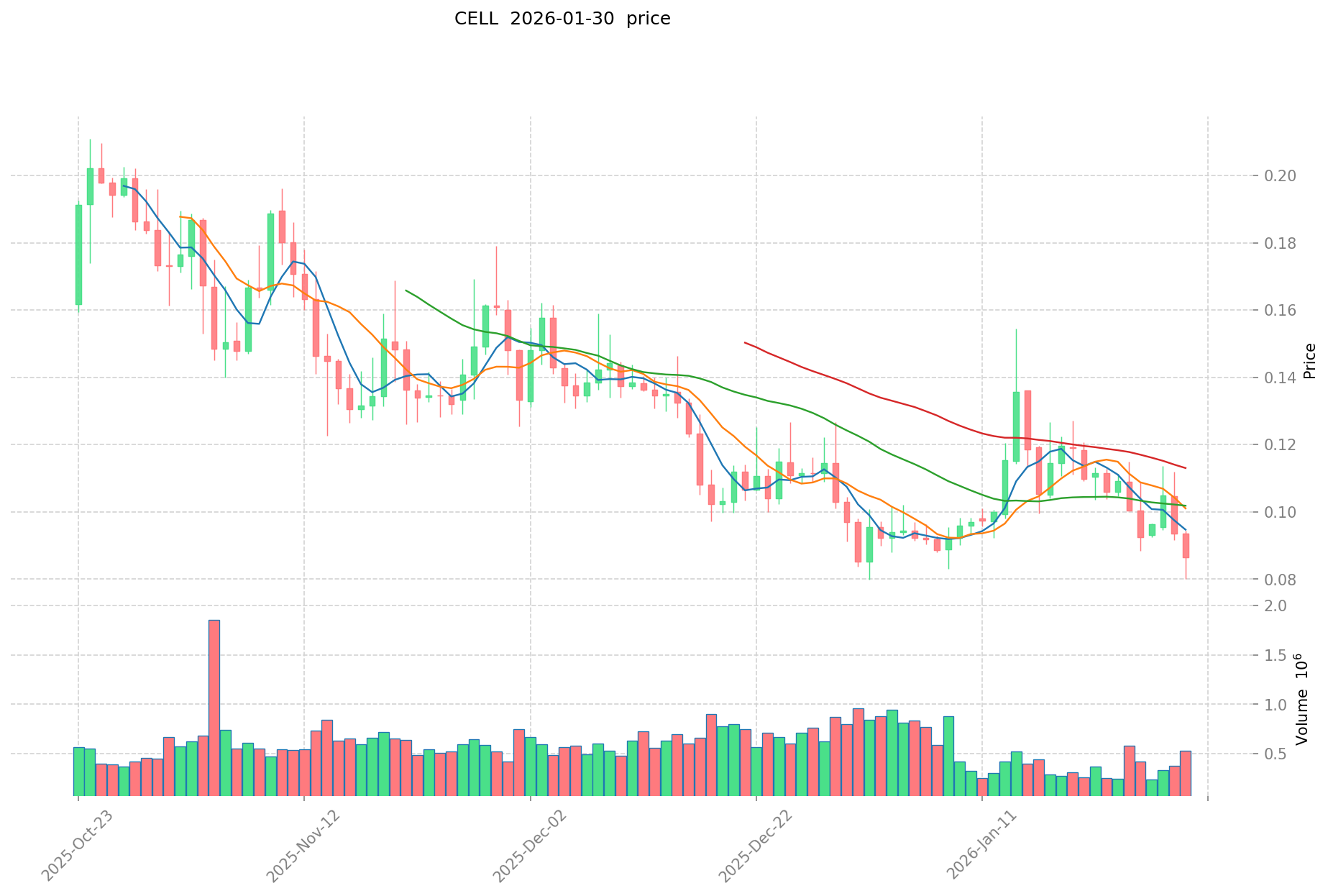
Recent price data shows varied performance across different timeframes: a 1.76% increase over one hour, a 4.92% decline over 24 hours, a 24.24% decrease over seven days, a 4.37% drop over 30 days, and an 85.19% decline over the past year. The 24-hour trading range has fluctuated between $0.07601 and $0.08712, with daily trading volume reaching approximately $39,986. The token's price history includes a recorded peak of $7.21 in March 2021 and a low of $0.078076 in January 2026.
I. Cellframe Network (CELL) Price History Review and Current Investment Status
- 2021: CELL reached a price level of $7.21 on March 25, representing a significant valuation period for early participants.
- 2023-2026: The token experienced substantial volatility, with price movements reflecting broader market dynamics and project developments.
- Recent Period: From elevated price levels, CELL adjusted to $0.08016 as of January 31, 2026, demonstrating the volatile nature of digital asset markets.
Current CELL Investment Market Status (January 2026)
- CELL Current Price: $0.08016
- 24-hour Trading Volume: $39,985.62
- Circulating Supply: 37,170,000 CELL
- Market Capitalization: $2,979,547.20
- 24-hour Price Change: -4.92%
- 7-day Price Change: -24.24%
Click to view real-time CELL market price
II. Core Factors Influencing Whether CELL is a Good Investment
Supply Mechanism and Scarcity (CELL Investment Scarcity)
- Unlimited supply mechanism → potential impact on long-term price dynamics and investment value assessment
- Current circulation: 37,170,000 CELL (representing approximately 98.5% of total supply of 37,735,000 CELL)
- Investment consideration: The unlimited maximum supply structure may influence scarcity-based valuation models, differentiating CELL from fixed-supply digital assets in terms of long-term investment characteristics
Technology and Ecosystem Development (Technology & Ecosystem for CELL Investment)
- Post-quantum cryptographic algorithms: Designed to enhance network security against potential future quantum computing threats → positioning as a forward-looking technological infrastructure
- Multi-chain architecture: Aims to facilitate secure and scalable cross-chain transfers → supporting decentralized low-level service infrastructure
- Technical features include: sharding technology, modern PoS-based consensus mechanism, multi-algorithm signatures, low-level dApp APIs, point-to-point sharding communication, and hybrid chain architectures (DAG and traditional blockchain structures)
- Ecosystem positioning: Focuses on creating infrastructure for decentralized services through its multi-chain framework, with potential applications in cross-chain interoperability and secure data transmission
III. CELL Future Investment Forecast and Price Outlook (Is Cellframe Network(CELL) worth investing in 2026-2031)
Short-term Investment Forecast (2026, short-term CELL investment outlook)
- Conservative forecast: $0.067728 - $0.0816
- Neutral forecast: $0.0816 - $0.100368
- Optimistic forecast: $0.100368 - $0.119136
Mid-term Investment Outlook (2027-2028, mid-term Cellframe Network(CELL) investment forecast)
-
Market stage expectation: The token may experience gradual growth as the network continues to develop its quantum-resistant infrastructure and cross-chain capabilities. Market conditions and adoption rates will likely influence price momentum.
-
Investment return forecast:
- 2027: $0.06423552 - $0.12144528
- 2028: $0.1042522416 - $0.155269296
-
Key catalysts: Network infrastructure development, cross-chain transfer capabilities expansion, quantum-resistant technology adoption, market sentiment shifts, and broader cryptocurrency market trends.
Long-term Investment Outlook (Is CELL a good long-term investment?)
- Base scenario: $0.092263233816 - $0.1563783624 (assuming steady development of the quantum-resistant layer-1 network and gradual adoption of cross-chain services)
- Optimistic scenario: $0.133087968 - $0.225184841856 (assuming accelerated adoption of quantum-resistant technology, significant cross-chain infrastructure growth, and favorable market conditions)
- Risk scenario: Below $0.067728 (in case of extended market downturns, technological challenges, or significant competitive pressure)
Click to view CELL long-term investment and price forecast: Price Prediction
2026-01-31 - 2031 Long-term Outlook
- Base scenario: $0.092263233816 - $0.1563783624 (corresponding to steady progress and gradual mainstream application enhancement)
- Optimistic scenario: $0.133087968 - $0.225184841856 (corresponding to large-scale adoption and favorable market environment)
- Transformative scenario: Above $0.225184841856 (in case of breakthrough progress in ecosystem development and mainstream popularization)
- 2031-12-31 forecast high: $0.225184841856 (based on optimistic development assumptions)
Disclaimer: The above forecasts are based on historical data analysis and market trend assessments. Cryptocurrency investments carry significant risks, and actual prices may differ substantially from predictions due to market volatility, technological developments, regulatory changes, and other unforeseen factors. This information should not be construed as investment advice.
| Year |
Predicted High Price |
Predicted Average Price |
Predicted Low Price |
Price Change |
| 2026 |
0.119136 |
0.0816 |
0.067728 |
1 |
| 2027 |
0.12144528 |
0.100368 |
0.06423552 |
25 |
| 2028 |
0.155269296 |
0.11090664 |
0.1042522416 |
38 |
| 2029 |
0.1796687568 |
0.133087968 |
0.1131247728 |
66 |
| 2030 |
0.225184841856 |
0.1563783624 |
0.092263233816 |
95 |
| 2031 |
0.20413631427696 |
0.190781602128 |
0.17551907395776 |
138 |
IV. CELL Investment Strategy and Risk Management (How to invest in Cellframe Network)
Investment Methodology (CELL investment strategy)
Long-term Holding (HODL CELL): Suitable for conservative investors
Long-term holding represents a relatively stable approach for CELL investors. Given the project's focus on quantum-resistant Layer-1 network infrastructure and cross-chain transfer capabilities, investors with a long-term perspective may consider allocating CELL as part of a diversified portfolio. This strategy typically involves purchasing tokens during market corrections and maintaining positions through market cycles, reducing the impact of short-term volatility.
Active Trading: Relying on technical analysis and swing operations
For experienced traders, CELL's price movements present opportunities for active trading strategies. Based on available data, CELL has exhibited notable volatility, with 24-hour fluctuations and weekly price changes indicating potential swing trading opportunities. Technical analysis tools, including support and resistance levels, volume analysis, and momentum indicators, may assist traders in identifying entry and exit points. However, this approach requires continuous market monitoring and carries higher risk compared to passive holding strategies.
Risk Management (Risk management for CELL investment)
Asset Allocation Ratios: Conservative / Aggressive / Professional investors
- Conservative investors: Consider limiting CELL exposure to 1-3% of total portfolio value, focusing on established cryptocurrencies with CELL as a speculative allocation
- Aggressive investors: May allocate 5-10% to CELL within their cryptocurrency portfolio, accepting higher volatility for potential returns
- Professional investors: Could employ dynamic allocation strategies based on market conditions, technical indicators, and fundamental developments, with positions ranging from 3-15% depending on risk appetite and market phase
Risk Hedging Solutions: Multi-asset portfolio + hedging instruments
Effective risk management for CELL investment involves diversification across multiple asset classes and blockchain sectors. Investors may consider:
- Balancing CELL holdings with established cryptocurrencies and stablecoins
- Diversifying across different blockchain infrastructure projects to reduce sector-specific risk
- Maintaining liquid reserves to capitalize on market opportunities or manage unexpected drawdowns
Secure Storage: Hot and cold wallets + hardware wallet recommendations
Secure storage remains essential for CELL holdings. Based on available contract information, CELL tokens exist on Ethereum and BSC networks. Investors should consider:
- Hardware wallets for long-term storage of significant holdings
- Cold wallet solutions for assets not intended for active trading
- Hot wallets with limited balances for trading and transaction purposes
- Multi-signature wallets for institutional or high-value holdings
- Regular security audits of storage solutions and backup procedures
V. CELL Investment Risks and Challenges (Risks of investing in Cellframe Network)
Market Risks: High volatility and price manipulation concerns
CELL demonstrates substantial price volatility, with data showing fluctuations across various timeframes. The token has experienced significant price movements, reflecting both market sentiment and liquidity conditions. With a market capitalization in the lower range and limited exchange listings (4 exchanges), CELL faces liquidity challenges that can amplify price swings. Lower trading volumes may create conditions where relatively small transactions impact price significantly, and the risk of price manipulation increases in less liquid markets.
Regulatory Risks: Policy uncertainty across different jurisdictions
As with all cryptocurrency projects, CELL faces regulatory uncertainty across global jurisdictions. Different countries maintain varying approaches to cryptocurrency regulation, ranging from supportive frameworks to restrictive policies. Changes in regulatory stance, classification of tokens, taxation policies, or restrictions on cryptocurrency trading and usage could materially impact CELL's accessibility, liquidity, and valuation. Investors should monitor regulatory developments in their jurisdictions and in markets where CELL maintains significant trading activity.
Technical Risks: Network security vulnerabilities and upgrade failures
While Cellframe Network emphasizes quantum-resistant technology and security features, technical risks remain inherent to blockchain infrastructure projects. Potential vulnerabilities in smart contracts, consensus mechanisms, or network architecture could compromise security or functionality. The project's multi-chain nature and integration of various technologies introduce complexity that may present unforeseen technical challenges. Network upgrades, while necessary for evolution, carry risks of implementation issues or compatibility problems that could affect token functionality or network operations.
VI. Conclusion: Is Cellframe Network a Good Investment?
Investment Value Summary
CELL presents a mixed investment profile characterized by innovative quantum-resistant technology and cross-chain infrastructure focus, balanced against significant volatility and market positioning challenges. The project's emphasis on post-quantum cryptography and multi-chain architecture addresses emerging technological needs in blockchain infrastructure. However, current market metrics indicate substantial price fluctuations and limited liquidity compared to established projects. Long-term investment potential exists for those believing in quantum-resistant blockchain infrastructure, though short-term price movements remain unpredictable and potentially severe.
Investor Recommendations
✅ Beginners: Dollar-cost averaging + secure wallet storage
- Consider systematic periodic investments rather than lump-sum purchases to mitigate timing risk
- Prioritize secure storage solutions immediately upon acquisition
- Limit initial exposure while developing understanding of cryptocurrency markets and CELL's specific characteristics
- Maintain realistic expectations regarding volatility and potential losses
✅ Experienced Investors: Swing trading + portfolio allocation
- Evaluate CELL within broader cryptocurrency portfolio context
- Consider technical analysis for potential swing trading opportunities
- Implement position sizing appropriate to risk tolerance and portfolio strategy
- Monitor project developments and market conditions for tactical adjustments
✅ Institutional Investors: Strategic long-term allocation
- Assess CELL's role within infrastructure and Layer-1 blockchain exposure
- Implement rigorous due diligence on technical architecture and team capabilities
- Consider gradual position building aligned with institutional risk management frameworks
- Establish clear investment theses and exit criteria
⚠️ Notice: Cryptocurrency investment carries substantial risk, including potential total loss of capital. This content serves informational purposes only and does not constitute investment advice. Investors should conduct independent research, consult financial advisors, and only invest amounts they can afford to lose. Past performance does not indicate future results, and all investment decisions remain the sole responsibility of individual investors.
VII. FAQ
Q1: What is Cellframe Network (CELL) and what makes it different from other blockchain projects?
Cellframe Network is a quantum-resistant Layer-1 blockchain infrastructure project launched in March 2021, designed to facilitate secure and scalable cross-chain transfers using post-quantum cryptographic algorithms. Its distinctiveness lies in its forward-looking approach to security threats posed by future quantum computing capabilities. The project integrates multiple technical features including sharding mechanisms, proof-of-stake consensus models, multi-algorithm signatures, and hybrid chain architectures combining DAG structures with traditional blockchain designs. This multi-faceted technical approach positions CELL as infrastructure for decentralized low-level services through its multi-chain framework, differentiating it from conventional blockchain projects that may lack quantum-resistant properties.
Q2: Is CELL a good investment for beginners in cryptocurrency?
For beginners, CELL represents a high-risk, speculative investment that requires careful consideration and risk management. Given the token's significant price volatility—including an 85.19% decline over the past year and 24.24% decrease over seven days—beginners should approach CELL with extreme caution. If considering CELL investment, beginners should limit exposure to 1-3% of total portfolio value, employ dollar-cost averaging strategies to mitigate timing risk, and prioritize secure wallet storage solutions. Most importantly, beginners should only invest amounts they can afford to lose completely, as cryptocurrency investments carry substantial risk including potential total loss of capital. Developing understanding of cryptocurrency markets and CELL's specific characteristics should precede any investment decision.
Q3: What are the main risks associated with investing in Cellframe Network (CELL)?
CELL investment carries multiple significant risk categories: (1) Market risks including extreme price volatility and potential manipulation concerns due to limited liquidity across only 4 exchanges and relatively low trading volumes; (2) Regulatory risks stemming from policy uncertainty across different jurisdictions, with potential changes in cryptocurrency classification, taxation, or trading restrictions that could materially impact token accessibility and valuation; (3) Technical risks including potential vulnerabilities in smart contracts, consensus mechanisms, or network architecture despite the project's emphasis on quantum-resistant technology. The token's multi-chain nature and integration of various technologies introduce complexity that may present unforeseen challenges. Additionally, the unlimited supply mechanism may influence long-term scarcity-based valuation models, differentiating CELL from fixed-supply digital assets.
Q4: What is the price prediction for CELL in 2026-2031?
Based on historical data analysis and market trend assessments, CELL price forecasts vary significantly across scenarios. For 2026, conservative estimates range from $0.067728 to $0.0816, neutral forecasts suggest $0.0816 to $0.100368, and optimistic projections indicate $0.100368 to $0.119136. Long-term projections for 2031 range from approximately $0.175519 (predicted low) to $0.204136 (predicted high) with an average forecast of $0.190782. However, these forecasts should be interpreted with significant caution as they are based on assumptions that may not materialize. Cryptocurrency markets exhibit extreme volatility, and actual prices may differ substantially from predictions due to technological developments, regulatory changes, market sentiment shifts, competitive pressures, and other unforeseen factors. Past performance does not indicate future results.
Q5: How can I securely store my CELL tokens?
CELL tokens exist on Ethereum and Binance Smart Chain networks, requiring appropriate storage solutions based on investment strategy and holding period. For long-term storage of significant holdings, hardware wallets provide the highest security level by keeping private keys offline and protected from network-based threats. Cold wallet solutions are recommended for assets not intended for active trading, minimizing exposure to potential security breaches. Hot wallets should only hold limited balances designated for trading and transaction purposes, as they remain connected to the internet and face higher security risks. Institutional or high-value holdings may benefit from multi-signature wallet configurations requiring multiple authorizations for transactions. Investors should implement regular security audits of storage solutions, maintain secure backup procedures for recovery phrases, and never share private keys or seed phrases with anyone.
Q6: What investment strategy should I use for CELL—long-term holding or active trading?
The appropriate CELL investment strategy depends on investor experience level, risk tolerance, and time commitment. Long-term holding (HODL) suits conservative investors who believe in the project's quantum-resistant Layer-1 infrastructure vision and can withstand significant short-term volatility. This approach involves purchasing during market corrections and maintaining positions through market cycles, reducing emotional decision-making impact. Active trading may appeal to experienced traders capable of employing technical analysis tools to identify swing trading opportunities based on CELL's notable price fluctuations. However, active trading requires continuous market monitoring, carries higher risk, and demands proficiency in technical analysis including support and resistance levels, volume analysis, and momentum indicators. Most investors should avoid attempting active trading without substantial experience and should never invest more than they can afford to lose regardless of strategy chosen.
Q7: What factors should I consider when evaluating CELL's investment potential?
Evaluating CELL's investment potential requires comprehensive assessment across multiple dimensions: (1) Technical fundamentals including the project's quantum-resistant cryptographic algorithms, multi-chain architecture, and infrastructure development progress; (2) Market metrics such as the current market capitalization of approximately $2.98 million, limited exchange listings (4 platforms), trading volume patterns, and liquidity conditions; (3) Supply dynamics recognizing the unlimited maximum supply mechanism that differentiates CELL from fixed-supply assets and may impact long-term scarcity-based valuations; (4) Competitive positioning within the quantum-resistant blockchain and Layer-1 infrastructure sectors; (5) Regulatory environment across jurisdictions where you operate and where CELL maintains trading activity; (6) Team capabilities and execution track record in delivering technical milestones; (7) Adoption trends for quantum-resistant technology and cross-chain infrastructure services. Investors should conduct thorough independent research and consult financial advisors before making investment decisions.
Q8: How does CELL's unlimited supply mechanism affect its investment value?
CELL's unlimited maximum supply mechanism represents a critical factor distinguishing it from fixed-supply cryptocurrencies like Bitcoin and potentially impacts long-term investment value assessment. Unlike scarcity-based models where limited supply can create upward price pressure as demand increases, unlimited supply structures may dilute existing holder value through ongoing token emissions unless balanced by equivalent or greater demand growth. Currently, approximately 98.5% of the total supply (37,170,000 of 37,735,000 CELL) is already in circulation, but the unlimited nature means additional tokens could enter circulation indefinitely. This supply characteristic requires investors to focus more heavily on utility, adoption, and demand drivers rather than scarcity alone when evaluating long-term price potential. Investors should understand that without sufficient demand growth to absorb new supply, price appreciation may face structural headwinds compared to fixed-supply alternatives.
* The information is not intended to be and does not constitute financial advice or any other recommendation of any sort offered or endorsed by Gate.