This comprehensive article examines whether CELO represents a viable investment opportunity by analyzing the mobile-first blockchain platform's financial inclusion mission and market performance. CELO, trading at $0.1386 with an $82.08 million market cap, has demonstrated recent gains of 13.66% over 30 days, though it faces significant volatility from its 78.61% annual decline. The analysis evaluates CELO's core strengths including its focus on 1.7 billion unbanked individuals, presence across 57 exchanges including Gate, and controlled token supply mechanism with 592.17 million circulating tokens. Key investment considerations span technical infrastructure capabilities, regulatory uncertainties, and extreme price volatility. The article provides detailed investment strategies for conservative, aggressive, and professional investors, complete with risk management frameworks encompassing portfolio allocation, secure storage solutions, and hedging approaches. Long-term price forecasts and investment recommendat
Introduction: CeloGold (CELO)'s Investment Position and Market Outlook
CELO is a notable asset in the cryptocurrency sector, launched in May 2020 with a focus on financial inclusion and mobile-first accessibility. As of January 2026, CELO holds a market capitalization of approximately $82.08 million, with a circulating supply of around 592.17 million tokens, and the current price stands at approximately $0.1386. Positioned as a platform dedicated to making financial tools accessible to anyone with a mobile phone, CELO has gradually become a focal point for investors discussing "Is CeloGold (CELO) a good investment?" This article will comprehensively analyze CELO's investment value, historical trends, future price forecasts, and associated risks to provide reference for investors.
CELO operates as an open platform addressing financial exclusion challenges, targeting populations without traditional banking access. The platform's architecture encompasses features such as token-based transaction fee payment, phone number-based payment routing, and ultra-light client design for limited data connectivity scenarios. With availability on 57 exchanges and a holder base of approximately 193.53 million addresses, CELO maintains a market dominance of 0.0040%. Recent price movements show a 24-hour increase of 2.37%, a 7-day gain of 6.15%, and a 30-day rise of 13.66%, though the 1-year performance reflects a decline of 78.61% from previous levels. The token's all-time high reached $9.82 on August 30, 2021, while its all-time low of $0.109096 was recorded on January 1, 2026.
The platform's mission centers on financial accessibility for underserved populations, with technological infrastructure designed to support users in regions with limited financial infrastructure. CELO's fully diluted market cap stands at $138.6 million, with a circulating supply representing 59.22% of the maximum supply of 1 billion tokens. The 24-hour trading volume of approximately $343,934.60 indicates ongoing market activity. This analysis will examine the factors influencing CELO's valuation, historical price patterns, predictive models for future performance, and risk considerations relevant to potential participants in this market segment.
I. CeloGold (CELO) Price History Review and Current Investment Value
- 2020: CELO launched with an initial price of $1.00, establishing its presence as a mobile-first blockchain platform focused on financial inclusion
- 2021: Platform experienced notable growth during the DeFi expansion period, with CELO reaching price levels that reflected increased adoption of its mobile-optimized financial tools
- 2022-2023: CELO underwent market adjustments alongside broader cryptocurrency sector corrections, experiencing price fluctuations as the platform continued development of its stable protocol and mobile wallet infrastructure
- 2024-2026: The token showed recovery signs with price movement from lower ranges toward $0.1386, reflecting ongoing ecosystem development and sustained commitment to expanding financial access for mobile users globally
Current CELO Investment Market Status (January 2026)
- CELO Current Price: $0.1386
- Market Sentiment: The platform maintains focus on its core mission of providing financial tools to mobile phone users, with development activity centered on stable value mechanisms and lightweight client capabilities
- 24-Hour Trading Volume: $343,934.60
- Holder Distribution: The network has approximately 193.5 million addresses, indicating widespread distribution across its target user base
- Circulating Supply: 592.17 million CELO (59.22% of total supply)
- Market Capitalization: $82.08 million
Click to view real-time CELO market price
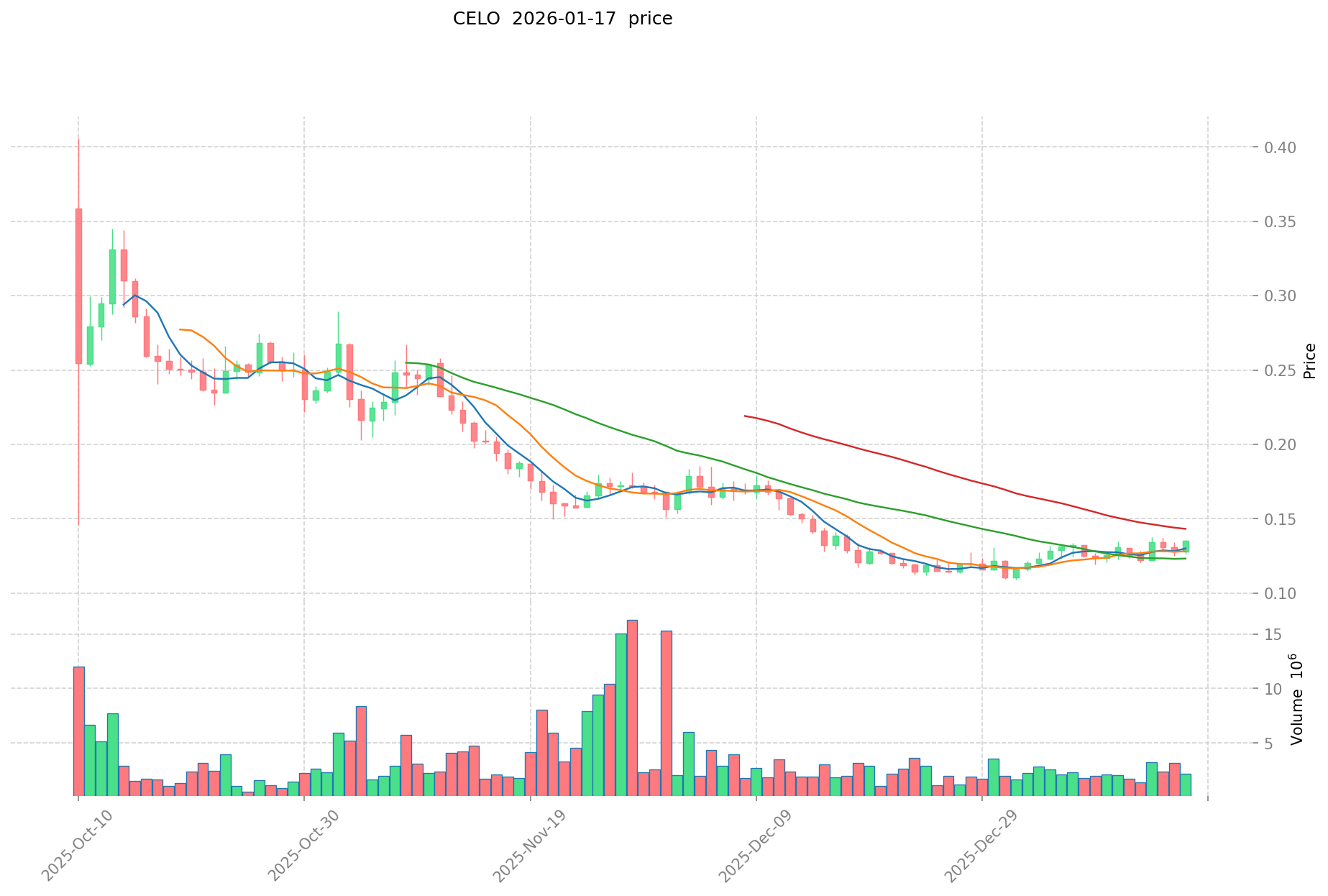
II. Core Factors Influencing Whether CELO is a Good Investment
Supply Mechanism and Scarcity (CELO Investment Scarcity)
- Total supply capped at 1,000,000,000 CELO tokens with circulating supply of 592,171,760 tokens (59.22% of total supply)
- Maximum supply mechanism establishes long-term scarcity framework
- Current market capitalization stands at $82,075,005.936 with fully diluted valuation at $138,600,000
- Investment significance: Fixed supply cap creates potential scarcity value that may support long-term holding strategies
Institutional Investment and Mainstream Adoption (Institutional Investment in CELO)
- Platform targets 1.7 billion unbanked individuals worldwide, addressing financial inclusion challenges
- Celo platform enables payment transfers via phone numbers without requiring recipient registration, enhancing accessibility
- Ultra-light client design accommodates users with limited data connectivity, supporting mobile-first adoption
- Exchange presence across 57 trading platforms indicates established market infrastructure
- Holder count reaches 193,533,340, suggesting broad distribution across user base
Macroeconomic Environment Impact on CELO Investment
- Stablecoin protocol within Celo ecosystem allows transaction fee payments with various tokens, potentially reducing volatility impact
- Mobile-first financial infrastructure positions CELO within emerging market dynamics
- Platform's financial inclusion mission aligns with global development trends in underbanked regions
Technology and Ecosystem Development (Technology & Ecosystem for CELO Investment)
- Open platform architecture supports DeFi applications and mobile wallet integration
- Stable protocol design enables currency value stabilization mechanisms
- Fast synchronization capability for data-limited environments enhances user experience
- Phone number-based payment system reduces technical barriers for mainstream adoption
- Platform infrastructure spans from protocol layer to application layer, supporting comprehensive ecosystem development
III. CELO Future Investment Forecast and Price Outlook (Is CeloGold(CELO) worth investing in 2026-2031)
Short-term Investment Forecast (2026, short-term CELO investment outlook)
- Conservative estimate: $0.12429 - $0.1381
- Neutral estimate: $0.1381 - $0.15191
- Optimistic estimate: $0.15191 and above
Mid-term Investment Outlook (2027-2029, mid-term CeloGold(CELO) investment forecast)
- Market phase expectation: During the mid-term period, CELO may experience gradual price expansion alongside ecosystem development and broader market conditions.
- Investment return forecast:
- 2027: $0.07685 - $0.1653
- 2028: $0.0822 - $0.1846
- 2029: $0.1053 - $0.1801
- Key catalysts: Platform adoption rates, technological improvements, integration with mobile financial services, and overall cryptocurrency market sentiment.
Long-term Investment Outlook (Is CELO a good long-term investment?)
- Base scenario: $0.1032 - $0.2292 (assuming steady ecosystem growth and moderate market conditions)
- Optimistic scenario: $0.2022 - $0.2870 (assuming accelerated adoption of mobile-first financial services and favorable regulatory environment)
- Risk scenario: Below $0.1032 (under conditions of significant market downturns or reduced platform utilization)
Check CELO long-term investment and price prediction: Price Prediction
2026-01-18 - 2031 Long-term Outlook
- Base scenario: $0.1032 - $0.2292 (corresponding to steady progress and gradual mainstream application growth)
- Optimistic scenario: $0.2022 - $0.2870 (corresponding to large-scale adoption and favorable market environment)
- Transformational scenario: Above $0.2870 (if ecosystem achieves breakthrough progress and mainstream popularization)
- 2031-12-31 projected high: $0.2870 (based on optimistic development assumptions)
Disclaimer: The above price forecasts are based on technical analysis and historical patterns. Cryptocurrency markets are highly volatile and subject to numerous unpredictable factors. These projections should not be considered as financial advice or guarantees of future performance. Investors should conduct their own research and assess their risk tolerance before making investment decisions.
| Year |
Predicted High Price |
Predicted Average Price |
Predicted Low Price |
Price Change |
| 2026 |
0.15191 |
0.1381 |
0.12429 |
0 |
| 2027 |
0.1653057 |
0.145005 |
0.07685265 |
4 |
| 2028 |
0.1846348665 |
0.15515535 |
0.0822323355 |
11 |
| 2029 |
0.180088814745 |
0.16989510825 |
0.105334967115 |
22 |
| 2030 |
0.229239469561725 |
0.1749919614975 |
0.103245257283525 |
26 |
| 2031 |
0.287004316052049 |
0.202115715529612 |
0.169777201044874 |
45 |
IV. CELO Investment Strategy and Risk Management (How to invest in CELO)
Investment Methodology (CELO investment strategy)
Long-term Holding (HODL CELO): Suitable for Conservative Investors
Long-term holding represents a passive investment approach that focuses on the fundamental value and development potential of the Celo platform. This strategy is particularly suitable for investors who believe in Celo's mission of financial inclusion and its technological infrastructure. Given that CELO currently trades at $0.1386, significantly below its historical high of $9.82 recorded on August 30, 2021, long-term investors may view the current price level as a potential accumulation opportunity. However, it is important to note that the token has experienced a substantial decline of 78.61% over the past year, indicating considerable market challenges.
For conservative investors considering this approach, the key is to establish a systematic accumulation plan rather than attempting to time market bottoms. The circulating supply represents approximately 59.22% of the total supply, with 592,171,760 tokens currently in circulation out of a maximum supply of 1,000,000,000 tokens. This relatively controlled supply schedule may provide some stability for long-term holders.
Active Trading: Technical Analysis and Swing Trading
Active trading strategies for CELO require careful attention to price movements and technical indicators. Based on recent data, CELO has shown mixed short-term performance: a 1-hour decline of 0.92%, a 24-hour gain of 2.37%, a 7-day increase of 6.15%, and a 30-day rise of 13.66%. The 24-hour trading range between $0.1336 (low) and $0.1479 (high) indicates volatility of approximately 10.7%, which can provide opportunities for swing traders.
Traders should monitor key support and resistance levels, with the recent low of $0.109096 (recorded on January 1, 2026) serving as a critical support zone, while the 24-hour high of $0.1479 represents near-term resistance. The 24-hour trading volume of $343,934.60 suggests moderate liquidity, which traders should consider when planning entry and exit strategies.
Risk Management (Risk management for CELO investment)
Asset Allocation Ratios: Conservative / Aggressive / Professional Investors
Conservative Investors: For risk-averse investors, CELO allocation should not exceed 2-3% of the total cryptocurrency portfolio, with an overall crypto allocation of no more than 5-10% of total investment assets. This approach acknowledges the high volatility inherent in cryptocurrency markets while allowing for potential upside exposure.
Aggressive Investors: More risk-tolerant investors might allocate 5-10% of their cryptocurrency portfolio to CELO, with total crypto exposure potentially reaching 20-30% of their investment portfolio. This strategy assumes a higher tolerance for volatility and a longer investment horizon.
Professional Investors: Institutional or professional investors with sophisticated risk management systems may allocate based on quantitative models and correlation analysis with other assets. Given CELO's market dominance of 0.0040% and ranking of 411, professional investors should consider its relatively smaller market capitalization when determining position sizes.
Diversification remains the primary risk management tool for CELO investors. Consider constructing a balanced portfolio that includes:
- Established cryptocurrencies with larger market capitalizations to reduce overall portfolio volatility
- Stablecoins to maintain liquidity and reduce correlation risk
- Traditional assets (stocks, bonds, commodities) to provide portfolio stability
The market cap to fully diluted valuation ratio of 59.22% indicates that a significant portion of tokens remains unvested, which represents a potential dilution risk that should be factored into risk management strategies.
Secure Storage: Hot and Cold Wallets + Hardware Wallet Recommendations
Given the decentralized nature of cryptocurrency investments, secure storage is paramount:
Cold Wallet Solutions:
- Hardware wallets offer the highest security for long-term holdings
- Paper wallets or air-gapped solutions for maximum security
- Recommended for holdings intended for periods exceeding several months
Hot Wallet Solutions:
- Mobile wallets for active trading and regular transactions
- Exchange wallets only for amounts intended for immediate trading
- Multi-signature wallets for enhanced security with convenience
Best Practices:
- Never store all CELO holdings in a single location
- Implement a tiered storage approach: 70-80% in cold storage, 20-30% in hot wallets for trading
- Regularly update wallet software and maintain secure backup procedures
- Verify all transaction addresses carefully before confirming transfers
V. CELO Investment Risks and Challenges (Risks of investing in CELO)
Market Risk: High Volatility and Price Manipulation
CELO exhibits significant price volatility, as evidenced by its 78.61% decline over the past year and the substantial gap between its current price of $0.1386 and its historical high of $9.82. This represents a decline of approximately 98.6% from peak levels, highlighting the extreme volatility characteristic of cryptocurrency markets.
The 24-hour trading volume of $343,934.60 relative to a market capitalization of $82,075,005.94 results in a volume-to-market-cap ratio of approximately 0.42%, which is relatively low compared to more liquid cryptocurrencies. This lower liquidity level may increase susceptibility to price volatility and potential market manipulation, particularly during periods of low trading activity.
With CELO listed on 57 exchanges, liquidity is distributed across multiple venues, which can create price discrepancies and arbitrage opportunities but may also lead to fragmented liquidity. Investors should be aware that sudden price movements can occur with relatively modest trading volumes.
Regulatory Risk: Policy Uncertainty Across Different Countries
Regulatory uncertainty represents a significant risk factor for CELO investors. As a cryptocurrency with global reach and a focus on financial inclusion through mobile accessibility, CELO operates in a complex regulatory environment spanning multiple jurisdictions.
Key regulatory considerations include:
Classification Uncertainty: Different regulatory bodies may classify CELO differently (as a security, commodity, or utility token), which could impact its legal status and trading requirements in various jurisdictions.
Financial Inclusion Regulations: CELO's mission to provide financial services to underbanked populations may attract regulatory scrutiny in jurisdictions with strict financial services regulations, anti-money laundering requirements, and know-your-customer compliance standards.
Cross-border Transaction Regulations: The platform's ability to send payments to phone numbers across borders may face regulatory challenges related to international money transmission laws.
Investors should monitor regulatory developments in major markets and be prepared for potential compliance requirements that could affect CELO's operations and token value.
Technical Risk: Network Security Vulnerabilities and Upgrade Failures
Technical risks associated with CELO include:
Network Security: As an open platform supporting financial transactions, CELO must maintain robust security protocols. Any security vulnerabilities or successful attacks could significantly impact token value and user confidence.
Protocol Upgrades: Blockchain networks require periodic upgrades to improve functionality and security. Failed upgrades or contentious protocol changes could lead to network disruptions or community splits.
Smart Contract Risks: If users interact with applications built on the Celo platform, they may be exposed to smart contract vulnerabilities that could result in loss of funds.
Competition and Technological Obsolescence: The blockchain space evolves rapidly, and newer platforms with improved technology or features could reduce CELO's competitive position.
Mobile-first Approach Limitations: While CELO's focus on mobile accessibility is innovative, it may face technical challenges related to mobile device limitations, data connectivity issues, and user experience optimization.
The project maintains active development, as evidenced by its GitHub presence, but investors should monitor development activity and community engagement as indicators of ongoing technical viability.
VI. Conclusion: Is CELO a Good Investment?
Investment Value Summary
CELO presents a unique value proposition focused on financial inclusion through mobile-first cryptocurrency infrastructure. Trading at $0.1386 with a market capitalization of $82,075,005.94 and ranking 411 by market cap, CELO represents a mid-to-lower tier cryptocurrency in terms of market presence.
The token has demonstrated recent positive momentum with gains of 2.37% (24-hour), 6.15% (7-day), and 13.66% (30-day), suggesting potential short-term recovery. However, the substantial 78.61% decline over the past year and the 98.6% drop from its historical high of $9.82 indicate significant long-term challenges and elevated risk levels.
Key factors supporting potential investment value include the platform's mission-driven approach to financial inclusion, its focus on mobile accessibility, and its established presence across 57 exchanges. The circulating supply represents 59.22% of maximum supply, indicating a relatively controlled token release schedule compared to some projects with higher dilution risk.
However, investors must weigh these factors against considerable risks including extreme price volatility, regulatory uncertainty, technical challenges, and intense competition in the blockchain space. The relatively low trading volume and market dominance of 0.0040% suggest limited market attention and potential liquidity concerns.
Investor Recommendations
✅ Beginners: New cryptocurrency investors considering CELO should:
- Implement a dollar-cost averaging strategy to mitigate timing risk
- Limit CELO allocation to 2-3% of cryptocurrency holdings
- Prioritize secure storage using hardware wallets or reputable custody solutions
- Thoroughly research the Celo platform's technology and mission before investing
- Avoid investing amounts they cannot afford to lose completely
- Consider CELO as a speculative position rather than a core holding
✅ Experienced Investors: Those with cryptocurrency market experience may:
- Employ swing trading strategies based on technical analysis, given recent volatility patterns
- Allocate 5-10% of cryptocurrency portfolio to CELO as part of a diversified mid-cap strategy
- Monitor on-chain metrics, development activity, and ecosystem growth indicators
- Implement stop-loss orders to manage downside risk
- Consider CELO's correlation with broader market movements when rebalancing portfolios
- Evaluate risk-reward ratios considering the significant gap between current and historical prices
✅ Institutional Investors: Professional and institutional investors should:
- Conduct comprehensive due diligence on technological infrastructure, team, and governance
- Consider strategic positioning based on quantitative models and correlation analysis
- Evaluate CELO within the context of broader blockchain infrastructure investments
- Assess regulatory compliance implications across relevant jurisdictions
- Implement sophisticated risk management including position sizing based on volatility metrics
- Monitor token unlock schedules and potential dilution effects from the remaining 40.78% of non-circulating supply
⚠️ Disclaimer: Cryptocurrency investments involve substantial risk and extreme price volatility. CELO has demonstrated significant price declines and may experience further volatility. This analysis is provided for informational purposes only and does not constitute investment, financial, legal, or tax advice. Investors should conduct independent research, consider their financial situation and risk tolerance, and consult with qualified professionals before making investment decisions. Past performance does not guarantee future results, and investors may lose their entire investment.
VII. FAQ
Q1: What is CELO and what makes it different from other cryptocurrencies?
CELO is a mobile-first blockchain platform launched in May 2020, specifically designed to provide financial services to the 1.7 billion unbanked individuals worldwide. Unlike traditional cryptocurrencies, CELO enables users to send payments using phone numbers without requiring recipient registration, features an ultra-light client design for limited data connectivity scenarios, and allows transaction fees to be paid with various tokens through its stable protocol. This unique focus on mobile accessibility and financial inclusion, combined with its infrastructure spanning from protocol to application layers, distinguishes CELO from other blockchain projects that primarily target tech-savvy users with reliable internet access.
Q2: Why has CELO's price declined 78.61% over the past year?
CELO's significant price decline reflects multiple factors including broader cryptocurrency market corrections, the platform's relatively small market dominance of 0.0040%, and competition from established blockchain networks. The token has fallen from its all-time high of $9.82 (August 30, 2021) to its current price of $0.1386, representing a 98.6% decline from peak levels. Additionally, the low 24-hour trading volume of $343,934.60 relative to its market cap indicates limited liquidity, making the token more susceptible to price volatility. The challenging macroeconomic environment and regulatory uncertainties surrounding cryptocurrency markets have further contributed to sustained downward pressure.
Q3: How much of my investment portfolio should I allocate to CELO?
Allocation recommendations vary based on investor risk profiles. Conservative investors should limit CELO to 2-3% of their cryptocurrency holdings, with overall crypto exposure not exceeding 5-10% of total investment assets. Aggressive investors with higher risk tolerance may allocate 5-10% of their cryptocurrency portfolio to CELO, with total crypto exposure potentially reaching 20-30%. Professional investors should determine position sizes based on quantitative models, considering CELO's market ranking of 411 and its relatively smaller market capitalization. Regardless of investor type, it is critical to invest only amounts that can be lost entirely given cryptocurrency market volatility.
Q4: What are the main risks associated with investing in CELO?
CELO investment risks include extreme price volatility (evidenced by the 78.61% one-year decline), regulatory uncertainty across different jurisdictions due to its global financial services focus, technical risks including network security vulnerabilities and protocol upgrade failures, and market manipulation risks due to relatively low liquidity. The remaining 40.78% of non-circulating supply represents potential dilution risk as tokens are released. Additionally, CELO faces intense competition from established blockchain platforms and newer technologies, with its mobile-first approach potentially facing limitations related to mobile device constraints and data connectivity issues in target markets.
Q5: What is CELO's realistic price forecast for 2026-2031?
Based on technical analysis and historical patterns, CELO's price projections show varied scenarios. For 2026, conservative estimates range from $0.12429 to $0.1381, neutral estimates from $0.1381 to $0.15191, and optimistic estimates above $0.15191. By 2031, the base scenario projects $0.1032 to $0.2292 assuming steady ecosystem growth, while the optimistic scenario ranges from $0.2022 to $0.2870 if accelerated adoption occurs. The transformational scenario places prices above $0.2870 if breakthrough progress is achieved. However, these forecasts should not be considered guarantees, as cryptocurrency markets remain highly unpredictable and subject to numerous external factors beyond technical analysis.
Q6: Is CELO suitable for long-term holding or active trading?
CELO can accommodate both strategies depending on investor goals and risk tolerance. Long-term holding suits conservative investors who believe in the platform's financial inclusion mission and are willing to weather significant volatility, viewing the current price as a potential accumulation opportunity despite the 98.6% decline from historical highs. Active trading may be appropriate for experienced traders who can capitalize on CELO's volatility patterns, with recent data showing a 24-hour price range fluctuation of approximately 10.7%. However, the relatively low trading volume requires careful attention to liquidity when planning entry and exit strategies. Both approaches require robust risk management including secure storage solutions and appropriate portfolio allocation.
Q7: How can I securely store my CELO tokens?
Secure CELO storage requires a tiered approach combining cold and hot wallet solutions. For long-term holdings, hardware wallets or cold storage solutions (air-gapped devices, paper wallets) offer maximum security and are recommended for 70-80% of holdings intended for periods exceeding several months. Hot wallets, including mobile wallets and multi-signature wallets, are suitable for the remaining 20-30% intended for active trading and regular transactions. Critical security practices include never storing all holdings in a single location, avoiding large amounts on exchange wallets except for immediate trading needs, regularly updating wallet software, maintaining secure backup procedures, and carefully verifying all transaction addresses before confirming transfers.
Q8: What factors should I monitor to assess CELO's future performance?
Key monitoring factors include platform adoption rates among target populations, development activity on GitHub and ecosystem growth indicators, integration progress with mobile financial services, regulatory developments in major markets affecting cryptocurrency classification and cross-border transactions, on-chain metrics including transaction volume and active addresses, token unlock schedules from the remaining 40.78% non-circulating supply, competitive positioning against other blockchain platforms, and overall cryptocurrency market sentiment. Additionally, investors should track CELO's trading volume trends, exchange listings, and correlation with broader market movements to inform investment decisions and portfolio rebalancing strategies.
* The information is not intended to be and does not constitute financial advice or any other recommendation of any sort offered or endorsed by Gate.