This comprehensive analysis evaluates whether CESS Network (CESS) represents a viable investment opportunity in the decentralized storage sector. As a Layer 1 infrastructure focused on data sovereignty and privacy for AI and Web3 applications, CESS currently trades at $0.002382 with a $6.31 million market cap on Gate and other exchanges. The article examines CESS's price history, featuring a 71.31% annual decline alongside significant volatility. It presents three forecasting scenarios through 2031, with long-term price projections ranging from $0.00264 to $0.00615 depending on adoption rates and market conditions. The analysis addresses critical investment considerations including token supply dynamics (26.5% circulation ratio), liquidity concerns, competitive pressures from established storage solutions, and regulatory uncertainties. Strategic recommendations differentiate between beginner, experienced, and institutional investors, emphasizing dollar-cost averaging for conservatives, active trading for prof
Introduction: CESS Network (CESS) Investment Position and Market Outlook
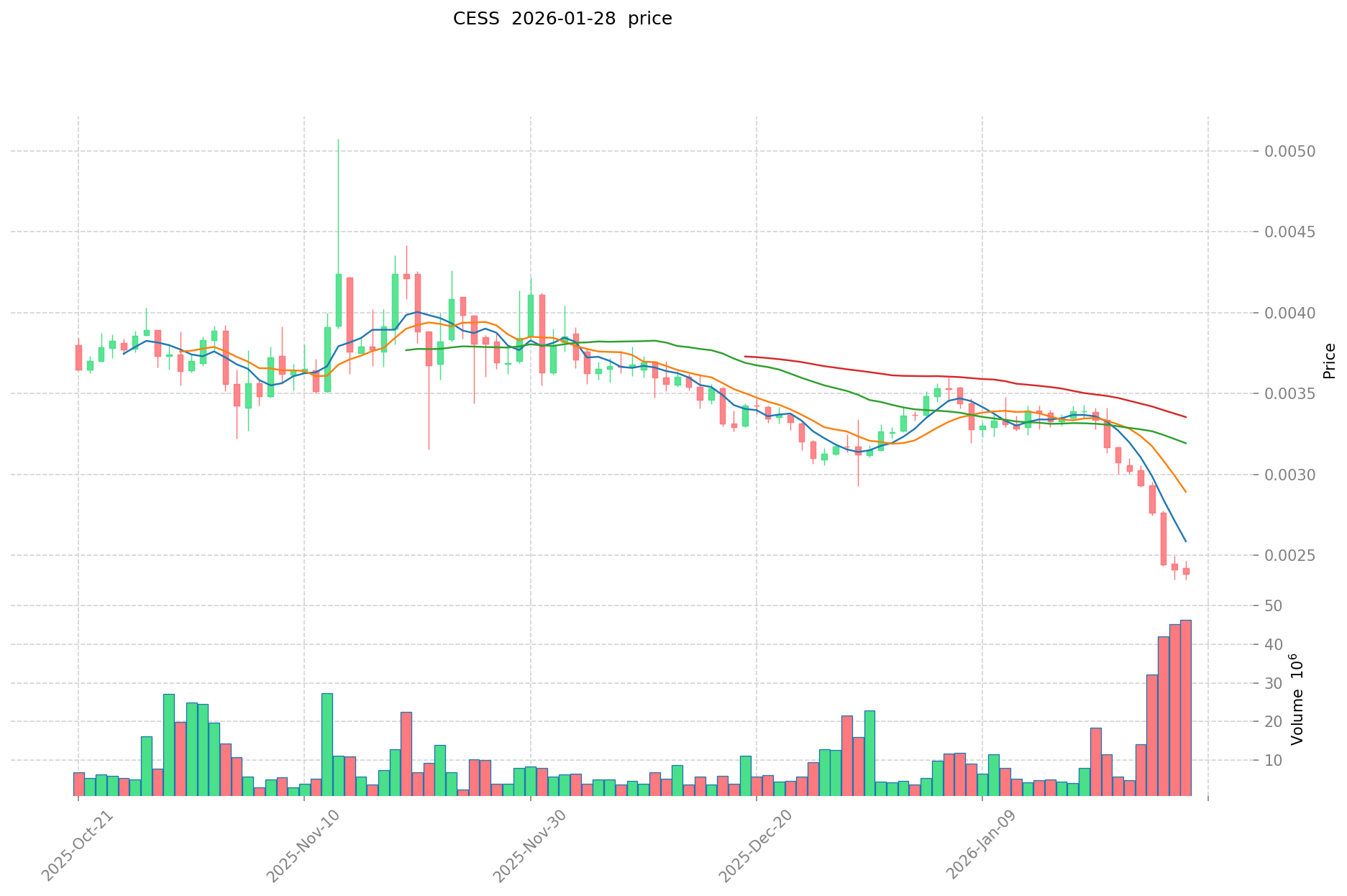
CESS Network (CESS) is a Layer1 decentralized infrastructure focused on data value within the cryptocurrency sector. As of January 28, 2026, CESS maintains a market capitalization of approximately $6.31 million, with a circulating supply of 2.65 billion tokens and a current trading price around $0.002382. The token has shown notable price fluctuations, with a 24-hour change of -1.2% and a 7-day decline of -23.93%. With its positioning as a data sovereignty and privacy-focused infrastructure designed for AI and Web3 data economy applications, CESS has attracted attention from investors evaluating "Is CESS Network (CESS) a good investment?" This analysis examines CESS's investment fundamentals, historical performance trends, future price projections, and associated investment risks to provide reference information for potential investors.
I. CESS Token Price History Review and Investment Value Status
- 2025 Q2: CESS experienced significant price volatility → Price reached approximately $0.02004 in late June 2025, followed by a sharp correction to around $0.00207
- 2025 Q3-Q4: Market consolidation phase → CESS price stabilized around $0.003355, with market capitalization reaching approximately $8.89 million
- Recent Period: Sustained downward pressure → Price declined from previous levels to current trading range, reflecting broader market adjustments
Current CESS Investment Market Status (January 2026)
- CESS current price: $0.002382
- Market sentiment (Fear & Greed Index): Data shows neutral market conditions
- 24-hour trading volume: $111,414.45
- Market capitalization: $6.31 million with 2.65 billion tokens in circulation (26.5% of total supply)
Click to view real-time CESS market price
II. Core Factors Affecting Whether CESS Network (CESS) is a Good Investment
Supply Mechanism and Scarcity (CESS Investment Scarcity)
- Total Supply and Circulation: CESS Network has a maximum supply of 10,000,000,000 tokens, with a current circulating supply of 2,650,000,000 tokens, representing a circulation ratio of 26.5%. The relatively low circulation ratio indicates that a significant portion of tokens remains locked or unreleased, which may influence supply dynamics in the future.
- Impact on Price and Investment Value: The token supply mechanism plays a role in shaping price behavior. According to market data, CESS reached a price level of $0.02004 on June 26, 2025, and subsequently declined to $0.00207 on June 27, 2025, reflecting notable price fluctuations within a short period.
- Investment Significance: The relationship between supply structure and long-term investment value remains a consideration for investors evaluating scarcity-driven opportunities.
Institutional Investment and Mainstream Adoption (Institutional Investment in CESS)
- Holder Base: CESS Network has approximately 55,857 holders, which provides some indication of token distribution and community participation.
- Market Liquidity: Current data indicates that CESS exhibits low liquidity, with a 24-hour turnover ratio of approximately 0.131, suggesting that trading volume represents a relatively small fraction of its market capitalization. This liquidity profile may affect the ease of entry and exit for investors.
- Institutional and Enterprise Adoption: The project positions itself as a decentralized infrastructure solution for businesses, institutions, and governments seeking to leverage AI and RWA (Real World Assets) applications. However, specific details regarding enterprise partnerships or institutional holdings were not disclosed in the reference materials.
Macroeconomic Environment and Its Impact on CESS Investment
- Broader Market Conditions: Macroeconomic factors such as monetary policy, interest rate changes, and inflation trends can influence the attractiveness of cryptocurrency investments, including CESS. However, no specific data linking CESS performance to macroeconomic indicators was provided in the reference materials.
- Geopolitical Considerations: While geopolitical uncertainty may drive interest in decentralized infrastructure solutions, direct evidence of such influence on CESS investment demand was not included in the available data.
Technology and Ecosystem Development (Technology & Ecosystem for CESS Investment)
- Network Upgrades and Technical Enhancements: According to some forecasts, the successful implementation of network upgrades, such as the "Protocol 23" upgrade in Q1 2026, may enhance smart contract capabilities and potentially support price stability. However, the extent to which these upgrades will materialize and their impact on long-term investment value remains uncertain.
- Ecosystem Applications: CESS Network's architecture is designed for the AI era and the Web3 data economy, with a focus on data ownership security, data sovereignty, and user privacy protection. The project aims to provide infrastructure for decentralized data storage and related applications, though specific details regarding DeFi, NFT, or payment integrations were not mentioned in the reference materials.
- Long-Term Value Support: The development of the CESS ecosystem and its ability to attract real-world use cases may play a role in determining the project's long-term investment appeal. Investors should monitor ongoing technical progress and adoption trends to assess potential value drivers.
III. CESS Future Investment Forecast and Price Outlook (Is CESS Network (CESS) worth investing in 2026-2031)
Short-term Investment Forecast (2026, short-term CESS investment outlook)
- Conservative forecast: $0.00217 - $0.00238
- Neutral forecast: $0.00238 - $0.00252
- Optimistic forecast: $0.00252 - $0.00267
Mid-term Investment Outlook (2027-2028, mid-term CESS Network (CESS) investment forecast)
- Market stage expectation: The project may experience gradual development as decentralized storage solutions gain traction in the Web3 ecosystem, with potential expansion in AI and data sovereignty applications
- Investment return forecast:
- 2027: $0.00217 - $0.00376
- 2028: $0.00264 - $0.00465
- Key catalysts: Ecosystem expansion in decentralized storage sector, potential partnerships in data management and cloud services, adoption of Layer1 infrastructure for AI applications
Long-term Investment Outlook (Is CESS a good long-term investment?)
- Base scenario: $0.00264 - $0.00482 (assuming steady ecosystem development and moderate adoption of decentralized storage solutions)
- Optimistic scenario: $0.00389 - $0.00615 (assuming accelerated adoption in AI and Web3 data economy sectors with favorable market conditions)
- Risk scenario: Below $0.00217 (under conditions of market downturns or limited ecosystem expansion)
Click to view CESS long-term investment and price forecast: Price Prediction
2026-01-28 - 2031 Long-term Outlook
- Base scenario: $0.00264 - $0.00482 USD (corresponding to steady progress and gradual mainstream application improvement)
- Optimistic scenario: $0.00389 - $0.00615 USD (corresponding to large-scale adoption and favorable market environment)
- Transformative scenario: Above $0.00615 USD (such as breakthrough progress in the ecosystem and mainstream popularization)
- 2031-12-31 predicted high: $0.00568 USD (based on optimistic development assumptions)
Disclaimer: The information provided represents analysis based on available data and market trends. Cryptocurrency investments carry inherent risks, and past performance does not guarantee future results. Investors should conduct their own research and consider their risk tolerance before making investment decisions.
| Year |
Predicted High Price |
Predicted Average Price |
Predicted Low Price |
Price Change |
| 2026 |
0.0026656 |
0.00238 |
0.0021658 |
0 |
| 2027 |
0.003758972 |
0.0025228 |
0.002169608 |
5 |
| 2028 |
0.00464851128 |
0.003140886 |
0.00263834424 |
31 |
| 2029 |
0.0048294263136 |
0.00389469864 |
0.0026873420616 |
63 |
| 2030 |
0.006150508092288 |
0.0043620624768 |
0.003140684983296 |
83 |
| 2031 |
0.005676788107307 |
0.005256285284544 |
0.003311459729262 |
120 |
IV. CESS Investment Strategy and Risk Management (How to invest in CESS Network)
Investment Methodology (CESS investment strategy)
Long-term Holding (HODL CESS)
For conservative investors seeking steady exposure to decentralized data infrastructure, a long-term holding strategy may be considered. This approach involves:
- Dollar-Cost Averaging (DCA): Regular periodic purchases regardless of price fluctuations to average out entry costs
- Strategic Allocation: Positioning CESS as part of a broader Web3 infrastructure portfolio
- Patience Through Volatility: Tolerating short-term price movements while focusing on fundamental development
Given CESS Network's focus on AI-era data economy and Web3 infrastructure, long-term holders typically monitor technological adoption metrics, partnership announcements, and ecosystem growth indicators rather than daily price movements.
Active Trading
For experienced traders comfortable with higher risk profiles, active trading strategies may include:
- Technical Analysis: Utilizing chart patterns, support/resistance levels, and volume indicators
- Swing Trading: Capturing medium-term price movements based on market momentum
- News-Based Trading: Responding to project updates, partnership announcements, or broader market catalysts
Traders should note CESS's 24-hour trading volume and liquidity characteristics when planning entry and exit positions.
Risk Management (Risk management for CESS investment)
Asset Allocation Ratio
Conservative Investors:
- Limit CESS allocation to 1-3% of total cryptocurrency portfolio
- Maintain larger positions in established assets
- Focus on capital preservation over aggressive growth
Moderate Investors:
- Allocate 3-7% to CESS within a diversified crypto portfolio
- Balance between growth potential and stability
- Combine with mid-cap projects and established protocols
Aggressive/Professional Investors:
- May allocate 7-15% depending on conviction and risk tolerance
- Employ sophisticated hedging strategies
- Maintain active monitoring and rebalancing protocols
Risk Hedging Solutions
- Multi-Asset Portfolio: Diversify across different blockchain sectors (DeFi, infrastructure, Layer 1/Layer 2)
- Stablecoin Reserves: Maintain liquid positions for opportunistic buying or risk reduction
- Correlation Analysis: Combine CESS with assets showing low correlation to reduce overall portfolio volatility
- Position Sizing: Never allocate more capital than you can afford to lose entirely
Secure Storage
Cold Storage Options:
- Hardware wallets (Ledger, Trezor) for long-term holdings
- Multi-signature wallets for institutional-grade security
- Offline paper wallets (for advanced users)
Hot Wallet Considerations:
- Keep only trading amounts in exchange wallets
- Use wallets with strong security features and two-factor authentication
- Regular security audits of connected applications
Best Practices:
- Never share private keys or seed phrases
- Verify contract addresses before transactions (CESS contract: 0x0c78d4605c2972e5f989de9019de1fb00c5d3462 on BSC)
- Use reputable wallet providers with proven track records
- Maintain backup copies of recovery phrases in secure, separate locations
V. CESS Investment Risks and Challenges (Risks of investing in CESS Network)
Market Risks
High Volatility
CESS has demonstrated significant price fluctuations:
- 1-hour change: -0.38%
- 24-hour change: -1.2%
- 7-day change: -23.93%
- 30-day change: -25.1%
- 1-year change: -71.31%
Such volatility presents both opportunities and substantial risks for investors. Price movements can be rapid and unpredictable, influenced by market sentiment, technological developments, and broader cryptocurrency market trends.
Liquidity Considerations
With a 24-hour trading volume of approximately $111,414 and availability on 8 exchanges, CESS may experience:
- Potential slippage on larger orders
- Price impact from significant buy or sell transactions
- Reduced trading opportunities during low-volume periods
Market Manipulation Risks
Smaller market cap tokens can be susceptible to:
- Pump-and-dump schemes
- Coordinated buying or selling pressure
- Influence from large holders (whales)
Regulatory Risks
Jurisdictional Uncertainty
Cryptocurrency regulations vary significantly across countries:
- Evolving legal frameworks may impact token trading and usage
- Potential classification changes affecting tax treatment
- Restrictions on crypto services in certain jurisdictions
Compliance Requirements
As blockchain infrastructure projects mature:
- Increased scrutiny from financial regulators
- Potential licensing requirements for decentralized storage services
- Data sovereignty regulations may impact project operations
Technical Risks
Network Security
- Smart contract vulnerabilities could lead to exploits
- Potential attack vectors on decentralized infrastructure
- Dependencies on underlying blockchain security (BSC network)
Development Execution
- Delays in roadmap implementation
- Technical challenges in scaling data infrastructure
- Competition from alternative decentralized storage solutions
Adoption Uncertainty
- Market acceptance of CESS's data sovereignty approach
- Integration challenges with existing enterprise systems
- Network effects required for widespread utility
Project-Specific Risks
Token Economics
- Circulating supply: 2.65 billion (26.5% of total supply)
- Significant unlocked tokens may create selling pressure
- Market cap to fully diluted valuation ratio suggests future dilution potential
Competition
- Numerous established players in decentralized storage (Filecoin, Arweave, Storj)
- Continuous innovation required to maintain competitive advantages
- Market share challenges in a crowded sector
VI. Conclusion: Is CESS Network a Good Investment?
Investment Value Summary
CESS Network positions itself as Layer 1 infrastructure for data value in the AI era and Web3 data economy. The project addresses important themes including data sovereignty, user privacy, and decentralized storage solutions. However, the investment case presents both opportunities and challenges:
Potential Strengths:
- Focus on emerging AI and RWA sectors
- Comprehensive approach to data ownership and privacy
- Infrastructure play in growing Web3 ecosystem
Notable Challenges:
- Significant price decline over multiple timeframes
- Relatively low trading volume and market capitalization
- High token supply dilution potential (73.5% not yet circulating)
- Intense competition in decentralized storage space
Short-term price action has been characterized by substantial volatility and downward pressure. Long-term potential depends on successful execution of technological roadmap, market adoption, and differentiation from competitors.
Investor Recommendations
✅ Beginners
- Dollar-Cost Averaging: Spread purchases over time to reduce timing risk
- Education First: Thoroughly research project fundamentals and blockchain technology
- Secure Storage: Prioritize using hardware wallets for holdings
- Limited Exposure: Keep CESS allocation minimal (1-3% of crypto portfolio)
- Long-term Perspective: Avoid reacting to short-term price movements
✅ Experienced Investors
- Swing Trading: Consider technical analysis for entry/exit points given volatility
- Portfolio Diversification: Balance CESS with established projects and other infrastructure plays
- Risk Management: Set stop-losses and take-profit targets based on personal risk tolerance
- Active Monitoring: Track development progress, partnerships, and ecosystem metrics
- Rebalancing: Periodically adjust positions based on performance and market conditions
✅ Institutional Investors
- Due Diligence: Conduct comprehensive analysis of technology, team, and competitive landscape
- Strategic Allocation: Evaluate as part of broader Web3 infrastructure thesis
- Risk-Adjusted Sizing: Position size appropriate to risk profile and liquidity needs
- Active Engagement: Monitor governance developments and protocol changes
- Hedging Strategies: Employ sophisticated risk management tools
⚠️ Important Disclaimer
Cryptocurrency investments carry substantial risks including potential total loss of capital. Market volatility, regulatory changes, technical vulnerabilities, and project execution risks can significantly impact investment outcomes. This analysis is provided for informational purposes only and does not constitute financial advice, investment recommendations, or an endorsement of CESS Network. Investors should:
- Conduct independent research and due diligence
- Consult qualified financial advisors
- Only invest amounts they can afford to lose entirely
- Understand the speculative nature of cryptocurrency investments
- Stay informed about evolving market conditions and project developments
Past performance does not guarantee future results. The cryptocurrency market remains highly speculative and unpredictable.
VII. FAQ
Q1: What is CESS Network (CESS) and what makes it different from other blockchain projects?
CESS Network is a Layer 1 decentralized infrastructure focused on data value, specifically designed for the AI era and Web3 data economy. The project differentiates itself through its comprehensive approach to data sovereignty, user privacy protection, and data ownership security. Unlike traditional blockchain platforms, CESS positions itself as infrastructure enabling businesses, institutions, and governments to leverage AI and Real World Assets (RWA) applications while maintaining control over their data. The network addresses growing concerns around data privacy and centralized storage vulnerabilities in the evolving Web3 ecosystem.
Q2: What has been CESS's historical price performance and investment returns?
CESS has experienced significant price volatility throughout its trading history. The token reached approximately $0.02004 in late June 2025, followed by a sharp correction to around $0.00207 within a single day. As of January 28, 2026, the current price stands at $0.002382, representing a 71.31% decline over the past year, a 25.1% decrease over 30 days, and a 23.93% drop over 7 days. The 24-hour trading volume is approximately $111,414.45 with a market capitalization of $6.31 million, indicating relatively low liquidity compared to more established cryptocurrencies.
Q3: What are the long-term price predictions for CESS Network?
According to forecasting models, CESS shows varied potential trajectories through 2031. For 2026, conservative estimates range from $0.00217 to $0.00238, while optimistic scenarios suggest $0.00252 to $0.00267. Mid-term projections for 2027-2028 indicate potential prices between $0.00217 and $0.00465, depending on ecosystem adoption and market conditions. Long-term base scenarios for 2031 estimate $0.00264 to $0.00482, with optimistic scenarios reaching $0.00389 to $0.00615. The predicted high for 2031 is $0.00568. However, these projections are speculative and depend heavily on successful technological implementation, market adoption, and favorable macroeconomic conditions.
Q4: What are the main risks associated with investing in CESS Network?
CESS investment carries multiple risk categories: Market risks include extreme volatility (71.31% annual decline), low liquidity with $111,414 daily volume, and potential manipulation due to smaller market cap. Technical risks encompass smart contract vulnerabilities, development execution challenges, and intense competition from established decentralized storage solutions like Filecoin and Arweave. Regulatory risks involve evolving cryptocurrency frameworks across jurisdictions and potential compliance requirements. Token economics present dilution concerns, as only 26.5% of the 10 billion total supply currently circulates, meaning 73.5% of tokens remain locked or unreleased, potentially creating future selling pressure.
Q5: How should different investor types approach CESS Network investment?
Investment strategies should align with experience levels and risk tolerance. Beginners should employ dollar-cost averaging, limit CESS allocation to 1-3% of their crypto portfolio, prioritize secure storage using hardware wallets, and maintain a long-term perspective while thoroughly researching blockchain fundamentals. Experienced investors may consider swing trading based on technical analysis, maintain 3-7% portfolio allocation, implement active risk management with stop-losses, and regularly monitor development progress. Institutional investors should conduct comprehensive due diligence, employ sophisticated hedging strategies, evaluate CESS as part of broader Web3 infrastructure thesis, and size positions according to liquidity needs and risk profiles.
Q6: Where and how can I securely purchase and store CESS tokens?
CESS tokens are available on 8 exchanges with the contract address 0x0c78d4605c2972e5f989de9019de1fb00c5d3462 on the BSC (Binance Smart Chain) network. For secure storage, long-term holders should use cold storage solutions such as hardware wallets (Ledger, Trezor) or multi-signature wallets for institutional-grade security. Hot wallets should only contain trading amounts, with the majority kept in cold storage. Best practices include never sharing private keys, verifying contract addresses before transactions, using reputable wallet providers with two-factor authentication, and maintaining backup copies of recovery phrases in secure, separate locations. Always prioritize security over convenience when storing cryptocurrency assets.
Q7: What factors could positively impact CESS Network's future investment value?
Several catalysts may support CESS's long-term investment potential: successful implementation of network upgrades such as the anticipated "Protocol 23" upgrade could enhance smart contract capabilities and ecosystem functionality. Expansion of the decentralized storage sector and growing adoption of Web3 infrastructure may create tailwinds for CESS. Strategic partnerships with enterprises, institutions, or governments seeking AI and data sovereignty solutions could drive utility and demand. Increased mainstream adoption of decentralized data management systems and favorable regulatory developments for blockchain infrastructure projects may also contribute positively. However, realization of these factors remains uncertain and dependent on execution and market conditions.
Q8: How does CESS's token supply structure affect investment considerations?
CESS has a maximum supply of 10 billion tokens with only 2.65 billion (26.5%) currently circulating, leaving 73.5% of tokens locked or unreleased. This low circulation ratio creates potential future supply pressure as tokens unlock according to the project's vesting schedule. The supply dynamics have contributed to historical price volatility, with significant fluctuations between $0.02004 and $0.00207 observed within short timeframes. While controlled token releases may support gradual price discovery, investors should monitor unlock schedules and potential dilution effects on market capitalization. Understanding the relationship between circulating supply, total supply, and price behavior is essential for evaluating long-term scarcity and investment value.
* The information is not intended to be and does not constitute financial advice or any other recommendation of any sort offered or endorsed by Gate.