This comprehensive analysis evaluates Cetus Protocol (CETUS) as an investment opportunity, examining its position as a concentrated liquidity DEX on Sui and Aptos blockchains with a current market cap of $21.57 million and price of $0.02404. The article provides historical price review showing 90.35% decline since launch, tokenomics analysis revealing 89.71% circulating supply, and technical assessment of its DeFi infrastructure capabilities. It presents diversified price forecasts for 2026-2031 across conservative to optimistic scenarios, ranging from $0.0168 to $0.0593, while highlighting substantial market volatility risks and regulatory uncertainties. Investment strategies accommodate different investor profiles from beginners using dollar-cost averaging to institutions employing dynamic allocation, with emphasis on risk management through portfolio diversification and secure storage on compatible wallets. The analysis concludes that CETUS offers long-term potential within emerging ecosystems despite sign
Introduction: Cetus Protocol (CETUS) Investment Position and Market Outlook
Cetus Protocol (CETUS) represents a notable asset within the cryptocurrency sector, having been launched in May 2023 as a decentralized exchange and concentrated liquidity protocol. As of January 2026, CETUS maintains a market capitalization of approximately $21.57 million, with a circulating supply of around 897.10 million tokens, and a current price hovering near $0.02404. Positioned as a pioneer DEX building liquidity infrastructure on blockchain networks, CETUS has gradually become a focal point when investors discuss "Is Cetus Protocol (CETUS) a good investment?" This article will comprehensively analyze CETUS's investment value, historical trends, future price forecasts, and associated risks to provide reference for investors.
According to available data, CETUS holds a market ranking of 842 among cryptocurrencies, with a market dominance of 0.00075%. The token has experienced notable price fluctuations since its launch, with recent performance showing a 1.13% increase over 24 hours and a 2.39% gain over 30 days, while facing an 11.61% decline over the past week. The project focuses on delivering liquidity efficiency through its concentrated liquidity protocol and interoperable functional modules for DeFi users. With approximately 24,698 holders and availability on 27 exchanges, CETUS maintains presence within the decentralized finance ecosystem. Understanding these market dynamics and technical characteristics is essential for evaluating CETUS's potential investment merit and associated considerations.
I. Historical Price Review and Investment Value Status of CETUS
- May 2023: CETUS launched on exchanges → Price reached $0.5
- October 2025: Market experienced significant decline → CETUS dropped to $0.01855
- 2025-2026: Extended market correction period → Price fluctuated between $0.01855 and $0.05
Current CETUS Investment Market Status (January 2026)
- Current CETUS Price: $0.02404
- 24-hour Trading Volume: $208,308.56
- Circulating Supply: 897,101,449 CETUS
- Market Capitalization: $21,566,318.83
- Circulating Supply Ratio: 89.71%
- Number of Holders: 24,698
Click to view real-time CETUS market price
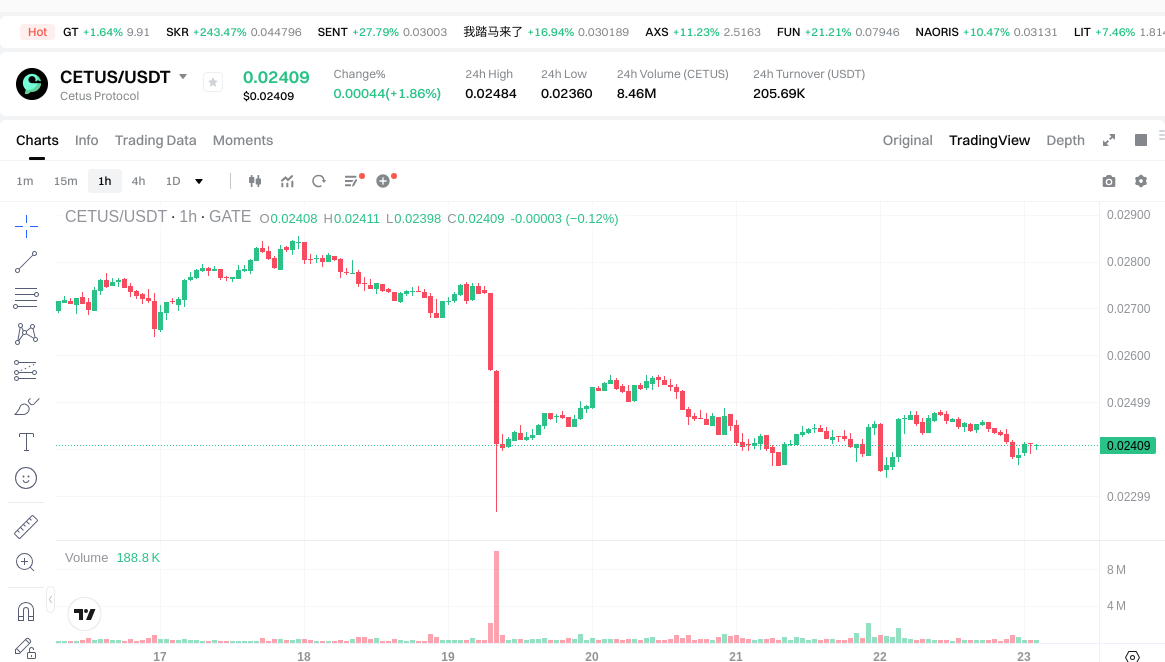
II. Core Factors Affecting Whether CETUS is a Good Investment (Is Cetus Protocol(CETUS) a Good Investment)
Supply Mechanism and Scarcity (CETUS Investment Scarcity)
- Fixed supply model → influences price and investment value
- Total supply: 1,000,000,000 CETUS tokens with a maximum supply cap of 1,000,000,000
- Current circulating supply: 897,101,449 CETUS (approximately 89.71% of total supply)
- Historical patterns: price fluctuations have been observed with a recorded price of 0.5 during May 2023, compared to the current price of 0.02404
- Investment significance: the controlled supply mechanism and high circulation ratio may influence long-term investment considerations
Institutional Investment and Mainstream Adoption (Institutional Investment in CETUS)
- Market presence: CETUS is listed on 27 exchanges, indicating a certain level of market accessibility
- Holder base: approximately 24,698 holders as of the latest data
- The project's deployment on Sui and Aptos blockchains may influence its adoption potential within these ecosystems
- Integration with DeFi infrastructure through its concentrated liquidity protocol may attract institutional interest in decentralized trading solutions
Macroeconomic Environment Impact on CETUS Investment
- Broader cryptocurrency market conditions influence CETUS performance
- Market capitalization: approximately 21,566,318.83 USD with a market dominance of 0.00075%
- Trading volume: 208,308.56 USD in 24-hour volume, reflecting current market activity
- Price volatility patterns show a 1-year change of -90.35%, indicating sensitivity to market conditions
- Global economic factors affecting cryptocurrency markets may impact CETUS investment prospects
Technology and Ecosystem Development (Technology & Ecosystem for CETUS Investment)
- Concentrated liquidity protocol: designed to enhance trading efficiency and liquidity management
- Multi-chain deployment: built on Sui and Aptos blockchains, potentially expanding reach across different ecosystems
- DeFi ecosystem integration: functions as a decentralized exchange (DEX) with focused liquidity provision
- Interoperable functional modules: the project emphasizes building affiliate modules that may support ecosystem expansion
- Trading experience optimization: the protocol aims to provide enhanced user experience through its technical infrastructure
- Network performance considerations: deployment on newer blockchain platforms may offer technical advantages in transaction processing
III. CETUS Future Investment Forecast and Price Outlook (Is Cetus Protocol(CETUS) worth investing in 2026-2031)
Short-term Investment Forecast (2026, short-term CETUS investment outlook)
- Conservative forecast: $0.0168 - $0.0240
- Neutral forecast: $0.0240 - $0.0280
- Optimistic forecast: $0.0280 - $0.0318
Mid-term Investment Outlook (2027-2029, mid-term Cetus Protocol(CETUS) investment forecast)
-
Market stage expectation: The mid-term outlook suggests potential gradual development as the concentrated liquidity protocol matures on Sui and Aptos blockchains. Price projections indicate moderate growth patterns with varying market conditions.
-
Investment return forecast:
- 2027: $0.0237 - $0.0352
- 2028: $0.0290 - $0.0448
- 2029: $0.0336 - $0.0446
-
Key catalysts: Expansion of liquidity network functionality, growth in DeFi user adoption on Sui and Aptos ecosystems, development of interoperable functional modules.
Long-term Investment Outlook (Is CETUS a good long-term investment?)
- Baseline scenario: $0.0273 - $0.0478 (assuming steady protocol development and maintained market presence through 2031)
- Optimistic scenario: $0.0414 - $0.0593 (assuming enhanced liquidity efficiency gains and expanded user base)
- Risk scenario: Below $0.0273 (under conditions of reduced DEX activity or increased competition in concentrated liquidity protocols)
For detailed CETUS long-term investment and price forecasts: Price Prediction
2026-01-23 - 2031 Long-term Outlook
- Base scenario: $0.0273 - $0.0478 (corresponding to steady progress and gradual mainstream application growth)
- Optimistic scenario: $0.0414 - $0.0593 (corresponding to large-scale adoption and favorable market environment)
- Transformative scenario: Above $0.0593 (in case of breakthrough ecosystem developments and mainstream penetration)
- 2031-12-31 projected high: $0.0593 (based on optimistic development assumptions)
Disclaimer: These forecasts are based on historical data patterns and current market information. Cryptocurrency markets are highly volatile and subject to numerous unpredictable factors. This analysis does not constitute investment advice, and investors should conduct their own research and risk assessment before making investment decisions.
| Year |
Predicted High Price |
Predicted Average Price |
Predicted Low Price |
Price Change |
| 2026 |
0.0317592 |
0.02406 |
0.016842 |
0 |
| 2027 |
0.035166096 |
0.0279096 |
0.02372316 |
16 |
| 2028 |
0.04478374416 |
0.031537848 |
0.02901482016 |
31 |
| 2029 |
0.0446481314136 |
0.03816079608 |
0.0335815005504 |
58 |
| 2030 |
0.054239847508308 |
0.0414044637468 |
0.037678062009588 |
72 |
| 2031 |
0.059299472978166 |
0.047822155627554 |
0.027258628707705 |
98 |
IV. CETUS Investment Strategy and Risk Management (How to invest in DeFi tokens)
Investment Strategy (CETUS investment strategy)
-
Long-term Holding (HODL CETUS): Suitable for conservative investors
Long-term holding strategies focus on the fundamental value proposition of Cetus Protocol as a concentrated liquidity DEX on Sui and Aptos blockchains. Investors adopting this approach typically believe in the protocol's mission to build a robust liquidity network for DeFi users. This strategy requires patience and tolerance for short-term price fluctuations while focusing on the protocol's ecosystem development and adoption metrics.
-
Active Trading: Relying on technical analysis and swing trading
Active traders may capitalize on CETUS price movements by analyzing technical indicators, trading volumes, and market sentiment. Given the token's 24-hour volatility and trading activity, swing trading opportunities may arise from price fluctuations between support and resistance levels. Traders should monitor on-chain metrics, DEX trading volumes, and broader DeFi market trends to identify potential entry and exit points.
Risk Management (Risk management for CETUS investment)
-
Asset Allocation Ratios: Conservative / Aggressive / Professional investors
- Conservative investors: Allocate 1-3% of crypto portfolio to CETUS, focusing on established assets as the core holding
- Aggressive investors: May allocate 5-10% to CETUS as part of a DeFi-focused strategy
- Professional investors: Employ dynamic allocation based on market cycles, protocol metrics, and risk-adjusted return analysis
-
Risk Hedging Solutions: Multi-asset portfolio + hedging instruments
Diversification across different blockchain ecosystems, combining CETUS with established DeFi blue-chips and stablecoins can help mitigate concentration risk. Investors may also consider hedging strategies through derivatives or maintaining stablecoin reserves for opportunistic rebalancing during market downturns.
-
Secure Storage: Hot/cold wallets + hardware wallet recommendations
For CETUS holdings on the Sui blockchain, investors should utilize:
- Hardware wallets compatible with Sui network for long-term storage
- Reputable software wallets for active trading positions
- Multi-signature solutions for larger holdings
- Regular security audits of wallet connections and smart contract interactions
V. CETUS Investment Risks and Challenges (Risks of investing in DeFi tokens)
-
Market Risk: High volatility and price manipulation concerns
CETUS has experienced significant price fluctuations, with data showing a 1-year decline of approximately 90.35% from previous levels. The 24-hour trading volume relative to market cap suggests varying liquidity conditions that may contribute to price volatility. Smaller market cap assets can be more susceptible to large order impacts and potential manipulation risks. The token's circulating supply represents 89.71% of total supply, which provides relative clarity on dilution risk but does not eliminate volatility concerns.
-
Regulatory Risk: Policy uncertainty across different jurisdictions
DeFi protocols and their associated tokens face evolving regulatory frameworks globally. Different countries maintain varying approaches to cryptocurrency regulation, creating uncertainty for protocol operations and token holders. Regulatory developments regarding decentralized exchanges, liquidity provision, and token classifications could impact CETUS's utility and market accessibility. Investors should monitor regulatory announcements in key markets where Sui and Aptos ecosystems operate.
-
Technical Risk: Network security vulnerabilities and upgrade failures
As a concentrated liquidity protocol operating on Sui and Aptos blockchains, Cetus faces multi-layered technical risks including:
- Smart contract vulnerabilities in the DEX protocol itself
- Underlying blockchain network issues or congestion on Sui and Aptos
- Protocol upgrade execution risks that could affect liquidity provisioning
- Integration risks with cross-chain bridges and other DeFi protocols
- Competition from other DEX platforms that may offer superior technology or incentives
VI. Conclusion: Is DeFi tokens a Good Investment?
-
Investment Value Summary: CETUS demonstrates long-term potential through its position as a concentrated liquidity protocol on emerging Layer 1 blockchains, but investors should recognize substantial short-term price volatility and market risks.
-
Investor Recommendations:
✅ Beginners: Dollar-cost averaging approach + secure wallet storage
- Start with minimal allocation to understand protocol mechanics
- Utilize hardware wallets or reputable Sui-compatible software wallets
- Focus on learning DeFi fundamentals before increasing position size
✅ Experienced Investors: Swing trading + portfolio diversification
- Monitor protocol TVL, trading volumes, and ecosystem developments
- Implement technical analysis for entry and exit timing
- Maintain diversified DeFi exposure across multiple protocols and chains
✅ Institutional Investors: Strategic long-term allocation
- Evaluate protocol fundamentals, team background, and competitive positioning
- Consider liquidity provision strategies alongside token holding
- Implement comprehensive risk management frameworks
⚠️ Disclaimer: Cryptocurrency investments carry high risks. This content is for informational purposes only and does not constitute investment advice. Investors should conduct independent research and consider their risk tolerance before making investment decisions.
VII. FAQ
Q1: Is Cetus Protocol (CETUS) a good investment for beginners?
CETUS may be suitable for beginners as a small portfolio allocation (1-3%), but requires careful consideration due to high volatility and DeFi complexity. Given the token's significant 90.35% decline over the past year and current market cap of approximately $21.57 million, beginners should start with minimal exposure using a dollar-cost averaging strategy. The protocol's position as a concentrated liquidity DEX on Sui and Aptos blockchains offers long-term potential, but the technical nature of DeFi protocols and substantial price fluctuations make it essential for newcomers to thoroughly understand both the underlying technology and market risks before investing.
Q2: What is the projected price range for CETUS by the end of 2026?
Conservative forecasts suggest CETUS could trade between $0.0168 and $0.0318 by the end of 2026, with a neutral outlook targeting $0.0240 to $0.0280. The optimistic scenario projects potential highs of $0.0318, representing approximately 32% growth from current levels of $0.02404. These projections assume continued development of the concentrated liquidity protocol, growing adoption on Sui and Aptos ecosystems, and favorable broader cryptocurrency market conditions. However, investors should note that cryptocurrency price predictions carry significant uncertainty, and actual performance may differ substantially based on market dynamics, regulatory developments, and protocol execution.
Q3: How does CETUS compare to other DEX tokens in terms of market position?
CETUS currently ranks 842nd among cryptocurrencies with a market dominance of 0.00075%, positioning it as a smaller-cap DeFi asset compared to established DEX tokens. With approximately 24,698 holders and listings on 27 exchanges, CETUS maintains moderate market accessibility but significantly lower liquidity compared to major DEX platforms. The protocol's unique positioning as a concentrated liquidity provider on newer Layer 1 blockchains (Sui and Aptos) differentiates it from Ethereum-based DEX tokens, potentially offering first-mover advantages within these emerging ecosystems. However, this also means greater exposure to the adoption risks of its underlying blockchain networks.
Q4: What are the main risks associated with investing in CETUS?
CETUS investment carries three primary risk categories: market risk from high volatility (evidenced by 90% decline over one year), regulatory risk due to evolving global DeFi regulations, and technical risk spanning smart contract vulnerabilities, blockchain network issues on Sui and Aptos, and protocol upgrade execution challenges. The relatively small market cap increases susceptibility to price manipulation and large order impacts. Additionally, investors face competition risk from established DEX platforms and newer concentrated liquidity protocols that may offer superior incentives or technology. The 24-hour trading volume of approximately $208,000 suggests limited liquidity conditions that could affect execution of larger trades.
Q5: What storage options are recommended for securing CETUS tokens?
For CETUS holdings on the Sui blockchain, investors should prioritize hardware wallets compatible with the Sui network for long-term storage of significant positions. Reputable software wallets designed for Sui can serve active trading needs while maintaining adequate security standards. Larger holdings benefit from multi-signature wallet solutions that require multiple approvals for transactions. Regardless of wallet type, investors must regularly audit wallet connections and smart contract interactions to prevent unauthorized access. Cold storage solutions provide maximum security for holdings not needed for immediate trading or liquidity provision activities.
Q6: How does the CETUS tokenomics structure affect its investment potential?
CETUS features a fixed supply model with a maximum cap of 1 billion tokens, of which 897.10 million (89.71%) currently circulate. This high circulation ratio provides relative transparency regarding potential dilution from future token releases, with only approximately 10% remaining for potential distribution. The controlled supply mechanism may support long-term value preservation if demand increases, though historical price action from $0.50 at launch to current levels of $0.02404 reflects significant market correction. The tokenomics structure positions CETUS as a governance and utility token within the concentrated liquidity protocol, with value tied to protocol adoption, trading volumes, and overall DeFi ecosystem growth on Sui and Aptos blockchains.
Q7: What catalysts could drive CETUS price appreciation in 2027-2029?
Mid-term CETUS price appreciation may be driven by several key catalysts: expansion of the concentrated liquidity network functionality across Sui and Aptos ecosystems, growth in DeFi user adoption on these Layer 1 blockchains, development of interoperable functional modules that enhance protocol utility, and increasing total value locked (TVL) within the Cetus DEX platform. Price projections for this period range from $0.0237 to $0.0448, reflecting potential 58% to 72% growth from 2026 baseline scenarios. Additional catalysts include strategic partnerships with other DeFi protocols, institutional adoption of Sui and Aptos networks, and improvements in liquidity efficiency that attract larger traders and market makers to the platform.
Q8: Should investors consider CETUS as a long-term hold or short-term trade?
The optimal approach depends on individual risk tolerance and investment objectives. Long-term holders (3-5 years) may benefit from CETUS's potential as an infrastructure protocol in emerging Layer 1 ecosystems, with base case scenarios projecting $0.0273 to $0.0593 by 2031. This strategy suits conservative investors willing to weather volatility while focusing on fundamental protocol development. Short-term traders can capitalize on price fluctuations using technical analysis, though they must navigate substantial volatility evidenced by weekly declines of 11.61% and monthly gains of 2.39%. Active traders should monitor on-chain metrics, DEX trading volumes, and broader DeFi trends for optimal entry and exit timing. A hybrid approach combining a core long-term position with tactical trading allocations may balance growth potential with risk management.
* The information is not intended to be and does not constitute financial advice or any other recommendation of any sort offered or endorsed by Gate.