This comprehensive analysis examines whether Chainbase (C) represents a viable investment opportunity within the emerging DataFi and AI-blockchain infrastructure sector. The article evaluates Chainbase's market position—currently valued at $12.16 million with a circulating supply representing 16% of maximum tokens—supported by institutional backing from Matrix Partners, Hash Global, and Folius Ventures. It analyzes historical performance since the July 2025 launch, current trading dynamics with 70,411 holders across 22 exchanges, and the project's ecosystem strength featuring over 20,000 developers and 8,000+ integrations processing 500 billion data calls. The analysis provides differentiated price forecasts for 2026-2031 across conservative, neutral, and optimistic scenarios, alongside comprehensive investment strategies including long-term holding and active trading approaches. Critical risk factors including price volatility, liquidity constraints, regulatory uncertainty, and competitive pressures are thor
Introduction: Chainbase (C) Investment Position and Market Outlook
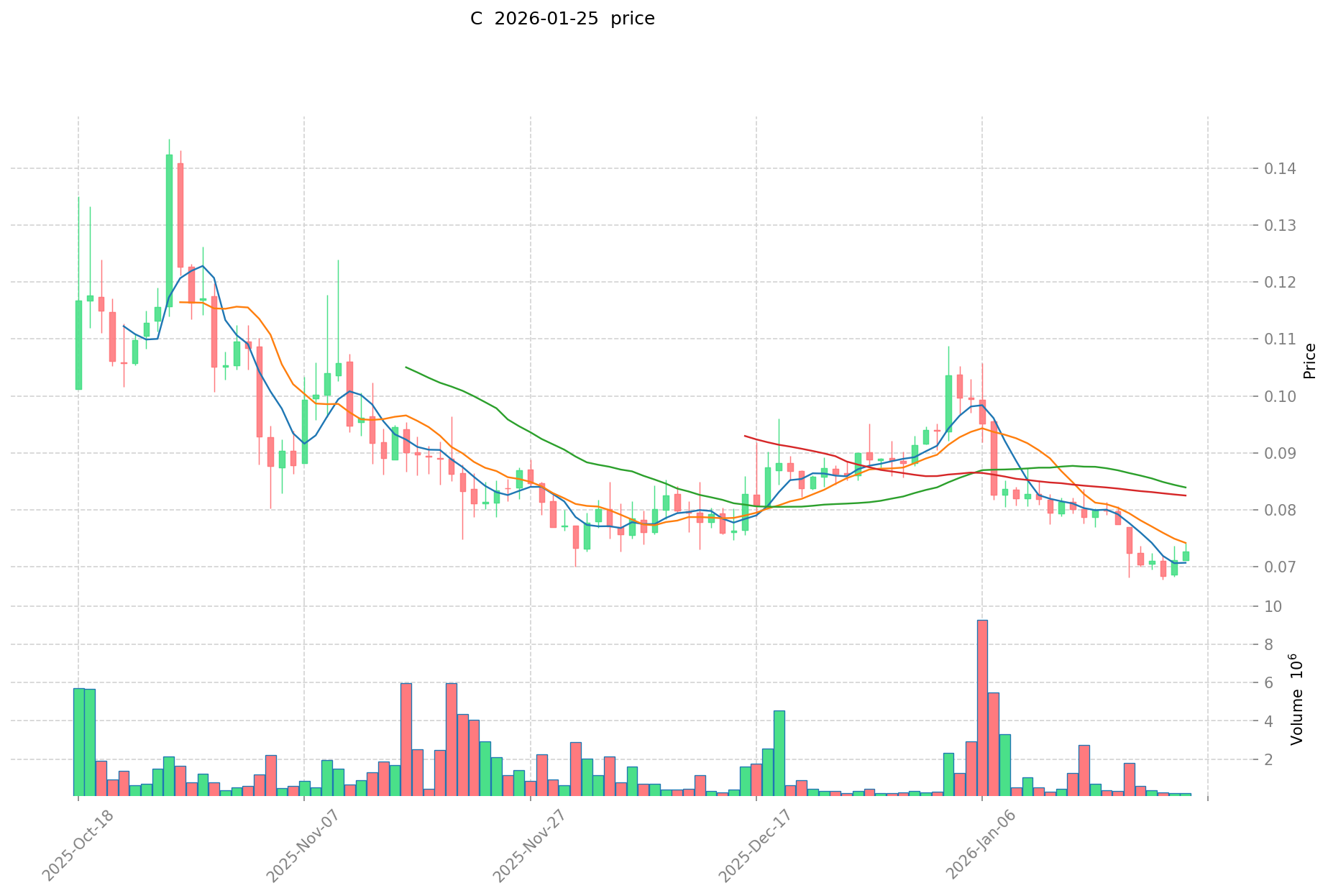
Chainbase (C) represents a developing asset in the cryptocurrency sector, focusing on AI-driven data infrastructure within the emerging DataFi landscape. As of January 25, 2026, C holds a market capitalization of approximately $12.16 million, with a circulating supply of 160 million tokens. The current price stands at around $0.07598, reflecting a 24-hour change of 3.39%. With its positioning as a hyperdata network that transforms fragmented on-chain signals into structured, verifiable, and AI-ready data, Chainbase has attracted attention from investors exploring "Is Chainbase (C) a good investment?" The project reports over 500 billion data calls, engagement from more than 20,000 developers, and integration with 8,000+ projects, while maintaining backing from various investment funds including Matrix Partners, Hash Global, and Folius Ventures. This analysis examines C's investment characteristics, historical price movements, future price considerations, and associated risks to provide reference information for market participants.
I. Cryptocurrency (C) Historical Price Review and Current Investment Value
- 2025: Chainbase (C) launched in July 2025, experiencing significant volatility in its initial trading period → Early investors saw price movements from launch levels to various trading ranges
- 2025: Price fluctuations between $0.0661 and $0.5396 during the first months of trading → C demonstrated considerable price variability in its early market phase
- 2025-2026: Market cycles led to price adjustments → Trading activity showed movements from higher price levels to lower ranges
Current C Investment Market Status (January 2026)
- C current price: $0.07598
- 24-hour trading volume: $16,389.14
- Market capitalization: $12,156,800
- Circulating supply: 160,000,000 C (16% of total supply)
- Fully diluted market cap: $75,980,000
- Number of holders: 70,411
- Listed on 22 exchanges
Click to view real-time C market price
II. Core Factors Affecting Whether C is a Good Investment (Is Chainbase(C) a Good Investment)
Supply Mechanism and Scarcity (C investment scarcity)
- Supply mechanism: Chainbase (C) has a maximum supply of 1,000,000,000 tokens, with 160,000,000 tokens currently in circulation, representing 16% of the total supply → affects price dynamics and investment value through circulating supply ratio
- Investment significance: The controlled circulating supply relative to maximum supply represents a key consideration for long-term investment evaluation
Institutional Investment and Mainstream Adoption (Institutional investment in C)
- Institutional backing: Chainbase is supported by prominent funds including Matrix Partners, Hash Global, Folius Ventures, JSquare, DFG, Mask Network, Bonfire Union Ventures, XVC, ZhenFund, M77, and BODL Ventures → demonstrates institutional confidence in the project
- Developer adoption: With over 20,000 developers in its community and 8,000+ project integrations, Chainbase shows growing adoption within the blockchain ecosystem → enhances its investment profile through practical utility
Technology & Ecosystem Development (Technology & Ecosystem for C investment)
- AI-ready data infrastructure: Chainbase transforms fragmented onchain signals into structured, verifiable, and AI-ready data → positions the project at the intersection of blockchain and AI technologies
- DataFi ecosystem: The platform enables permissionless coordination between agents, applications, and humans, with over 500 billion data calls recorded → supports long-term value through expanding data economy use cases
- Composable data capital: Chainbase's approach makes data composable, monetizable, and accessible → creates multiple value streams for ecosystem participants and potential investment appreciation
III. C Future Investment Forecast and Price Outlook (Is Chainbase(C) worth investing in 2026-2031)
Short-term C Investment Outlook (2026)
- Conservative forecast: $0.0418 - $0.0760
- Neutral forecast: $0.0760 - $0.0988
- Optimistic forecast: $0.0760 - $0.0988
Mid-term Chainbase(C) Investment Forecast (2027-2029)
-
Market stage expectation: The mid-term outlook suggests a gradual growth trajectory, with projected increases ranging from 14% to 31% across the period. This phase may correspond to the continued development of Chainbase's AI-ready data infrastructure and expansion of its developer ecosystem.
-
Investment return forecast:
- 2027: $0.0498 - $0.1022
- 2028: $0.0844 - $0.1052
- 2029: $0.0860 - $0.1200
-
Key catalysts: Expansion of the DataFi ecosystem, growth in developer adoption (currently over 20,000 developers), increased integration volume (currently 8,000+ projects), and advancement in AI-ready data structuring capabilities.
Long-term Investment Outlook (Is Chainbase a good long-term investment?)
- Base scenario: $0.0704 - $0.1584 (Assumes steady ecosystem development and maintained developer community engagement through 2030-2031)
- Optimistic scenario: $0.1181 - $0.1476 (Assumes accelerated adoption of DataFi infrastructure and expanded institutional partnerships)
- Risk scenario: Below $0.0704 (Under conditions of heightened market volatility or competitive pressure in the blockchain data infrastructure sector)
View C long-term investment and price forecast: Price Prediction
2026-01-25 - 2031 Long-term Outlook
- Base scenario: $0.0704 - $0.1584 (Corresponding to steady progress and gradual mainstream application growth)
- Optimistic scenario: $0.1181 - $0.1584 (Corresponding to large-scale adoption and favorable market conditions)
- Transformative scenario: Above $0.1584 (In case of breakthrough ecological developments and mainstream popularization)
- 2031-12-31 predicted high: $0.1476 (Based on optimistic development assumptions)
Disclaimer: This analysis is for informational purposes only and does not constitute investment advice. Cryptocurrency investments carry substantial risk, and past performance does not guarantee future results. Investors should conduct their own research and consult with financial professionals before making investment decisions.
| Year |
Predicted High Price |
Predicted Average Price |
Predicted Low Price |
Price Change |
| 2026 |
0.098761 |
0.07597 |
0.0417835 |
0 |
| 2027 |
0.102217635 |
0.0873655 |
0.049798335 |
14 |
| 2028 |
0.105218639925 |
0.0947915675 |
0.084364495075 |
24 |
| 2029 |
0.120006124455 |
0.1000051037125 |
0.08600438919275 |
31 |
| 2030 |
0.1584080842806 |
0.11000561408375 |
0.0704035930136 |
44 |
| 2031 |
0.147627534100392 |
0.134206849182175 |
0.118102027280314 |
76 |
IV. Chainbase (C) Investment Strategy and Risk Management (How to invest in Chainbase)
Investment Methodology (Chainbase investment strategy)
Long-term Holding (HODL Chainbase)
For conservative investors seeking exposure to the emerging DataFi and AI-driven blockchain infrastructure sector, a long-term holding strategy may be considered. Chainbase's positioning as a foundational layer for the DataFi era, combined with its substantial developer community of over 20,000 participants and 8,000+ project integrations, suggests potential alignment with broader trends in decentralized data economies. The project has received backing from established investment firms including Matrix Partners, Hash Global, and Folius Ventures.
Investors considering this approach should note that Chainbase has experienced notable price fluctuations since its launch in July 2025, with historical price ranges between $0.0661 and $0.5396. The current circulation represents 16% of the maximum supply of 1 billion tokens, which may influence long-term price dynamics as additional tokens enter circulation.
Active Trading Strategy
For traders employing technical analysis and swing trading approaches, Chainbase has demonstrated short-term volatility patterns. Recent performance data shows:
- 1-hour change: +2.65%
- 24-hour change: +3.39%
- 7-day change: -3.78%
- 30-day change: -11.81%
- 1-year change: +38.62%
The 24-hour trading range of $0.07144 to $0.07598 indicates intraday price movement opportunities. However, with a 24-hour trading volume of approximately $16,389, liquidity considerations should be factored into any active trading strategy.
Risk Management (Risk management for Chainbase investment)
Asset Allocation Guidelines
Conservative Investors: Given Chainbase's market cap ranking of approximately 1,110 and its classification as a mid-to-lower cap asset, conservative portfolios might limit exposure to 1-3% of total crypto allocation, with primary holdings in more established assets.
Moderate Investors: Those with higher risk tolerance and conviction in the DataFi sector narrative may consider allocations of 3-7% within their cryptocurrency portfolio, while maintaining diversification across different blockchain infrastructure categories.
Experienced Investors: Sophisticated investors with deep understanding of blockchain data infrastructure and AI integration trends may allocate 5-10% or more, potentially treating Chainbase as a thematic play within a broader Web3 infrastructure thesis.
Risk Hedging Strategies
- Portfolio Diversification: Balance Chainbase exposure with holdings in established layer-1 protocols, stablecoins, and other data infrastructure projects to reduce concentration risk.
- Position Sizing: Consider dollar-cost averaging to mitigate timing risk, particularly given the token's historical volatility and relatively recent launch.
- Correlation Analysis: Monitor Chainbase's price correlation with broader crypto markets and specific data/AI-focused blockchain projects for portfolio construction purposes.
Secure Storage Practices
Cold Storage Solutions: For long-term holdings, hardware wallets that support ERC-20 tokens and Base network compatibility provide enhanced security. The token's contract address on Base (0xba12bc7b210e61e5d3110b997a63ea216e0e18f7) should be verified before any transactions.
Hot Wallet Considerations: For active trading positions, use reputable exchanges with strong security track records. Chainbase is currently listed on 22 exchanges according to available data.
Multi-Signature Options: Institutional or high-net-worth investors may consider multi-signature wallet solutions for additional security layers when managing significant Chainbase holdings.
V. Chainbase (C) Investment Risks and Challenges (Risks of investing in Chainbase)
Market Risks
Price Volatility: Chainbase has demonstrated significant price fluctuations since launch. The asset reached $0.5396 in July 2025 and declined to $0.0661 by October 2025, representing substantial downside movement. Current price levels around $0.076 reflect continued volatility patterns common in newer cryptocurrency projects.
Liquidity Considerations: With a 24-hour trading volume of approximately $16,389 and a circulating market cap of about $12.16 million, Chainbase presents moderate liquidity that may impact larger position entries or exits. The market cap to fully diluted valuation ratio of 16% indicates significant future token supply that could affect price dynamics.
Market Manipulation Susceptibility: Lower market cap assets with limited liquidity may be more susceptible to price manipulation tactics. The current holder count of approximately 70,411 addresses suggests a developing but not yet deeply established distribution network.
Regulatory Risks
Jurisdictional Uncertainty: Data infrastructure tokens operating across multiple blockchain networks face evolving regulatory frameworks in different jurisdictions. Regulations concerning data handling, AI integration, and decentralized network operations vary significantly across regions.
Classification Ambiguity: The categorization of tokens like Chainbase—which blend infrastructure, data services, and potential utility functions—remains subject to interpretation by various regulatory bodies, creating compliance uncertainty.
Cross-Border Data Regulations: As Chainbase processes and structures blockchain data, it may intersect with data protection regulations in different jurisdictions, potentially affecting operational flexibility or token utility in certain regions.
Technical Risks
Smart Contract Vulnerabilities: As an ERC-20 token deployed on Base network, Chainbase is subject to potential smart contract exploits or vulnerabilities. While the project has received backing from established investors, contract security should be independently verified.
Network Dependencies: The token's deployment on Base network creates dependency on that layer-2 solution's continued operation, security, and adoption. Any technical issues, congestion, or security incidents affecting Base could impact Chainbase accessibility and functionality.
Integration Complexity: The project's positioning as a data infrastructure layer for 8,000+ integrations creates technical complexity. Failures in data processing, verification systems, or AI integration capabilities could affect token utility and value proposition.
Competition Risk: The blockchain data infrastructure space is rapidly evolving with multiple competing solutions. Chainbase faces competition from established data indexing protocols and emerging AI-blockchain integration platforms, which may impact long-term market share and token value.
VI. Conclusion: Is Chainbase a Good Investment?
Investment Value Summary
Chainbase (C) represents a positioning within the emerging DataFi and AI-blockchain infrastructure sector, supported by notable venture capital backing and a developing ecosystem of over 20,000 developers and 8,000+ project integrations. The token has shown substantial price volatility since its July 2025 launch, with a 1-year performance of +38.62% from initial levels, though it currently trades significantly below its historical peak.
The project's fundamental value proposition centers on transforming fragmented blockchain data into structured, AI-ready information—a narrative aligned with broader trends in decentralized data economies and AI integration. However, with a market cap ranking around 1,110 and a circulating supply representing only 16% of maximum supply, the token carries characteristics typical of earlier-stage cryptocurrency investments.
Investor Recommendations
✅ New Investors
- Approach: Consider dollar-cost averaging strategies to mitigate timing risk in a volatile asset
- Allocation: Limit initial exposure to a small percentage of overall portfolio (1-3%)
- Storage: Utilize hardware wallets or secure custody solutions that support Base network tokens
- Education: Develop understanding of DataFi sector dynamics and blockchain data infrastructure before significant allocation
✅ Experienced Investors
- Strategy: Evaluate Chainbase within a broader blockchain infrastructure thesis, considering correlation with data-focused protocols
- Position Management: Implement swing trading tactics around technical levels while maintaining core long-term position if conviction warrants
- Portfolio Integration: Balance exposure with established layer-1 assets and diversified mid-cap infrastructure plays
- Monitoring: Track developer activity, integration growth, and competitive positioning within the data infrastructure landscape
✅ Institutional Investors
- Due Diligence: Conduct comprehensive technical audits of smart contracts and thorough analysis of competitive positioning
- Strategic Allocation: Consider as part of thematic exposure to decentralized data infrastructure and AI-blockchain convergence
- Risk Framework: Implement structured position sizing within venture-stage digital asset allocations
- Custody: Utilize institutional-grade custody solutions with appropriate security protocols for ERC-20 tokens
⚠️ Important Disclaimer
Cryptocurrency investments carry substantial risk, including potential loss of principal. Chainbase's price history demonstrates significant volatility, and past performance does not indicate future results. This analysis is provided for informational purposes only and does not constitute investment advice, financial guidance, or a recommendation to buy, sell, or hold any cryptocurrency. Investors should conduct independent research, consider their risk tolerance, and consult with qualified financial advisors before making investment decisions.
VII. FAQ
Q1: What is Chainbase (C) and what makes it different from other blockchain data projects?
Chainbase is a hyperdata network that transforms fragmented on-chain signals into structured, verifiable, and AI-ready data infrastructure within the DataFi ecosystem. Unlike traditional blockchain data indexing projects, Chainbase specifically focuses on making data composable, monetizable, and accessible for AI applications, enabling permissionless coordination between agents, applications, and humans. The project has processed over 500 billion data calls, supports more than 20,000 developers, and integrates with 8,000+ projects, positioning itself at the intersection of blockchain and AI technologies with backing from established investors including Matrix Partners, Hash Global, and Folius Ventures.
Q2: Is Chainbase a good investment in 2026?
The investment suitability of Chainbase depends on individual risk tolerance and portfolio strategy. Conservative investors might consider allocating 1-3% of their crypto portfolio given the token's market cap ranking around 1,110 and significant volatility since launch. Moderate investors with conviction in the DataFi sector narrative may allocate 3-7%, while experienced investors focused on blockchain infrastructure themes might consider 5-10% or more. The token has shown +38.62% 1-year performance but trades significantly below its historical peak of $0.5396. Short-term forecasts for 2026 range from $0.0418 to $0.0988 under various scenarios, with the current price at $0.07598.
Q3: What are the main risks of investing in Chainbase?
Chainbase presents several key investment risks: (I) Price volatility, with historical fluctuations from $0.5396 to $0.0661 demonstrating substantial downside potential; (II) Liquidity concerns, with 24-hour trading volume around $16,389 and market cap of approximately $12.16 million potentially impacting larger position management; (III) Token dilution risk, as only 16% of the 1 billion maximum supply currently circulates; (IV) Technical dependencies on Base network infrastructure; (V) Regulatory uncertainty regarding data handling and token classification across jurisdictions; (VI) Competition from established data indexing protocols and emerging AI-blockchain platforms.
Q4: What is the long-term price forecast for Chainbase through 2031?
Long-term projections for Chainbase through 2031 vary significantly based on development scenarios. The base scenario suggests prices ranging from $0.0704 to $0.1584, assuming steady ecosystem development and maintained developer engagement. The optimistic scenario forecasts $0.1181 to $0.1476, contingent upon accelerated DataFi adoption and expanded institutional partnerships. By 2031, the predicted high reaches $0.1476 under favorable conditions, representing potential growth from current levels. However, risk scenarios project prices below $0.0704 under conditions of heightened market volatility or competitive pressure. Year-over-year growth projections show increases ranging from 14% to 76% across the 2026-2031 period under optimistic assumptions.
Q5: How should I store my Chainbase tokens securely?
For long-term holdings, hardware wallets that support ERC-20 tokens and Base network compatibility provide optimal security. Always verify the official contract address on Base (0xba12bc7b210e61e5d3110b997a63ea216e0e18f7) before conducting transactions. For active trading positions, use reputable exchanges with strong security track records—Chainbase is currently listed on 22 exchanges. Institutional or high-net-worth investors should consider multi-signature wallet solutions for additional security layers. Avoid keeping significant holdings on exchanges for extended periods, and implement proper backup procedures for wallet recovery phrases.
Q6: What is the token supply structure of Chainbase?
Chainbase has a maximum supply of 1,000,000,000 tokens, with 160,000,000 tokens currently in circulation, representing 16% of the total supply. This controlled circulating supply creates potential future dilution as additional tokens enter the market, which may influence long-term price dynamics. The fully diluted market cap stands at approximately $75,980,000, significantly higher than the current circulating market cap of $12,156,800. The token holder count is approximately 70,411 addresses, suggesting a developing but not yet deeply established distribution network.
Q7: What investment strategy works best for Chainbase?
Investment strategies should align with individual risk profiles and market perspectives. (I) Long-term holding (HODL) suits conservative investors seeking exposure to DataFi infrastructure trends, though volatility since the July 2025 launch requires patience. (II) Dollar-cost averaging helps mitigate timing risk given historical price fluctuations. (III) Active trading strategies can capitalize on short-term volatility patterns (recent changes: +2.65% 1-hour, +3.39% 24-hour, -3.78% 7-day), though modest trading volume of $16,389 requires careful position sizing. (IV) Portfolio diversification across established layer-1 protocols and other data infrastructure projects reduces concentration risk while maintaining thematic exposure to blockchain-AI convergence narratives.
Q8: How does institutional backing affect Chainbase's investment potential?
Chainbase has secured backing from prominent venture capital firms including Matrix Partners, Hash Global, Folius Ventures, JSquare, DFG, Mask Network, Bonfire Union Ventures, XVC, ZhenFund, M77, and BODL Ventures. This institutional support provides several investment considerations: (I) Validation of the project's technical approach and market positioning within the DataFi sector; (II) Potential for continued financial resources supporting development and ecosystem expansion; (III) Network effects through institutional connections facilitating partnerships and integrations; (IV) Increased credibility within the developer community, contributing to the current 20,000+ developer base. However, institutional backing does not guarantee investment success, and investors should conduct independent due diligence regardless of venture capital involvement.
* The information is not intended to be and does not constitute financial advice or any other recommendation of any sort offered or endorsed by Gate.