This comprehensive analysis evaluates Chainflip (FLIP) as an investment opportunity in the cross-chain DEX sector. FLIP, currently trading at $0.3777 with a market cap of $25.1 million, operates as an ERC-20 token offering native asset swaps across Bitcoin, Ethereum, and Polkadot without wrapped tokens. The article examines FLIP's historical decline from $9.501 (March 2024) to present levels, price forecasts suggesting $0.47-$1.03 potential by 2031, and diversified investment strategies including long-term holding and active trading. Key investment factors include limited liquidity ($33,260 daily volume), modest holder base (4,744 addresses), and technological differentiation through threshold signature schemes. Significant risks encompass market volatility, regulatory uncertainty, technical vulnerabilities, and competition from established DEX platforms. The analysis provides asset allocation guidelines (1-15% based on investor profile), security best practices emphasizing cold storage via Gate exchange acce
Introduction: Chainflip (FLIP) Investment Position and Market Outlook
FLIP is a significant asset in the cryptocurrency landscape, launched in November 2023 as the native token of the Chainflip protocol. Positioned as a cross-chain decentralized exchange (DEX) solution, Chainflip has established its presence in the DeFi interoperability sector. As of January 22, 2026, FLIP maintains a market capitalization of approximately $25.1 million, with a circulating supply of around 66.47 million tokens and a current trading price of $0.3777. With its positioning as a cross-chain liquidity protocol utilizing threshold signature schemes and Just In Time liquidity mechanisms, FLIP has become a subject of interest when investors discuss "Is Chainflip (FLIP) a good investment?" This article provides a comprehensive analysis of FLIP's investment value, historical price trends, future price projections, and associated investment risks to serve as a reference for potential investors.
The token currently holds the 776th position by market capitalization, representing approximately 0.0010% market dominance. With a circulating supply ratio of 73.85% relative to its total supply of 90 million tokens, FLIP demonstrates a relatively high circulation rate. The protocol launched with an initial price of $1.83 and is currently available on 8 exchanges, with approximately 4,744 token holders recorded. The token operates on the Ethereum blockchain as an ERC-20 standard token, with its contract address verified on Etherscan.
I. Coin (FLIP) Price History Review and Investment Value Status
- 2024: FLIP experienced significant price movement during March, with the token reaching $9.501 on March 7, 2024 → This represented a notable high point in the token's trading history
- 2025: Market conditions shifted throughout the year → FLIP price declined from earlier levels to $0.3077 on July 7, 2025
- Recent Period: The token has shown price volatility → Trading between $0.3077 and current levels of approximately $0.3777
Current FLIP Investment Market Status (January 2026)
- FLIP current price: $0.3777
- 24-hour trading volume: $33,260.19
- Price performance: 1H (-0.041%), 24H (-2.43%), 7D (-6.08%), 30D (-15.58%), 1Y (-58.07%)
- 24-hour price range: High $0.3865, Low $0.3759
- Market capitalization: $25,104,611.66
- Circulating supply: 66,467,068.19 FLIP (73.85% of total supply)
- Total supply: 90,000,000 FLIP
- Fully diluted market cap: $33,993,000
- Market dominance: 0.0010%
- Token holders: 4,744
- Listed on 8 exchanges
Click to view real-time FLIP market price
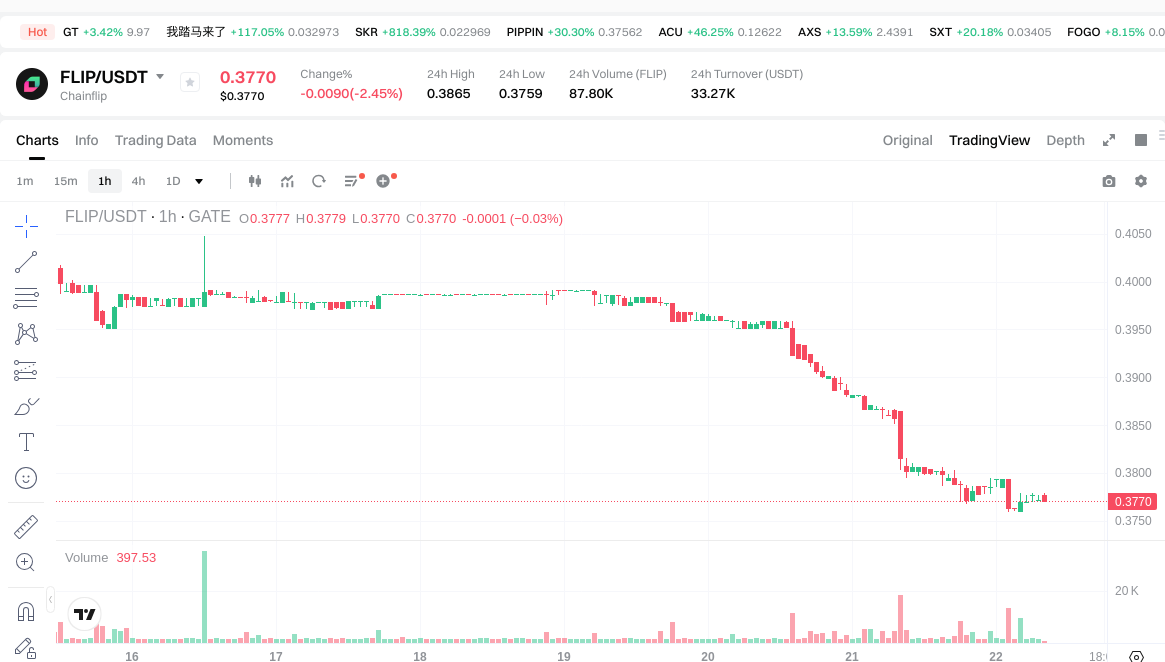
II. Core Factors Affecting Whether FLIP is a Good Investment (Is Chainflip(FLIP) a Good Investment)
Supply Mechanism and Scarcity (FLIP investment scarcity)
- Total supply of 90 million FLIP tokens with unlimited maximum supply → influences price dynamics and investment characteristics
- Circulating supply represents approximately 73.85% of total supply, indicating substantial token availability in the market
- Investment significance: The unlimited maximum supply structure presents a different scarcity model compared to fixed-cap cryptocurrencies, which may influence long-term value proposition
Institutional Investment and Mainstream Adoption (Institutional investment in FLIP)
- FLIP is listed on 8 exchanges, providing institutional and retail access points
- The token holder base comprises approximately 4,744 addresses, reflecting current adoption levels
- Market capitalization to fully diluted valuation ratio of 73.85% suggests significant circulating supply relative to total anticipated supply
Macroeconomic Environment's Impact on FLIP Investment
- Monetary policy and interest rate changes → alter investment attractiveness across cryptocurrency markets
- Inflation environments and their impact on digital asset positioning → may affect investor allocation decisions
- Geopolitical uncertainty → can enhance demand for decentralized exchange solutions and cross-chain infrastructure
Technology and Ecosystem Development (Technology & Ecosystem for FLIP investment)
- Cross-chain DEX infrastructure utilizing threshold signature schemes → provides technical foundation for native asset swaps
- Application-specific blockchain architecture with Just In Time liquidity AMM → enhances capital efficiency and reduces slippage
- DeFi integration potential through native cross-chain swaps for ETH, DOT, BTC and other isolated assets → supports long-term ecosystem value and investment thesis
III. FLIP Future Investment Forecast and Price Outlook (Is Chainflip(FLIP) worth investing in 2026-2031)
Short-term Investment Forecast (2026, short-term FLIP investment outlook)
- Conservative forecast: $0.24 - $0.38
- Neutral forecast: $0.38 - $0.46
- Optimistic forecast: $0.46 - $0.55
Based on the provided data, FLIP is currently trading at $0.3777 as of January 22, 2026. The short-term outlook for 2026 suggests a potential trading range between the predicted low of $0.24128 and the predicted high of $0.55042, with an average price target around $0.377. The token has experienced notable volatility, with a 24-hour change of -2.43% and a 7-day decline of -6.08%, reflecting cautious market sentiment in the near term.
Mid-term Investment Outlook (2027-2029, mid-term Chainflip(FLIP) investment forecast)
-
Market stage expectation: The mid-term period may witness gradual recovery and potential growth phases as the cross-chain DEX sector continues to develop. Market conditions during this timeframe could be influenced by broader adoption of decentralized finance infrastructure and improvements in cross-chain liquidity solutions.
-
Investment return forecast:
- 2027: $0.45 - $0.53 (representing a potential 22% year-over-year change)
- 2028: $0.30 - $0.71 (indicating a possible 31% year-over-year change)
- 2029: $0.38 - $0.89 (suggesting approximately 60% year-over-year growth potential)
-
Key catalysts: Expansion of cross-chain functionality, enhancement of AMM mechanisms with Just In Time liquidity features, increased integration with native assets from multiple blockchain ecosystems, and growing adoption of decentralized exchange infrastructure may serve as potential growth drivers during this period.
Long-term Investment Outlook (Is Chainflip a good long-term investment?)
- Baseline scenario: $0.47 - $0.86 (assuming steady protocol development and moderate market expansion)
- Optimistic scenario: $0.61 - $1.03 (under conditions of accelerated adoption and favorable market dynamics)
- Risk scenario: $0.24 - $0.38 (under challenging market conditions or limited ecosystem growth)
Click to view FLIP long-term investment and price forecast: Price Prediction
2026-2031 Long-term Outlook
- Base scenario: $0.47 - $0.97 (corresponding to steady progress and gradual mainstream application enhancement)
- Optimistic scenario: $0.61 - $1.03 (corresponding to large-scale adoption and favorable market conditions)
- Transformative scenario: Above $1.03 (if the ecosystem achieves breakthrough developments and mainstream adoption)
- 2031-12-31 predicted high: $1.03 (based on optimistic development assumptions)
Disclaimer: The forecast data provided is for reference purposes only and does not constitute investment advice. Cryptocurrency markets are highly volatile and subject to numerous unpredictable factors. Past performance does not guarantee future results. Investors should conduct thorough research and consider their risk tolerance before making any investment decisions.
| Year |
Predicted High Price |
Predicted Average Price |
Predicted Low Price |
Price Change |
| 2026 |
0.55042 |
0.377 |
0.24128 |
0 |
| 2027 |
0.5332665 |
0.46371 |
0.4451616 |
22 |
| 2028 |
0.7128381975 |
0.49848825 |
0.3040778325 |
31 |
| 2029 |
0.8903249389125 |
0.60566322375 |
0.375511198725 |
60 |
| 2030 |
0.972392305730625 |
0.74799408133125 |
0.613355146691625 |
98 |
| 2031 |
1.032231832237125 |
0.860193193530937 |
0.473106256442015 |
127 |
IV. Chainflip Investment Strategy and Risk Management (How to invest in cross-chain DEX tokens)
Investment Methodology (Chainflip investment strategy)
Long-term Holding (HODL FLIP)
Long-term holding may be suitable for investors who believe in the fundamental value proposition of cross-chain decentralized exchanges. This approach involves:
- Acquiring FLIP tokens and holding them through market cycles
- Focusing on the protocol's development milestones and adoption metrics
- Minimizing transaction costs by reducing trading frequency
- Accepting short-term price volatility in exchange for potential long-term appreciation
This strategy tends to align with conservative investors who prefer to avoid frequent market timing decisions and are comfortable with extended holding periods.
Active Trading
Active trading strategies rely on technical analysis and market timing:
- Technical Analysis: Utilizing chart patterns, support and resistance levels, and trading indicators to identify entry and exit points
- Swing Trading: Capturing price movements over days or weeks based on market momentum
- News-based Trading: Responding to protocol updates, partnership announcements, or broader market developments
- Volume Analysis: Monitoring the reported 24-hour trading volume of approximately $33,260 to assess liquidity conditions
Active trading requires continuous market monitoring and may involve higher transaction costs and tax implications.
Risk Management (Risk management for FLIP investment)
Asset Allocation Strategies
Conservative Investors:
- Allocate 1-3% of crypto portfolio to FLIP
- Prioritize established assets with larger market capitalizations
- Focus on capital preservation over aggressive growth
Moderate Investors:
- Allocate 3-7% of crypto portfolio to FLIP
- Balance between established and emerging protocols
- Accept measured risk for potential returns
Aggressive Investors:
- Allocate 7-15% of crypto portfolio to FLIP
- Seek higher-risk, higher-reward opportunities
- Maintain active monitoring and adjustment strategies
These percentages should be adjusted based on individual financial circumstances, risk tolerance, and overall portfolio composition.
Risk Hedging Approaches
- Portfolio Diversification: Combining FLIP with assets from different sectors (Layer 1 protocols, DeFi platforms, stablecoins)
- Correlation Analysis: Including assets with low correlation to cross-chain DEX tokens
- Stablecoin Reserves: Maintaining liquid positions for opportunistic purchases during market downturns
- Position Sizing: Limiting exposure to any single asset based on predetermined risk parameters
Secure Storage Solutions
Hot Wallets (for active trading):
- Exchange wallets for immediate liquidity
- Software wallets with multi-signature capabilities
- Regular security audits and password updates
Cold Wallets (for long-term storage):
- Hardware wallets (Ledger, Trezor, or similar devices)
- Paper wallets stored in secure physical locations
- Multi-signature setups for large holdings
Security Best Practices:
- Enable two-factor authentication on all accounts
- Verify contract addresses before transactions (FLIP contract: 0x826180541412d574cf1336d22c0c0a287822678a on Ethereum)
- Use dedicated devices for crypto transactions
- Maintain offline backups of recovery phrases
- Regularly update wallet software
V. Chainflip Investment Risks and Challenges (Risks of investing in cross-chain DEX tokens)
Market Risks
High Volatility:
FLIP has demonstrated substantial price fluctuations:
- 1-hour change: -0.041%
- 24-hour change: -2.43%
- 7-day change: -6.08%
- 30-day change: -15.58%
- 1-year change: -58.07%
The token traded at a historical high of $9.501 on March 7, 2024, and reached a historical low of $0.3077 on July 7, 2025. As of January 22, 2026, the price stands at $0.3777, representing significant volatility over its trading history.
Liquidity Concerns:
- The relatively modest 24-hour trading volume may result in increased slippage for larger transactions
- Limited exchange availability (listed on 8 exchanges) compared to more established tokens
- Market depth variations across different trading platforms
Price Manipulation Risks:
- Lower market capitalization tokens (approximately $25.1 million in circulating market cap) may be more susceptible to coordinated trading activities
- Thin order books can amplify price movements
- Whale wallet concentrations (4,744 holders as of the latest data) may influence market dynamics
Regulatory Risks
Jurisdictional Uncertainties:
- Evolving regulatory frameworks for decentralized exchanges across different countries
- Potential classification changes affecting cross-chain protocols
- Compliance requirements for decentralized finance platforms
Policy Developments:
- Securities classification considerations in various jurisdictions
- Tax treatment variations for cross-chain transactions
- Potential restrictions on decentralized exchange operations
- Know Your Customer (KYC) and Anti-Money Laundering (AML) regulatory pressures
Geographic Restrictions:
- Possible limitations on access to the protocol in certain regions
- Compliance requirements for tokenholders in different countries
- Changes in legal status of DeFi protocols
Technical Risks
Network Security Vulnerabilities:
- Smart contract risks associated with the ERC-20 token implementation
- Cross-chain bridge security considerations
- Potential exploits in threshold signature schemes
- AMM mechanism vulnerabilities
Protocol Upgrade Challenges:
- Implementation risks during network upgrades
- Potential compatibility issues with integrated blockchains
- Governance decision disputes affecting protocol direction
- Technical debt from rapid development cycles
Blockchain Dependencies:
- Reliance on Ethereum network performance and security
- Dependency on integrated blockchain ecosystems (Bitcoin, Polkadot, etc.)
- Risks associated with the protocol's independent application-specific blockchain
- Validator set security and decentralization considerations
Competition Risks:
- Emergence of alternative cross-chain solutions
- Competition from established DEX platforms expanding into cross-chain capabilities
- Technological innovations that could render current approaches obsolete
VI. Conclusion: Is Chainflip a Good Investment?
Investment Value Summary
Chainflip presents a distinctive value proposition in the cross-chain decentralized exchange sector. The protocol addresses the challenge of native asset swaps across isolated blockchain ecosystems, including Ethereum, Bitcoin, and Polkadot. As of January 22, 2026, FLIP demonstrates characteristics of an emerging protocol with:
- A circulating supply of approximately 66.47 million tokens (73.85% of total supply)
- Market capitalization of approximately $25.1 million
- Trading availability across 8 exchanges
- A holder base of 4,744 addresses
The token has experienced considerable price movement since its launch, with the current price of $0.3777 representing a significant decline from its historical high. The protocol's focus on capital efficiency, low slippage, and native asset support distinguishes it within the competitive DEX landscape.
Long-term potential depends on factors including protocol adoption, cross-chain transaction volume growth, competitive positioning, and successful execution of technical roadmaps. Short-term price movements have demonstrated volatility, with recent performance showing declines across multiple timeframes.
Investor Recommendations
✅ New Investors:
- Consider dollar-cost averaging to mitigate entry timing risks
- Prioritize secure storage solutions, beginning with hardware wallets for significant holdings
- Allocate only capital that can be held through extended market cycles
- Conduct thorough research on cross-chain DEX fundamentals before investing
- Start with conservative position sizes while developing understanding of the protocol
✅ Experienced Investors:
- Employ technical analysis for potential swing trading opportunities
- Monitor protocol development metrics and on-chain activity
- Integrate FLIP into diversified cryptocurrency portfolios
- Consider correlation with other DeFi and cross-chain protocols
- Maintain disciplined risk management with predetermined exit strategies
✅ Institutional Investors:
- Evaluate long-term strategic positioning within cross-chain infrastructure themes
- Assess protocol governance mechanisms and decentralization characteristics
- Consider liquidity requirements and market depth constraints
- Conduct comprehensive due diligence on technical architecture and security audits
- Monitor regulatory developments affecting decentralized exchange protocols
⚠️ Important Notice: Cryptocurrency investments carry substantial risk, including the potential for complete loss of capital. This analysis is provided for informational purposes only and does not constitute financial, investment, legal, or tax advice. Market conditions, token prices, and protocol characteristics may change. Individuals should conduct independent research and consult with qualified financial advisors before making investment decisions. Past performance does not indicate future results.
VII. FAQ
Q1: What makes Chainflip different from other decentralized exchanges?
Chainflip distinguishes itself through native cross-chain asset swaps without requiring wrapped tokens or synthetic assets. The protocol utilizes threshold signature schemes and an application-specific blockchain with Just In Time (JIT) AMM liquidity mechanisms, enabling direct swaps between isolated blockchain ecosystems including Bitcoin, Ethereum, and Polkadot. This architecture eliminates the need for bridge tokens and provides enhanced capital efficiency with reduced slippage compared to traditional cross-chain solutions that rely on wrapped asset intermediaries.
Q2: Is FLIP a good long-term investment given its price decline from the all-time high?
FLIP's long-term investment potential depends on multiple factors including protocol adoption, competitive positioning, and market conditions. While the token has declined approximately 96% from its March 2024 high of $9.501 to the current price of $0.3777, long-term forecasts suggest potential recovery ranges between $0.47-$1.03 by 2031 under various scenarios. However, investors should recognize that early-stage DeFi protocols carry substantial risk, and past price performance does not guarantee future results. Conservative investors should limit FLIP allocation to 1-3% of their crypto portfolio, while more aggressive investors comfortable with volatility might allocate 7-15%.
Q3: How liquid is FLIP and where can I trade it?
FLIP currently trades on 8 exchanges with a 24-hour trading volume of approximately $33,260, which represents relatively modest liquidity compared to more established cryptocurrencies. This limited liquidity may result in increased slippage for larger transactions and wider bid-ask spreads. Investors planning significant positions should consider executing trades gradually to minimize market impact. The relatively small holder base of 4,744 addresses also indicates that FLIP remains in early adoption stages, which contributes to liquidity constraints and potential price volatility.
Q4: What are the primary risks associated with investing in FLIP?
FLIP carries multiple investment risks: (1) Market risk - demonstrated by a 58% decline over one year and significant volatility across shorter timeframes, (2) Liquidity risk - with modest trading volumes potentially causing slippage on larger orders, (3) Technical risk - including smart contract vulnerabilities, cross-chain bridge security concerns, and dependencies on multiple blockchain networks, (4) Regulatory risk - as evolving DeFi regulations could impact decentralized exchange protocols, and (5) Competition risk - from established DEX platforms expanding cross-chain capabilities. The token's market capitalization of approximately $25 million also makes it more susceptible to price manipulation compared to larger-cap cryptocurrencies.
Q5: What security measures should I implement when holding FLIP?
For FLIP holdings, implement a tiered security approach: use hot wallets (exchange or software wallets) only for actively traded amounts, and store long-term holdings in cold storage solutions such as hardware wallets (Ledger, Trezor) or multi-signature setups. Always verify the FLIP contract address (0x826180541412d574cf1336d22c0c0a287822678a on Ethereum) before transactions to prevent phishing attacks. Enable two-factor authentication on all exchange accounts, maintain offline backups of recovery phrases in secure physical locations, use dedicated devices for crypto transactions, and regularly update wallet software. Given FLIP's status as an ERC-20 token, ensure your storage solution supports Ethereum-based assets.
Q6: What factors could drive FLIP price appreciation in the coming years?
Several factors could positively impact FLIP's price trajectory: (1) Increased adoption of cross-chain swapping functionality as blockchain interoperability becomes more critical, (2) Growth in total value locked (TVL) and transaction volume through the protocol, (3) Successful implementation of technical upgrades enhancing capital efficiency and user experience, (4) Strategic partnerships expanding the range of supported blockchain networks beyond current Bitcoin, Ethereum, and Polkadot integrations, (5) Favorable DeFi market conditions driving demand for decentralized exchange infrastructure, and (6) Improvements in tokenomics or governance mechanisms attracting institutional participation. However, these potential catalysts must materialize amid significant market competition and execution risks.
Q7: Should I dollar-cost average into FLIP or wait for a specific price level?
Dollar-cost averaging (DCA) may be a prudent strategy for FLIP given the token's demonstrated volatility and the challenges of timing market bottoms. Current technical indicators show FLIP trading near recent lows, with 30-day performance down 15.58% and one-year performance down 58.07%. A DCA approach allows investors to build positions gradually while mitigating timing risk, particularly relevant for assets with limited trading history like FLIP (launched November 2023). This strategy involves investing fixed amounts at regular intervals regardless of price, potentially achieving a favorable average entry price across market cycles. However, investors should determine position size limits based on their overall portfolio allocation targets and risk tolerance before implementing any accumulation strategy.
Q8: How does FLIP's tokenomics structure affect its investment thesis?
FLIP's tokenomics feature a total supply of 90 million tokens with an unlimited maximum supply, distinguishing it from fixed-cap cryptocurrencies. Currently, approximately 73.85% (66.47 million tokens) circulate in the market, with the fully diluted valuation at $33.99 million representing only 35% above the current market capitalization. This high circulation rate suggests limited additional token unlock pressure compared to protocols with extensive vesting schedules. However, the unlimited maximum supply structure lacks the scarcity mechanism present in assets like Bitcoin, potentially affecting long-term value accrual dynamics. Investors should monitor token emission schedules, validator reward structures, and any governance proposals that could modify supply parameters, as these factors directly influence the investment case through supply-demand dynamics.
* The information is not intended to be and does not constitute financial advice or any other recommendation of any sort offered or endorsed by Gate.